
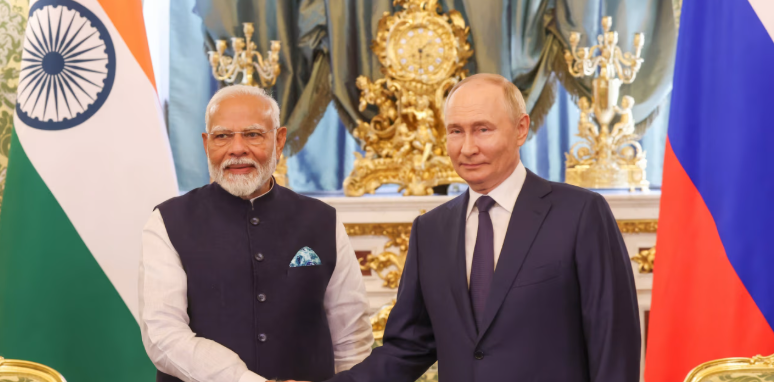
The upcoming 23rd India–Russia Annual Summit, scheduled for December 4–5, 2025 in New Delhi, is poised to be one of the most closely watched diplomatic engagements of the year. Prime Minister Narendra Modi will host Russian President Vladimir Putin in what is expected to be a high-stakes meeting, covering defense, energy, trade, and global geopolitics.
This summit carries particular weight as it marks Putin’s first visit to India since the outbreak of the Ukraine war in 2022. For New Delhi, the meeting is an opportunity to reaffirm its longstanding ties with Moscow while carefully balancing its growing partnerships with Western nations. For Russia, the summit offers a chance to showcase that it remains a relevant global player despite Western isolation.
Defense Cooperation: The Cornerstone of Ties
Defense has traditionally been the backbone of the India–Russia relationship, and this summit is expected to reinforce that legacy. India is reportedly interested in acquiring next-generation Russian systems, including the Sukhoi Su-57 stealth fighter jets and the S-500 missile defense system. These discussions come on top of the ongoing deployment of the S-400 Triumf air defense squadrons, which India has already inducted into its arsenal.
The summit will also review joint military exercises and technology transfers. Russia remains India’s largest defense supplier, and despite diversification of imports from the U.S., France, and Israel, Moscow continues to play a critical role in India’s military modernization. The talks are expected to explore deeper collaboration in co-production and joint research, ensuring that the partnership adapts to new technological realities.
Energy and Trade: Expanding the Economic Horizon
Beyond defense, energy and trade will dominate the agenda. India has significantly increased its imports of discounted Russian crude oil since 2022, making Moscow one of its top suppliers. The summit will likely focus on strengthening this cooperation, particularly in oil, gas, and nuclear energy.
Equally important are discussions on financial mechanisms to bypass Western sanctions. Both countries are exploring ways to link India’s RuPay payment system with Russia’s Mir network, creating an alternative to Western-dominated platforms like Visa and Mastercard. Expanding rupee–rouble trade is also on the table, which could reduce dependence on the U.S. dollar and signal a broader shift in global financial alignments.
Trade diversification is another priority. India is keen to expand exports of pharmaceuticals, IT services, and agricultural products to Russia, while Moscow is looking to deepen its footprint in India’s energy and defense markets. Several Memorandums of Understanding (MoUs) are expected to be signed during the summit to formalize these initiatives.
Strategic Partnership in a Changing World
The summit will reaffirm the “Special and Privileged Strategic Partnership” that has defined India–Russia relations for decades. This partnership has endured through changing global dynamics, from the Cold War era to the present multipolar world.
Geopolitically, Modi and Putin are expected to exchange views on the Ukraine conflict, Indo-Pacific security, and cooperation within BRICS. India has maintained a neutral stance on the Ukraine war, calling for dialogue and diplomacy rather than sanctions or military escalation. This position has allowed New Delhi to continue engaging with both Moscow and Western capitals, though it has drawn scrutiny from the U.S. and Europe.
For Russia, the summit is a symbolic victory. Putin skipped the G20 summit in South Africa earlier this year due to the International Criminal Court (ICC) warrant, but India is not a signatory to the Rome Statute, enabling him to visit without legal complications. His presence in New Delhi underscores Russia’s ability to maintain high-level diplomatic engagements despite Western efforts to isolate it.
Why the Summit Matters
The Modi–Putin summit is more than a bilateral meeting; it is a test of India’s diplomatic balancing act. On one hand, India values its traditional partnership with Russia, particularly in defense and energy. On the other, it is deepening ties with the U.S., Europe, and Japan, especially in the Indo-Pacific context.
The agreements expected from the summit—whether in defense procurement, energy cooperation, or financial linkages—could reshape India’s strategic posture. They may also signal a broader trend of countries seeking alternatives to Western-dominated systems in trade and finance.
For India, the summit reinforces its image as a nation capable of engaging all major powers while safeguarding its national interests. For Russia, it is a demonstration that despite sanctions and geopolitical challenges, it retains influential partners willing to engage at the highest level.
Conclusion
As Modi and Putin meet in New Delhi, the 23rd India–Russia Annual Summit will serve as a reminder of the enduring depth of their relationship. Defense, energy, and trade will dominate discussions, but the larger significance lies in how both nations navigate a rapidly changing global order.
Whether the summit produces groundbreaking agreements or simply reaffirms existing ties, it will be seen as a pivotal moment in India’s foreign policy and Russia’s quest for global relevance. In a world marked by shifting alliances and contested power structures, the India–Russia partnership remains a constant—adaptable, resilient, and strategically significant.