
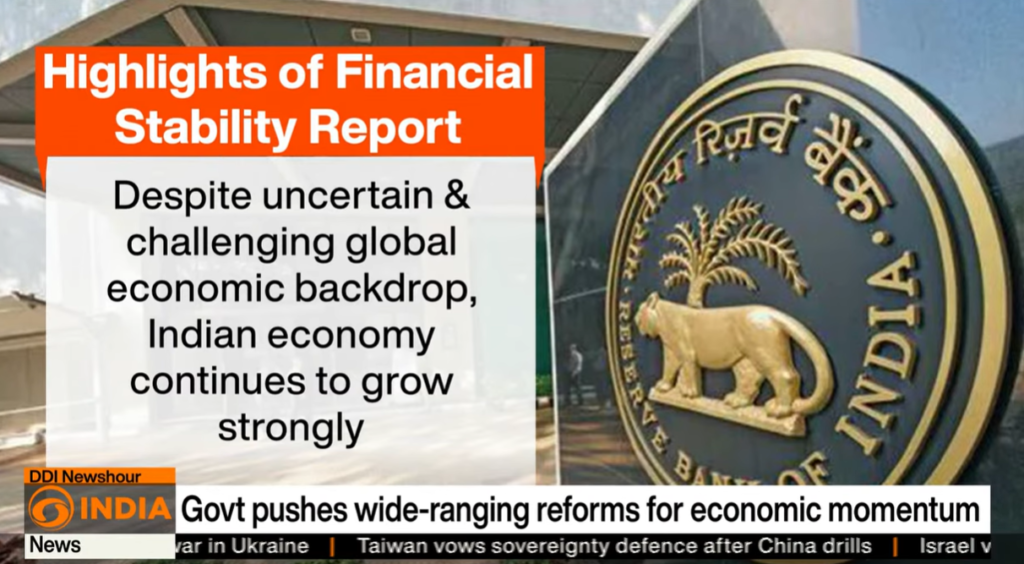
RBI Financial Stability Report December 2025 Shows Strong GDP Growth
The RBI Financial Stability Report December 2025 underscores India’s robust economic performance. The report reveals that GDP growth surged to 7.8% in Q1 and 8.2% in Q2 of FY 2025-26, driven by strong private consumption, infrastructure investment, and favorable financial conditions. The central bank noted that inflation remained under control, while domestic demand continued to fuel momentum.
RBI Financial Stability Report December 2025 Confirms Banking Sector Strength
The RBI Financial Stability Report December 2025 highlights the resilience of India’s banking sector. Scheduled commercial banks (SCBs) maintained capital adequacy ratios well above regulatory requirements, supported by improved asset quality and profitability. Liquidity buffers remain strong, ensuring banks can withstand adverse scenarios. Stress tests conducted by the RBI reaffirmed that the sector is capable of absorbing shocks without compromising stability.

RBI Financial Stability Report December 2025 Flags Risks in Unsecured Lending
Despite overall resilience, the RBI Financial Stability Report December 2025 raises concerns about unsecured lending growth. Personal loans and credit card debt have expanded rapidly, posing potential risks if economic conditions weaken. The RBI cautioned that unchecked growth in unsecured credit could lead to stress in household balance sheets and impact financial stability.
RBI Financial Stability Report December 2025 Warns on Fintech and Crypto Assets
The RBI Financial Stability Report December 2025 also highlights vulnerabilities linked to fintech exposure and crypto assets. While adoption of digital assets remains limited, the central bank warned that risks could escalate if left unregulated. The report emphasized the need for balanced regulation to encourage innovation while safeguarding systemic stability.
RBI Financial Stability Report December 2025 Notes Global Uncertainty Challenges
The RBI Financial Stability Report December 2025 cautions that global uncertainties—including geopolitical tensions, trade disruptions, and volatile financial markets—pose challenges to India’s stability. External risks such as exchange rate volatility, reduced foreign investment, and global debt concerns could affect India’s growth trajectory.
RBI Financial Stability Report December 2025 Provides Stress Test Insights
Stress tests conducted as part of the RBI Financial Stability Report December 2025 show that banks, mutual funds, and clearing corporations remain resilient even under adverse scenarios. The findings confirm that India’s financial institutions are well‑positioned to manage shocks, thanks to strong capital buffers and effective regulatory oversight.
Comparative Snapshot of RBI Financial Stability Report December 2025
| Aspect | Findings (Dec 2025) | Implications |
|---|---|---|
| GDP Growth | 7.8% (Q1), 8.2% (Q2) | Strong domestic demand |
| Banking Sector Health | Robust capital & liquidity | Ability to withstand shocks |
| NPAs | Under control | Improved asset quality |
| Emerging Risks | Unsecured loans, fintech, crypto | Need for tighter regulation |
| Global Risks | Geopolitical & trade uncertainties | Potential volatility in markets |
RBI Financial Stability Report December 2025 Outlook for 2026
Looking ahead, the RBI Financial Stability Report December 2025 projects continued resilience in India’s economy, supported by domestic demand, low inflation, and strong financial institutions. However, vigilance is required to manage risks from unsecured lending, fintech exposure, and global volatility.
The RBI emphasized that balanced regulation will be critical in 2026, ensuring innovation in digital finance while maintaining systemic stability. Policymakers must remain proactive in addressing vulnerabilities to safeguard India’s growth momentum.
In summary, the RBI Financial Stability Report December 2025 highlights India’s strong GDP growth and resilient banking sector, while warning of risks from unsecured lending, fintech, and global uncertainties.
I savour, lead to I discovered just what I used to be taking a look for. You’ve ended my 4 day lengthy hunt! God Bless you man. Have a great day. Bye
Thank you so much for your kind words. I’m really happy to know that you found exactly what you were looking for.
Your appreciation truly means a lot to me. I’m glad I could help and make your 4-day search worthwhile.
Wishing you a wonderful day ahead as well. Stay blessed!