Trump Orders US Withdrawal from 66 International Organizations Including UN Agencies:
Trump Orders US Withdrawal: America First Policy in Action
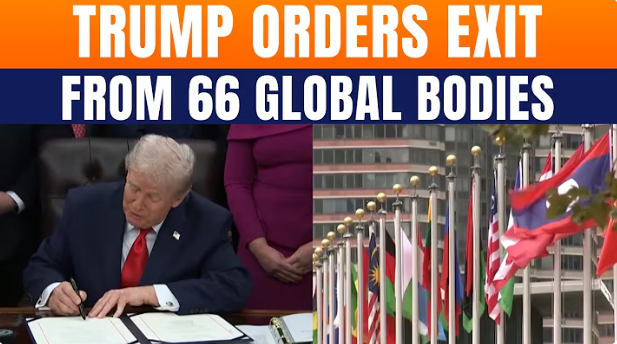
In a dramatic escalation of his “America First” foreign policy, President Donald Trump has officially ordered the United States to withdraw from 66 international organizations, including 31 UN agencies and 35 non-UN bodies. The move, announced via Presidential Memorandum on January 7, 2026, signals a sweeping retreat from multilateral diplomacy and global cooperation.
66 International Organizations Targeted by Trump’s Directive–
The memorandum outlines the termination of US participation and funding in a wide range of global institutions:
- UN-affiliated agencies (31):
- UN Human Rights Council
- UN Population Fund
- UN Educational, Scientific and Cultural Organization (UNESCO)
- United Nations Framework Convention on Climate Change (UNFCCC)
- Non-UN organizations (35):
- International Solar Alliance
- International Union for Conservation of Nature
- Global Migration Forum
- World Urban Forum
This marks one of the largest mass withdrawals in US diplomatic history.
Trump’s Justification: Sovereignty and Strategic Interests
The Trump administration’s rationale centers on sovereignty, financial burden, and ideological misalignment:
“We will no longer fund or participate in organizations that do not serve our people,” Trump stated. “America First means America decides.”
The memorandum claims these bodies undermine US interests, promote globalist agendas, and impose unfair obligations on American taxpayers.

Impact of US Withdrawal from UN Agencies
The decision to exit UN agencies will have far-reaching consequences:
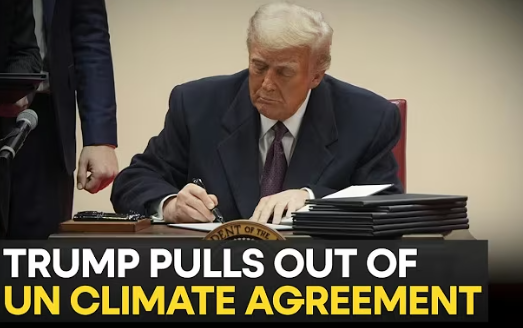
- Climate diplomacy setback: Leaving UNFCCC weakens global climate negotiations ahead of COP32.
- Human rights vacuum: US absence from the Human Rights Council may reduce global accountability.
- Education and culture loss: UNESCO programs in developing nations may suffer funding gaps.
- Health and population risks: UN Population Fund initiatives on reproductive health and humanitarian aid could be disrupted.
Domestic Reactions to Trump’s Withdrawal Order
The move has sparked intense debate across political and civil society circles:
- Supporters: Applaud the decision as a bold assertion of national sovereignty and fiscal responsibility.
- Critics: Warn of diplomatic isolation, weakened alliances, and loss of global leadership.
Policy analysts argue that the withdrawal from 66 international organizations could damage US credibility and influence in global governance.
Trump Orders US Withdrawal from 66 International Organizations Including UN Agencies:
Strategic Implications of Trump’s Foreign Policy Shift
This directive aligns with Trump’s broader strategy of strategic decoupling from multilateral institutions:
- Follows earlier exits from WHO, Paris Climate Agreement, and UNESCO
- Signals a pivot toward bilateral deals and transactional diplomacy
- May embolden other nations to reconsider their global commitments
Experts caution that this could lead to fragmentation in international cooperation and reduced effectiveness of global problem-solving.
Next Steps: US Disengagement Timeline
Federal agencies have been instructed to begin immediate disengagement procedures, including:
- Halting financial contributions
- Ending diplomatic participation
- Reviewing treaty obligations and legal implications
The full withdrawal process is expected to unfold over several months, with potential legal challenges and international pushback.
Trump Orders US Withdrawal from 66 International Organizations Including UN Agencies:
List of 66 International Organizations
UN Agencies (31)
- United Nations Framework Convention on Climate Change (UNFCCC)
- UN Human Rights Council (UNHRC)
- UN Population Fund (UNFPA)
- UN Educational, Scientific and Cultural Organization (UNESCO)
- UN Development Programme (UNDP)
- UN Environment Programme (UNEP)
- UN Children’s Fund (UNICEF)
- World Food Programme (WFP)
- International Labour Organization (ILO)
- World Health Organization (WHO)
- International Telecommunication Union (ITU)
- UN Industrial Development Organization (UNIDO)
- UN Office for Disaster Risk Reduction (UNDRR)
- UN Office for Project Services (UNOPS)
- UN Relief and Works Agency (UNRWA)
- UN Women
- UN Office on Drugs and Crime (UNODC)
- UN High Commissioner for Refugees (UNHCR)
- UN Conference on Trade and Development (UNCTAD)
- UN Economic and Social Commission for Asia and the Pacific (ESCAP)
- UN Economic Commission for Africa (UNECA)
- UN Economic Commission for Europe (UNECE)
- UN Economic Commission for Latin America and the Caribbean (ECLAC)
- UN Economic and Social Council (ECOSOC)
- UN Office for Outer Space Affairs (UNOOSA)
- UN Institute for Training and Research (UNITAR)
- UN University (UNU)
- UN System Staff College (UNSSC)
- UN Global Compact
- UN Office for South-South Cooperation (UNOSSC)
- UN Habitat
Non‑UN International Organizations (35)
- International Solar Alliance (ISA)
- International Union for Conservation of Nature (IUCN)
- Global Migration Forum
- World Urban Forum
- International Criminal Court (ICC)
- Organisation for Economic Co-operation and Development (OECD)
- International Atomic Energy Agency (IAEA)
- International Maritime Organization (IMO)
- International Civil Aviation Organization (ICAO)
- World Trade Organization (WTO)
- International Monetary Fund (IMF)
- World Bank Group
- International Finance Corporation (IFC)
- Multilateral Investment Guarantee Agency (MIGA)
- International Centre for Settlement of Investment Disputes (ICSID)
- International Organization for Migration (IOM)
- International Committee of the Red Cross (ICRC)
- International Federation of Red Cross and Red Crescent Societies (IFRC)
- International Energy Agency (IEA)
- International Renewable Energy Agency (IRENA)
- International Chamber of Commerce (ICC Business)
- International Criminal Police Organization (Interpol)
- International Seabed Authority (ISA)
- International Tribunal for the Law of the Sea (ITLOS)
- International Fund for Agricultural Development (IFAD)
- International Grains Council (IGC)
- International Coffee Organization (ICO)
- International Sugar Organization (ISO)
- International Cotton Advisory Committee (ICAC)
- International Olive Council (IOC)
- International Tropical Timber Organization (ITTO)
- International Whaling Commission (IWC)
- International Hydrographic Organization (IHO)
- International Bureau of Weights and Measures (BIPM)
- Hague Conference on Private International Law (HCCH)
Conclusion: Trump’s Withdrawal from Global Organizations Reshapes US Diplomacy
By ordering the US withdrawal from 66 international organizations, President Trump has redefined America’s role on the world stage. While the move reinforces his America First policy, it also raises serious questions about the future of global cooperation, climate action, and multilateral diplomacy.
As the world reacts, the long-term impact of this decision will be felt across sectors—from human rights and health to climate and education.