
The White House revises India trade deal fact sheet in a move that has reshaped the narrative around the recently announced interim trade agreement between India and the United States. The updated document drops references to India reducing duties on pulses and softens language around India’s earlier pledge to purchase $500 billion worth of American goods. This revision, made public on February 12, 2026, brings the U.S. fact sheet closer to the joint statement issued by both nations, ensuring clarity and alignment in bilateral commitments.
Background of the Interim Trade Agreement
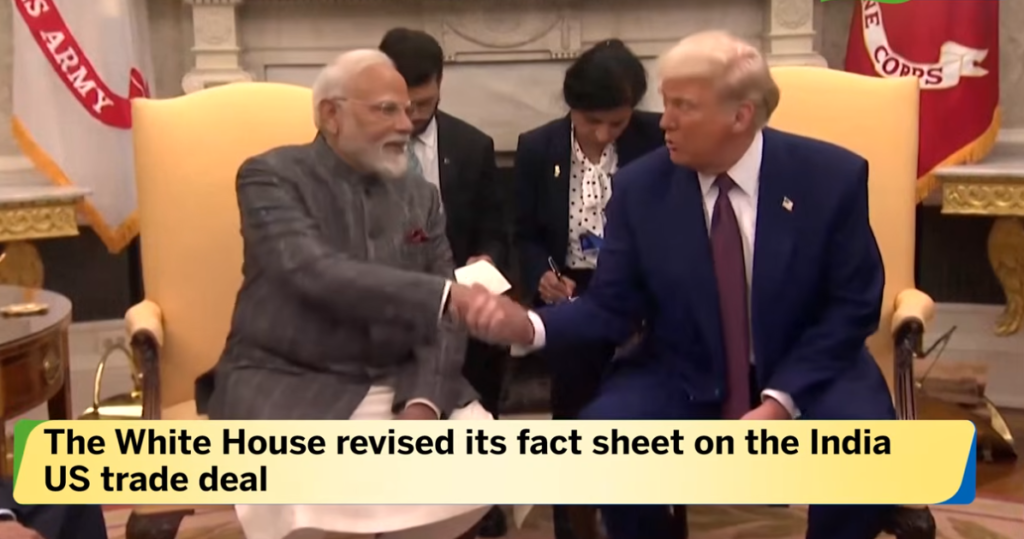
Earlier this month, India and the United States unveiled a framework for an Interim Trade Agreement. The deal was celebrated as a breakthrough in bilateral economic relations, promising tariff reductions, expanded market access, and stronger cooperation in industrial and agricultural sectors.
However, the initial White House fact sheet went beyond the joint statement, suggesting India would commit to massive purchases and eliminate certain taxes. This sparked debate in India, particularly among farmer groups and opposition parties, who feared the deal could undermine domestic agriculture.
Key Changes in the Revised Fact Sheet
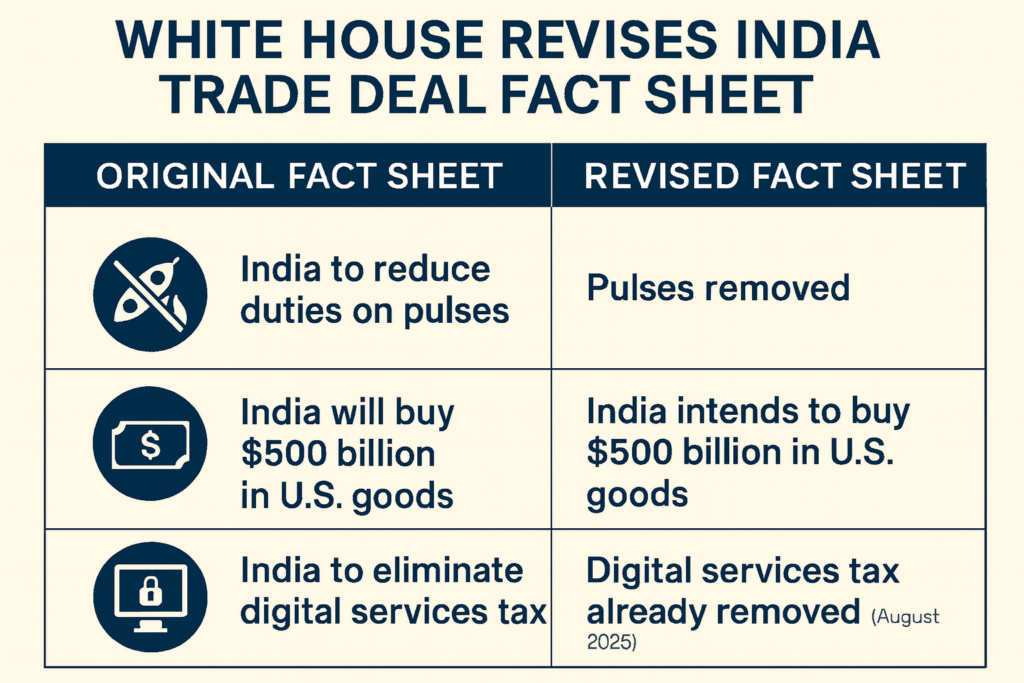
The White House revises India trade deal fact sheet with several notable adjustments:
- Pulses Removed: References to India reducing duties on pulses have been eliminated, addressing concerns from Indian farmers about cheap imports destabilizing local markets.
- Purchase Commitment Softened: The earlier statement that India “will buy” $500 billion worth of American goods has been revised to “intends to buy,” reducing the perception of a binding obligation.
- Digital Services Tax: The revised fact sheet no longer claims India will eliminate its digital services tax. Instead, it states India will “address non‑tariff barriers,” leaving room for negotiation.
- Alignment with Joint Statement: The revisions ensure consistency with the India–US joint statement, which emphasized reciprocity and mutual benefit rather than unilateral commitments.
India’s Reaction
India’s Ministry of External Affairs welcomed the revisions, noting that they reflect the shared understanding reached in the joint statement. Officials stressed that the joint statement remains the foundation of the agreement and that the revised fact sheet now accurately represents the negotiated terms.
Political and Economic Implications
For India
- Farmer Concerns Addressed: Dropping pulses from the deal is seen as a win for Indian farmers.
- Flexibility in Commitments: The softened $500 billion pledge gives India more leeway to balance imports with domestic priorities.
- Digital Tax Retained: India maintains room to negotiate on digital services taxes, a contentious issue given its growing digital economy.
For the United States
- Strategic Clarity: The revisions clarify India’s actual commitments, reducing the risk of political backlash in New Delhi.
- Market Access Still Expanded: Despite softened language, U.S. exporters stand to gain from reduced tariffs on industrial goods, food products, and technology.
- Diplomatic Balance: The changes demonstrate Washington’s willingness to accommodate India’s sensitivities, reinforcing the partnership’s strategic nature.

Domestic Reactions in India
Farmer groups and opposition parties had criticized the initial fact sheet, arguing that it misrepresented India’s commitments and ignored agricultural concerns. The revisions are likely to blunt some of this criticism, though skepticism remains about the broader impact of the deal on domestic industries.
Strategic Context of the Trade Deal
The White House revises India trade deal fact sheet not only clarifies trade commitments but also underscores the broader strategic partnership between India and the United States. Both nations are seeking to strengthen economic ties amid shifting global dynamics.
For India, closer trade relations with the U.S. provide diversification away from traditional partners and reduce reliance on adversarial economies. For the U.S., India’s vast market of 1.4 billion people offers immense opportunities for American exporters.
Conclusion
The revision of the India trade deal fact sheet marks a crucial step in aligning expectations and clarifying commitments. By dropping references to pulses and softening the $500 billion purchase pledge, Washington has acknowledged India’s domestic sensitivities while preserving the spirit of reciprocity.
For India, the revisions ease political pressure and safeguard key agricultural interests. For the U.S., they ensure the deal remains credible and strategically valuable. Ultimately, the changes underscore the importance of transparency and mutual respect in forging trade agreements between two of the world’s largest democracies.