
India’s FDI Boom: $90 Billion Inflows in FY26
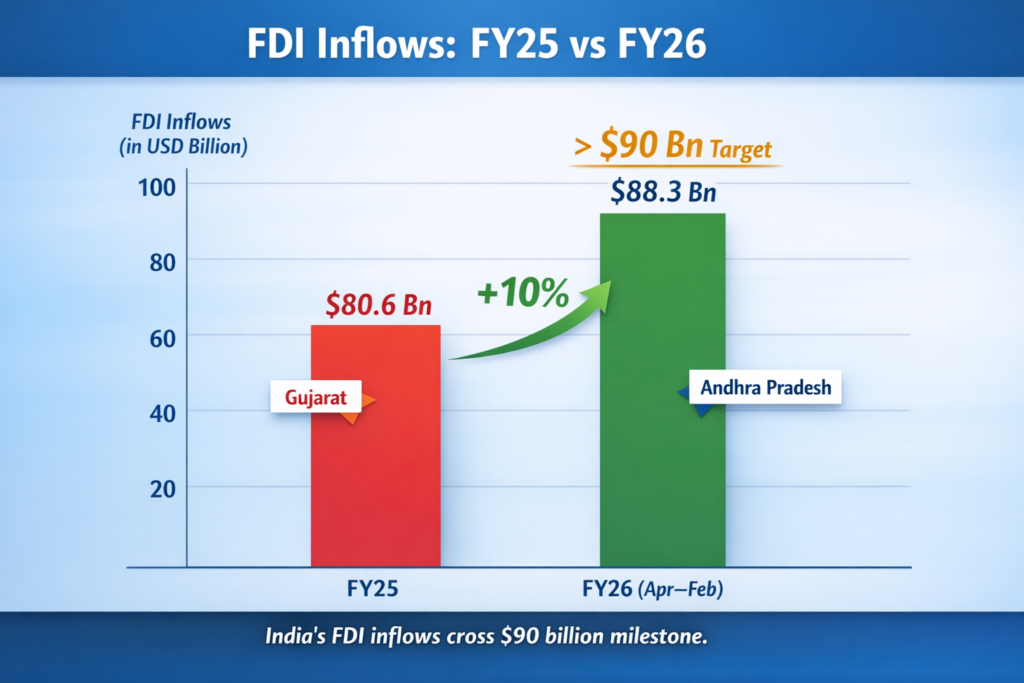
India’s FDI Boom: $90 Billion Inflows in FY26 marks a historic milestone in the country’s economic journey. With inflows already touching $88.3 billion by February 2026, the Department for Promotion of Industry and Internal Trade (DPIIT) projects that the full year will surpass the $90 billion mark. This achievement reflects India’s growing stature as a global investment hub, powered by reforms, trade agreements, and investor confidence.

India’s FDI Boom: $90 Billion Inflows in FY26 – Key Highlights
- Gross inflows (Apr–Feb FY26): $88.3 billion, nearly 10% higher than FY25.
- Net inflows: $6.26 billion, a sharp rise from $959 million in FY25.
- Projected milestone: Crossing $90 billion, India’s highest-ever annual FDI.
This surge demonstrates India’s resilience in attracting capital even amid global volatility.
Policy Reforms Driving India’s FDI Boom: $90 Billion Inflows in FY26
India’s liberalization of FDI rules, sectoral deregulation, and improved ease of doing business have been crucial. The government’s proactive stance on free trade agreements (FTAs) has further boosted investor confidence. These reforms have created a transparent, predictable environment that global investors find attractive.
Role of Digital Transformation in India’s FDI Boom: $90 Billion Inflows in FY26
Digital infrastructure has become a cornerstone of India’s economic appeal. Initiatives like Digital India have transformed business operations:
- Seamless online approvals
- Digital payment systems
- Improved transparency
The rise of platforms powered by National Payments Corporation of India has enabled faster financial transactions, further boosting investor confidence.

Sectoral Growth Behind India’s FDI Boom: $90 Billion Inflows in FY26
- Chemicals, pharmaceuticals, biotechnology, and food processing account for nearly 65% of grounded investments.
- Emerging sectors such as electronics, aerospace, defence, and electric vehicles (EVs) are witnessing rapid inflows.
- Invest India projects: 60 projects worth $6.1 billion facilitated in FY26, spanning 14 states and expected to generate over 31,000 jobs.
Regional Leaders in India’s FDI Boom: $90 Billion Inflows in FY26
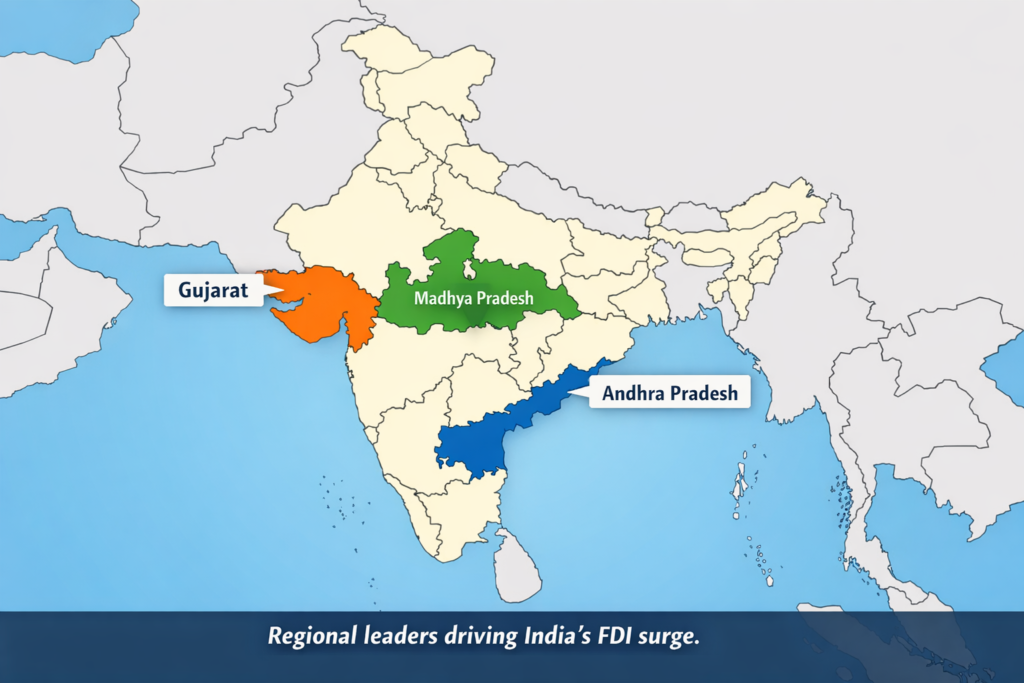
States like Gujarat, Madhya Pradesh, and Andhra Pradesh have emerged as top destinations. Their proactive policies, infrastructure development, and investor-friendly ecosystems have positioned them as magnets for foreign capital.
Comparative Snapshot
| Indicator | FY25 | FY26 (Apr–Feb) | Outlook FY26 |
|---|---|---|---|
| Gross FDI inflows | $80.6 bn | $88.3 bn | >$90 bn |
| Net FDI inflows | $0.96 bn | $6.26 bn | Strong rise |
| Grounded projects | ~$2 bn | $6.1 bn | 3x growth |
| Job creation (projects) | ~10,000 | 31,000+ | Expanding |
Global Investor Base Expanding in India’s FDI Boom: $90 Billion Inflows in FY26
Traditional partners such as the US, Japan, and the EU remain strong contributors. However, new entrants like Brazil, New Zealand, and Canada signal widening global interest. This diversification reduces dependency and strengthens India’s global investment profile.
Risks & Challenges
Despite the optimism, challenges remain:
- Global volatility in capital flows and repatriation pressures.
- Geopolitical risks in West Asia and supply chain disruptions.
- Regulatory adjustments for countries sharing land borders with India.
Outlook – India’s FDI Boom: $90 Billion Inflows in FY26
DPIIT Secretary Amardeep Singh Bhatia has emphasized that India could touch $100 billion in annual FDI by 2030. The FY26 milestone underscores India’s growing stature as a preferred global investment hub. With diversified investor participation and high-value projects across sectors, India is consolidating its position as one of the world’s most attractive destinations for foreign capital.
Conclusion
India’s FDI Boom: $90 Billion Inflows in FY26 is more than just a headline—it represents a structural shift in the global economic landscape. With strong policy support, digital transformation, and a growing consumer base, India is emerging as a global investment powerhouse.
For investors, businesses, and policymakers, this surge signals one clear message: India is no longer just an emerging market—it is a leading growth engine of the world economy.