
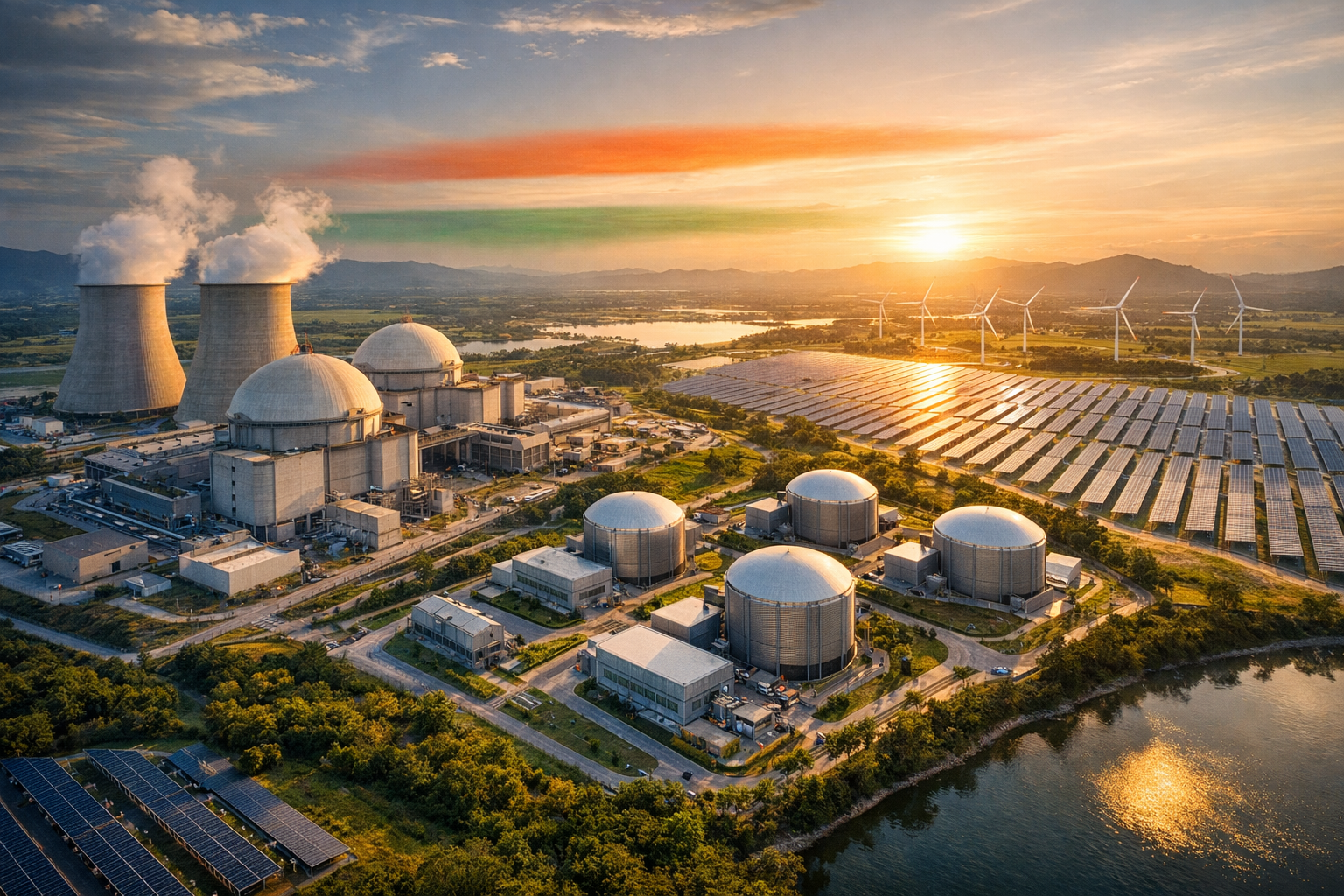
India’s Nuclear & SMR Power: 5 Bold Steps to 2047
India stands at one of the most significant turning points in its energy journey. As the country races toward becoming a developed nation by 2047—the centenary of its independence—ensuring reliable, affordable, and clean electricity has become a national priority. Renewable energy sources like solar and wind have transformed India’s power landscape, yet they face one common challenge: intermittency. The sun doesn’t always shine, and the wind doesn’t always blow.
This is where India’s Nuclear & SMR Power: 5 Bold Steps to 2047 becomes increasingly important. Nuclear energy provides round-the-clock, low-carbon electricity, while Small Modular Reactors (SMRs) promise safer, more flexible, and cost-effective nuclear solutions suitable for the next generation of energy infrastructure.
As India’s economy expands, industries modernize, electric vehicles gain momentum, and data centers consume more electricity than ever before, the nation will require an energy system capable of meeting growing demand without compromising climate commitments.
This article explores India’s Nuclear & SMR Power: 5 Bold Steps to 2047, examining how nuclear innovation could shape India’s energy future while complementing renewable sources and strengthening energy security.
Table of Contents
- Why India Needs More Nuclear Power
- Current Status of India’s Nuclear Sector
- Step 1: Accelerate Large Nuclear Projects
- Step 2: Deploy Small Modular Reactors (SMRs)
- Step 3: Expand Domestic Nuclear Fuel Capability
- Step 4: Strengthen Private Sector & Global Partnerships
- Step 5: Invest in Next-Generation Nuclear Innovation
India’s Nuclear & SMR Power: 5 Bold Steps to 2047
Why India Needs More Nuclear Power
India is among the world’s fastest-growing major economies. Rising incomes, rapid urbanization, expanding manufacturing, artificial intelligence infrastructure, electric mobility, and digital transformation are driving electricity demand to unprecedented levels.
Although renewable energy has expanded rapidly, dependence on weather conditions makes it difficult to rely solely on solar and wind power. Battery storage technologies continue to improve, but large-scale deployment remains expensive.
Nuclear power offers several strategic advantages:
- Continuous electricity generation
- Minimal greenhouse gas emissions during operation
- High energy density
- Long operational life
- Reduced dependence on fossil fuel imports
- Greater energy security
Unlike coal-fired power plants, nuclear reactors produce electricity without releasing significant carbon dioxide during generation. This makes them an important component of long-term decarbonization strategies.
India’s ambition to become a developed economy by 2047 will likely require a diversified energy portfolio, with nuclear energy serving as a dependable source of baseload power.
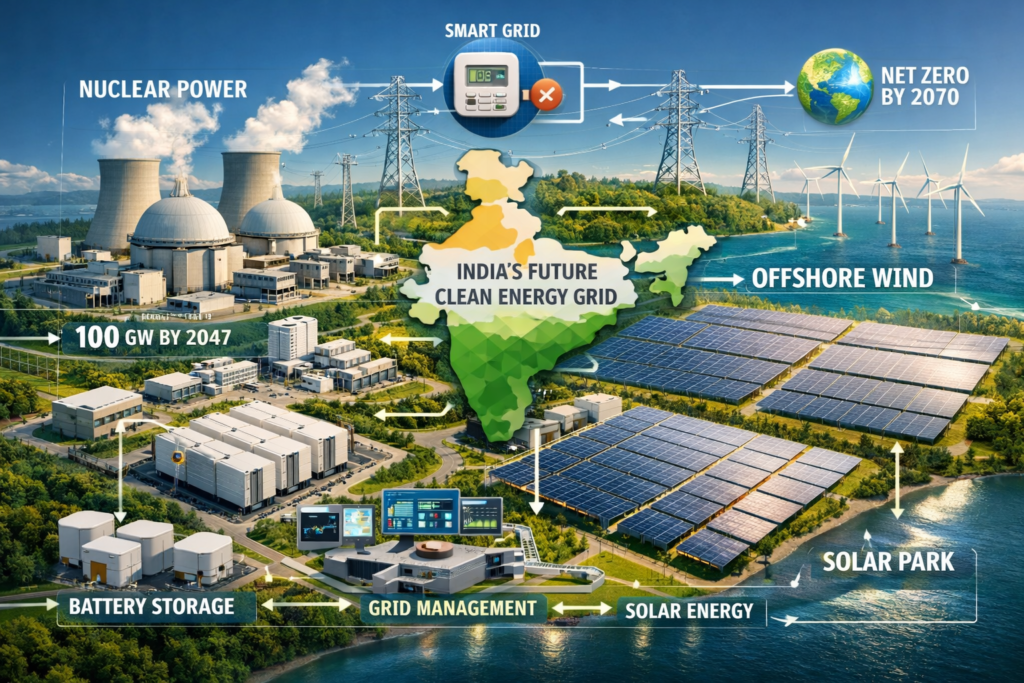
Current Status of India’s Nuclear Sector
India has steadily expanded its civilian nuclear program over the past several decades. Indigenous reactor designs, improved engineering capabilities, and long-term investments have strengthened the country’s nuclear expertise.
Today, nuclear power contributes a modest share of India’s electricity generation compared to coal, hydroelectricity, solar, and wind energy. However, numerous reactors are operational, while several more are under construction or in various stages of planning.
India has also developed a unique three-stage nuclear program focused on maximizing domestic resources, including thorium reserves, which are among the largest in the world.
Key strengths include:
- Indigenous reactor technology
- Skilled scientific workforce
- Established regulatory institutions
- Growing international cooperation
- Significant thorium potential
Nevertheless, project execution timelines, financing challenges, land acquisition, and public perception continue to influence the pace of expansion.
These realities make India’s Nuclear & SMR Power: 5 Bold Steps to 2047 an essential roadmap for balancing ambition with practical implementation.
Step 1: Accelerate Large Nuclear Power Projects
The first major step involves accelerating the construction of conventional nuclear power stations already planned or under development.
Large nuclear reactors remain the backbone of reliable baseload electricity. Once operational, they can generate massive quantities of clean power for several decades with relatively low fuel requirements.
Faster project execution would require:
- Streamlined regulatory approvals
- Improved project management
- Timely land acquisition
- Efficient supply chains
- Stable financing mechanisms
- Enhanced domestic manufacturing
Reducing construction delays can significantly lower project costs while helping India meet future electricity demand more efficiently.
Expanding domestic manufacturing of reactor components would also strengthen the “Make in India” initiative, create high-skilled employment, and reduce dependence on imported equipment.
Economic Benefits
Accelerating nuclear projects could stimulate:
- Heavy engineering industries
- Advanced manufacturing
- Precision fabrication
- Research institutions
- Skilled employment
- Regional infrastructure development
Large nuclear projects also generate long-term economic activity in surrounding regions through transportation, housing, education, and supporting industries.
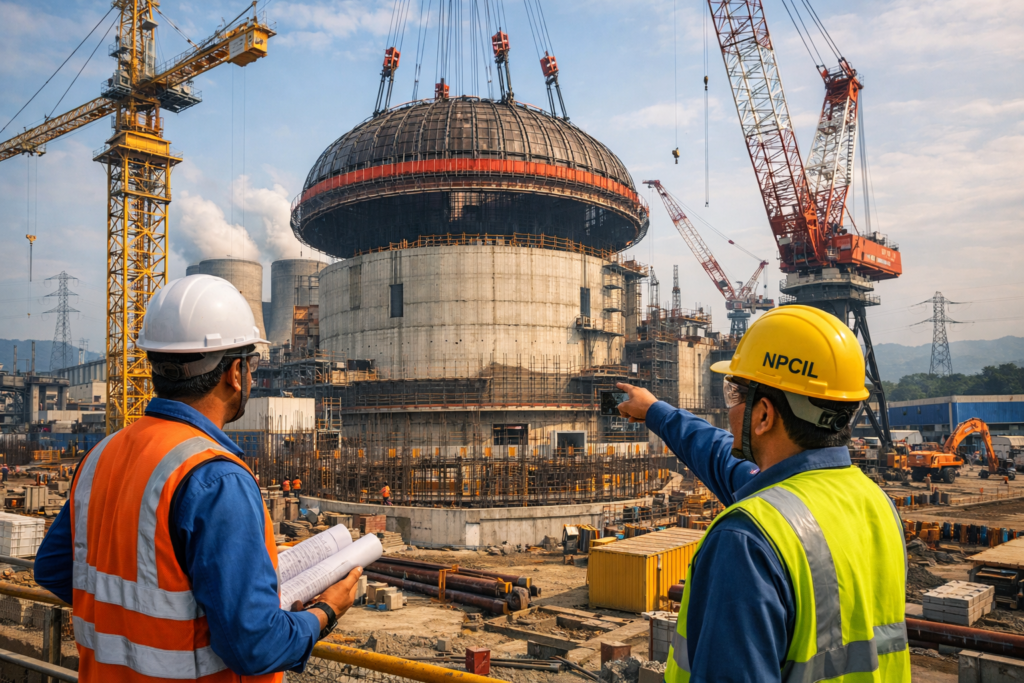
Step 2: Deploy Small Modular Reactors (SMRs)
Among the most exciting developments in global nuclear technology is the emergence of Small Modular Reactors (SMRs).
Unlike traditional reactors, SMRs are significantly smaller and are designed using modular construction techniques.
Their advantages include:
- Lower upfront investment
- Faster construction
- Enhanced safety systems
- Flexible deployment
- Easier scalability
- Reduced land requirements
SMRs can be particularly valuable for:
- Industrial parks
- Data centers
- Remote regions
- Mining operations
- Hydrogen production
- Grid balancing
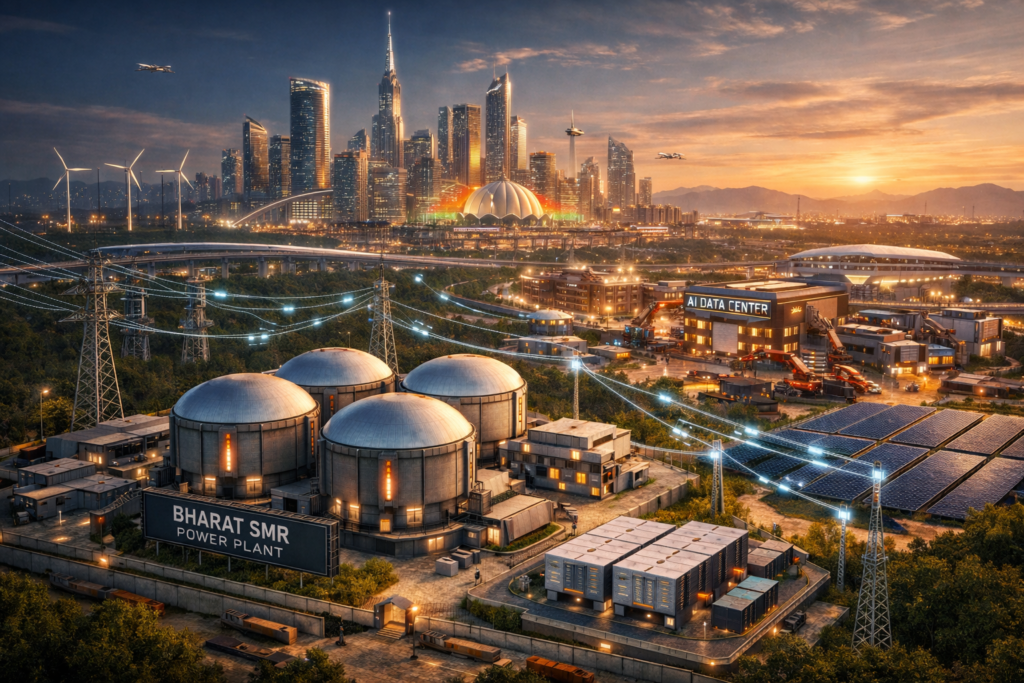
As India’s digital economy grows rapidly, demand for reliable electricity from AI infrastructure, semiconductor manufacturing, cloud computing facilities, and large industrial clusters will continue to increase.
SMRs could provide dedicated, uninterrupted clean power to these sectors while reducing dependence on fossil fuels.
Why SMRs Matter for India
India possesses extensive engineering expertise and manufacturing capabilities that could support domestic SMR production.
If successfully developed and commercialized, India could eventually become an exporter of advanced SMR technologies to developing countries seeking affordable clean energy solutions.
SMRs also align well with India’s vision of decentralized, resilient, and low-carbon infrastructure.
Furthermore, their modular nature enables phased investments, reducing financial risk compared to massive conventional nuclear projects.
This flexibility makes SMRs an increasingly attractive component of India’s Nuclear & SMR Power: 5 Bold Steps to 2047.
Key Takeaways So Far
The first two pillars of India’s Nuclear & SMR Power: 5 Bold Steps to 2047 focus on expanding reliable clean energy through two complementary strategies:
- Accelerating conventional nuclear power projects to provide large-scale baseload electricity.
- Adopting Small Modular Reactors (SMRs) to deliver flexible, scalable, and innovative clean energy solutions for emerging industries and regional power needs.
Together, these measures can strengthen India’s energy security, reduce carbon emissions, support industrial growth, and create a resilient electricity system capable of meeting the country’s ambitions through 2047.
India’s Nuclear & SMR Power: 5 Bold Steps to 2047 (Continued)
Step 3: Expand Domestic Nuclear Fuel Capability
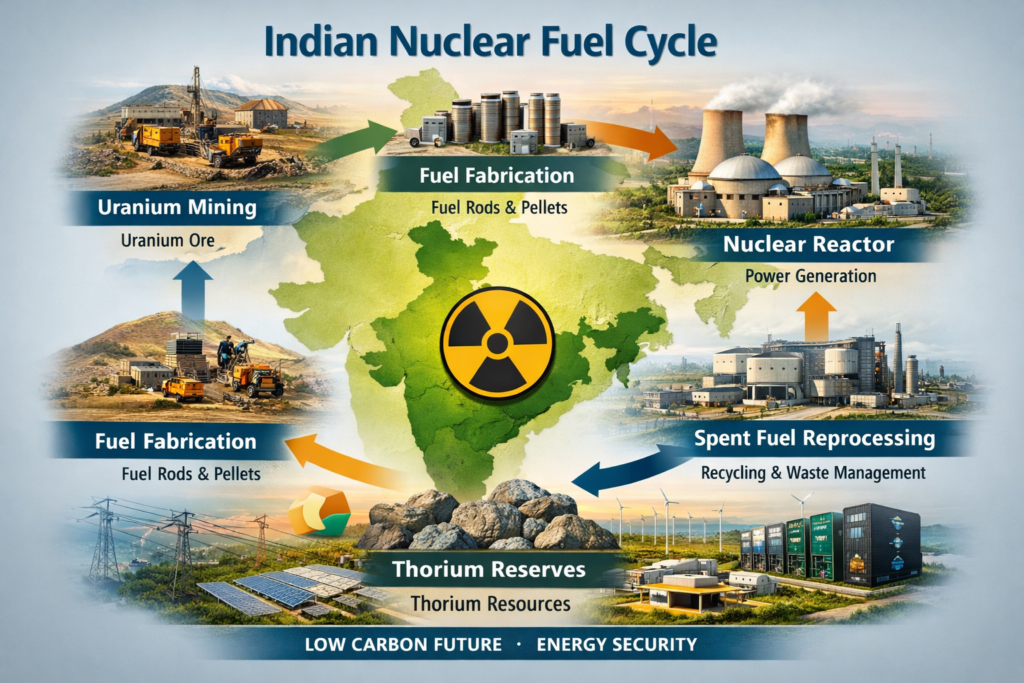
A robust nuclear power program depends not only on reactors but also on a secure and sustainable fuel supply. As India scales up its nuclear capacity, strengthening domestic fuel capabilities will be critical to reducing import dependence and ensuring uninterrupted power generation.
India possesses substantial uranium and one of the world’s largest thorium reserves. While uranium currently fuels most reactors, the country’s long-term three-stage nuclear program aims to harness thorium as a strategic energy resource.
Strengthening the Nuclear Fuel Cycle
India can reinforce its nuclear fuel ecosystem by:
- Expanding uranium exploration and mining.
- Improving fuel fabrication facilities.
- Investing in spent fuel reprocessing technologies.
- Accelerating thorium-based reactor research.
- Enhancing radioactive waste management systems.
- Building strategic fuel reserves.
A resilient fuel cycle minimizes external vulnerabilities while ensuring that nuclear plants continue operating efficiently even during geopolitical or supply-chain disruptions.
The Promise of Thorium
India’s abundant thorium reserves represent a long-term strategic advantage. Although commercial thorium reactors remain under development globally, continued investment in research could eventually provide India with a more sustainable and self-reliant nuclear energy pathway.
Step 4: Strengthen Private Sector Participation & Global Partnerships
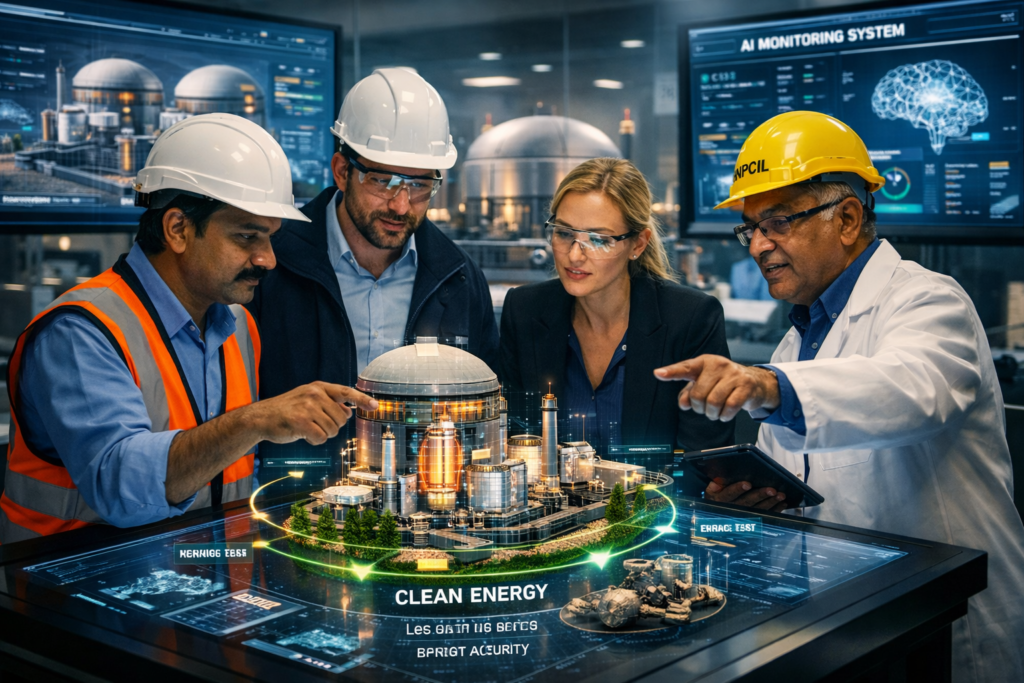
Meeting India’s ambitious energy goals will require collaboration between government agencies, public sector enterprises, private industry, research institutions, and international partners.
While nuclear power has traditionally been dominated by the public sector, greater private-sector participation can accelerate innovation, improve manufacturing capacity, and enhance project execution.
Key Areas for Collaboration
Private companies can contribute through:
- Manufacturing reactor components.
- Advanced engineering services.
- Digital monitoring systems.
- AI-powered predictive maintenance.
- Robotics for plant inspection.
- Cybersecurity solutions.
- Construction and infrastructure development.
International Cooperation
Global partnerships can support India’s nuclear ambitions through:
- Technology transfer.
- Joint research programs.
- Fuel supply agreements.
- Safety best practices.
- Advanced reactor development.
- Workforce training.
Such collaborations can help reduce costs, improve efficiency, and accelerate the deployment of next-generation nuclear technologies.
Step 5: Invest in Next-Generation Nuclear Innovation
The final pillar of India’s Nuclear & SMR Power: 5 Bold Steps to 2047 is sustained investment in innovation.
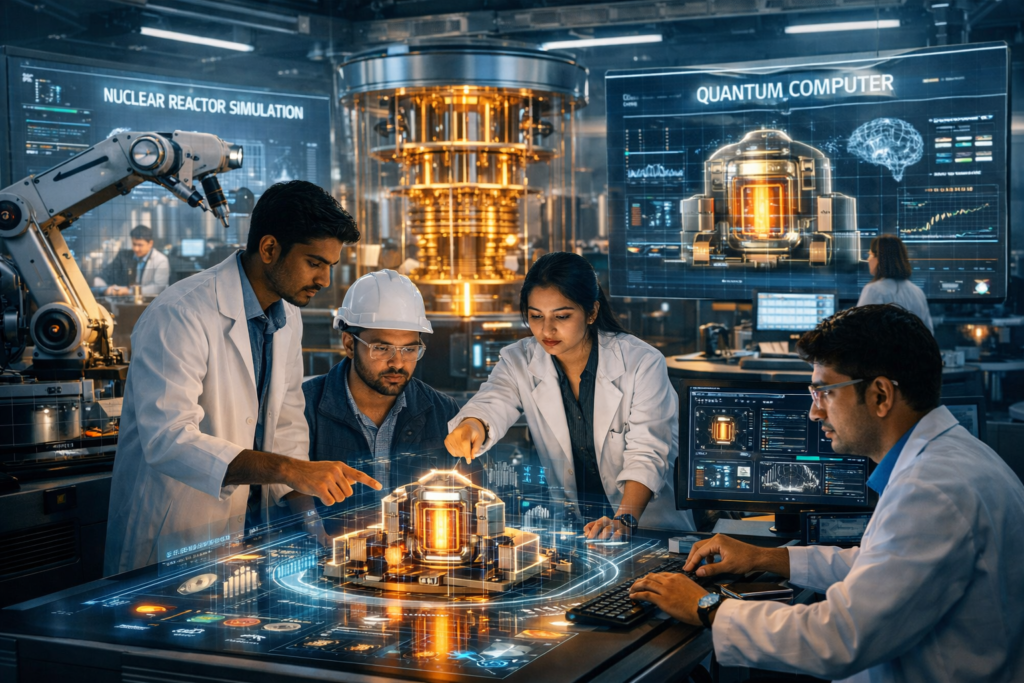
The future of nuclear energy extends beyond today’s reactors. Emerging technologies promise greater efficiency, enhanced safety, lower costs, and broader applications.
Areas Worth Investing In
India should continue supporting research in:
- Generation IV reactors.
- Molten Salt Reactors.
- High-temperature gas-cooled reactors.
- Fast breeder reactors.
- Advanced Small Modular Reactors.
- Nuclear hydrogen production.
- Artificial intelligence for reactor operations.
- Digital twin technology.
- Robotics and autonomous inspection systems.
Building a Nuclear Innovation Ecosystem
Innovation thrives when universities, startups, national laboratories, and industry collaborate.
Developing specialized research parks, incubators, and funding mechanisms can position India as a global leader in advanced nuclear technologies.
Long-term investment in human capital—scientists, engineers, technicians, and safety experts—will be just as important as investment in infrastructure.
Challenges Facing India’s Nuclear Expansion
Although the future appears promising, several challenges remain.
1. High Initial Investment
Nuclear projects require significant upfront capital, making financing one of the biggest hurdles.
2. Lengthy Construction Timelines
Large reactors often take several years to complete due to engineering complexity, regulatory approvals, and infrastructure requirements.
3. Public Perception
Safety concerns continue to influence public opinion, making transparent communication and community engagement essential.
4. Nuclear Waste Management
Safe handling, storage, and disposal of radioactive waste require continuous technological and regulatory improvements.
5. Skilled Workforce
Expanding nuclear capacity will demand thousands of additional engineers, operators, technicians, and researchers.
Opportunities Ahead
Despite these challenges, the opportunities are substantial.
Energy Security
Nuclear energy reduces dependence on imported fossil fuels while providing stable electricity generation.
Industrial Growth
Reliable electricity supports manufacturing, semiconductors, artificial intelligence, green hydrogen, and data centers.
Employment
The nuclear sector creates high-value jobs across engineering, research, manufacturing, construction, and operations.
Climate Commitments
Low-carbon electricity contributes to India’s long-term emissions reduction objectives.
Export Potential
If India develops competitive SMR technology, it could become a supplier of advanced reactors to emerging economies.
Global Perspective
Several countries are investing heavily in advanced nuclear technologies and Small Modular Reactors to complement renewable energy sources.
Global interest in SMRs has grown because they:
- Require less capital.
- Can be deployed more quickly.
- Improve grid flexibility.
- Serve remote communities.
- Support industrial decarbonization.
India has the opportunity to leverage its engineering expertise and manufacturing capabilities to become a major participant in this evolving global market.
India’s Nuclear & SMR Power: 5 Bold Steps to 2047
Economic Impact of Nuclear Expansion
An ambitious nuclear roadmap can generate significant economic benefits.
Direct Benefits
- Increased electricity generation.
- Improved grid reliability.
- Higher industrial productivity.
- Reduced fossil fuel imports.
- Enhanced energy resilience.
Indirect Benefits
- Growth in heavy engineering.
- Expansion of advanced manufacturing.
- Skilled employment opportunities.
- Technology exports.
- Regional infrastructure development.
As India’s GDP continues to grow, reliable electricity will become an increasingly valuable economic asset.
Environmental Benefits
Nuclear power complements renewable energy by providing dependable low-carbon electricity regardless of weather conditions.
Major environmental advantages include:
- Minimal greenhouse gas emissions during operation.
- Reduced air pollution compared to fossil fuels.
- Smaller land footprint than many other energy sources for equivalent output.
- Stable electricity generation supporting renewable integration.
A balanced energy mix combining nuclear, solar, wind, hydroelectricity, and storage technologies can improve both sustainability and reliability.
Government Policy and Future Roadmap
Achieving the vision outlined in India’s Nuclear & SMR Power: 5 Bold Steps to 2047 will require supportive policies, consistent investment, regulatory efficiency, and continued innovation.
Key priorities include:
- Accelerating reactor approvals.
- Expanding domestic manufacturing.
- Supporting SMR development.
- Encouraging research and innovation.
- Strengthening safety oversight.
- Developing skilled human resources.
- Enhancing international cooperation.
With coordinated efforts, nuclear energy can play an increasingly important role in India’s long-term energy transition.
India’s Nuclear & SMR Power: 5 Bold Steps to 2047
Conclusion
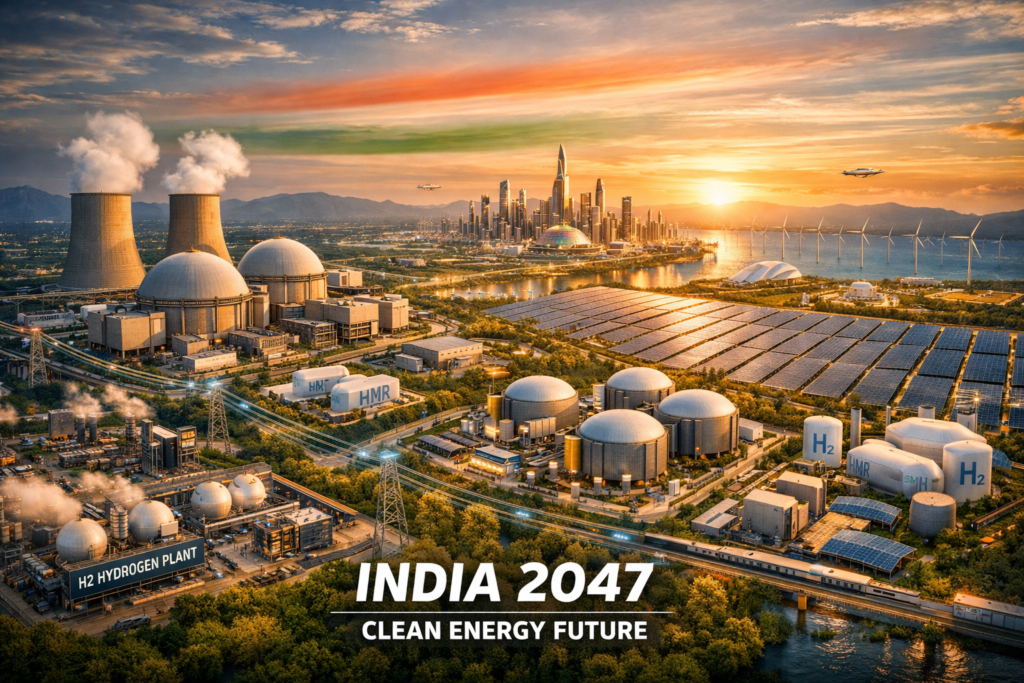
India’s journey toward becoming a developed nation by 2047 will depend heavily on secure, affordable, and sustainable energy. While renewable energy will remain a cornerstone of this transformation, nuclear power offers the reliability needed to support continuous economic growth.
The roadmap outlined in India’s Nuclear & SMR Power: 5 Bold Steps to 2047—accelerating large reactors, deploying Small Modular Reactors, strengthening the domestic fuel cycle, fostering partnerships, and investing in next-generation innovation—provides a practical framework for building a resilient and diversified energy future.
By combining scientific expertise, technological innovation, and strategic planning, India can strengthen its energy security, reduce carbon emissions, create high-value jobs, and position itself as a global leader in advanced nuclear technology.
India’s Nuclear & SMR Power: 5 Bold Steps to 2047 (Final Part)
Frequently Asked Questions (FAQs)
1. What are Small Modular Reactors (SMRs)?
Small Modular Reactors (SMRs) are advanced nuclear reactors with a smaller power output than conventional nuclear plants. They are factory-built, modular in design, quicker to deploy, and incorporate advanced passive safety features. SMRs are suitable for industrial zones, remote locations, and grid support.
2. Why is India investing in nuclear power?
India is investing in nuclear power to strengthen energy security, reduce dependence on imported fossil fuels, support economic growth, and achieve long-term clean energy and climate objectives while ensuring reliable 24/7 electricity generation.
3. How do SMRs differ from traditional nuclear reactors?
Unlike conventional reactors, SMRs require less land, have lower upfront costs, shorter construction timelines, and can be deployed in phases. They are designed with modular components that simplify manufacturing and installation.
4. Is nuclear energy environmentally friendly?
Nuclear energy produces very low greenhouse gas emissions during electricity generation. Although radioactive waste requires careful management, nuclear power is widely recognized as a low-carbon energy source that complements renewable energy.
5. Does India have enough uranium?
India has domestic uranium resources, but they are limited compared to some other countries. To strengthen long-term energy security, India is expanding uranium exploration while also pursuing international fuel partnerships.
6. Why is thorium important for India?
India possesses one of the world’s largest thorium reserves. Developing thorium-based reactor technology could provide a long-term, sustainable, and largely indigenous source of nuclear fuel.
7. Can SMRs replace solar and wind power?
No. SMRs are expected to complement renewable energy rather than replace it. Together, nuclear, solar, wind, hydroelectricity, and energy storage can create a reliable and balanced electricity system.
8. Are Small Modular Reactors safe?
Modern SMRs incorporate passive safety systems that can operate without external power or active human intervention in certain emergency situations. Their simplified designs are intended to reduce operational risks while enhancing overall safety.
9. How can nuclear power support India’s industries?
Reliable nuclear electricity can power data centers, semiconductor manufacturing, green hydrogen production, steel plants, railways, electric vehicle charging infrastructure, and other energy-intensive industries.
10. What challenges does India’s nuclear sector face?
Major challenges include high capital costs, lengthy project approvals, public awareness and acceptance, fuel-cycle management, skilled workforce development, and financing large infrastructure projects.
11. What role will artificial intelligence play in future nuclear plants?
Artificial intelligence can improve predictive maintenance, optimize reactor performance, enhance safety monitoring, detect equipment anomalies, and support digital twin technologies for plant operations.
12. Can India become an exporter of SMR technology?
If India successfully develops competitive SMR technology and manufacturing capabilities, it could become a supplier of advanced nuclear solutions to countries seeking clean, reliable, and scalable energy systems.
13. How does nuclear power contribute to India’s Net Zero ambitions?
Nuclear power generates electricity with minimal direct carbon emissions, making it an important component of a diversified low-carbon energy mix alongside renewable sources.
14. Will nuclear energy create jobs?
Yes. Expanding the nuclear sector can create employment opportunities in engineering, manufacturing, research, construction, operations, maintenance, digital technologies, and education.
15. What is the vision behind India’s Nuclear & SMR Power: 5 Bold Steps to 2047?
The vision is to build a secure, sustainable, and technologically advanced energy system by expanding conventional nuclear power, deploying SMRs, strengthening the domestic fuel cycle, fostering innovation, and enhancing global competitiveness by India’s centenary year in 2047.
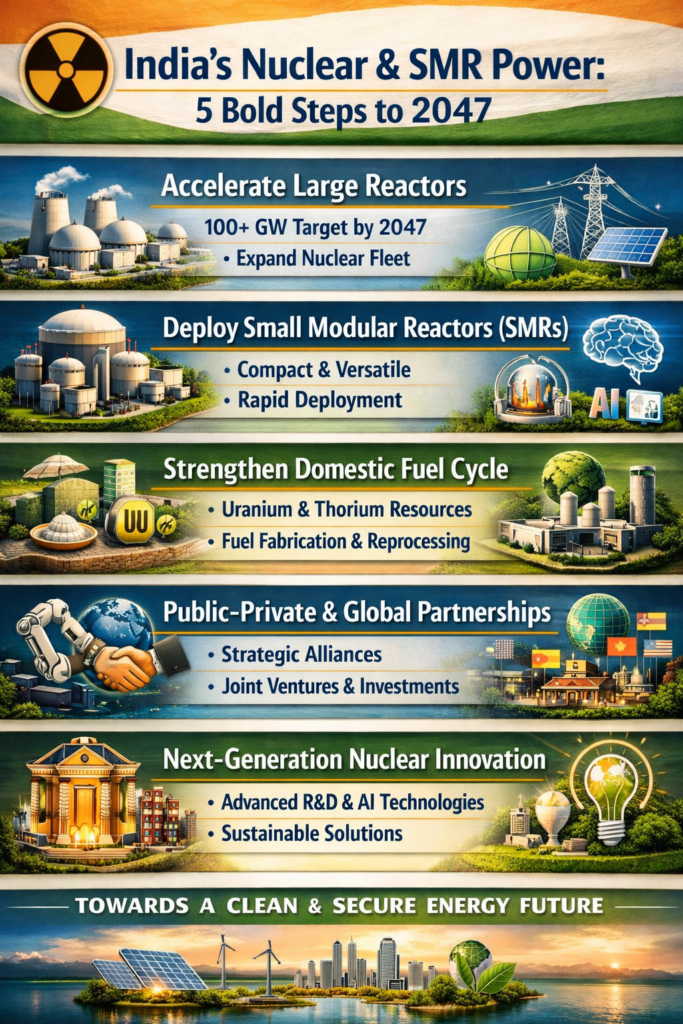
Final Thoughts
India’s path to becoming a developed nation by 2047 will depend on a resilient, diversified, and low-carbon energy system. While renewable energy will continue to expand rapidly, nuclear power and Small Modular Reactors (SMRs) can provide the dependable baseload electricity needed for industries, cities, transportation, and emerging technologies.
The five bold steps—accelerating conventional reactors, deploying SMRs, strengthening the domestic fuel cycle, encouraging strategic partnerships, and investing in next-generation innovation—offer a balanced roadmap for long-term energy security and sustainable economic growth.
By embracing these strategies, India can not only meet rising electricity demand but also position itself as a global leader in advanced nuclear technologies. The vision outlined in India’s Nuclear & SMR Power: 5 Bold Steps to 2047 reflects an ambitious yet achievable pathway toward cleaner energy, technological self-reliance, and a stronger economy.
Yo, just wanted to throw in my two cents on tigo88. Had some fun times, no big complaints. Give it a shot if you’re looking for something different over at tigo88.