
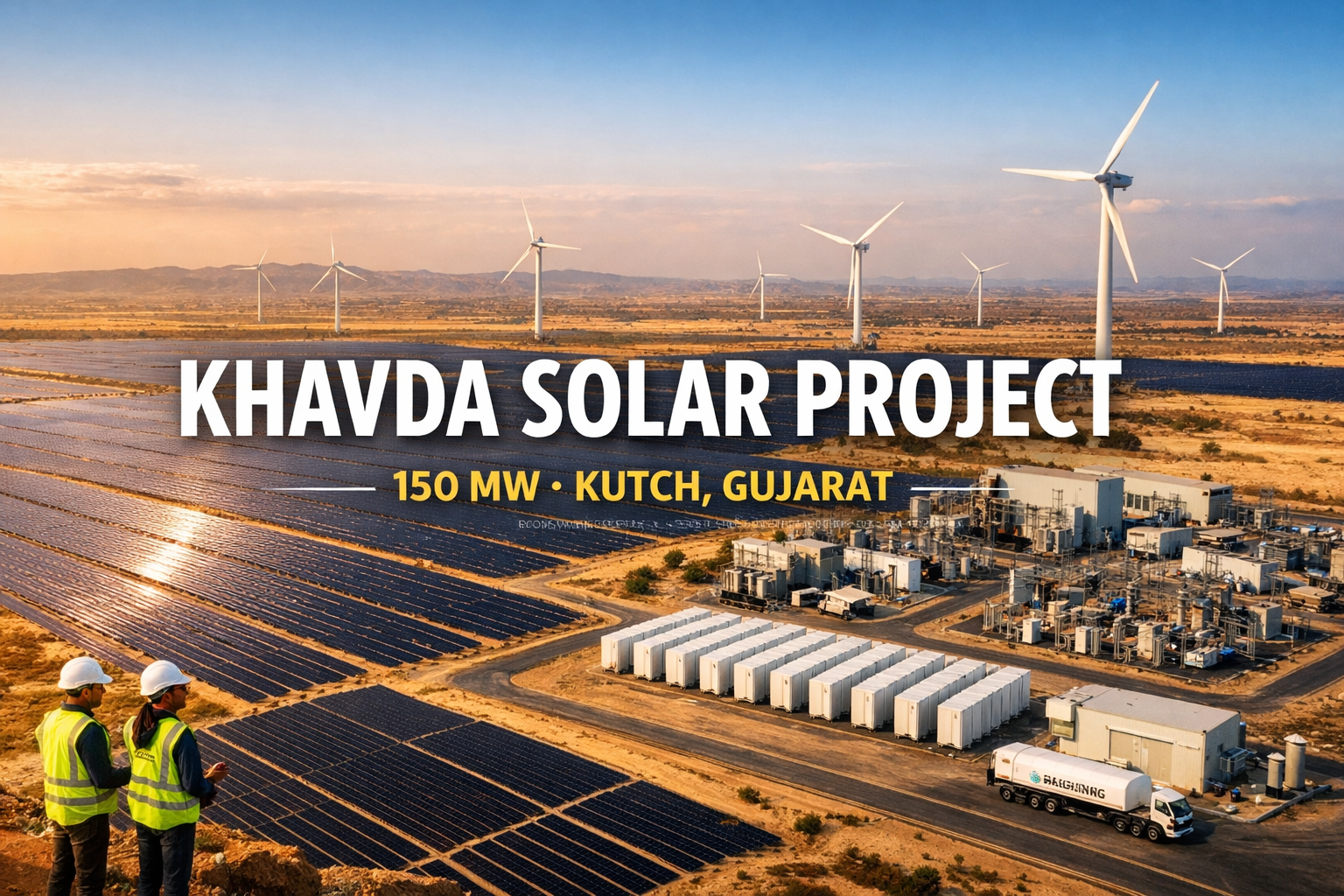
Adani Green Hits 20 GW: 150 MW Khavda Solar Project Powers Up
India’s renewable energy revolution continues to gather momentum, and one of its biggest contributors has reached another remarkable milestone. Adani Green Hits 20 GW: 150 MW Khavda Solar Project Powers Up marks a significant achievement not only for Adani Green Energy Limited (AGEL) but also for India’s ambitious clean energy transition.
150 MW Khavda Solar Project Overview
- Commissioned: June 28, 2026
- Developer: Adani Renewable Energy Eight Ltd — a wholly owned subsidiary of Adani Green Energy Limited (AGEL)
- Location: Khavda, Kutch district, Gujarat — part of the world’s largest renewable energy park, spanning 538 sq km, nearly five times the size of Paris.
- Technology: Equipped with advanced bifacial solar modules, single‑axis trackers, and waterless robotic cleaning systems to maximize efficiency and sustainability.
AGEL’s Expanding Renewable Portfolio
- Total Operational Capacity: 19,985.8 MW (as of June 2026)
- FY26 Additions:
- 3,409 MW Solar Power — rapid expansion across Gujarat and Rajasthan
- 686 MW Wind Energy — harnessing India’s coastal wind corridors
- 956 MW Hybrid Projects — combining solar and wind for round‑the‑clock generation
- Battery Energy Storage System (BESS): 3,366 MWh installed at Khavda — the largest single‑location deployment outside China, enabling continuous renewable power supply and grid stability.
Strategic Importance of Khavda
- Planned Capacity: 30 GW by 2029, positioning Khavda as the centerpiece of India’s renewable energy ambitions.
- Current Installed Capacity: Approximately 10 GW already operational, making it one of the largest clean‑energy clusters in the world.
- Geopolitical Significance: Located near the Pakistan border, Khavda enhances India’s strategic infrastructure presence while reinforcing national energy security.
- Environmental Impact: Projected to cut millions of tonnes of CO₂ emissions annually — equivalent to removing millions of cars from Indian roads and driving India’s decarbonisation goals forward.
The commissioning of a 150 MW solar power project at Khavda in Gujarat has pushed Adani Green’s operational renewable energy capacity close to the prestigious 20 GW milestone, reinforcing its position among the world’s largest renewable energy companies.
As India races toward its target of 500 GW of non-fossil fuel energy capacity by 2030, projects like Khavda are becoming the backbone of the nation’s sustainable future. The newly operational solar facility represents more than just another addition to the national grid—it symbolizes technological innovation, energy security, environmental sustainability, and economic growth.
Table of Contents
- Introduction
- Adani Green Nears the 20 GW Milestone
- Understanding the Khavda Renewable Energy Park
- Why the 150 MW Solar Project Matters
- How the Solar Project Works
- Key Features of the Khavda Solar Project
- Economic Benefits of the Project
- Employment Generation
- Environmental Benefits
- Supporting India’s Net-Zero Goals
- Government Push for Renewable Energy
- Future Expansion Plans
- Frequently Asked Questions
- Conclusion
Adani Green Nears the Historic 20 GW Milestone
The commissioning of the latest 150 MW solar installation marks another important chapter in Adani Green’s extraordinary growth story.
Over the past decade, the company has transformed from a growing renewable energy developer into one of the world’s largest producers of renewable electricity.
With every new solar and wind project, Adani Green has steadily expanded its operational portfolio across multiple Indian states.
The latest project at Khavda in Gujarat brings the company’s operational renewable capacity close to 20 GW, highlighting its ability to execute some of the world’s largest clean energy projects efficiently.
This achievement demonstrates the scale of investment flowing into India’s renewable sector and reflects growing confidence in the country’s clean energy future.
What Makes the Khavda Renewable Energy Park Special?
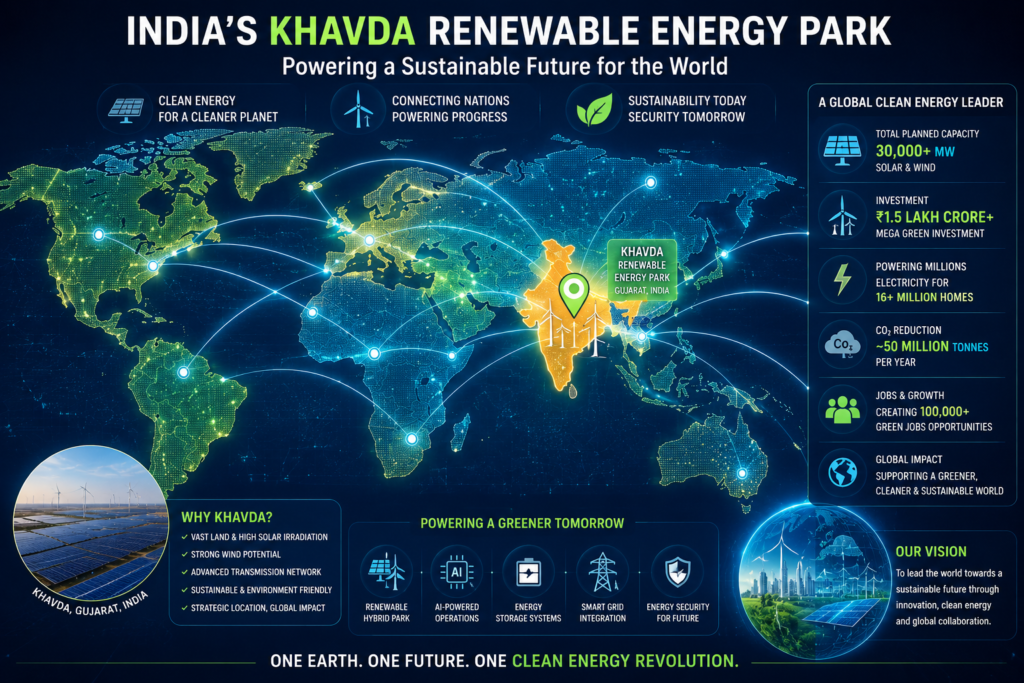
Located in Gujarat’s Kutch district, the Khavda Renewable Energy Park is rapidly becoming one of the largest renewable energy developments on Earth.
The region offers several natural advantages that make it ideal for large-scale renewable energy generation.
These include:
- Extremely high solar irradiation
- Vast stretches of unused land
- Excellent wind resources
- Low population density
- Strong transmission connectivity
- Favorable weather conditions
The massive renewable energy complex is expected to host thousands of megawatts of solar and wind capacity over the coming years.
Once fully completed, Khavda will become one of the most significant clean energy hubs globally.
Why the New 150 MW Solar Project Matters
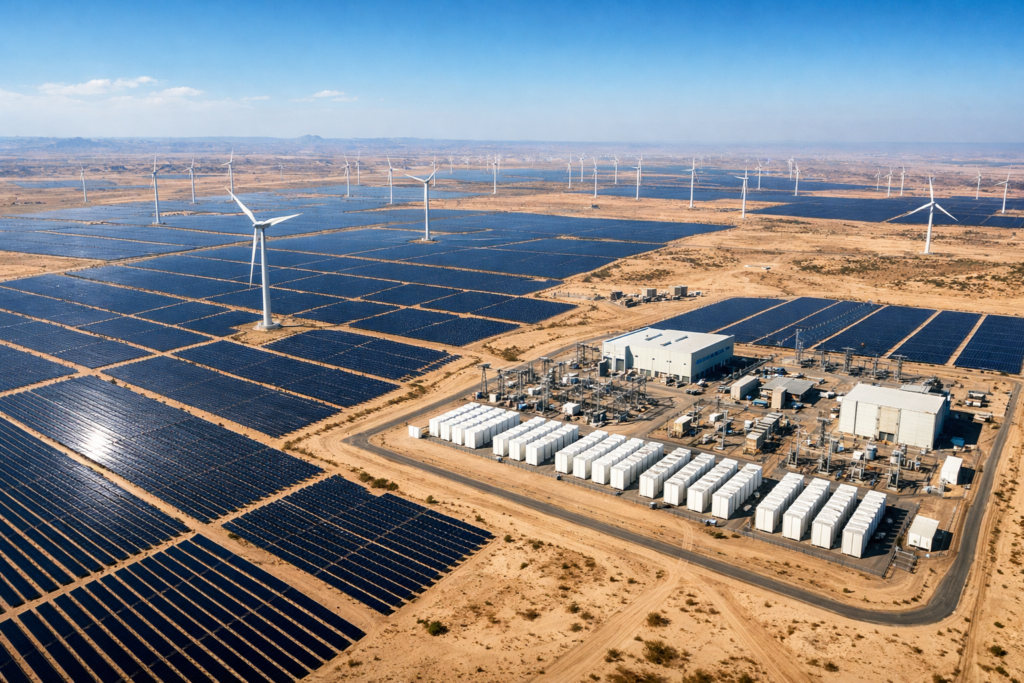
Although 150 MW may appear modest compared to the park’s long-term ambitions, every newly commissioned phase strengthens India’s renewable energy infrastructure.
The project contributes to:
- Higher clean electricity generation
- Lower carbon emissions
- Reduced coal dependence
- Improved energy security
- Stable power supply
- Long-term sustainability
It also demonstrates the speed at which India’s largest renewable developers are bringing projects online.
Rapid commissioning is essential for meeting India’s ambitious climate targets.
How Does the Solar Project Generate Electricity?
Modern utility-scale solar plants operate using highly advanced photovoltaic technology.
The process begins when sunlight strikes photovoltaic (PV) modules.
These panels convert solar radiation directly into direct current (DC) electricity.
Power electronics then convert DC electricity into alternating current (AC), making it suitable for India’s power grid.
Electricity is transmitted through:
- Inverters
- Transformers
- Substations
- High-voltage transmission lines
Finally, the electricity reaches homes, industries, commercial establishments, and public utilities.
The entire process produces electricity without combustion, smoke, or greenhouse gas emissions during operation.
Advanced Technology Behind the Project
Today’s utility-scale solar plants are far more advanced than earlier generations.
The Khavda project incorporates several cutting-edge technologies.
These may include:
- High-efficiency bifacial solar modules
- Single-axis solar trackers
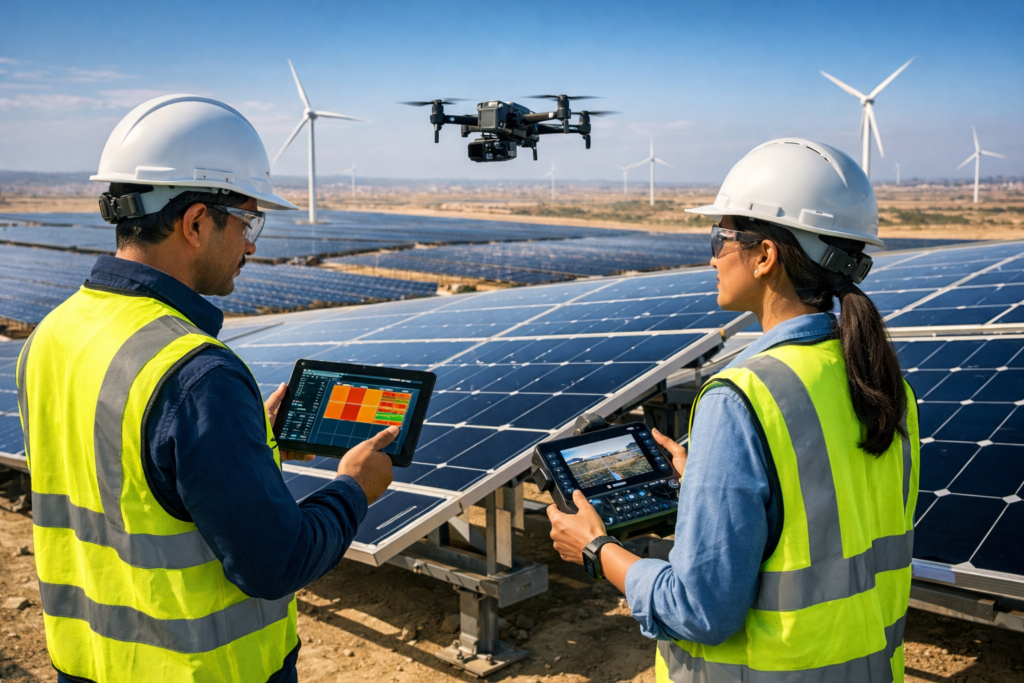
- AI-powered monitoring systems
- Drone-based inspection technology
- Predictive maintenance software
- Weather forecasting analytics
- Smart grid integration
These innovations significantly improve electricity generation while reducing maintenance costs.
Artificial intelligence continuously monitors thousands of solar panels, detecting faults before they become major operational issues.
Economic Benefits Extend Beyond Electricity
Large renewable energy projects create value throughout the economy.
The Khavda project is expected to generate benefits across multiple sectors.
These include:
Infrastructure Development
Developing renewable energy parks requires major investments in:
- Roads
- Bridges
- Transmission infrastructure
- Communication networks
- Grid substations
Such infrastructure benefits nearby communities as well.
Industrial Growth
Reliable electricity encourages investments in:
- Manufacturing
- Electric vehicles
- Green hydrogen
- Data centres
- Industrial parks
Renewable energy therefore becomes a catalyst for broader economic development.
Increased Investment
Large-scale renewable projects attract domestic and international investors seeking sustainable infrastructure opportunities.
India’s renewable sector has become one of the world’s fastest-growing investment destinations.
Employment Generation
Renewable energy development creates employment throughout every stage of the project lifecycle.
During construction, thousands of workers contribute to:
- Civil engineering
- Electrical installation
- Logistics
- Equipment transportation
- Quality control
Once operational, the solar park requires professionals in:
- Plant operations
- Engineering
- Security
- Maintenance
- Digital monitoring
- Grid management
Indirect employment also increases in transportation, hospitality, manufacturing, and local businesses.
As renewable investments continue expanding, employment opportunities are expected to grow substantially across India.
Environmental Benefits
One of the biggest strengths of solar power is its minimal environmental impact during electricity generation.
Unlike coal-fired power stations, solar plants do not emit carbon dioxide while generating electricity.
Major environmental advantages include:
- Zero operational emissions
- Cleaner air
- Reduced dependence on fossil fuels
- Lower water consumption
- Improved public health
- Long-term climate resilience
Every additional megawatt of renewable energy contributes toward reducing India’s carbon footprint while supporting sustainable development.
Supporting India’s Climate Commitments
India has committed to significantly increasing its renewable energy capacity over the coming decade.
The country aims to:
- Achieve 500 GW of non-fossil fuel energy capacity by 2030.
- Reduce emissions intensity.
- Expand solar and wind generation.
- Strengthen energy independence.
- Accelerate green industrial growth.
Projects like Khavda directly support these national objectives by adding reliable renewable electricity to the grid while reducing dependence on imported fossil fuels.
They also enhance India’s position as one of the world’s leading renewable energy markets.
Government Support Accelerating Renewable Growth
The rapid expansion of renewable energy in India has been supported by a combination of policy reforms, infrastructure development, and investment incentives.
Key initiatives include:
- Competitive renewable energy auctions.
- Expansion of interstate transmission networks.
- Production-linked incentives for solar manufacturing.
- Green Open Access Rules.
- Promotion of battery energy storage systems.
- Investment in green hydrogen infrastructure.
These measures have created a favorable ecosystem for large-scale developers such as Adani Green, enabling faster execution of renewable energy projects.
Adani Green Hits 20 GW: 150 MW Khavda Solar Project Powers Up (Part 2)
The Road to 20 GW: A Landmark Achievement
Reaching nearly 20 GW of operational renewable energy capacity is a milestone that reflects years of strategic planning, investment, and execution. For Adani Green Energy Limited (AGEL), this achievement is more than a numerical target—it represents a transformational shift in India’s clean energy landscape.
Over the last decade, the company has steadily expanded its renewable energy portfolio by commissioning utility-scale solar parks, wind farms, and hybrid renewable projects across multiple states. The addition of the 150 MW Khavda Solar Project further strengthens this portfolio and demonstrates the company’s ability to deliver large infrastructure projects on schedule.
A renewable energy capacity of nearly 20 GW means millions of Indian households and businesses can be supplied with clean electricity while reducing dependence on conventional fossil fuels. This milestone also reinforces investor confidence in India’s renewable energy sector and highlights the country’s capability to execute projects at a globally competitive scale.
Why Gujarat Is Leading India’s Solar Revolution
Gujarat has emerged as one of India’s most important renewable energy destinations due to its favorable climate, strong infrastructure, and investor-friendly policies.
Several factors make Gujarat ideal for utility-scale renewable projects:
- High solar radiation throughout the year.
- Vast stretches of non-agricultural land.
- Long coastline suitable for wind energy.
- Robust transmission network.
- Pro-business industrial ecosystem.
- Strong government support for renewable investments.
The Khavda region, located in the Kutch district, combines these advantages, making it one of the best locations in the world for integrated solar and wind projects.
Khavda Renewable Energy Park: A Global Benchmark
The Khavda Renewable Energy Park is not just another solar project—it is a globally significant clean energy initiative.
Once fully developed, it is expected to become one of the world’s largest renewable energy parks, integrating:
- Solar photovoltaic generation.
- Wind power.
- Battery Energy Storage Systems (BESS).
- Smart grid infrastructure.
- Artificial intelligence for plant monitoring.
- Digital energy management systems.
The scale of this project demonstrates India’s ambition to become a global clean energy leader while supporting sustainable economic growth.
The Role of Smart Technology in Modern Solar Parks
Today’s renewable energy facilities are powered by much more than solar panels.
Modern projects increasingly rely on digital technologies that improve efficiency and reliability.
Some of the advanced technologies used include:
Artificial Intelligence
AI continuously analyzes equipment performance, weather conditions, and electricity generation patterns.
It helps operators detect potential equipment failures before they occur, minimizing downtime.
Drone-Based Inspections
Instead of manually inspecting thousands of solar panels, drones equipped with thermal imaging cameras can quickly identify damaged modules.
IoT Sensors
Internet of Things (IoT) sensors monitor:
- Panel temperature.
- Wind speed.
- Dust accumulation.
- Equipment vibration.
- Power generation efficiency.
Predictive Maintenance
Instead of waiting for equipment to fail, predictive maintenance software schedules servicing before problems develop.
These innovations significantly reduce maintenance costs while improving electricity generation.
Contribution to India’s Energy Security
India imports a substantial portion of its fossil fuel requirements. Expanding renewable energy reduces this dependence and strengthens national energy security.
Large-scale solar projects like Khavda help by:
- Diversifying the energy mix.
- Lowering fuel import bills.
- Reducing exposure to global energy price fluctuations.
- Improving long-term electricity availability.
- Enhancing grid resilience.
As renewable capacity continues to grow, India becomes less vulnerable to disruptions in international energy markets.
Boosting Green Hydrogen Development
The rapid expansion of renewable energy also supports India’s emerging green hydrogen economy.
Green hydrogen is produced using renewable electricity to split water into hydrogen and oxygen through electrolysis.
Large solar parks such as Khavda provide abundant clean electricity, making green hydrogen production more economical.
Green hydrogen is expected to play a critical role in:
- Fertilizer production.
- Steel manufacturing.
- Heavy transport.
- Shipping.
- Aviation.
- Industrial decarbonization.
The availability of low-cost renewable electricity is essential for making India a competitive global producer of green hydrogen.
Investment Opportunities in Renewable Energy
The renewable energy sector has become one of India’s most attractive investment destinations.
Institutional investors are increasingly allocating capital toward sustainable infrastructure due to:
- Stable long-term returns.
- Growing electricity demand.
- Government policy support.
- ESG (Environmental, Social, and Governance) priorities.
- Global decarbonization efforts.
Projects such as the Khavda Solar Park demonstrate the long-term growth potential of India’s clean energy industry.
Challenges Ahead
Despite impressive progress, India’s renewable energy expansion also faces several challenges.
These include:
Grid Integration
Managing electricity generated from intermittent sources like solar and wind requires advanced grid management systems.
Energy Storage
Battery storage capacity must continue expanding to ensure reliable electricity supply even when sunlight is unavailable.
Land Acquisition
Large renewable projects require significant land resources, making careful planning essential.
Transmission Infrastructure
Power generated in remote renewable parks must be efficiently transmitted to demand centers across the country.
Addressing these challenges will be crucial for achieving India’s long-term renewable energy targets.
Future Expansion Plans
The commissioning of the 150 MW solar project represents only one phase of a much larger vision.
Adani Green continues to develop:
- Additional solar parks.
- Wind energy projects.
- Hybrid renewable plants.
- Battery storage systems.
- Round-the-clock renewable energy solutions.
Future phases of the Khavda Renewable Energy Park are expected to add several gigawatts of additional clean energy capacity.
As these projects become operational, India’s renewable energy infrastructure will continue expanding at an unprecedented pace.
What This Means for Consumers
The expansion of renewable energy ultimately benefits consumers in multiple ways.
Advantages include:
- Cleaner electricity.
- Greater energy security.
- Improved grid reliability.
- Reduced dependence on imported fuels.
- More sustainable economic growth.
- Long-term price stability.
As renewable generation increases, consumers can expect greater access to environmentally friendly electricity over the coming decades.
Expert Analysis
From an industry perspective, the commissioning of the 150 MW Khavda Solar Project is another indication that India’s renewable energy transition is accelerating.
Large developers are no longer commissioning isolated solar plants. Instead, they are creating integrated clean energy ecosystems combining:
- Solar generation.
- Wind farms.
- Battery storage.
- Smart grids.
- Artificial intelligence.
- Digital energy management.
This integrated approach improves reliability while maximizing renewable electricity generation.
The Khavda Renewable Energy Park is likely to become a global case study in large-scale renewable infrastructure development.
Key Takeaways
- Adani Green has commissioned a new 150 MW solar project at Khavda, Gujarat.
- Operational renewable capacity is approaching 20 GW.
- Khavda is emerging as one of the world’s largest renewable energy parks.
- The project supports India’s target of 500 GW non-fossil fuel capacity by 2030.
- Advanced technologies such as AI, drones, and smart monitoring improve operational efficiency.
- Renewable energy expansion strengthens India’s energy security and climate goals.
- Large-scale projects create employment, infrastructure, and investment opportunities.
Frequently Asked Questions (FAQs)
1. What is the latest achievement of Adani Green?
Adani Green has commissioned a 150 MW solar project at Khavda, Gujarat, taking its operational renewable energy capacity close to 20 GW.
2. Where is the Khavda Solar Project located?
The project is located in the Kutch district of Gujarat, within the massive Khavda Renewable Energy Park.
3. Why is the Khavda Renewable Energy Park important?
It is expected to become one of the world’s largest renewable energy parks, integrating solar, wind, battery storage, and smart grid technologies.
4. How does the project benefit India?
The project increases clean electricity generation, reduces carbon emissions, enhances energy security, creates employment, and supports India’s renewable energy targets.
5. What technologies are used in modern solar parks?
Modern projects utilize AI monitoring, drone inspections, bifacial solar panels, IoT sensors, predictive maintenance software, and advanced grid management systems.
6. How does this project contribute to climate goals?
Solar power produces electricity without direct greenhouse gas emissions during operation, helping India reduce its carbon footprint and transition toward cleaner energy sources.
7. Will Khavda support green hydrogen production?
Yes. Large renewable energy parks provide low-cost clean electricity that can be used for green hydrogen production through electrolysis.
8. What is India’s renewable energy target for 2030?
India aims to achieve 500 GW of non-fossil fuel energy capacity by 2030, making projects like Khavda crucial to reaching this goal.
Conclusion
The commissioning of the 150 MW Khavda Solar Project marks another milestone in India’s renewable energy journey. As Adani Green’s operational capacity approaches 20 GW, the company continues to demonstrate its leadership in developing world-class clean energy infrastructure.
Beyond increasing electricity generation, the Khavda Renewable Energy Park symbolizes India’s commitment to sustainability, technological innovation, and long-term energy security. By integrating solar power, wind energy, battery storage, and smart digital technologies, the project showcases the future of renewable energy development.
As India accelerates toward its ambitious clean energy goals, initiatives like Khavda will play a pivotal role in reducing emissions, attracting investment, creating jobs, and powering sustainable economic growth. The project stands as a powerful example of how large-scale renewable infrastructure can transform both the energy sector and the nation’s future.