
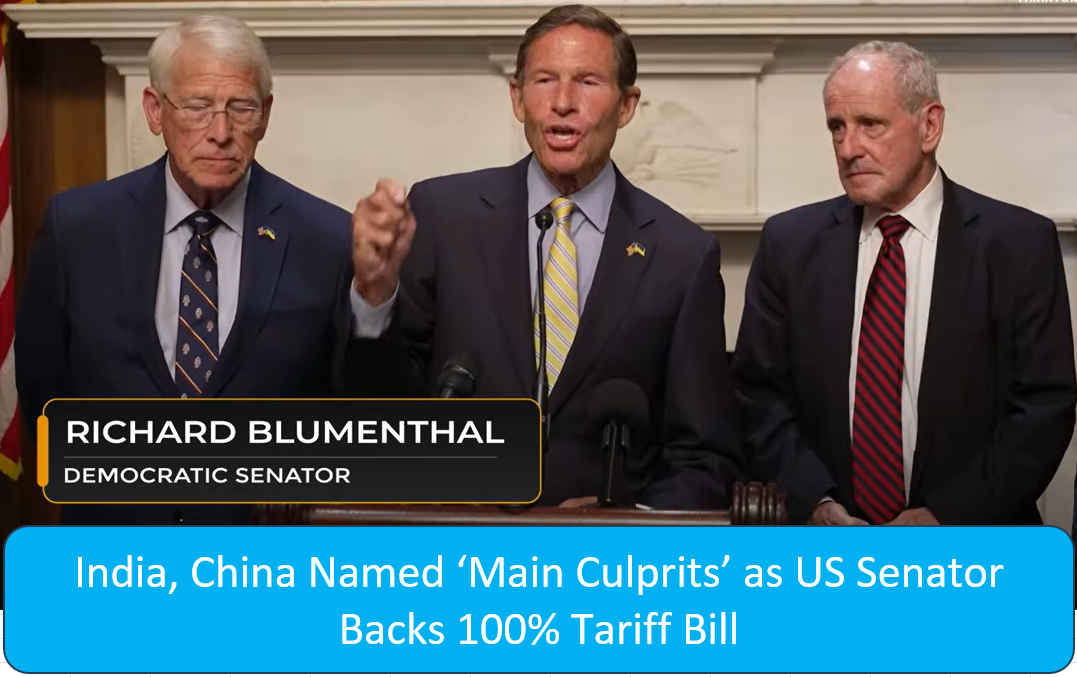
US 100% Tariff Threat: India & China Face 5 Big Risks
US 100% Tariff Threat: India & China Face 5 Big Risks has emerged as one of the biggest geopolitical and economic stories of the week, after the U.S. Senate advanced legislation that could give the president authority to impose tariffs of up to 100% on countries that remain major purchasers of Russian oil and gas.
The proposed measure is aimed primarily at increasing pressure on Russia and reducing the revenue that supports its war effort in Ukraine. However, because India and China are among the world’s major buyers of Russian energy, the legislation has raised concerns in New Delhi, Beijing and global financial markets.
The latest development is significant because the Senate voted 86-12 on July 28 to advance the sanctions legislation, marking a major procedural step. The bill still faces further legislative hurdles before it could become law, and its final form, implementation and potential exemptions remain uncertain.
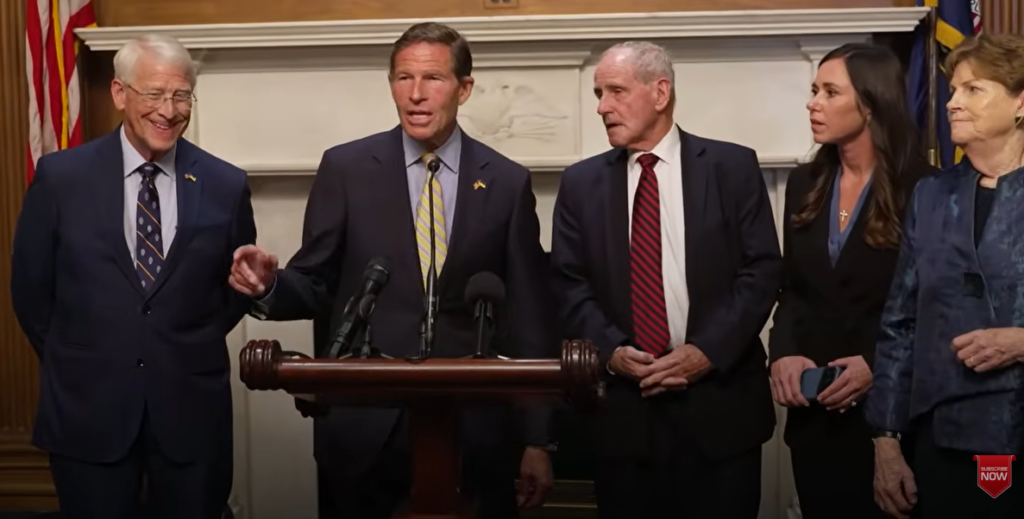
The measure is connected to the bipartisan Lindsey O. Graham Sanctioning Russia and Iran Act of 2026, which would strengthen sanctions against Russia and potentially allow secondary tariffs against major purchasers of Russian energy. The revised proposal narrowed the potential tariff exposure compared with earlier versions that had discussed penalties as high as 500%.
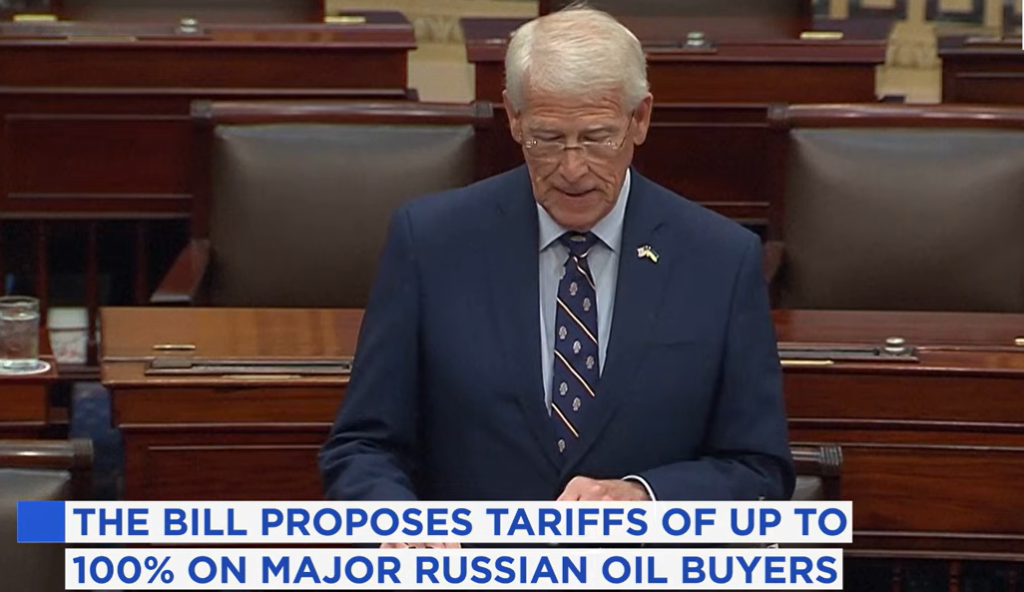
For India and China, the issue is bigger than tariffs alone. A 100% tariff on affected exports to the United States could disrupt trade flows, increase costs for companies, create uncertainty for investors and force both countries to reconsider their energy and foreign-policy strategies.
This article examines five major risks created by the US 100% Tariff Threat: India & China Face 5 Big Risks, while also explaining why the potential impact would differ between the world’s two largest emerging economies.
What Is Behind the US 100% Tariff Threat?
The central objective of the proposed legislation is to increase economic pressure on Russia by targeting countries that purchase significant quantities of Russian oil and gas.
The revised legislation reportedly focuses on the five largest importers of Russian crude oil or natural gas, along with countries that could assist in sanctions evasion. The proposed tariffs could reach as high as 100%, although the measure includes provisions related to presidential discretion and potential waivers.
The logic behind the policy is straightforward: if major economies reduce their purchases of Russian energy, Moscow could face lower export revenues. The United States hopes that increased economic pressure could encourage changes in Russia’s approach to the war in Ukraine.
However, the strategy also creates a complicated dilemma.
India and China have economic reasons for purchasing Russian energy. Russian crude has often been commercially attractive because of pricing, availability and established refining economics. For large energy-consuming economies, changing suppliers is not always as simple as signing a new contract.
This is why the US 100% Tariff Threat: India & China Face 5 Big Risks debate has quickly expanded beyond U.S.-Russia relations.
It now involves energy security, international trade, inflation, supply chains, currency markets and the future of global economic alliances.
US 100% Tariff Threat: India & China Face 5 Big Risks
The potential consequences can be divided into five major areas: exports, energy security, inflation, financial markets and geopolitical realignment.
While India and China have different economic structures and trade relationships with the United States, both could face significant challenges if the proposed tariffs are implemented at their maximum level.
Here are the five biggest risks.
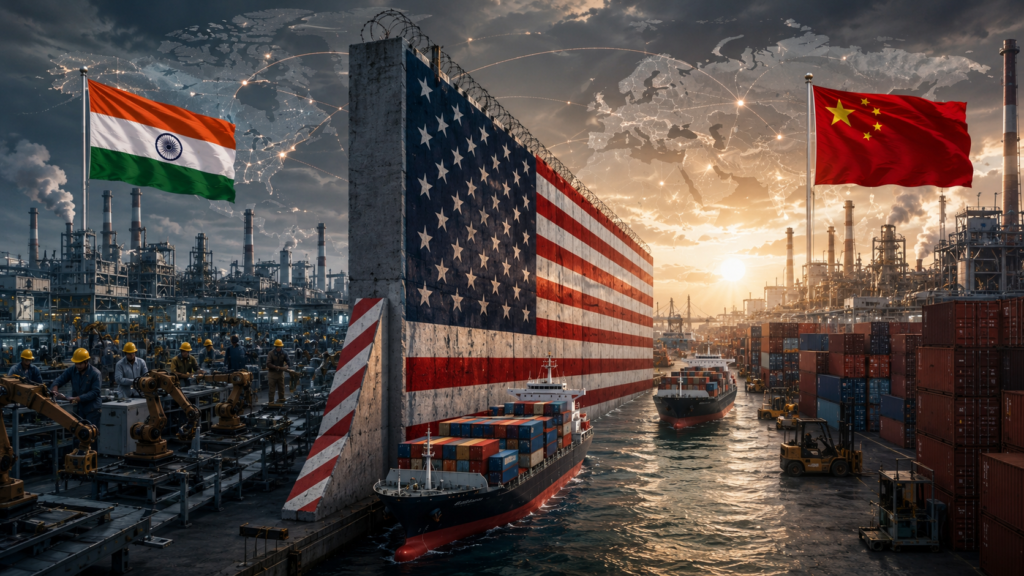
1. US 100% Tariff Threat Could Hit India and China Exports
The first and most direct risk is the impact on exports.
A 100% tariff can dramatically increase the landed cost of imported goods in the U.S. market. Depending on how the tariff is structured and how businesses respond, American importers could face higher costs, while exporters could lose competitiveness.
For India, this could be particularly important for sectors that rely heavily on access to the U.S. market.
Indian industries with significant exposure to American demand include:
- Pharmaceuticals
- Textiles and apparel
- Engineering goods
- Electronics
- Auto components
- Chemicals
- Gems and jewellery
- Machinery
- Information technology-related services, although tariffs primarily affect goods
A sudden increase in trade barriers could force Indian exporters to reduce prices, accept lower margins or search for alternative markets.
For smaller businesses, the pressure could be even greater. Large multinational companies may have the financial capacity to redesign supply chains, shift production or negotiate new contracts. Smaller exporters may not have the same flexibility.
China could face a different but potentially larger challenge.
The Chinese economy has long been deeply integrated with global manufacturing and international supply chains. Although China has diversified its export markets over the years, the United States remains a major destination for Chinese products.
A 100% tariff could therefore intensify existing trade tensions between Washington and Beijing.
Chinese manufacturers could respond by:
- Cutting prices to maintain market share.
- Redirecting exports toward Europe, Asia, Africa and Latin America.
- Increasing investment in overseas manufacturing.
- Expanding domestic consumption.
- Accelerating technological self-reliance.
The problem is that redirecting such a large volume of trade takes time.
Why This Risk Matters
The biggest danger is not necessarily that all exports would suddenly stop.
Instead, uncertainty itself could become a major economic cost.
Businesses make investment decisions based on expected future market conditions. If companies believe tariffs could remain in place for years, they may postpone factory expansion, reduce hiring or move production to countries with lower tariff exposure.
This could create a chain reaction across manufacturing ecosystems.
For India, the challenge could also become an opportunity if global companies accelerate their “China+1” strategies. But the immediate shock from a major tariff escalation could still be disruptive.
For China, the pressure could encourage faster diversification away from the U.S. market.
In both cases, the US 100% Tariff Threat: India & China Face 5 Big Risks story is therefore not simply about one tariff rate. It is about the potential restructuring of global trade.
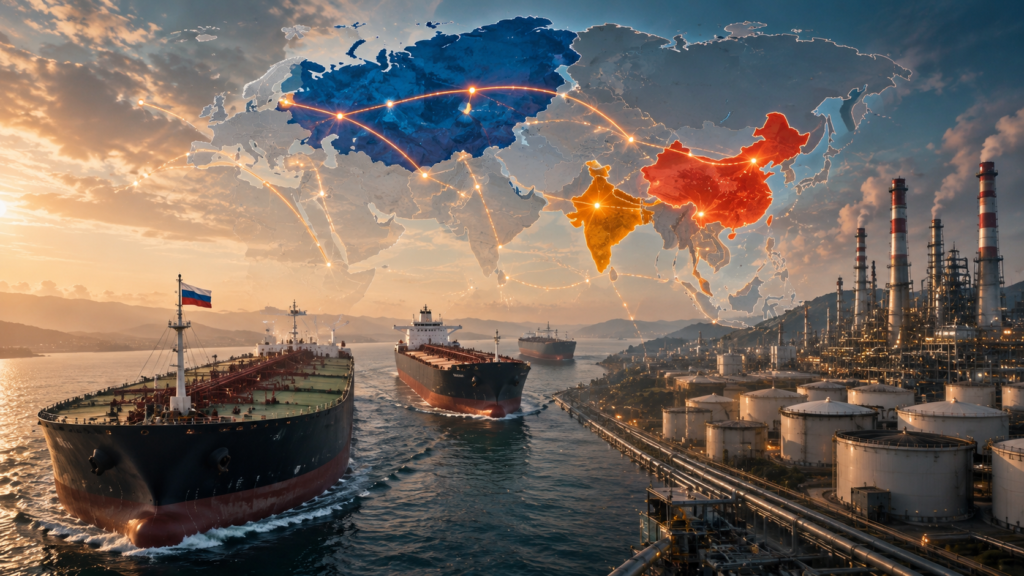
2. US 100% Tariff Threat Could Create a Major Energy Security Risk
The second major risk is energy.
India and China are among the world’s largest energy-consuming economies, and both have relied significantly on imported crude oil.
Russia has become an important energy supplier to both countries, especially after the global energy market was reshaped by sanctions and geopolitical tensions.
For India, Russian crude imports have provided refiners with access to competitively priced supplies. Indian refiners can process crude from different origins, but replacing a major supplier immediately could increase logistical complexity and potentially raise costs.
China is even larger in absolute energy consumption and has extensive relationships with Russia across oil, gas and other commodities.
A tariff penalty linked to Russian energy purchases could therefore force difficult decisions.
India and China could face three broad choices:
- Continue purchasing Russian energy and risk higher U.S. trade penalties.
- Reduce Russian energy purchases and seek alternative suppliers.
- Negotiate waivers or exemptions while maintaining diversified energy imports.
None of these options is straightforward.
The Energy Price Problem
If India and China suddenly reduce purchases from Russia, global oil markets could experience a major adjustment.
Other suppliers would need to increase production or redirect existing cargoes.
That could increase competition for supplies from:
- Middle Eastern producers
- African producers
- U.S. energy companies
- Latin American exporters
If global crude prices rise, the impact could spread far beyond India and China.
Higher oil prices could increase:
- Transportation costs
- Manufacturing expenses
- Airline fuel bills
- Fertilizer prices
- Electricity costs
- Consumer inflation
This is why the energy component of the US 100% Tariff Threat: India & China Face 5 Big Risks debate could become a global issue.
For India, the risk is particularly important because the country imports a large share of its crude oil requirements. Higher international oil prices can put pressure on the trade balance and the currency while increasing inflationary risks.
China also faces energy challenges, although its large manufacturing base and diversified supplier relationships provide some flexibility.
The key point is that energy markets are interconnected.
A policy designed to reduce Russian energy revenues could unintentionally reshape global energy flows and increase competition among major buyers.
3. US 100% Tariff Threat Could Fuel Inflation
The third risk is inflation.
Tariffs are generally designed to make imported goods more expensive. However, the economic impact depends on who ultimately absorbs the cost.
Possible outcomes include:
- U.S. importers paying higher prices.
- Foreign exporters cutting profit margins.
- Retailers passing costs to consumers.
- Companies shifting supply chains.
- Businesses replacing suppliers with more expensive alternatives.
If India and China face higher barriers to the U.S. market, their exporters may be forced to absorb part of the tariff burden.
That could reduce corporate profitability.
Alternatively, companies may increase prices, making their products less competitive.
At the same time, if the tariff policy causes disruptions in energy markets, the inflation impact could extend beyond manufactured goods.
Oil is an input into almost every modern economy.
When energy becomes more expensive, businesses often face higher costs throughout their operations.
A logistics company pays more for fuel.
A factory pays more to transport raw materials.
An airline pays more for jet fuel.
A farmer may face higher fertilizer and transportation costs.
Consumers eventually feel these pressures through higher prices.
Inflation Could Become a Policy Challenge
Central banks in India, China and other economies would have to monitor the situation carefully.
If inflation rises because of higher energy costs, policymakers could face a difficult trade-off.
Keeping monetary policy tight for longer could help contain inflation but might slow economic growth.
On the other hand, easing policy too quickly could increase inflationary pressure.
This creates a second-round risk.
The original tariff dispute may begin as a geopolitical issue, but it could eventually influence interest rates, investment decisions and consumer demand.
For India, any sharp increase in energy prices could also put pressure on the current account balance.
For China, weaker global demand combined with higher trade barriers could create additional challenges for its manufacturing sector.
Therefore, the US 100% Tariff Threat: India & China Face 5 Big Risks could become an inflation story as much as a trade story.
4. US 100% Tariff Threat Could Shake Currency and Financial Markets
The fourth major risk involves financial markets.
Markets dislike uncertainty.
When investors cannot predict whether tariffs will be implemented, delayed, reduced or waived, they often become more cautious.
The first reaction could appear in:
- Stock markets
- Currency markets
- Bond yields
- Commodity prices
- Emerging-market investments
If investors expect slower growth in India or China, they may reduce exposure to riskier assets.
For India, pressure could emerge through the rupee if investors become concerned about:
- Higher oil import costs
- Wider trade deficits
- Foreign capital outflows
- Export weakness
- Higher inflation
China’s renminbi could also face pressure if tariffs significantly reduce exports or trigger additional capital movements.
However, the impact would not necessarily be one-directional.
Currency depreciation can make exports more competitive, potentially helping exporters offset some tariff pressure.
But a weaker currency also makes imports more expensive.
For India, this is especially relevant because crude oil is primarily imported.
A weaker rupee combined with higher oil prices could create a difficult combination.
Investor Confidence Is Critical
The biggest financial risk may be uncertainty rather than the tariff itself.
Investors want predictable rules.
If trade restrictions become part of a recurring geopolitical strategy, multinational companies may rethink where they invest.
That could accelerate a trend toward regional supply chains.
Instead of one global manufacturing network, companies may build separate production systems for:
- North America
- Europe
- Asia
- Middle East
- Africa
This could increase costs across the global economy.
India may benefit from supply-chain diversification, but it must also compete with countries such as Vietnam, Indonesia, Mexico and others for new investment.
China, meanwhile, may accelerate efforts to reduce dependence on Western technology and markets.
The financial consequences of the US 100% Tariff Threat: India & China Face 5 Big Risks could therefore extend well beyond the immediate tariff announcement.
5. US 100% Tariff Threat Could Accelerate a Global Geopolitical Split
The fifth risk may be the most important in the long term.
If the United States imposes severe secondary tariffs on countries buying Russian energy, it could accelerate the formation of competing economic blocs.
India has traditionally maintained strategic relationships with multiple major powers.
It cooperates with the United States on technology, defense, investment and Indo-Pacific security.
At the same time, it maintains important energy and defense relationships with Russia.
China has also developed deep economic links with Russia while competing strategically with the United States.
A major tariff escalation could force both countries to make difficult strategic choices.
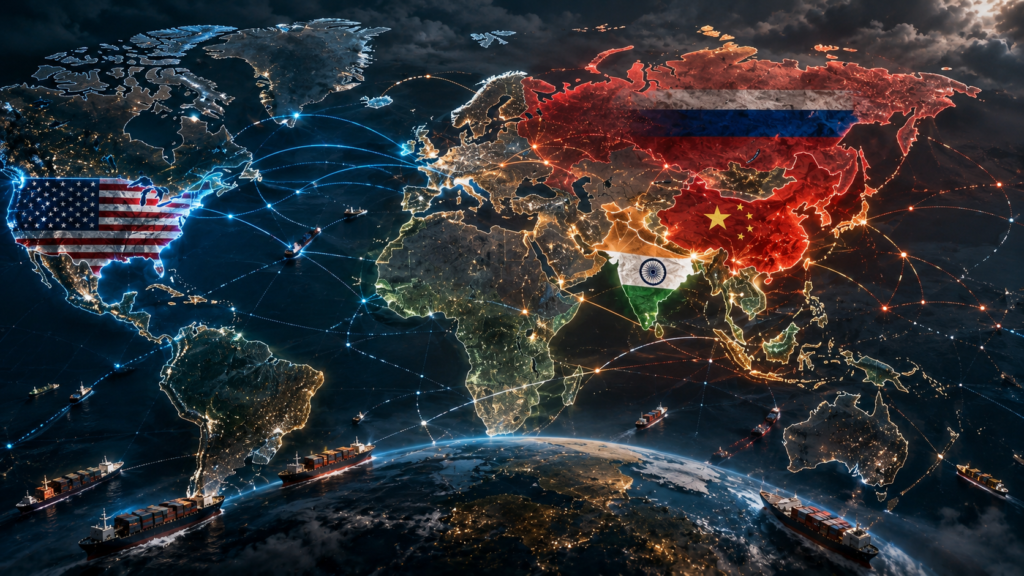
The BRICS Factor
A stronger U.S. sanctions and tariff strategy could also encourage countries to explore alternative payment systems and trade arrangements.
This does not mean the dollar-based global financial system would disappear overnight.
The U.S. dollar remains deeply embedded in international trade and finance.
However, repeated sanctions and tariffs could encourage governments to diversify their reserves, payment mechanisms and trading partners.
India and China may increase bilateral trade settlement in local currencies in selected areas.
Other countries could also explore:
- Local-currency trade
- Alternative payment systems
- Regional financial institutions
- New energy agreements
- Greater use of non-dollar settlement mechanisms
This could gradually contribute to a more fragmented global economic system.
The result could be a world where international trade is increasingly influenced by geopolitical alignment.
That would represent a major shift from the globalization model that dominated previous decades.
Why India and China Could Face Different Impacts
Although India and China are both mentioned in discussions surrounding the proposed tariffs, their economic exposure is not identical.
India’s Exposure
India’s biggest vulnerability is likely to be the combination of energy dependence and U.S. market access.
India has strong commercial ties with the United States, while Russian oil has played an important role in its energy supply.
Therefore, New Delhi may seek diplomatic flexibility.
Possible strategies could include:
- Negotiating exemptions
- Diversifying crude suppliers
- Increasing domestic energy production
- Expanding renewable energy
- Strengthening trade with other markets
- Accelerating negotiations with Washington
India may also attempt to demonstrate that its energy decisions are driven by national economic interests rather than geopolitical alignment.
China’s Exposure
China’s situation is different.
Beijing already has significant strategic tensions with Washington.
A new tariff mechanism targeting Russian energy buyers could therefore add another layer to the existing U.S.-China trade conflict.
China has a much larger manufacturing base and a broader export network, giving it greater capacity to redirect trade.
However, its sheer dependence on global manufacturing demand means prolonged tariff escalation could still create serious economic consequences.
China may respond by increasing:
- Domestic consumption
- Regional Asian trade
- Belt and Road-related economic links
- Investment in overseas manufacturing
- Technological self-reliance
The two countries therefore face different versions of the same challenge.
Could the 100% Tariff Actually Happen?
This is one of the most important questions.
The answer is: it remains uncertain.
The Senate’s July 28 vote was a procedural step advancing the legislation, not the final implementation of a 100% tariff on India or China. The bill still has to move through additional legislative processes, and the final text could change.
The legislation also reportedly includes provisions related to presidential authority and waivers.
That means the headline figure of 100% should not automatically be interpreted as a guaranteed tariff rate that will immediately apply to all Indian or Chinese exports.
The actual outcome could depend on:
- The final legislation passed by Congress.
- The scope of countries covered.
- The definition of major Russian energy purchasers.
- Presidential decisions.
- Possible waivers.
- India and China’s response to U.S. pressure.
- Developments in the Russia-Ukraine conflict.
- Broader U.S.-India and U.S.-China trade negotiations.
This distinction is critical for readers.
A threat of a 100% tariff can influence markets even before a tariff is implemented.
But the actual economic impact depends on whether the measure becomes law and how it is ultimately enforced.
What Could India Do to Reduce the Risk?
India has several potential options.
1. Diversify Energy Sources
India could increase purchases from a broader group of suppliers to reduce dependence on any single country.
2. Accelerate Renewable Energy
Solar, wind, nuclear and other clean-energy investments can gradually reduce India’s exposure to imported fossil fuels.
3. Strengthen U.S. Trade Relations
India could pursue negotiations aimed at protecting bilateral trade from broader sanctions-related measures.
4. Expand Export Markets
Indian companies could increase exports to Europe, Africa, Southeast Asia, the Middle East and Latin America.
5. Build Domestic Manufacturing
A stronger domestic industrial base could reduce India’s vulnerability to external disruptions.
These measures would not eliminate the risks created by the US 100% Tariff Threat: India & China Face 5 Big Risks, but they could make the Indian economy more resilient.
What Could China Do?
China has its own set of potential responses.
Beijing could continue diversifying its energy suppliers while increasing domestic energy security.
It could also expand trade with:
- Southeast Asia
- Middle East
- Africa
- Latin America
- Central Asia
China could further strengthen domestic consumption and reduce reliance on exports to any single market.
The country could also accelerate investment in advanced technologies, electric vehicles, batteries, renewable energy and semiconductor capabilities.
However, China’s biggest challenge would be avoiding an escalation that damages global demand.
A prolonged tariff confrontation between the world’s two largest economies could hurt both sides.
Global Economic Impact: Why the World Should Watch Closely
The biggest lesson from the US 100% Tariff Threat: India & China Face 5 Big Risks is that modern economies are deeply interconnected.
A policy aimed at Russia can affect India and China.
A tariff imposed on Indian or Chinese exports can affect American importers.
A reduction in Russian oil purchases can affect global energy prices.
Higher energy prices can influence inflation worldwide.
And inflation can influence central-bank decisions.
This is why the potential tariff threat should not be viewed as a narrow dispute between Washington, Moscow, New Delhi and Beijing.
It is part of a much larger transformation in global economic relations.
The world is moving toward a more fragmented trade environment in which economic policy and foreign policy are increasingly connected.
The old assumption that business and geopolitics could remain separate is becoming harder to maintain.
US 100% Tariff Threat: India & China Face 5 Big Risks — Final Analysis
The US 100% Tariff Threat: India & China Face 5 Big Risks is a developing story with potentially significant consequences for global trade.
The five biggest risks are:
- Export disruption — Indian and Chinese products could become less competitive in the U.S. market.
- Energy insecurity — Pressure to reduce Russian oil purchases could increase competition for alternative supplies.
- Inflation — Higher trade and energy costs could spread through global supply chains.
- Financial volatility — Currency markets, stocks and investor confidence could face increased uncertainty.
- Geopolitical fragmentation — The dispute could accelerate the formation of competing economic and strategic blocs.
At the same time, it is important not to treat the 100% tariff figure as a certainty.
The legislation has advanced but is not the same as an immediately implemented tariff. The final policy could change through congressional negotiations, presidential action, exemptions or diplomatic developments.
For India, the challenge will be balancing energy security with its growing strategic partnership with the United States.
For China, the challenge will be managing an already complicated relationship with Washington while protecting its energy supplies and export economy.
For the global economy, the biggest concern is escalation.
If tariffs, sanctions and countermeasures continue to expand, the world could enter a period of deeper economic fragmentation.
The coming months will therefore be critical.
The ultimate impact of the US 100% Tariff Threat: India & China Face 5 Big Risks will depend not only on what Washington decides, but also on how New Delhi, Beijing and Moscow respond.
Frequently Asked Questions (FAQ)
1. What is the US 100% tariff threat?
The US 100% tariff threat refers to proposed authority that could allow the U.S. president to impose tariffs of up to 100% on imports from major purchasers of Russian oil or gas under proposed sanctions legislation. India and China are among the countries identified as potentially exposed because of their Russian energy purchases.
2. Is the U.S. already imposing a 100% tariff on India and China?
No. The proposed measure has advanced through the U.S. Senate but is not the same as an immediate, blanket 100% tariff on all Indian and Chinese goods. The legislation still faces further steps, and the final implementation could depend on its final wording and presidential action.
3. Why are India and China at risk of tariffs?
India and China are major buyers of Russian energy. The proposed sanctions strategy is designed to pressure Russia by targeting countries that continue significant purchases of Russian oil and gas.
4. What are the five biggest risks for India and China?
The five major risks are export disruption, energy-security pressure, inflation, financial-market volatility and increased geopolitical fragmentation.
5. Could India stop buying Russian oil?
India could potentially reduce or change its Russian oil purchases, but doing so could have economic consequences. Russian crude has been an important component of India’s energy supply, and replacing large volumes quickly could affect costs and supply logistics.
6. Could China avoid the impact?
China may have greater capacity to diversify trade and energy supplies, but it would not necessarily be immune. A major tariff escalation could affect Chinese exports, manufacturing and international investment.
7. Could the tariff threat increase global oil prices?
It could, depending on how much Russian energy supply is disrupted and how quickly other producers can compensate. Any major disruption in global oil flows could increase price volatility.
8. Will the tariff threat hurt the U.S. economy too?
Potentially. Tariffs can increase costs for importers and businesses that depend on foreign products or components. The ultimate effect would depend on how companies and consumers respond and whether trade flows adjust.
9. Could India benefit from the trade conflict?
India could potentially benefit in some areas if multinational companies accelerate supply-chain diversification away from China. However, the country could also face higher energy costs and trade uncertainty, meaning the overall impact could be mixed.
10. What should readers watch next?
The most important developments will be the progress of the sanctions legislation, its final provisions, possible presidential waivers, U.S.-India trade negotiations, China’s response and any changes in Russian energy exports.
MY View:-
The US 100% Tariff threat to India and China could face 5 big risks is a warning sign of how quickly geopolitical conflicts can spill into global trade and economic policy. While the proposed tariff mechanism is not yet a guaranteed 100% duty on Indian or Chinese goods, the possibility itself creates uncertainty for businesses, investors and governments. India will need to carefully balance affordable energy supplies with its expanding relationship with Washington, while China may face another layer of pressure in its already tense economic relationship with United States. The biggest risk for the global economy is not simple one tariff, It is the possibility of a prolonged cycle of sanctions, tariffs and retaliation that fragments international trade.