
Mobile Manufacturing 2.0: ₹62,500 Cr Boost — India’s Next Electronics Push
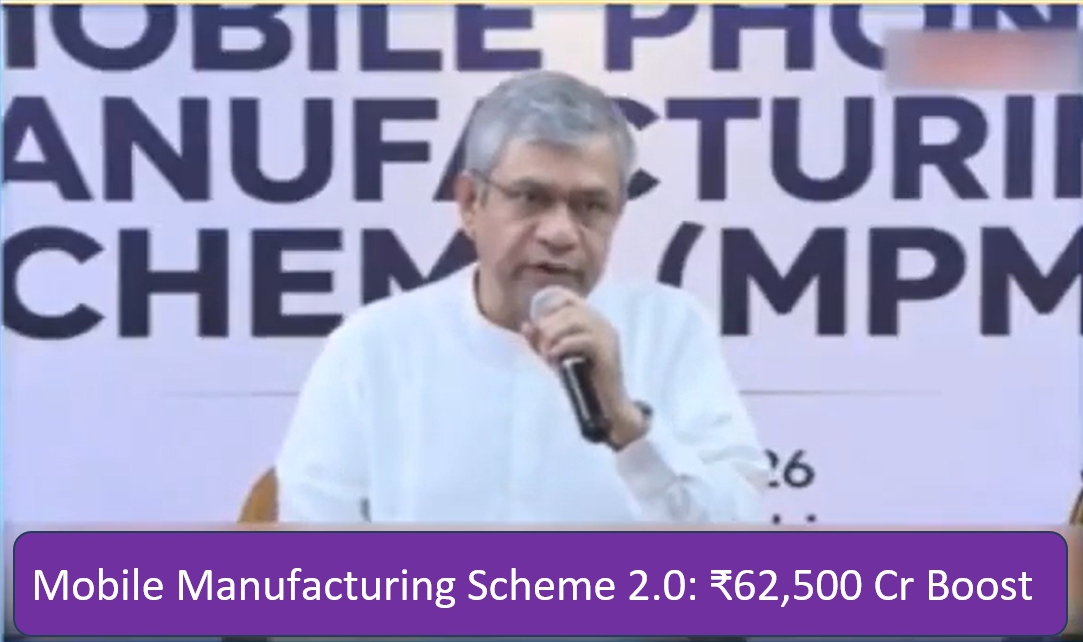
Mobile Manufacturing 2.0: ₹62,500 Cr Boost marks a major new phase in India’s electronics manufacturing journey. The Union Government has officially notified the ₹62,500 – Crore Mobile Phone Manufacturing Scheme (MPMS), giving smartphone makers and electronics manufacturers a fresh five-year policy framework aimed at increasing production, deepening domestic value addition, strengthening supply chains and improving India’s global competitiveness.
The scheme was approved by the Union Cabinet in July 2026 and will operate from FY 2026-27 through FY 2030-31. During this period, the government expects cumulative mobile-phone production in India to reach approximately by a significant ₹39 lakh crore, accompanied by a significant increase in exports. The programme is also expected to generate around 60.000 direct jobs.
The announcement comes at an important moment. India’s smartphone manufacturing industry has already moved from being heavily dependent on imports to becoming a major global production and export hub. Government data says 99.2% of mobile phones used in India are now manufactured domestically, while India has become the world’s second-largest mobile -phone manufacturer by volume.
The new Mobile Manufacturing 2.0: ₹62,500 Cr Boost is therefore not simply about producing more phones. Its larger objective is to increase the amount of economic value created inside India.
What Is Mobile Manufacturing 2.0: ₹62,500 Cr Boost?
The Mobile Manufacturing 2.0: ₹62,500 Cr Boost refers to the government’s new Mobile Phone Manufacturing Scheme, which has a total budgetary outlay of ₹62,500 crore and a five-year tenure.
The policy has been designed around several interconnected objectives:
- Expand mobile-phone production in India
- Increase domestic value addition
- Strengthen supply-chain resilience
- Encourage domestic sourcing of components
- Increase smartphone exports
- Support Indian mobile brands
- Promote product design and R&D
- Create intellectual property in India
- Improve India’s global manufacturing competitiveness
- Generate employment
The scheme provides incentives on eligible sales at differentiated rates ranging from 2.25% to 5%. Manufacturers can also receive an additional incentive of up to 1.5% linked to domestic sourcing of key components and sub-assemblies. For Indian brands, the scheme provides an additional 3% incentive on eligible sales for product design and R&D.
That combination is important because it moves policy support beyond simply encouraging assembly.
The government increasingly wants India to manufacture more components, develop products, create intellectual property and capture a larger share of the global electronics value chain.
Mobile Manufacturing 2.0: ₹62,500 Cr Boost Comes After PLI
The new programme builds on the foundation created by India’s earlier Production Linked Incentive (PLI) Scheme for Large Scale Electronics Manufacturing.
The PLI-LSEM programme played a major role in establishing India as a global mobile-phone manufacturing hub. Its tenure ended on March 31, 2026, creating the need for a new framework to maintain momentum in the sector.
The new scheme can therefore be viewed as the next chapter rather than an entirely separate manufacturing strategy.
Under the earlier policy environment, manufacturers expanded factories, increased production and developed export capabilities. The new Mobile Manufacturing 2.0: ₹62,500 Cr Boost seeks to build on those capabilities while placing greater emphasis on domestic sourcing, product development and Indian brands.
This transition is strategically significant.
Assembly can create employment and exports, but a deeper electronics ecosystem requires local suppliers, component manufacturing, engineering capabilities, design centres, testing facilities and R&D.
That is where the new scheme is expected to have its biggest long-term impact
Why Mobile Manufacturing 2.0: ₹62,500 Cr Boost Matters
The most important question is why the government has committed such a large amount to mobile manufacturing when India already produces most phones sold domestically.
The answer is scale plus value addition.
Government data shows that India’s electronics production increased from around ₹1.9 lakh crore in FY2014-15 to approximately ₹13.11 lakh crore in FY2025-26, representing roughly seven times growth. Electronics exports increased from around ₹38,000 crore to ₹4.24 lakh crore during the same period.
Mobile-phone production has grown even more dramatically, from roughly ₹18,000 crore in FY2014-15 to around ₹6.27 lakh crore in FY2025-26. Mobile-phone exports rose from approximately ₹1,500 crore to ₹2.59 lakh crore.
These numbers show that India has already created significant manufacturing capacity.
The next challenge is to ensure that more of the value generated by that manufacturing remains within the country.
Mobile Manufacturing 2.0: ₹62,500 Cr Boost and Domestic Value Addition
Domestic value addition is one of the central themes of the Mobile Manufacturing 2.0: ₹62,500 Cr Boost.
A smartphone contains hundreds of components and sub-components. Manufacturing the final device in India does not automatically mean that every part is produced domestically.
For example, the manufacturing ecosystem can involve:
- Displays
- Camera modules
- Printed circuit boards
- Batteries
- Connectors
- Mechanical components
- Sensors
- Speakers
- Microphones
- Chargers
- Cables
- Semiconductor components
- Memory-related components
- Packaging
- Testing equipment
The government’s additional incentive of up to 1.5% for domestic sourcing of key components and sub-assemblies is designed to encourage manufacturers to increase local procurement.
This could create opportunities for Indian component manufacturers and suppliers.
Domestic Component Ecosystem
A Big Opportunity for Indian Mobile Brands
Another important feature of Mobile Manufacturing 2.0: ₹62,500 Cr Boost is its focus on Indian brands.
India has become a major manufacturing destination for global smartphone companies, but manufacturing a foreign brand’s product and creating an Indian technology brand are two different things.
The new scheme seeks to encourage Indian companies to develop their own products and intellectual property.
The government has specifically included an additional 3% incentive on eligible sales for product design and R&D for building Indian brands.
This could encourage Indian companies to spend more on:
- Smartphone design
- Hardware engineering
- Software development
- Artificial intelligence integration
- Camera technology
- Battery optimisation
- Industrial design
- Semiconductor integration
- Product testing
- Patents
- Research laboratories
If Indian companies successfully develop products for both domestic and international markets, the economic impact could extend well beyond assembly plants.
Mobile Manufacturing 2.0: ₹62,500 Cr Boost Could Increase Exports
Exports are another major reason behind the scheme.
India’s smartphone industry has already become an important export engine. According to government data, smartphones emerged as India’s largest individual exported product category in FY2025-26, surpassing traditional export categories such as petroleum products and gems and jewellery.
The new policy aims to accelerate that trend.
The government expects mobile-phone production during the scheme period to reach approximately ₹39 lakh crore, with significant growth in exports.
Higher exports could help India strengthen its position in global electronics supply chains.
It could also encourage manufacturers to establish India not merely as a market for smartphones but as a major production base serving multiple international markets.
Global Supply Chains Are Creating a Strategic Opportunity
The global electronics industry is increasingly focused on supply-chain resilience.
Manufacturers and technology companies are looking for diversified production locations, reliable suppliers and competitive manufacturing ecosystems.
India offers several advantages:
- A huge domestic consumer market
- Large workforce
- Growing electronics ecosystem
- Expanding semiconductor capabilities
- Improving infrastructure
- Established smartphone assembly capacity
- Growing export infrastructure
- Government manufacturing incentives
The Mobile Manufacturing 2.0: ₹62,500 Cr Boost attempts to combine these advantages with financial incentives.
If manufacturers increase their investments, India could become more deeply integrated into international electronics supply chains.
Employment Could Get a Major Lift
The employment impact of Mobile Manufacturing 2.0: ₹62,500 Cr Boost could be another important benefit.
The government estimates that the scheme could create around 60,000 direct jobs during its five-year tenure.
Direct employment would include jobs inside manufacturing facilities, but the wider economic impact could extend to suppliers and service providers.
The mobile manufacturing ecosystem can generate demand for:
- Factory workers
- Electronics technicians
- Quality-control specialists
- Engineers
- Packaging workers
- Logistics professionals
- Warehouse employees
- Equipment maintenance staff
- Software engineers
- Product designers
- R&D professionals
The government has also highlighted electronics manufacturing as an important source of employment, particularly for young workers, including people from rural and smaller-town backgrounds.
Jobs and Workforce
How the ₹62,500 Crore Could Transform the Ecosystem
The headline figure of ₹62,500 crore is significant, but the real economic impact could be larger because government incentives are expected to encourage private investment and production.
The policy is structured around eligible sales rather than simply providing unconditional financial assistance.
That means manufacturers have to generate qualifying production and sales to access the incentives.
This creates a performance-oriented framework.
A successful manufacturer could benefit from several layers of support:
Base incentive:
Eligible mobile-phone sales can attract incentives ranging from 2.25% to 5%.
Domestic sourcing incentive:
Manufacturers can receive up to an additional 1.5% for sourcing eligible key components and sub-assemblies domestically.
Indian brand incentive:
Eligible Indian brands can receive an additional 3% for product design and R&D.
This structure encourages companies to do more than assemble phones.
Mobile Manufacturing 2.0: ₹62,500 Cr Boost and Semiconductor Strategy
The mobile-phone programme is also connected to India’s broader electronics and semiconductor ambitions.
The government has separately approved Semicon 2.0, with an outlay of ₹1,27,500 crore, aimed at strengthening India’s semiconductor ecosystem.
That matters because smartphones increasingly depend on advanced semiconductor technologies.
A strong semiconductor ecosystem can eventually support industries ranging from:
- Smartphones
- Automobiles
- Telecommunications
- Consumer electronics
- Industrial equipment
- Defence electronics
- Artificial intelligence
- Data centres
The combination of semiconductor support and Mobile Manufacturing 2.0: ₹62,500 Cr Boost therefore creates a broader policy ecosystem.
India’s long-term objective is increasingly to develop capabilities across the electronics value chain rather than focusing on a single stage of production.
Electronics Components Are the Missing Link
One of the biggest challenges for India’s electronics industry has been developing a deeper domestic component ecosystem.
The government has already expanded the Electronics Components Manufacturing Scheme (ECMS) to an outlay of ₹40,000 crore to accelerate domestic component manufacturing.
This is important because mobile manufacturing and component manufacturing reinforce each other.
More smartphone factories create demand for components.
More component factories make domestic manufacturing more competitive.
A stronger supplier base can reduce dependence on imported parts.
And larger production volumes can make India more attractive to global electronics companies.
This creates a potentially powerful manufacturing cycle.
What Does Mobile Manufacturing 2.0 Mean for Consumers?
Consumers may wonder whether the Mobile Manufacturing 2.0: ₹62,500 Cr Boost will immediately reduce smartphone prices.
There is no guarantee of an immediate price cut.
Smartphone prices depend on many factors, including:
- Component prices
- Currency movements
- Global semiconductor prices
- Import costs
- Logistics
- Taxes
- Competition
- Marketing expenses
- Manufacturer margins
However, deeper domestic manufacturing could improve supply-chain efficiency over time.
More competition among local suppliers could also encourage cost efficiencies.
Consumers could ultimately benefit through greater product availability, faster innovation and stronger competition.
But the primary objective of the scheme is not to subsidise retail smartphone prices. Its main purpose is to build manufacturing capacity and economic value within India.
What It Means for Small and Medium Suppliers
Although the scheme focuses on large-scale mobile manufacturing, smaller companies could also benefit indirectly.
Large smartphone manufacturers require extensive supplier networks.
Those suppliers can include companies producing:
- Metal frames
- Plastic components
- Glass parts
- Cables
- Batteries
- Packaging
- Printed circuit assemblies
- Precision components
- Testing equipment
As manufacturers increase local sourcing, Indian suppliers may get opportunities to enter or expand within global electronics supply chains.
This could create an ecosystem effect where the benefits extend beyond the companies receiving the primary incentives.
India’s Mobile Manufacturing Journey So Far
To understand the significance of Mobile Manufacturing 2.0: ₹62,500 Cr Boost, it is useful to look at India’s transformation over the past decade.
In FY2014-15, mobile-phone production was approximately ₹18,000 crore.
By FY2025-26, government data puts mobile-phone production at approximately ₹6.27 lakh crore.
Mobile-phone exports also expanded dramatically from approximately ₹1,500 crore to ₹2.59 lakh crore during the same broad period.
India has also shifted from being a net importer of mobile phones to a net exporter.
Today, approximately 99.2% of mobile phones used in India are manufactured domestically.
These figures demonstrate why the government is now targeting the next level of the industry.
Mobile Manufacturing 2.0: ₹62,500 Cr Boost — What Happens Next?
The next few years will be crucial.
Manufacturers will need to assess the scheme’s eligibility criteria, investment requirements, production opportunities and sourcing strategies.
The government, meanwhile, will need to ensure that implementation remains transparent and predictable.
For the programme to succeed, several factors will matter:
1. Faster Component Development
India needs more domestic suppliers capable of producing advanced components at competitive prices.
2. Better R&D
The Indian ecosystem needs greater investment in product engineering, design and intellectual property.
3. Global Quality Standards
Indian manufacturing must consistently meet international quality and reliability standards.
4. Export Competitiveness
Manufacturers must be able to compete not only in India but also in international markets.
5. Skilled Workforce
Advanced electronics manufacturing requires technicians, engineers, designers and specialised professionals.
6. Supply-Chain Reliability
A strong manufacturing ecosystem requires dependable logistics, power, testing and component availability.
Challenges That Could Affect the Scheme
Despite its strong potential, Mobile Manufacturing 2.0: ₹62,500 Cr Boost also faces challenges.
The first is global competition.
Countries across Asia and other regions are competing aggressively for electronics manufacturing investment.
The second is component competitiveness.
If locally manufactured components remain significantly more expensive than imported alternatives, manufacturers may have limited incentives to source domestically despite government support.
The third challenge is technology.
Smartphone technology changes rapidly. Manufacturing policies must therefore keep pace with developments in AI-enabled devices, advanced displays, new battery technologies, semiconductor integration and connected devices.
Another challenge is building globally recognised Indian brands.
Manufacturing at scale is one task. Creating a smartphone brand that can successfully compete internationally is considerably more difficult.
Finally, implementation will matter.
The effectiveness of Mobile Manufacturing 2.0: ₹62,500 Cr Boost will ultimately depend on how efficiently companies can access incentives and how effectively domestic suppliers respond to rising demand.
Why This Scheme Is Bigger Than Smartphones
The significance of the programme extends beyond mobile phones.
Smartphone manufacturing can act as an anchor industry for a wider electronics ecosystem.
When a major manufacturer establishes a large production facility, suppliers often follow.
That can encourage investments in:
- Components
- Tooling
- Packaging
- Logistics
- Warehousing
- Testing
- Engineering
- Software
- Industrial automation
Over time, these capabilities can support other electronics industries.
This is why mobile manufacturing is strategically important to India’s broader industrial policy.
Mobile Manufacturing 2.0: ₹62,500 Cr Boost Could Strengthen Make in India
The new programme fits directly into the broader Make in India and Aatmanirbhar Bharat strategy.
The objective is not simply to replace imports.
The larger goal is to establish India as a competitive manufacturing destination capable of serving both domestic and international markets.
Government data shows that electronics manufacturing has already expanded substantially, with electronics production reaching around ₹13.11 lakh crore in FY2025-26 and exports reaching approximately ₹4.24 lakh crore.
Mobile phones have been one of the biggest drivers behind this transformation.
The new programme is designed to keep that momentum going.
The Bigger Economic Picture
The Mobile Manufacturing 2.0: ₹62,500 Cr Boost arrives as India seeks to strengthen manufacturing’s contribution to economic growth.
The government has been pursuing multiple initiatives across electronics, semiconductors, components, advanced manufacturing and strategic technologies.
The mobile-phone programme fits into this larger strategy by combining:
Scale + exports + domestic value addition + R&D + Indian brands + employment.
That combination could be more important than the ₹62,500-crore headline itself.
If the scheme works as intended, India could move further up the electronics value chain.
Mobile Manufacturing 2.0: ₹62,500 Cr Boost — Key Numbers
| Indicator | Details |
|---|---|
| Total scheme outlay | ₹62,500 crore |
| Scheme duration | FY2026-27 to FY2030-31 |
| Incentive on eligible sales | 2.25%–5% |
| Domestic sourcing incentive | Up to 1.5% |
| Indian brand design/R&D incentive | Additional 3% |
| Expected cumulative production | Approximately ₹39 lakh crore |
| Expected direct jobs | Around 60,000 |
| Domestic phones manufactured in India | 99.2% |
| India’s global manufacturing position | 2nd-largest by volume |
The figures underline the scale of India’s mobile manufacturing ambition.
Frequently Asked Questions
What is Mobile Manufacturing 2.0: ₹62,500 Cr Boost?
Mobile Manufacturing 2.0: ₹62,500 Cr Boost refers to India’s new Mobile Phone Manufacturing Scheme, a five-year programme with a ₹62,500-crore outlay designed to increase mobile production, exports, domestic value addition and global competitiveness.
How long will the Mobile Phone Manufacturing Scheme run?
The scheme will run for five years, from FY2026-27 to FY2030-31.
How much incentive can mobile manufacturers receive?
The scheme provides incentives on eligible mobile-phone sales at differentiated rates ranging from 2.25% to 5%. Additional incentives are available for domestic sourcing and Indian product design and R&D.
What is the domestic sourcing incentive?
Manufacturers can receive an additional incentive of up to 1.5% linked to domestic sourcing of key components and sub-assemblies.
Is there special support for Indian smartphone brands?
Yes. The scheme provides an additional 3% incentive on eligible sales for product design and R&D for building Indian brands.
How much mobile-phone production is expected?
The government expects cumulative mobile-phone production during the five-year scheme period to reach approximately ₹39 lakh crore, alongside a significant increase in exports.
How many jobs could the scheme create?
The government estimates around 60,000 direct jobs could be generated during the scheme tenure.
Will Mobile Manufacturing 2.0 make smartphones cheaper?
Not necessarily. The scheme is primarily focused on production, exports, domestic sourcing and value addition. Any effect on consumer prices will depend on manufacturing costs, component prices, competition, taxes and other market conditions.
Why is domestic value addition important?
Higher domestic value addition means a larger share of the economic value of a smartphone is created inside India. It can support component manufacturers, create jobs, reduce supply-chain vulnerabilities and strengthen India’s position in global electronics.
Is India already a major mobile-phone manufacturer?
Yes. India is currently the world’s second-largest mobile-phone manufacturer by volume, and 99.2% of mobile phones used domestically are manufactured in India, according to government data.
When was the scheme approved?
The Union Cabinet approved the Mobile Phone Manufacturing Scheme on July 15, 2026, with a total outlay of ₹62,500 crore.
Final Verdict: Mobile Manufacturing 2.0: ₹62,500 Cr Boost
Mobile Manufacturing 2.0: ₹62,500 Cr Boost could become one of the most important next steps in India’s electronics manufacturing strategy.
The country has already demonstrated that it can manufacture smartphones at enormous scale. The next challenge is to manufacture more components domestically, create stronger Indian brands, develop intellectual property and capture a larger share of global electronics value.
The government’s ₹62,500-crore commitment provides a substantial policy foundation for that transition.
The expected ₹39 lakh crore cumulative production, rising exports and approximately 60,000 direct jobs underline the scale of the ambition.
But the ultimate success of Mobile Manufacturing 2.0: ₹62,500 Cr Boost will not be measured only by the number of phones assembled in India.
The real test will be whether India can increasingly design, develop, manufacture, source and export high-value mobile technology from within the country.
If that happens, the programme could help India move from being primarily a major smartphone manufacturing destination to becoming a much deeper and more sophisticated global electronics powerhouse.
In short: ₹62,500 crore is the headline, but domestic value addition, Indian innovation and global competitiveness are the real targets.