
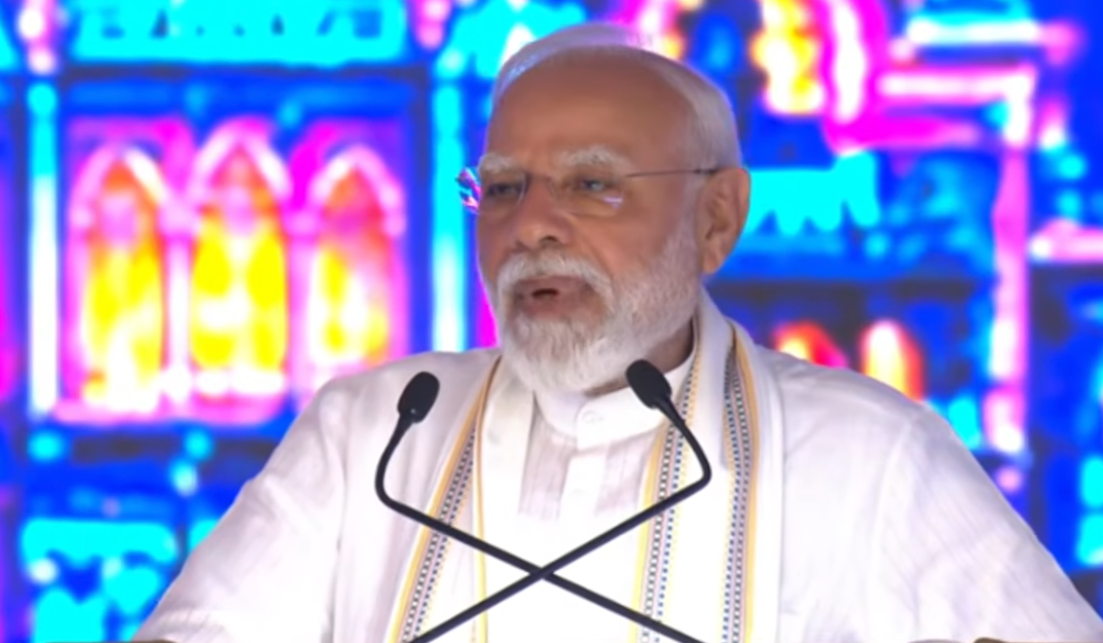
PM Modi Unveils ₹35000 Cr Projects in Vadodara: Major Infrastructure Push for Gujarat.
PM Modi Unveils ₹35000 Cr Projects in Vadodara as Prime Minister Narendra Modi inaugurated, dedicated and laid the foundation stones for a massive package of development projects worth more than ₹35,000 crore in Vadodara, Gujarat, on September 8, 2026.
The projects cover some of the most important areas of India’s infrastructure strategy, including railways, dedicated freight corridors, highways, renewable energy, urban infrastructure, housing and water supply. The programme also marked a major milestone for India’s logistics network with the completion of the 2,800 KM Dedicated Freight Corridor (DFC).
The Vadodara event is significant not only because of the size of the investment but also because of the several projects are designed to improve the movement of goods, strengthen industrial connectivity, reduce logistics bottlenecks and support economic growth.
According to the official government announcement, three major sections of the Western Dedicated Freight Corridor (WDFC) covering 326 route kilometers were dedicated to the nation. These sections were developed at a cost of more than ₹20,700 crore.
PM Modi Unveils ₹35000 Cr Projects in Vadodara: What Happened?
The Prime Minister’s September 8 visit to Vadodara brought together several major infrastructure announcements under one programme.
PM Modi inaugurated and dedicated completed projects while also laying foundation stones for new railway and highway projects. In addition, Gujarat government projects worth around ₹2,600 crore were included in the programme.
The event was held at the Maharaja Sayajirao University ground in Vadodara, where the Prime Minister addressed citizens and spoke about infrastructure, manufacturing, logistics, renewable energy and India’s ambition to become a developed nation by 2047.
The government’s broader objective is to create an infrastructure ecosystem that allows people and goods to move faster, connects production centres with markets and ports, and supports new industries.
Key Highlights at a Glance
| Project/Initiative | Key Detail |
|---|---|
| Total development projects | More than ₹35,000 crore |
| Dedicated Freight Corridor | 2,800 km completed |
| WDFC sections dedicated | 326 route km |
| WDFC investment | More than ₹20,700 crore |
| New railway projects | 3 projects, 329 km |
| Railway project investment | More than ₹9,700 crore |
| National Highway projects | 3 projects |
| Highway investment | Around ₹1,780 crore |
| Gujarat projects | Around ₹2,600 crore |
| Floating solar project | 110 MW at Kadana Dam |
These figures underline the scale of the infrastructure push announced in Vadodara.
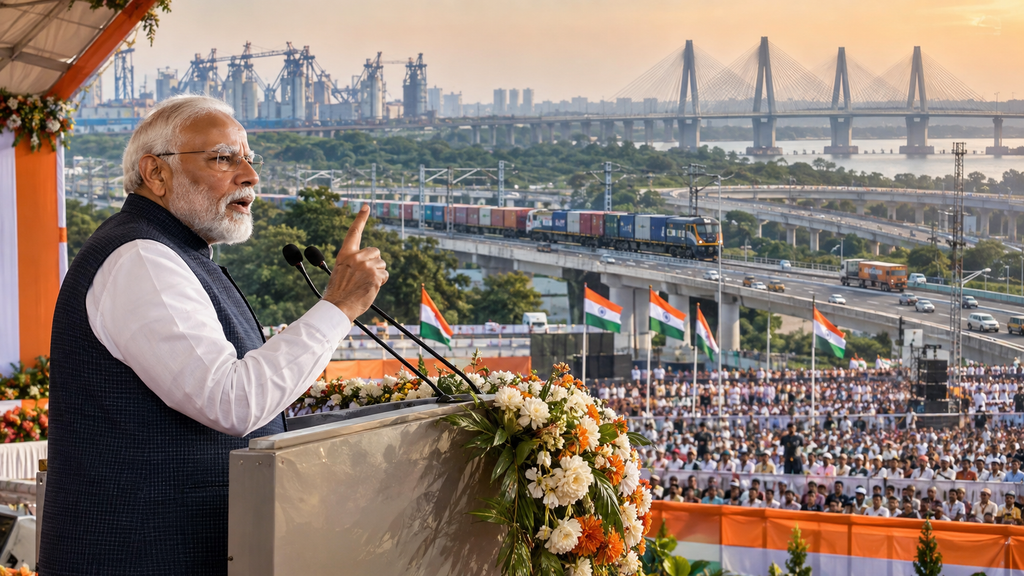
PM Modi unveils ₹35000 crore projects in Vadodara Gujarat
PM Modi Unveils ₹35000 Cr Projects in Vadodara With DFC Milestone
One of the biggest achievements associated with the Vadodara programme is the completion of India’s 2,800-kilometre Dedicated Freight Corridor network.
The Dedicated Freight Corridor is designed to separate freight traffic from passenger railway operations. This allows goods trains to move more efficiently without being constrained by the congestion that can occur on conventional mixed-use railway routes.
The Prime Minister described the Dedicated Freight Corridor as a critical infrastructure backbone for India’s rapidly expanding economy.
The three sections of the Western Dedicated Freight Corridor dedicated during the programme are:
- Sanand (North)–Makarpura
- New Umbergaon–New Saphale
- New Saphale–JNPT
Together, these sections cover approximately 326 route kilometres and were developed at a cost of more than ₹20,700 crore.
The completion of these sections means the country’s Dedicated Freight Corridor network is now fully operational across its planned length.
This is particularly important for Gujarat because the state has a strong manufacturing, petrochemical, engineering, automotive and export-oriented industrial base.
Why the Dedicated Freight Corridor Matters
The DFC is much more than a railway project.
It is an important component of India’s logistics transformation because freight corridors connect factories, agricultural production centres, industrial clusters, distribution hubs and ports.
The government says the separation of freight and passenger operations allows more than 430 cargo trains to operate daily. PM Modi also highlighted the reduction in journey times for freight movement.
According to the Prime Minister, a journey that could previously take around 30 hours by truck can be completed much faster through the dedicated freight network on relevant routes.
Faster freight movement can provide several advantages:
- Lower transportation time.
- Better utilisation of railway infrastructure.
- Reduced pressure on highways.
- Potentially lower logistics costs.
- Faster movement of export-import cargo.
- Better connectivity between ports and industrial centres.
- More efficient movement of agricultural products.
For businesses, time is often as important as transportation cost. A supply chain that moves faster can reduce inventory requirements, improve delivery schedules and increase the competitiveness of manufacturers.
Double-Stack Container Trains Add Another Advantage
Another important logistics development highlighted during the Vadodara event was the operation of a double-stack container freight train between JNPT and Vadodara.
PM Modi said one such train can transport cargo equivalent to more than 250 trucks.
This demonstrates the scale advantage that dedicated freight rail can provide.
Instead of moving large quantities of cargo through hundreds of individual trucks, rail can consolidate the same freight into fewer, high-capacity movements.
For India’s growing economy, this could be especially valuable as manufacturing and international trade volumes increase.
The direct connection to Jawaharlal Nehru Port Authority (JNPA) also strengthens the relationship between industrial centres and India’s maritime trade infrastructure.
PM Modi Unveils ₹35000 Cr Projects in Vadodara With New Railway Expansion
Railway infrastructure forms another major part of the Vadodara development package.
The Prime Minister laid the foundation stones for three railway projects spanning 329 kilometres, with a combined estimated cost of more than ₹9,700 crore.
The projects include:
- Vadodara–Ratlam third and fourth lines
- Miyagam Karjan–Choranda–Malsar gauge conversion
- Vishwamitri–Dabhoi doubling project
These projects are intended to increase railway capacity, reduce congestion and strengthen connectivity between Gujarat and Madhya Pradesh.
Additional railway connectivity is also being extended towards areas that historically had fewer rail links.
The government highlighted the importance of the Jobat–Tanda Road new rail line, developed as part of the Chhota Udepur–Dhar project.
The line will connect remote and tribal areas of Alirajpur with the national railway network. A new train service between Vadodara and Tanda Road will also benefit people in Vadodara, Chhota Udepur and Alirajpur districts.
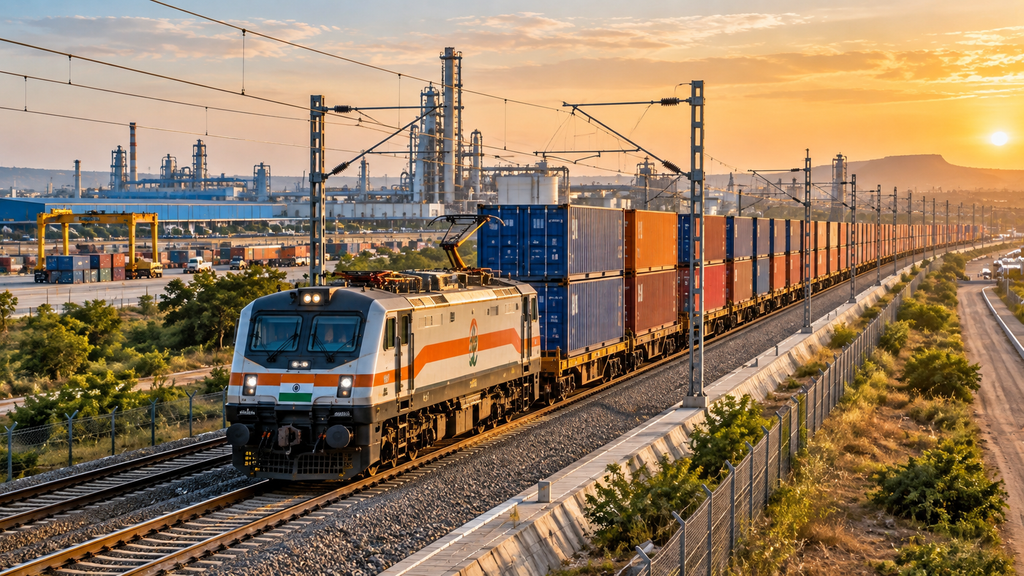
Dedicated Freight Corridor and railway projects launched in Vadodara
PM Modi Unveils ₹35000 Cr Projects in Vadodara: Highway Push
Road infrastructure is another major component of the development package.
The Prime Minister laid the foundation stone for three National Highway projects worth around ₹1,780 crore.
The projects include:
1. Kamrej–Chalthan Section of NH-48
The project involves six-laning of the Kamrej–Chalthan section of NH-48.
NH-48 is one of India’s most important north-south highway corridors and carries substantial passenger and commercial traffic.
Improving capacity on the corridor can support smoother movement between important economic centres in Gujarat and Maharashtra.
2. Vadodara–Surat NH-48 Improvements
Additional structures, including major bridges over the Tapi and Narmada rivers, are part of the planned infrastructure expansion.
Bridges and associated highway structures are particularly important on major freight routes because bottlenecks at river crossings can affect overall journey times.
3. NH-53 Junction Improvements
Grade-separated structures are planned at Abhava, Mindhola and Khajod junctions on NH-53.
Grade separation can reduce conflicts between crossing traffic streams and potentially improve both road safety and traffic flow.
New Six-Lane Flyovers in Gujarat
Two important flyovers were also inaugurated at:
- Kandari Chokdi
- Luvara Patia
Both are located on the Vadodara–Surat section of NH-48.
The government says the flyovers are intended to improve road safety and address identified traffic black spots.
For commuters and freight operators, such improvements can make an important difference because even relatively small bottlenecks can create substantial delays on heavily used corridors.
Gujarat Projects Worth Around ₹2,600 Crore
The Vadodara programme was not limited to national infrastructure.
The Prime Minister also laid foundation stones for and inaugurated various Government of Gujarat projects worth around ₹2,600 crore.
These projects target urban infrastructure, renewable energy, housing and basic services.
Among the important projects is Vadodara Urban Development Authority Ring Road Phase II.
The expansion of the ring road network can improve traffic distribution by providing alternative routes around the urban area.
For a growing city such as Vadodara, better peripheral connectivity can also support planned urban expansion.
110 MW Floating Solar Project at Kadana Dam
Renewable energy is another important element of the Vadodara development programme.
The Prime Minister laid the foundation stone for a 110 MW floating solar project at Kadana Dam.
Floating solar projects use water surfaces for solar photovoltaic installations rather than relying entirely on land.
This approach can be useful in regions where land availability is constrained or where water bodies provide suitable conditions for floating solar infrastructure.
The project also fits into Gujarat’s broader renewable-energy strategy.
During his address, PM Modi highlighted India’s expansion of solar manufacturing and renewable energy.
He also referred to the PM Surya Ghar Muft Bijli Yojana, under which around 55 lakh families across India, including approximately 11 lakh families in Gujarat, have benefited, according to the Prime Minister.
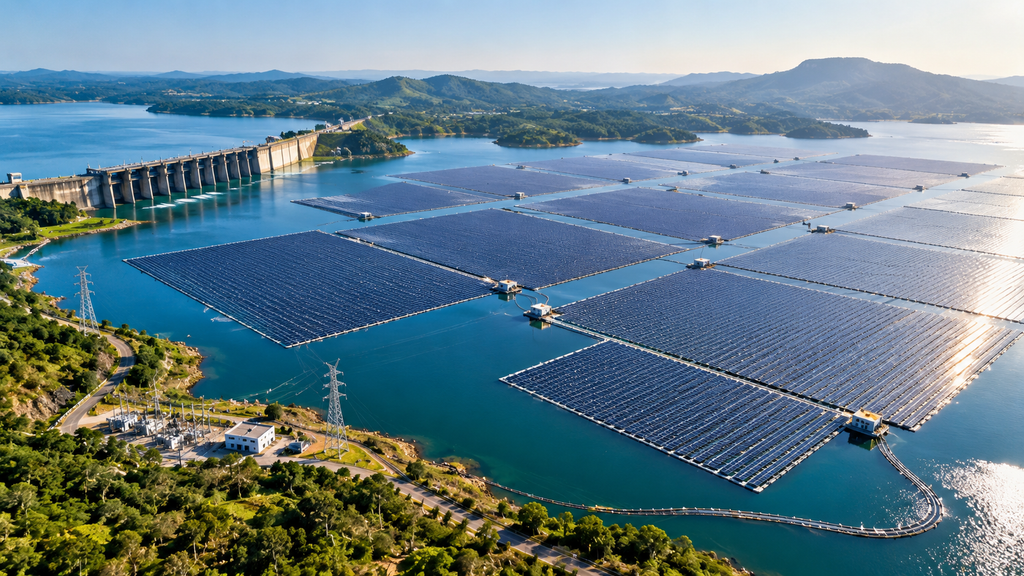
110 MW floating solar project at Kadana Dam Gujarat
Urban Development Gets a Major Boost
Vadodara’s urban infrastructure also received attention through the development package.
The government announced the construction of a new Vadodara Municipal Corporation office building, along with other urban-development initiatives.
Housing projects under the Pradhan Mantri Awas Yojana (PMAY) were also among the projects inaugurated.
Affordable housing is an important component of India’s urban-development strategy because population growth and migration increase demand for housing and public services.
The programme also included a water-supply project covering 11 villages in eastern Vadodara.
Water infrastructure can have a direct impact on households, agriculture and local economic activity.
Together, these projects show that the ₹35,000-crore-plus development package is not limited to large transport infrastructure. It also includes projects intended to affect everyday urban and rural life.
PM Modi Unveils ₹35000 Cr Projects in Vadodara and Highlights Manufacturing
Vadodara’s importance goes beyond its location on major transport corridors.
The city has developed into an important manufacturing and engineering centre with a long industrial history.
During his address, PM Modi highlighted Vadodara’s industrial evolution from textiles and petrochemicals to a broader MSME and manufacturing ecosystem.
The city has also become important for India’s aerospace and defence manufacturing ambitions.
One of the major developments is the production of India’s first domestically manufactured C-295 military transport aircraft in Vadodara. PM Modi referred to the first flight of the aircraft from the city as an important manufacturing milestone.
This development demonstrates how traditional industrial centres can become part of India’s emerging advanced-manufacturing ecosystem.
From Railways to Defence Manufacturing
The Prime Minister also highlighted India’s growing domestic manufacturing capabilities in railway equipment.
According to the government’s account of his speech, India has produced around 50,000 modern railway coaches and added nearly 2.5 lakh wagons to the railway network since 2014.
The larger message is that infrastructure investment and manufacturing capacity can reinforce each other.
New railway lines create demand for locomotives, coaches, signalling systems and engineering services.
Highway expansion creates demand for construction equipment, materials and engineering.
Renewable energy projects create demand for solar modules, electrical equipment, transmission systems and storage technologies.
Defence manufacturing creates another layer of demand for advanced engineering and aerospace components.
This interconnected model is central to India’s manufacturing ambitions.
Why PM Modi Unveils ₹35000 Cr Projects in Vadodara Matters for Gujarat
The scale of the investment is important, but the geographical positioning of the projects may be equally significant.
Gujarat is one of India’s major manufacturing and export-oriented states.
It has:
- Major ports
- Large industrial clusters
- Automotive manufacturing
- Petrochemical industries
- Engineering companies
- MSME clusters
- Renewable energy projects
- Major highways
- Extensive railway infrastructure
Improving connectivity between these economic assets can help reduce friction in supply chains.
The completed WDFC sections connecting toward JNPT are particularly relevant because ports are gateways for international trade.
Faster movement between factories and ports can potentially improve the competitiveness of Indian exporters.
Agriculture Could Also Benefit From Faster Logistics
Infrastructure development is not only about factories.
The Prime Minister highlighted the agricultural benefits of faster freight transportation.
Fresh produce such as vegetables, fruits and flowers is highly sensitive to transportation delays.
If farmers can move perishable products to larger markets more quickly, they may have greater opportunities to access demand beyond their immediate region.
A stronger freight network can therefore create links between rural production and urban consumption.
This is one reason logistics infrastructure is increasingly viewed as an important component of agricultural supply-chain reform.
Employment and Economic Growth
Large infrastructure projects can influence the economy through several channels.
During construction, projects create demand for:
- Engineers
- Construction workers
- Equipment operators
- Transport services
- Materials suppliers
- Project-management professionals
- Electrical and mechanical specialists
Once projects become operational, they can support additional employment through logistics, manufacturing, maintenance and commercial activity.
For example, better freight connectivity can make an industrial location more attractive to companies that depend heavily on transportation.
Similarly, better roads and railways can encourage businesses to establish warehouses, distribution centres and manufacturing facilities along major corridors.
PM Modi linked infrastructure spending with job creation and the emergence of new industries and businesses.
AI, Skills and the Future Workforce
The Vadodara programme also moved beyond physical infrastructure.
PM Modi spoke about India’s need to prepare young people for an economy increasingly influenced by artificial intelligence and emerging technologies.
He argued that AI should not be considered only an IT-sector technology.
AI can potentially influence:
- Agriculture
- Healthcare
- Manufacturing
- Robotics
- Logistics
- Education
- Financial services
- Startups
The Prime Minister called for India’s youth to become AI-ready and highlighted the importance of continuous skill development.
He also announced a government initiative for free coaching for competitive examinations, aimed at reducing the financial burden on poor and middle-class families.
This technology-and-skills agenda complements the infrastructure investments being made across the country.
Physical infrastructure moves goods and people, while digital skills and technology increasingly determine productivity.
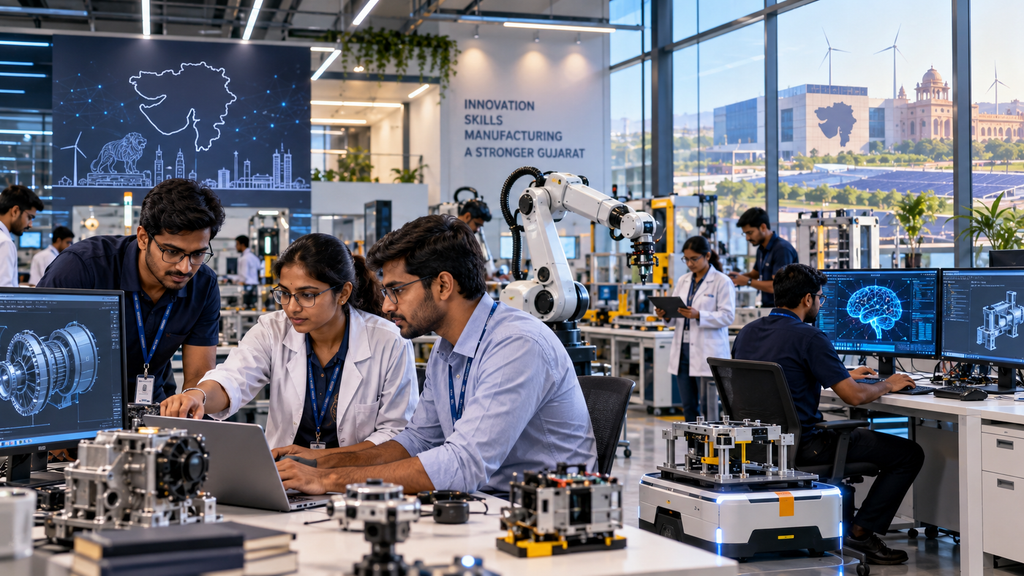
India AI skills and advanced manufacturing workforce
India’s “Chips to Ships” Manufacturing Vision
Another major theme from the Prime Minister’s Vadodara speech was India’s effort to build complete domestic value chains.
PM Modi used the phrase “from chips to ships” to describe the country’s broader manufacturing ambitions.
This reflects a strategy aimed at reducing dependence on imported components and strengthening domestic capabilities in critical sectors.
The government is focusing on areas such as:
- Semiconductors
- Solar manufacturing
- Defence production
- Critical minerals
- Rare earth elements
- Rail equipment
- Electric mobility
- Advanced manufacturing
- Artificial intelligence infrastructure
The availability of reliable electricity, transportation and industrial infrastructure is essential for these industries.
This is where the different elements of the Vadodara programme come together.
Railways support logistics.
Highways support road freight.
Ports support international trade.
Renewable energy supports electricity generation.
Manufacturing creates economic value.
Skills and AI support productivity.
What the ₹35,000 Crore Investment Could Mean for Vadodara
For Vadodara, the projects could strengthen the city’s position as a regional infrastructure and industrial hub.
Improved roads can reduce congestion.
Expanded railway capacity can increase passenger and freight movement.
The ring road can improve urban mobility.
Housing projects can support residents.
Water projects can strengthen basic infrastructure.
Renewable energy can contribute to Gujarat’s clean-energy ambitions.
Meanwhile, stronger connections to the national freight network can potentially make the city more attractive for logistics and manufacturing investments.
The combination of projects is therefore more significant than any single announcement.
PM Modi Unveils ₹35000 Cr Projects in Vadodara: Key Takeaways
The September 8 programme can be summarised through several major developments.
1. ₹35,000 Crore-Plus Investment
The total value of development projects inaugurated, dedicated or initiated in Vadodara exceeds ₹35,000 crore.
2. 2,800-Km Freight Corridor Completed
The completion of the Dedicated Freight Corridor is one of India’s major railway and logistics milestones.
3. ₹20,700 Crore WDFC Sections
Three Western Dedicated Freight Corridor sections covering 326 route kilometres were dedicated to the nation.
4. ₹9,700 Crore Railway Expansion
Three railway projects covering 329 kilometres received foundation stones.
5. ₹1,780 Crore Highway Projects
Three National Highway projects are expected to strengthen road connectivity.
6. ₹2,600 Crore Gujarat Projects
State-level projects cover urban development, renewable energy, housing and water infrastructure.
7. 110 MW Floating Solar
The Kadana Dam floating solar project adds another major renewable-energy initiative.
8. Tribal Connectivity
The Jobat–Tanda Road railway line is expected to connect remote and tribal areas to the national railway network.
9. Manufacturing Expansion
Vadodara’s role in aerospace, defence, railways and industrial manufacturing was highlighted.
10. AI and Skills
The Prime Minister emphasised the need to prepare India’s youth for AI and future technologies.
What Happens Next?
The real impact of the Vadodara programme will depend on the execution and commissioning of the projects whose foundation stones were laid.
For projects already inaugurated, the focus shifts to utilisation and operational efficiency.
For new railway and highway projects, timely construction will be important.
The same applies to the floating solar project and urban infrastructure initiatives.
Infrastructure investments generate the greatest economic benefits when projects are completed on schedule, integrated with existing networks and supported by efficient maintenance.
For Gujarat, the combination of freight rail, highways, ports and manufacturing infrastructure provides a strong foundation for continued industrial growth.
Conclusion: PM Modi Unveils ₹35000 Cr Projects in Vadodara
PM Modi Unveils ₹35000 Cr Projects in Vadodara marks a major infrastructure push for Gujarat and another important milestone in India’s logistics transformation.
The most significant development is the completion of the 2,800-kilometre Dedicated Freight Corridor, which strengthens the connection between industrial centres, markets and ports.
At the state level, new railway lines, highway upgrades, flyovers, the Vadodara ring road, housing, water infrastructure and the 110 MW Kadana floating solar project expand the impact beyond freight transportation.
The broader significance lies in how these investments connect infrastructure with manufacturing, renewable energy, employment and technology.
Vadodara’s growing role in aerospace and defence manufacturing adds another dimension to the city’s economic importance.
At the same time, PM Modi’s emphasis on AI skills and future-oriented education shows that India’s development strategy is increasingly combining physical infrastructure with digital and human capital.
The government has positioned these projects as part of the larger Viksit Bharat 2047 vision. Whether that vision translates into sustained economic benefits will ultimately depend on project execution, industrial investment, job creation and efficient use of the infrastructure being built.
For Gujarat, however, the Vadodara programme represents a substantial step toward strengthening connectivity, logistics and industrial capacity.
FAQ: PM Modi Unveils ₹35000 Cr Projects in Vadodara
1. What projects did PM Modi unveil in Vadodara?
PM Narendra Modi inaugurated, dedicated and laid foundation stones for development projects worth more than ₹35,000 crore in Vadodara. The projects cover railways, highways, freight infrastructure, renewable energy, housing, water supply and urban development.
2. What is the biggest project highlighted in Vadodara?
One of the biggest milestones is the completion of the 2,800-kilometre Dedicated Freight Corridor. Three remaining Western Dedicated Freight Corridor sections covering 326 route kilometres were dedicated to the nation.
3. How much do the Western Dedicated Freight Corridor sections cost?
The three WDFC sections dedicated during the programme cover 326 route kilometres and were developed at a cost of more than ₹20,700 crore.
4. Which railway projects received foundation stones?
The three railway projects include the Vadodara–Ratlam third and fourth lines, Miyagam Karjan–Choranda–Malsar gauge conversion and Vishwamitri–Dabhoi doubling project. Together, they span 329 kilometres and cost more than ₹9,700 crore.
5. What is the Kadana solar project?
The Kadana project is a 110 MW floating solar project at Kadana Dam in Gujarat. It is designed to expand renewable electricity generation using floating solar infrastructure.
6. How will the Dedicated Freight Corridor help India?
The DFC is designed to improve freight movement by separating cargo traffic from passenger railway operations. It can increase freight capacity, reduce transit times and strengthen connections between industrial centres and ports.
7. Which highway projects were announced?
The package includes six-laning of the Kamrej–Chalthan section of NH-48, additional structures including major bridges over the Tapi and Narmada on the Vadodara–Surat section of NH-48, and grade-separated structures on NH-53.
8. How much are the Gujarat government projects worth?
Various Gujarat government projects included in the programme are worth around ₹2,600 crore, covering areas such as urban infrastructure, renewable energy, housing and water supply.
9. Why is Vadodara important to India’s manufacturing sector?
Vadodara has a long industrial history and has developed into an important manufacturing and MSME centre. It is also becoming significant for aerospace and defence manufacturing, including domestic production of the C-295 military transport aircraft.
10. What did PM Modi say about AI?
PM Modi stressed that India’s youth need to become AI-ready and develop skills suited to an economy increasingly influenced by artificial intelligence, robotics and advanced technologies.