
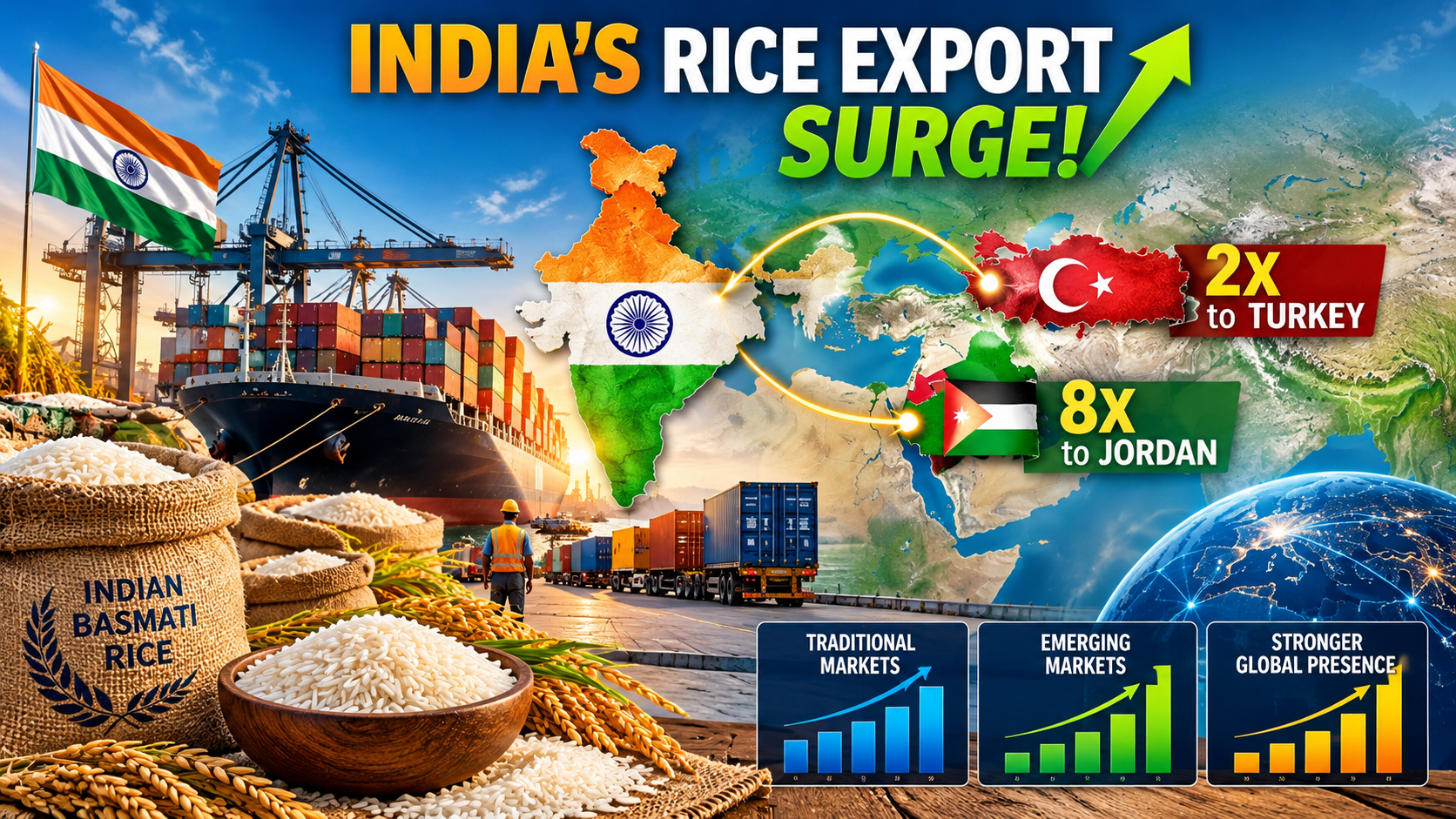
India’s Rice Export Boom: Jordan 8x, Turkey Doubles
India’s Rice Export Boom: Jordan 8x, Turkey Doubles has emerged as one of the clearest signals that Indian rice exporters are moving beyond traditional high-volume markets and exploring new destinations with strong commercial potential.
Shipments of Indian rice to Jordan have increased nearly eight-fold, while Indian basmati rice exports to Turkey have doubled, according to information released ahead of the Bharat International Rice Conference 2026. The development highlights a broader shift in India’s agricultural export strategy, with exporters increasingly examining demand growth, import dependence, pricing, freight costs, duties and payment risks rather than simply targeting the world’s largest rice-importing countries.
The change is particularly important because it comes at a time when geopolitical disruptions are affecting traditional trade routes in the Middle East. Direct trade with Iran has faced pressure from sanctions, shipping difficulties, insurance costs and payment-related challenges. In response, Indian exporters have increasingly explored alternative routes and reginal trading hubs.
Jordan and Turkey are therefore becoming important examples of how India’s rice trade can adapt when established corridors are disrupted.
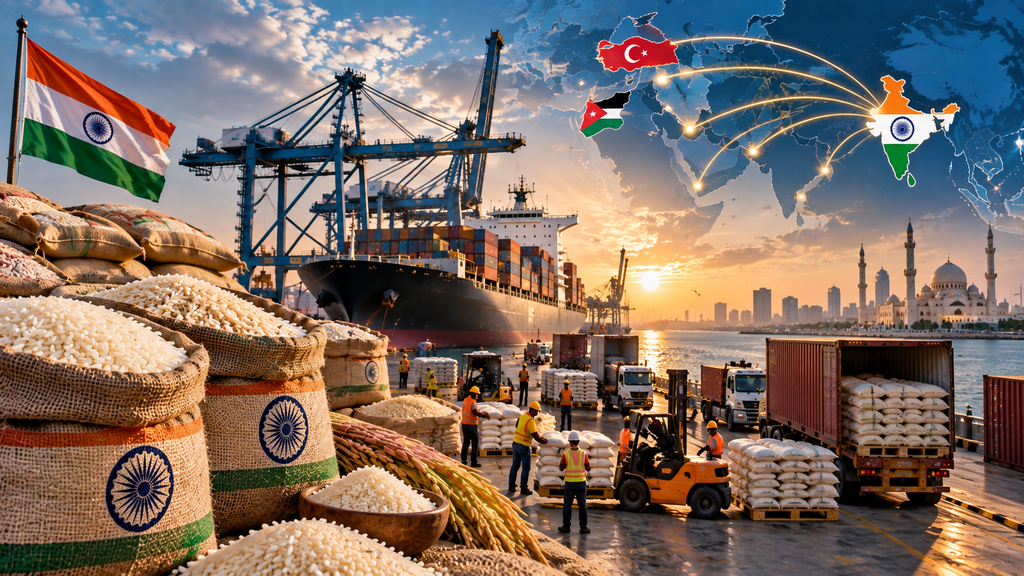
Why India’s Rice Export Boom Is Gaining Momentum
The phrase India’s Rice Export Boom: Jordan 8x, Turkey Doubles captures more than two individual market statistics. It represents a wider transformation in the country’s export strategy.
India is already one of the world’s largest rice exporters, supplying more than 170 countries. But exporters have traditionally concentrated on established destinations where Indian rice has strong market recognition.
That strategy is now evolving.
According to the Indian Rice Exporters Federation, exporters are increasingly looking at markets based on their growth potential rather than simply their current size.
This means a country with relatively modest rice imports today could become more attractive if its demand is rising rapidly, its import dependence is high or it can provide better price realisation.
Dev Garg, vice-president of the Indian Rice Exporters Federation, said the conventional approach of automatically targeting the largest import markets needs to be reconsidered. Turkey and Jordan, he noted, are examples of markets that few exporters would have identified as standout opportunities at the beginning of the year.
This approach could become increasingly important as competition among major rice-exporting countries intensifies.
India’s Rice Export Boom: Jordan 8x, Turkey Doubles Explained
The most eye-catching development is Jordan.
Indian rice shipments to Jordan have risen by approximately 800%, or nearly eight times, according to industry representatives.
However, the increase should not be interpreted simply as an eight-fold increase in Jordanian household rice consumption.
A significant part of the growth reflects changes in regional trade routes.
Disruptions affecting direct shipments to Iran have encouraged exporters and traders to explore alternative destinations and corridors. Jordan has consequently become more important as a potential regional distribution point.
That distinction matters.
An increase in exports to Jordan can reflect both:
- Domestic Jordanian demand
- Regional redistribution and re-routing of Indian rice
The second factor appears particularly important in the current situation.
Jordan’s Strategic Importance for Indian Rice
Jordan is not among the world’s biggest rice markets, which is exactly why its recent growth has attracted attention.
The country demonstrates how a smaller market can suddenly become commercially significant when supply chains change.
India’s rice exporters are increasingly assessing markets through several parameters:
- Import dependence
- Demand growth
- Price realisation
- Freight costs
- Import duties
- Competition
- Payment risks
- Regional distribution potential
- Political and logistical stability
Jordan scores differently across these variables compared with traditional destinations.
Its importance is therefore not necessarily based on domestic consumption alone. Its location and trading relationships can also influence its role in the regional supply chain.
This is one reason the India’s Rice Export Boom: Jordan 8x, Turkey Doubles story is attracting attention across India’s agricultural export sector.
Turkey Basmati Exports Double
The second major development is Turkey.
Indian basmati rice exports to Turkey have doubled, according to the Indian Rice Exporters Federation and reports surrounding the Bharat International Rice Conference 2026.
Turkey presents a different opportunity from Jordan.
While Jordan’s growth has been closely associated with changing regional trade routes, Turkey offers Indian exporters an opportunity to develop demand for premium basmati rice in a market with a diverse food culture and established international trading connections.
Basmati rice occupies a premium position in India’s rice export portfolio.
It is differentiated from ordinary commodity rice through characteristics such as:
- Long grains
- Aroma
- Texture
- Cooking characteristics
- Grain elongation
- Culinary suitability
- Premium positioning
The doubling of exports to Turkey therefore matters not only in terms of volume but also because it demonstrates the potential for Indian premium rice varieties to gain traction in less traditional markets.
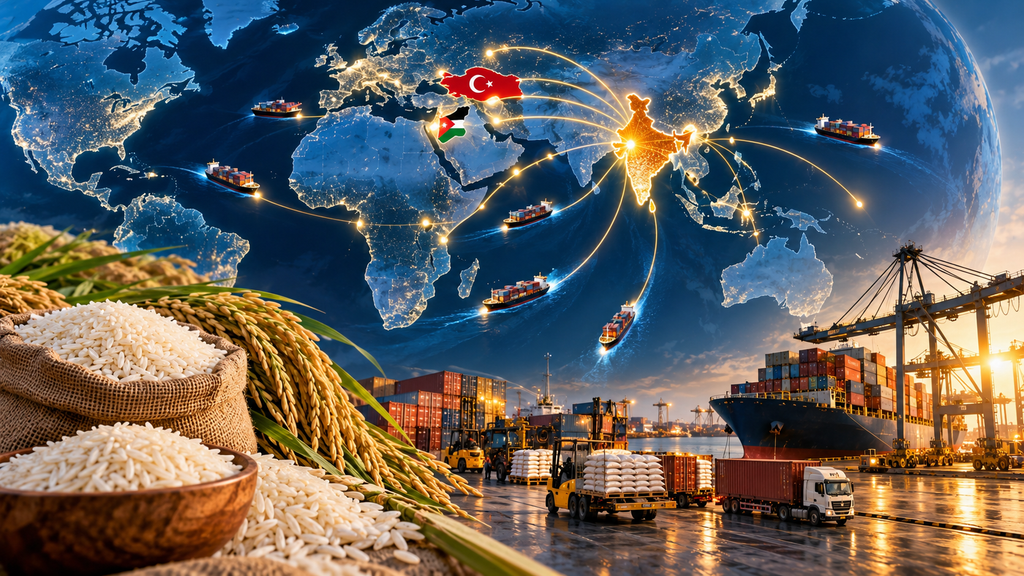
India’s Rice Export Boom: Jordan 8x, Turkey Doubles Amid Iran Disruption
The developments in Jordan and Turkey cannot be separated from the disruption affecting India’s rice trade with Iran.
Iran is a major destination for Indian rice, particularly basmati.
Indian exporters have continued to regard Iran as an important market despite sanctions and geopolitical tensions. Government and industry data cited by the Indian Rice Exporters Federation indicate that Iran purchased more than 1 million tonnes of Indian rice during the previous financial year, an increase of approximately 17% from a year earlier.
However, direct shipments during April-June 2026 declined sharply.
Industry estimates indicated that Indian rice shipments to Iran during the period fell by around 64% year-on-year, representing a reduction of approximately 185,000 tonnes. Export value also declined by nearly ₹1,049 crore.
Yet the broader Middle Eastern market proved considerably more resilient.
Exports to the wider Middle East increased by about 3%, according to industry estimates.
That divergence is crucial.
It suggests that the reduction in direct Iranian shipments did not translate into an equivalent collapse in India’s overall regional rice trade.
Instead, exporters began adapting.
How Alternative Routes Are Changing India’s Rice Trade
International agricultural trade is rarely determined by consumption alone.
Logistics can be equally important.
A rice shipment involves:
- Production
- Milling
- Packaging
- Inland transportation
- Port handling
- Shipping
- Insurance
- Banking
- Customs
- Import distribution
If any part of that chain becomes difficult, exporters must find alternatives.
This is what appears to be happening in the Middle East.
Shipping and insurance difficulties have complicated direct trade with Iran. Payment mechanisms have also become more challenging because of sanctions and restrictions.
As a result, alternative destinations and routes have gained importance.
Jordan’s eight-fold increase and Turkey’s doubling of basmati exports therefore illustrate how trade can be redirected when established corridors face disruption.
India’s Rice Export Boom Is Bigger Than Jordan and Turkey
Although Jordan and Turkey provide the most dramatic examples, India’s rice export diversification is much broader.
India currently exports rice to more than 170 countries.
The country has been actively looking for new destinations and attempting to match particular rice varieties with local culinary requirements.
Between November 2025 and March 2026, exports to 26 priority markets reached approximately ₹23,476 crore, representing around 4.79 million tonnes.
According to an IREF analysis of government trade data, that volume was 5.6% above the corresponding three-year average.
The performance indicates that diversification is already producing results across several markets.
The UAE, for example, recorded substantial increases during the period, while Belgium, Germany, France, the United Kingdom, South Africa, Kenya, Mexico, the Netherlands and Canada also recorded notable gains.
This suggests that the current rice export story is not dependent on one or two countries.
Instead, India is developing a broader network of international demand.
India’s Rice Export Boom and the Rise of Non-Basmati Rice
Another important component of India’s export performance is non-basmati rice.
India’s rice exports increased by approximately 5% during the first half of 2026, with stronger non-basmati shipments helping offset weakness in some basmati markets. Higher demand from African countries played an important role in the increase.
This creates two parallel opportunities.
Premium Basmati
Basmati provides India with a premium export segment where aroma, grain length and culinary characteristics can support higher prices.
Non-Basmati Rice
Non-basmati rice provides access to large-volume markets, particularly in Africa and other price-sensitive regions.
The combination gives India a diversified export portfolio.
Rather than depending exclusively on premium basmati or low-cost commodity rice, Indian exporters can serve multiple segments simultaneously.
Africa Could Become India’s Next Major Rice Export Opportunity
While Jordan and Turkey are currently attracting attention, Africa may represent an even larger long-term opportunity.
The OECD-FAO Agricultural Outlook 2026-2035 projects global rice trade to increase by approximately 22 million tonnes, reaching around 81 million tonnes by 2035.
More importantly, Africa’s share of global rice imports is expected to increase.
The region currently accounts for roughly 35% of global rice imports, but that share could approach 45% by 2035.
For India, this could create a major opportunity.
African countries already purchase significant quantities of Indian non-basmati rice. Population growth, urbanisation, food demand and changing consumption patterns could support further import growth.
The opportunity is particularly important because India has the production capacity and export infrastructure needed to serve large-volume markets.
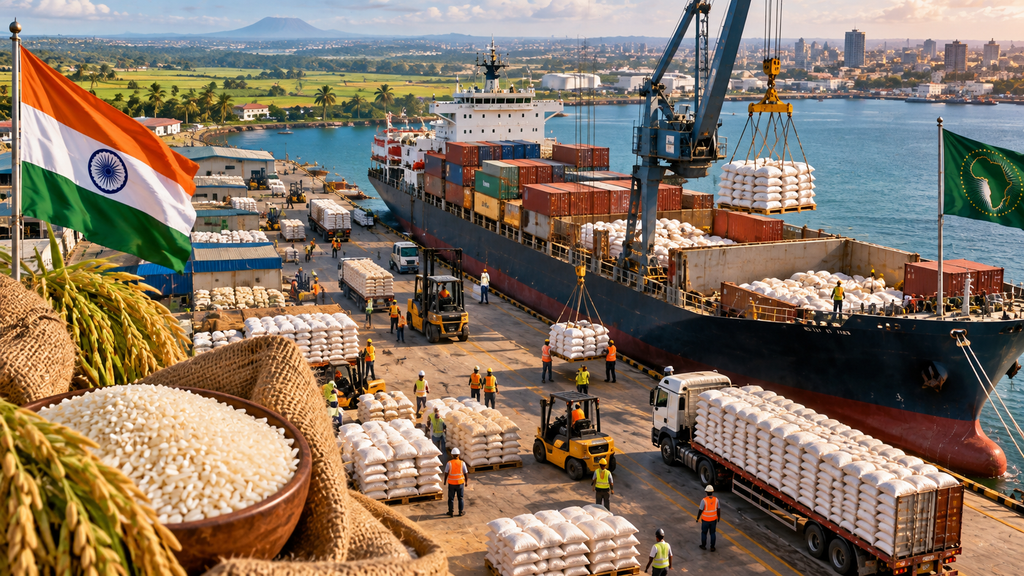
Why Indian Rice Is Competitive Globally
India’s competitive advantage comes from a combination of scale, variety and established export infrastructure.
The country produces both premium basmati and large quantities of non-basmati rice.
Its exporters also have experience serving diverse markets with different requirements.
Several factors support India’s position:
1. Large Production Base
India has one of the world’s largest rice production ecosystems, providing exporters with substantial supply availability.
2. Variety
Indian exporters can offer numerous varieties suited to different cuisines and price points.
3. Competitive Pricing
India has historically been competitive against other major exporters, particularly in non-basmati rice.
4. Established Export Network
Indian rice already reaches more than 170 countries.
5. Strong Basmati Brand
Indian basmati has established recognition across the Middle East, Europe, North America and other regions.
These advantages make market diversification easier than it would be for an exporter starting from scratch.
India’s Rice Export Boom: Jordan 8x, Turkey Doubles and the New Market Strategy
The most important lesson from the latest developments is that market size alone is not enough.
A country may import millions of tonnes of rice but still provide limited opportunities for a particular exporter because of:
- Intense competition
- Low prices
- High freight costs
- Import restrictions
- Payment risks
- Strong local suppliers
Conversely, a smaller market can become highly attractive if demand is accelerating.
Jordan and Turkey illustrate this principle.
The Indian Rice Exporters Federation is encouraging exporters to evaluate potential destinations based on multiple commercial indicators rather than simply ranking markets by total import volume.
That represents a potentially important shift from a volume-first strategy to a value-and-growth strategy.
From Commodity Exports to Cuisine-Led Marketing
Another emerging strategy is to market Indian rice according to the requirements of individual cuisines.
This is particularly relevant for basmati.
Different cuisines may require different characteristics:
- Grain length
- Aroma
- Texture
- Starch content
- Water absorption
- Cooking time
- Grain separation
India can therefore market specific rice varieties according to how they perform in particular dishes.
The Bharat International Rice Conference 2026 is expected to continue this approach by bringing exporters, importers, chefs, food creators and other stakeholders together.
The strategy aims to move beyond simply telling international buyers that India produces large quantities of rice.
Instead, it seeks to demonstrate why a particular Indian variety is suitable for a particular cuisine.
What the Jordan and Turkey Surge Means for Indian Farmers
The export boom could eventually have implications beyond exporters and traders.
If international demand remains strong, greater export opportunities can support the wider rice value chain.
Potential beneficiaries include:
- Farmers
- Rice millers
- Packaging companies
- Logistics providers
- Warehouses
- Export houses
- Port operators
- Food processors
However, stronger export demand does not automatically guarantee higher farm incomes.
Farmers’ earnings depend on procurement prices, input costs, yields, domestic demand and government policies.
The key challenge is ensuring that export growth translates into sustainable value creation throughout the agricultural supply chain.
Risks That Could Slow India’s Rice Export Boom
Despite the positive outlook, India’s rice exporters face several risks.
Geopolitical Risk
The Middle East remains highly sensitive to geopolitical developments.
A new conflict or shipping disruption could rapidly change trade routes.
Freight Costs
Longer or alternative routes can increase transportation costs.
Insurance
Higher geopolitical risk can increase marine insurance premiums.
Currency Volatility
Movements in the Indian rupee and major trading currencies can influence exporter margins.
Import Policies
Countries can introduce tariffs, quotas or phytosanitary requirements.
Competition
Thailand, Vietnam, Pakistan and other exporters continue to compete aggressively in global rice markets.
Payment Risk
Sanctions and financial restrictions can complicate international transactions.
These factors mean that India’s rice export diversification must be managed carefully.
India’s Rice Export Boom Could Reshape Global Competition
India’s growing presence in new markets could have implications for competing exporters.
When Indian rice becomes available at competitive prices, buyers gain another supply option.
That can put pressure on exporters from Thailand, Vietnam, Pakistan and other major rice-producing countries.
India’s strong export performance in 2025 demonstrated the scale of this competitive advantage.
Indian rice exports reached approximately 21.55 million tonnes in 2025, up 19.4% from 2024, according to data reported by Reuters. Non-basmati exports increased 25%, while basmati exports reached a record 6.4 million tonnes.
The scale of India’s supply means that changes in Indian export policy and availability can influence international rice prices.
What Happens Next?
The next phase of India’s rice export strategy will likely focus on three priorities.
Market Diversification
Exporters will continue identifying countries with rising demand and limited domestic production.
Product Differentiation
Indian companies can increasingly position different rice varieties according to cuisine, quality and consumer preferences.
Supply-Chain Resilience
The experience of the Iran trade disruption demonstrates the importance of having alternative logistics and payment channels.
These three factors could determine whether the current increase in exports becomes a temporary response to geopolitical disruption or a permanent expansion of India’s global rice footprint.
India’s Rice Export Boom: Jordan 8x, Turkey Doubles — What It Means for the Future
The story of India’s Rice Export Boom: Jordan 8x, Turkey Doubles ultimately reflects a broader transformation in global agricultural trade.
Jordan’s nearly eight-fold increase demonstrates how quickly a relatively smaller market can become important when regional trade routes change.
Turkey’s doubling of basmati exports demonstrates the potential for Indian premium rice to gain traction in markets outside the traditional Middle Eastern buyer base.
Meanwhile, India’s wider export strategy is expanding toward Africa, Europe, North America and other emerging markets.
Global rice trade is also expected to expand substantially over the coming decade, creating room for additional suppliers and destinations. The projected increase to approximately 81 million tonnes by 2035 could provide India with a significant opportunity if it can maintain competitive pricing, reliable supply and efficient logistics.
The biggest opportunity may therefore not simply be selling more rice.
It may be selling the right Indian rice to the right market at the right price.
Frequently Asked Questions
1. What is driving India’s rice export boom?
India’s rice export growth is being supported by strong production, competitive pricing, growing demand in Africa and other emerging markets, and diversification away from traditional destinations.
2. Why have Indian rice shipments to Jordan increased 8x?
Shipments to Jordan have risen nearly eight-fold amid changing regional trade routes. Industry representatives say part of the increase reflects redistribution and alternative routing linked to disruption in direct trade with Iran.
3. Why have India’s basmati exports to Turkey doubled?
Indian basmati exports to Turkey have doubled as exporters identify Turkey as an increasingly attractive market. The growth is part of a broader effort to find new destinations beyond traditional high-volume markets.
4. Is Jordan consuming all the additional rice it imports from India?
Not necessarily. Industry representatives have indicated that part of the increase reflects changes in regional trade routes and redistribution rather than an equivalent increase in Jordan’s domestic consumption.
5. How important is Iran to India’s rice exports?
Iran remains an important destination, particularly for Indian basmati rice. Industry representatives have described Iran as the second-largest market for Indian basmati rice and said the country imports roughly 1 million tonnes annually.
6. Did India’s rice exports to Iran decline in 2026?
Yes. Industry estimates cited by the Indian Rice Exporters Federation indicated that direct rice shipments to Iran fell approximately 64% year-on-year during April-June 2026.
7. Which region could provide India’s biggest future rice opportunity?
Africa could become one of India’s most important long-term opportunities. The OECD-FAO projects Africa’s share of global rice imports to rise from around 35% currently to approximately 45% by 2035.
8. How much rice does India export globally?
India exported approximately 21.55 million tonnes of rice in 2025, according to figures reported by Reuters. That represented a 19.4% increase from 2024.
9. Is basmati or non-basmati rice driving India’s export growth?
Both segments are important, but recent 2026 growth has been supported strongly by non-basmati shipments, particularly demand from African markets. Basmati remains strategically important because of its premium value.
10. What is the biggest challenge for India’s rice exporters?
Geopolitical uncertainty, freight costs, insurance, payment restrictions, import policies and competition from other major exporters remain key risks.
Conclusion
India’s Rice Export Boom: Jordan 8x, Turkey Doubles is becoming a powerful example of how India’s agricultural trade is adapting to a rapidly changing global environment.
The nearly eight-fold rise in shipments to Jordan and doubling of basmati exports to Turkey show that new markets can emerge quickly when exporters combine commercial opportunity with flexible supply-chain strategies.
At the same time, India’s broader rice export performance demonstrates that diversification is already underway. The country is strengthening its presence across Africa, Europe, the Middle East and other international markets.
The next challenge will be converting short-term trade rerouting into long-term demand.
If India can combine competitive pricing, dependable supply, efficient logistics and stronger product marketing, its rice exporters could capture a much larger share of the projected expansion in global rice trade.
For farmers, exporters and the wider agricultural economy, the message is clear: India’s rice export future may depend less on selling to the biggest markets and more on identifying the fastest-growing opportunities before they become mainstream.
I switched over from my old site and the difference is night and day. Everything loads instantly and I never had to wait forever for my bonus to hit. Such a refreshing experience and I can already tell this is going to be my go to for a long while. m280con