
US Sanctions on Russia: 5 Key Oil-Uranium Double Standards.
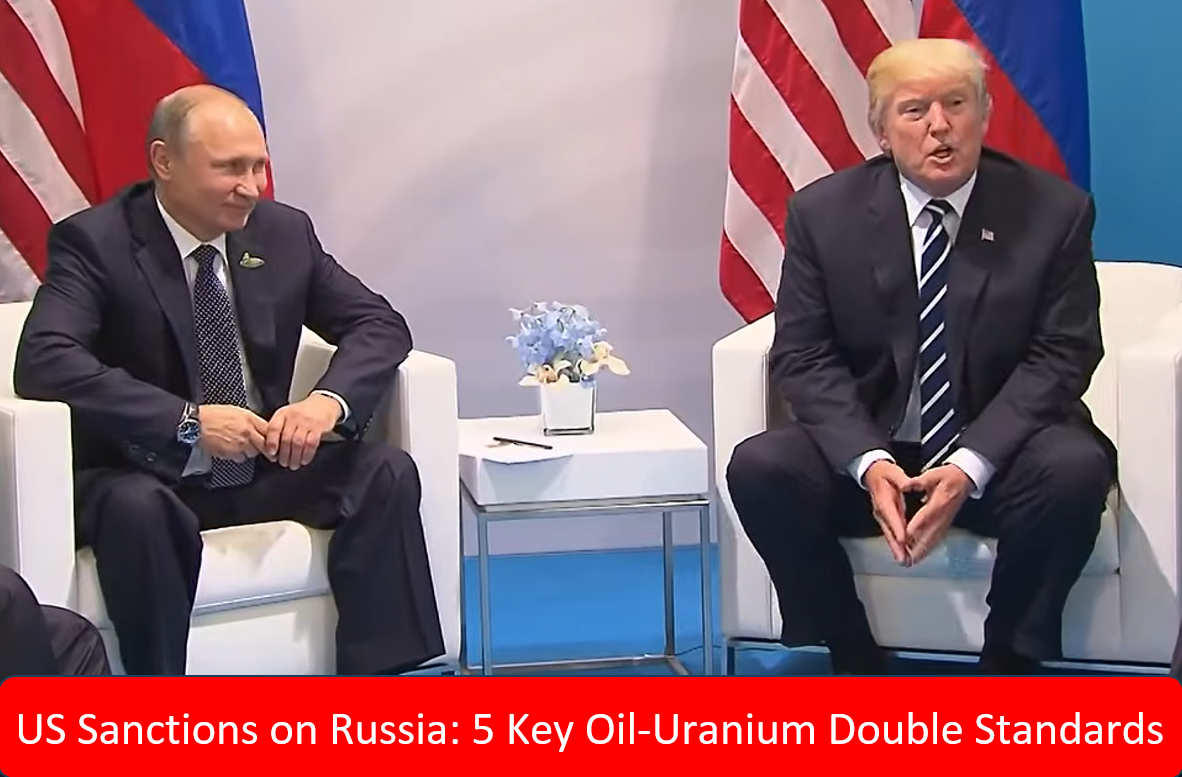
US Sanctions on Russia: 5 Key Oil-Uranium Double Standards has become a significant topic in the global energy debate after Washington expanded its ability to pressure countries purchasing Russian oil and gas while maintaining narrowly defined legal mechanisms for Russian nuclear-fuel imports.
The issue became particularly prominent in September 2026 after U.S. President Donald Trump signed the Lindsey O. Graham Sanctioning Russia and Iran Act of 2026. The law gives the administration additional authority to impose tariffs of up to 100% on goods from major purchasers of Russian crude oil or natural gas, subject to the law’s criteria and presidential implementation.
At the same time, the U.S. nuclear sector has not completely eliminated its exposure to Russian uranium and enrichment services.
That apparent contradiction is the foundation of the debate around US Sanctions on Russia: 5 Key Oil-Uranium Double Standards.
However, the legal picture is more complicated than simply saying Washington has “banned Russian energy for everyone except itself.” The United States enacted the Prohibiting Russian Uranium Imports Act in 2024. The law prohibits certain Russian Uranium imports but allows the Energy Secretary to grant temporary waivers when alternative supplies are unavailable or when an import is considered to be in the national interest. Those waivers cannot continue beyond January 1, 2028.
The result is a policy landscape in which oil and uranium are treated differently because they occupy very different positions in global energy supply chains.

US Sanctions on Russia: 5 Key Oil-Uranium Double Standards Explained
The phrase US Sanctions on Russia: 5 Key Oil-Uranium Double Standards refers to five major differences that have emerged between Washington’s approach to Russian oil and its approach to Russian nuclear fuel.
These differences are:
- Oil buyers can face additional tariffs, while Russian uranium has limited waiver pathways.
- Oil has a much broader global supply base than nuclear enrichment.
- The U.S. is a major consumer of imported nuclear-fuel services.
- Washington is simultaneously restricting Russian uranium and building replacement capacity.
- Energy-security considerations influence how sanctions are applied.
Understanding these points is essential because the debate is not simply about whether the United States is “against” Russian energy. It is about how sanctions interact with supply security, domestic industries, national interests and the availability of alternative suppliers.
1. US Sanctions on Russia Target Major Russian Oil Buyers
The first major difference concerns crude oil.
The 2026 Russia sanctions legislation gives the U.S. president authority to impose tariffs of up to 100% on goods from the five largest purchasers of Russian-origin crude oil or natural gas, as well as certain countries identified as facilitating Russian oil sanctions evasion.
The legislation is therefore not simply a ban on Russian oil entering the United States. It creates a mechanism for applying economic pressure to third countries that continue significant purchases of Russian energy.
This distinction matters for countries such as India and China.
S&P Global reported that India was the largest importer of Russian crude among the countries it tracked in August 2026, at approximately 1.6 million barrels per day, while China was second at around 1.1 million barrels per day.
The policy objective is connected to Washington’s broader effort to reduce Russian energy revenues.
From the U.S. perspective, restricting the economic benefits associated with Russian oil purchases is intended to increase pressure on Moscow.
For oil-importing countries, however, the calculation can be different.
They may consider Russian crude in terms of price, refinery compatibility, transportation costs, supply availability and overall energy security.
This creates a fundamental tension in the international sanctions system.
Why this matters
Oil is one of the world’s most internationally traded commodities. A buyer can potentially replace Russian barrels with crude from the Middle East, the Americas, Africa or other producing regions.
That does not mean replacement is always cheap or immediate. But the existence of multiple large producers provides governments with more options.
This becomes important when comparing oil with uranium.
2. US Sanctions on Russia Treat Uranium Differently
The second difference is the most important part of the US Sanctions on Russia: 5 Key Oil-Uranium Double Standards debate.
In May 2024, the United States enacted the Prohibiting Russian Uranium Imports Act.
The legislation prohibits imports into the United States of certain Russian uranium products, including natural uranium and unirradiated low-enriched uranium (LEU), subject to statutory provisions and waivers. The prohibition became effective in August 2024.
Therefore, it would be inaccurate to say that the United States simply permits unlimited Russian uranium imports.
It does not.
The critical issue is the waiver system.
Under the law, the U.S. Energy Secretary can authorize certain imports when:
- no viable alternative source is available to sustain a nuclear reactor or U.S. nuclear company; or
- the import is considered to be in the national interest.
The waiver authority is temporary and must end no later than January 1, 2028. Congress must also be notified of waivers.
This creates a significant distinction from the political pressure being placed on major Russian oil buyers.
The U.S. nuclear industry can therefore retain access to certain Russian nuclear-fuel supplies under defined circumstances even as Washington seeks to reduce Russia’s energy revenues.
That is the central reason critics use the phrase “double standard.”
3. Why Uranium Is Harder to Replace Than Oil
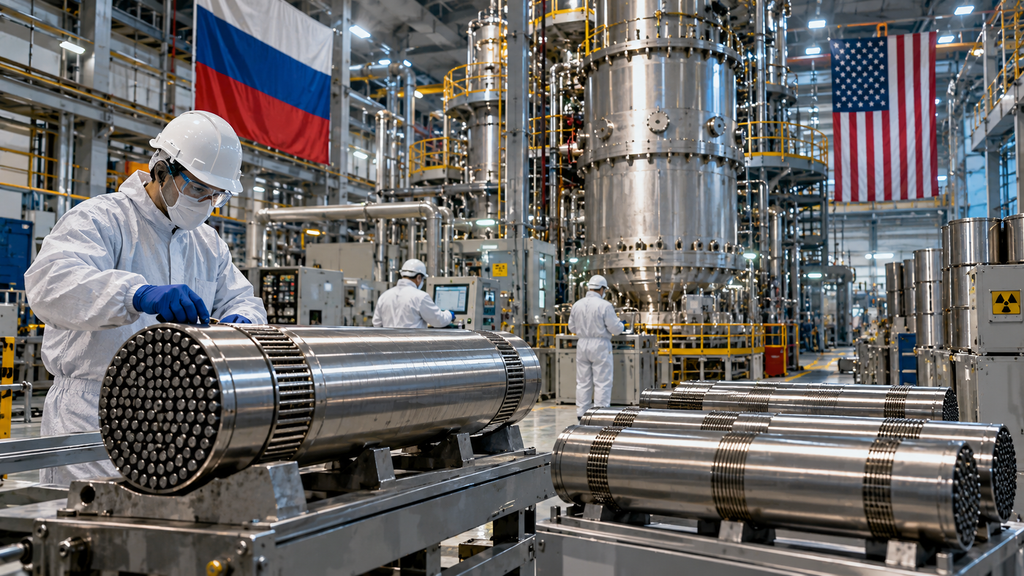
The third point is central to understanding US Sanctions on Russia: 5 Key Oil-Uranium Double Standards.
Uranium is not simply mined and immediately placed inside a nuclear reactor.
The nuclear-fuel cycle includes several stages:
Mining → Conversion → Enrichment → Fuel fabrication → Reactor use
A disruption at any major stage can create supply problems.
This is different from crude oil, where large volumes can be transported between producing regions through established tanker, pipeline and trading networks.
The United States has significant uranium resources, but domestic mining alone does not solve the nuclear-fuel problem.
Enrichment capacity is particularly important.
The U.S. Department of Energy previously said Russia possessed roughly 44% of global uranium enrichment capacity and supplied about 35% of U.S. imports for nuclear fuel when the 2024 uranium ban was being developed. The department also said the transition away from Russian fuel would not happen immediately.
That explains why Congress built a waiver mechanism into the uranium ban.
The objective was to reduce dependence without creating an immediate shock to American nuclear reactors.
4. US Sanctions on Russia Clash With America’s Nuclear-Fuel Dependence
Another important element of US Sanctions on Russia: 5 Key Oil-Uranium Double Standards is the structure of the American nuclear industry.
The United States operates one of the world’s largest commercial nuclear fleets.
Those reactors require a reliable supply of enriched uranium.
The problem is that the U.S. does not currently produce all the enriched nuclear fuel required by its civilian reactor fleet domestically.
This creates a strategic dilemma.
Washington wants to reduce Russia’s influence over the nuclear-fuel supply chain.
At the same time, abruptly eliminating Russian supplies could create problems for nuclear operators.
The 2024 legislation therefore attempted to balance both objectives.
The Department of Energy created a waiver process specifically to prevent disruptions to U.S. nuclear power plants while alternative sources were developed.
The U.S. government has also allocated billions of dollars to rebuilding domestic uranium conversion, enrichment and advanced-fuel capabilities.
The Energy Department said the 2024 uranium legislation unlocked approximately $2.72 billion in congressional funding to increase production of low-enriched uranium and high-assay low-enriched uranium for existing and advanced reactors.
This suggests that the waiver is intended as a transitional mechanism rather than a permanent commitment to Russian nuclear fuel.
5. The “Double Standard” Argument Has Two Sides
The fifth element of US Sanctions on Russia: 5 Key Oil-Uranium Double Standards involves the competing interpretations of the policy.
Critics argue that the policy appears inconsistent.
Their argument is that if Russian energy revenue is considered strategically important enough to justify economic pressure on foreign oil buyers, then purchases of Russian uranium should also face comparable restrictions.
From this perspective, the distinction between oil and uranium can look like a case of Washington applying tougher standards to foreign consumers than to strategically important U.S. industries.
However, another interpretation is possible.
Supporters of the uranium waiver system can argue that nuclear fuel is a specialized commodity with fewer immediately available alternatives.
The U.S. government itself has explicitly cited the absence of viable alternative supplies and national interest as reasons for allowing limited Russian LEU imports.
This means the issue is not simply hypocrisy versus consistency.
It is also a question of how governments balance sanctions objectives against energy-security risks.

US Sanctions on Russia: Why the Oil-Uranium Gap Matters for India
The debate has particular relevance for India.
India has become one of the world’s largest purchasers of Russian crude following the disruption of traditional global energy flows after Russia’s invasion of Ukraine.
Russian oil has provided Indian refiners with an additional source of crude and, depending on market conditions, attractive purchasing economics.
The new U.S. sanctions framework therefore matters because India is among the countries that could face additional trade measures if it falls within the law’s criteria.
S&P Global reported India as the largest Russian crude buyer in August 2026, at around 1.6 million barrels per day.
The legislation gives Washington substantial leverage because tariffs can affect Indian exports to the United States even when those exports have nothing directly to do with petroleum.
This is one of the most consequential features of the policy.
India faces an energy-security calculation
India imports the overwhelming majority of the crude oil it consumes.
Consequently, decisions concerning Russian oil are not simply geopolitical decisions. They also affect:
- refinery economics;
- fuel prices;
- inflation;
- trade balances;
- shipping costs;
- energy security;
- domestic consumers.
The United States, meanwhile, is approaching Russian uranium through a different supply-chain calculation.
That difference is precisely why the phrase US Sanctions on Russia: 5 Key Oil-Uranium Double Standards has gained attention in discussions about global energy policy.
Russia’s Importance in the Nuclear-Fuel Market
Russia’s role extends beyond uranium mining.
The country has major capabilities in uranium conversion, enrichment and nuclear-fuel services.
This distinction is critical.
A country can obtain uranium ore from one supplier but still depend on another country for conversion or enrichment.
Consequently, replacing Russian nuclear-fuel supplies requires more than increasing uranium mining.
The United States has recognized this challenge.
Its policy has increasingly focused on developing domestic enrichment capacity and strengthening supply relationships with allied countries.
The U.S. Energy Department has described the uranium ban as part of a broader effort to create a more secure domestic and international nuclear-fuel market.
This means the long-term objective is not necessarily to keep purchasing Russian uranium.
Instead, Washington is attempting to reduce the dependence while preventing an abrupt disruption.
US Sanctions on Russia and the Broader Energy-Security Debate
The oil-uranium comparison illustrates a broader problem with sanctions policy.
Economic sanctions are rarely applied in isolation from domestic economic interests.
Governments must consider the potential consequences of cutting off strategically important supplies.
This is especially true for:
- oil;
- natural gas;
- uranium;
- rare earths;
- critical minerals;
- semiconductor materials;
- industrial metals.
When alternative suppliers are plentiful, sanctions can be easier to implement.
When supply is concentrated among a few producers, governments may create exceptions.
The uranium waiver is an example of this approach.
The United States has simultaneously pursued two objectives:
Objective 1: Reduce Russia’s role in the nuclear-fuel supply chain.
Objective 2: Protect the continuity of the U.S. nuclear-power system while alternative capacity is developed.
Those objectives can appear contradictory, but they can also be understood as part of a transition strategy.
Is the US Uranium Waiver a Complete Exception?
No.
This distinction is essential for anyone writing about US Sanctions on Russia: 5 Key Oil-Uranium Double Standards.
The United States does not have a blanket exemption allowing unlimited Russian uranium imports.
The 2024 law prohibits specified Russian uranium imports and places limits on certain imports. The waiver authority is conditional and temporary.
The Department of Energy says a waiver can be granted when an alternative viable source is unavailable or when the import is in the national interest.
The U.S. nuclear sector therefore operates within a more complicated framework than simply “Russian uranium is allowed.”
This legal distinction should be included in any serious analysis.
A New Layer: Civil Nuclear Transactions
The situation is also affected by U.S. sanctions rules concerning civilian nuclear activity.
The U.S. Treasury’s Office of Foreign Assets Control updated guidance in June 2026 concerning certain transactions involving civil nuclear energy. General License 115D broadly authorizes certain activities supporting existing civil nuclear-energy projects and operations, including specified activities involving uranium, enrichment, fuel and nuclear power.
However, that authorization has limits.
It does not automatically authorize every transaction involving every sanctioned Russian entity or every new nuclear project.
This is another reason the phrase “U.S. sanctions have an uranium exception” needs qualification.
The legal system contains multiple layers:
- import restrictions;
- statutory waivers;
- sanctions designations;
- general licenses;
- specific licenses;
- civil nuclear exemptions;
- national-interest determinations.
For readers, the most important point is that the U.S. policy is restrictive but not absolute.
US Sanctions on Russia: What Are the 5 Key Differences?
The five differences can now be summarized clearly.
1. Different treatment of foreign oil buyers
The 2026 sanctions law gives the president authority to impose tariffs of up to 100% on goods from qualifying major purchasers of Russian crude oil and natural gas.
2. Limited uranium waiver mechanism
Russian uranium imports are prohibited under the 2024 law, but certain imports can receive temporary waivers.
3. Different supply-chain structures
Oil has a broad international supplier network, while uranium enrichment and conversion are more concentrated.
4. U.S. nuclear dependence
The United States needs reliable supplies of enriched uranium to operate its commercial nuclear fleet.
5. Transition strategy
Washington is investing in domestic nuclear-fuel capacity while using temporary mechanisms to prevent immediate disruptions.
These five factors explain why the comparison has generated debate without requiring the conclusion that the two commodities should necessarily be regulated identically.
What Happens Next?
The future of the policy will depend on how quickly the United States can develop alternative nuclear-fuel capacity and how aggressively the administration implements the new Russia sanctions authorities.
The uranium waiver deadline is particularly important.
Under the 2024 law, waivers cannot continue beyond January 1, 2028.
That creates a clear deadline for the development of alternative supplies.
Meanwhile, the new Russia sanctions law gives the U.S. administration additional tools to pressure countries purchasing Russian energy.
The result could be increased tension between Washington and major Russian oil customers, particularly if the United States chooses to impose the maximum available tariffs.
At the same time, the U.S. nuclear industry will need reliable non-Russian supplies if Washington intends to eliminate the remaining dependency.
What This Means for Global Energy Markets
The debate around US Sanctions on Russia: 5 Key Oil-Uranium Double Standards highlights a larger transformation in global energy markets.
Energy security is increasingly becoming inseparable from geopolitics.
Oil flows can be redirected, but the process may involve higher freight costs, longer shipping routes and different refinery requirements.
Nuclear fuel presents an even more specialized challenge.
A reactor requires fuel that meets specific technical and regulatory requirements. Replacing one supplier can therefore take significantly longer than changing a crude-oil cargo.
This is why governments may impose restrictions gradually rather than immediately.
The United States is effectively trying to create alternatives before completely eliminating Russian nuclear-fuel dependence.
Conclusion: US Sanctions on Russia and the Energy-Security Test
The debate over US Sanctions on Russia: 5 Key Oil-Uranium Double Standards reflects a genuine tension in Washington’s energy policy.
The United States is increasing pressure on major purchasers of Russian oil and gas while maintaining limited legal mechanisms that can permit certain Russian uranium imports.
That difference can reasonably be described by critics as a “double standard,” but the underlying legal reality is more nuanced.
The United States has banned specified Russian uranium imports. It has not simply exempted itself from sanctions. Instead, Congress created a temporary waiver mechanism based on supply availability and national interest.
At the same time, Russia remains an important participant in the global nuclear-fuel supply chain, making an immediate cutoff more complicated than restricting a conventional commodity.
The broader story is therefore about the difficult balance between sanctions, national interest and energy security.
For countries such as India, the issue raises another question: whether major powers should expect other countries to accept significant energy costs while retaining exceptions where their own strategic industries face supply constraints.
For Washington, the long-term test will be whether it can develop sufficient domestic and allied nuclear-fuel capacity to eliminate the need for Russian uranium without disrupting its nuclear-power sector.
Until that transition is complete, the contrast between Russian oil restrictions and limited uranium waivers will remain an important feature of the global sanctions debate.
Frequently Asked Questions (FAQ)
What are the US Sanctions on Russia: 5 Key Oil-Uranium Double Standards?
The phrase refers to five differences between U.S. policy toward Russian oil and Russian uranium: pressure on major oil buyers, temporary uranium waivers, different supply-chain structures, U.S. nuclear-fuel dependence and Washington’s effort to build alternative nuclear-fuel capacity.
Does the US ban Russian uranium?
Yes. The Prohibiting Russian Uranium Imports Act prohibits specified imports of Russian natural uranium and unirradiated low-enriched uranium. However, the law provides a temporary waiver mechanism under defined conditions.
Can the US still import Russian uranium?
Certain imports can be authorized through waivers if the statutory requirements are met, including circumstances where no viable alternative supply is available or an import is determined to be in the national interest. The waiver authority ends no later than January 1, 2028.
Why does the US need Russian nuclear fuel?
Russia has historically held substantial uranium-enrichment capacity, and replacing enrichment services requires new infrastructure and alternative suppliers. The U.S. government has therefore pursued a gradual transition rather than an immediate elimination of all Russian nuclear-fuel dependence.
Can the US impose 100% tariffs on countries buying Russian oil?
The 2026 Russia sanctions law gives the president authority to impose tariffs of up to 100% on goods from qualifying major purchasers of Russian crude oil or natural gas and certain countries facilitating sanctions evasion. The actual application depends on the statutory criteria and presidential action.
Could India be affected by the Russia sanctions law?
India is among the largest purchasers of Russian crude and therefore is potentially exposed to the law’s provisions concerning major Russian energy buyers. S&P Global reported India as the largest Russian crude importer in August 2026 among the countries it tracked.
Is the US uranium policy a complete exemption?
No. The legal framework is not a blanket exemption. It consists of an import prohibition combined with limited, conditional waiver provisions and other narrowly defined civil-nuclear authorizations.
When does the Russian uranium waiver authority expire?
The statutory waiver authority for covered Russian uranium imports cannot continue beyond January 1, 2028.
Why is uranium treated differently from oil?
Uranium and nuclear fuel have a more specialized supply chain. Reactor fuel requires mining, conversion, enrichment and fabrication, and replacing enrichment capacity can take years. Oil has a much larger and more diversified global production and trading network.
What is the bigger issue behind the debate?
The broader issue is how governments balance geopolitical sanctions with domestic energy security. The U.S. is attempting to reduce Russia’s role in both oil and nuclear fuel while protecting its own energy system from supply disruptions.