
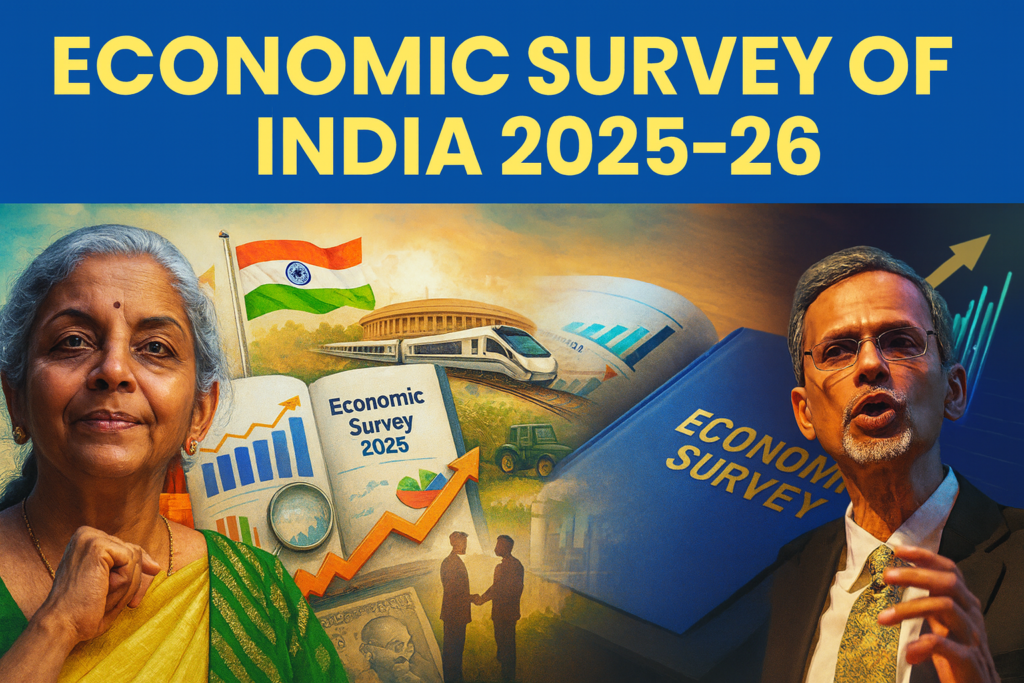
Economic Survey of India 2025–26 sets the tone for India’s economic roadmap, highlighting resilience, reforms, and inclusive growth. Presented in Parliament ahead of the Union Budget, the survey outlines GDP projections, inflation trends, employment data, and structural reforms. Prime Minister Narendra Modi, in his speech, emphasized innovation, infrastructure, and equitable development as the guiding principles for India’s future.
Economic Survey of India 2025–26: Growth Outlook
The Economic Survey of India 2025–26 projects real GDP growth in the range of 6.8–7.2% for FY27, reaffirming India’s position as the fastest-growing major economy. For FY26, growth is estimated at 7.4%, driven by strong domestic demand, robust investment, and policy reforms.
- Potential Growth Upgrade: The survey raises India’s potential growth rate to 7%, up from 6.5%, signaling confidence in structural reforms.
- Global Context: Despite geopolitical uncertainties and supply chain disruptions, India continues to outperform peers, showcasing resilience in a volatile global economy.
Economic Survey of India 2025–26: Inflation and Employment Trends
One of the most striking highlights of the Economic Survey of India 2025–26 is the historically low inflation rate of 1.7%, creating what economists call a “Goldilocks moment”—high growth with price stability.
- Employment: Unemployment rates fluctuated between 4.7% and 5.6% over the past nine months. The survey stresses the need for quality job creation to harness India’s demographic dividend.
- Wages and Productivity: Rising productivity in manufacturing and services is expected to support wage growth, while digital platforms are expanding employment opportunities.
Economic Survey of India 2025–26: Sectoral Performance
The survey provides a detailed sectoral analysis, highlighting agriculture, industry, services, and infrastructure.
- Agriculture: Focus on farmer welfare, sustainable practices, and adoption of agri-tech solutions.
- Industry & MSMEs: MSMEs are recognized as engines of employment and innovation, with policy support for credit access and digitalization.
- Services: IT, fintech, and tourism continue to drive growth, contributing significantly to exports.
- Infrastructure: The government’s push for highways, railways, and renewable energy projects remains central to long-term growth.
Economic Survey of India 2025–26: Reform Roadmap
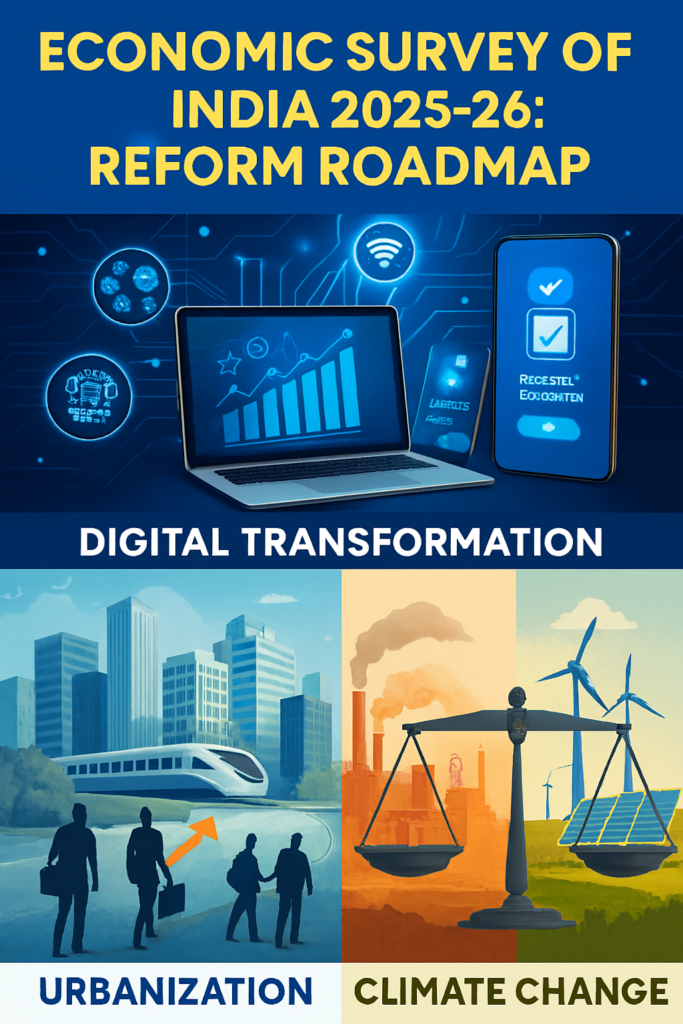
The Economic Survey of India 2025–26 outlines reforms aimed at sustaining growth and ensuring inclusivity.
- Digital Transformation: AI, fintech, and digital platforms are identified as productivity drivers.
- Urbanization: Planned urban growth is emphasized to accommodate migration and rising aspirations.
- Climate Change: The survey acknowledges trade-offs between growth and sustainability, stressing green energy transitions.
PM Modi’s Speech on Economic Survey of India 2025–26
Prime Minister Narendra Modi described the Economic Survey of India 2025–26 as a “snapshot of India’s Reform Express”, reflecting steady progress despite global challenges.
Key Highlights from PM Modi’s Address
- Inclusive Development: Growth must benefit farmers, MSMEs, and youth employment.
- Innovation & Startups: Modi praised India’s expanding startup ecosystem as a driver of entrepreneurship.
- Infrastructure Push: Commitment to world-class highways, railways, and digital networks.
- Macroeconomic Fundamentals: Modi highlighted India’s strong fundamentals, noting resilience amid global uncertainties.
- Global Leadership: India is positioned as a rising global power in technology, trade, and sustainability.
Economic Survey of India 2025–26: Significance for Policy and Business
The survey is more than a statistical document—it is a strategic blueprint guiding policy decisions.
- For Policymakers: Identifies constraints and opportunities, shaping the Union Budget.
- For Businesses: Signals investment opportunities in infrastructure, digital economy, and green energy.
- For Citizens: Reassures that growth is pursued with inclusivity and sustainability.
Challenges Ahead for Economic Survey of India 2025–26 Goals
Despite optimism, the survey acknowledges challenges:
- Global Uncertainty: Geopolitical tensions may impact exports.
- Job Creation: Sustained efforts are needed to generate high-quality employment.
- Climate Risks: Balancing growth with environmental sustainability remains critical.
- Fiscal Discipline: Ensuring reforms do not strain fiscal stability.
Conclusion: Economic Survey of India 2025–26 and India’s Future
The Economic Survey of India 2025–26 underscores resilience, reform momentum, and growth potential. With GDP projected to rise steadily, inflation under control, and reforms deepening across sectors, India stands at a pivotal juncture. Prime Minister Modi’s emphasis on inclusive development, innovation, and infrastructure aligns with the survey’s vision of a balanced and forward-looking economy.
As India prepares for the Union Budget 2026, the survey sets the stage for policies that will sustain growth while ensuring benefits reach every citizen.