
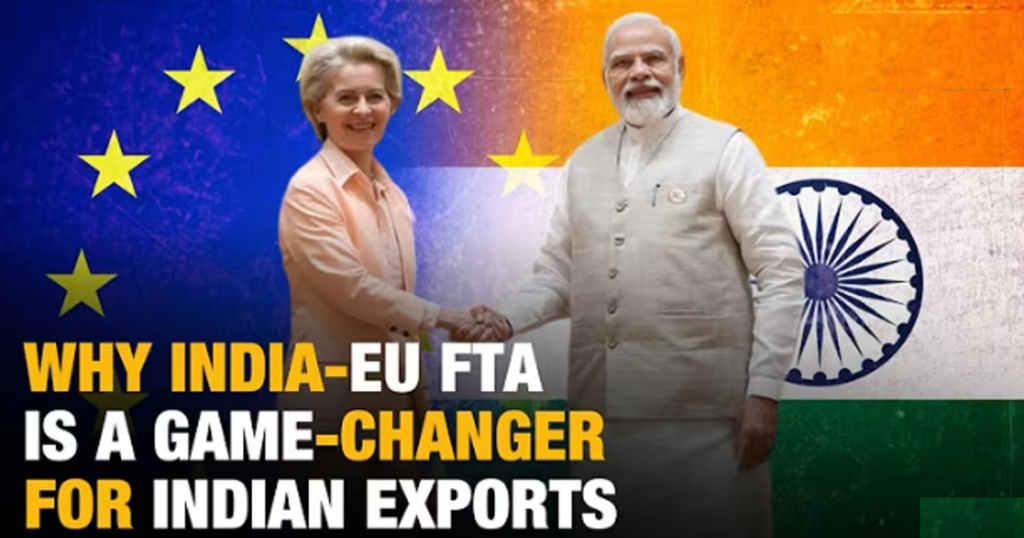
India-EU Trade Deal – A Landmark Free Trade Agreement
The India-EU Trade Deal has finally been sealed after 19 years of negotiations, marking a historic breakthrough in global trade diplomacy. The India-EU Free Trade Agreement (FTA), concluded in January 2026, is set to reshape India’s economic landscape, boost exports, and deepen ties with the European Union, which remains India’s largest trading partner for goods.
By securing this India-EU Trade Pact, New Delhi has demonstrated its ability to negotiate strategically, balancing domestic interests with global opportunities. The deal is expected to unlock new markets, create jobs, and strengthen India’s position in the global economy.
India-EU Free Trade Agreement – Key Features
- Tariff Reductions: India will lower tariffs on European industrial goods, while the EU will reduce duties on Indian textiles, leather, and agricultural products.
- Market Access: Indian IT services, pharmaceuticals, and engineering firms will gain easier access to the EU market.
- Carbon Tariffs: The agreement addresses the EU’s Carbon Border Adjustment Mechanism (CBAM), ensuring Indian exporters are not unfairly penalized.
- Investment Protection: Stronger safeguards for European investors in India, while ensuring India retains policy space for domestic industries.
- Sustainable Trade: Commitments to environmental standards, labor rights, and cooperation in green technologies.
This India-EU Economic Partnership ensures that trade flows are not only expanded but also aligned with sustainability and innovation.
Why the India-EU Trade Deal Matters
For India
- Boost to Exports: The EU accounts for nearly 16% of India’s global trade. The India-EU FTA will help Indian exporters diversify markets, especially amid geopolitical tensions and rising US tariffs.
- Job Creation: Sectors like textiles, leather, agriculture, and IT services will benefit, creating millions of jobs.
- Technology Transfer: Collaboration with European firms will accelerate India’s adoption of advanced technologies, particularly in renewable energy and green manufacturing.
For the EU
- Access to India’s Market: With over 1.4 billion people, India offers a massive consumer base.
- Strategic Partnership: Strengthening ties with India helps the EU balance its trade relations in Asia, especially amid challenges with China.
- Supply Chain Diversification: India provides a reliable alternative for European companies seeking to reduce dependence on single-source suppliers.
Sectors Benefiting from the India-EU Trade Pact
- Textiles & Apparel: Indian garments will face lower tariffs in Europe, boosting competitiveness.
- Agriculture & Food Processing: Indian tea, spices, and processed foods will gain wider access.
- Pharmaceuticals: India’s generic drug industry will benefit from streamlined regulatory approvals.
- IT & Services: Easier movement of professionals and recognition of Indian qualifications will expand opportunities.
- Automobiles & Machinery: European companies will find India’s market more accessible, while Indian firms can integrate into EU supply chains.
Challenges in Implementing the India-EU Free Trade Agreement
While the India-EU Trade Deal is promising, challenges remain:
- Implementation: Ensuring smooth execution of tariff reductions and regulatory changes.
- Compliance Costs: Indian exporters must adapt to EU’s strict environmental and labor standards.
- Domestic Resistance: Some Indian industries fear competition from European imports.
- Carbon Tariffs: Adjusting to EU’s CBAM could be costly for Indian steel and cement exporters.
Geopolitical Significance of the India-EU Trade Deal
The India-EU Economic Partnership is not just economic—it is geopolitical. It signals India’s growing role in global trade and strengthens its partnership with Europe at a time of shifting global alliances.
- Balancing China: The EU sees India as a strategic partner to balance China’s dominance in Asia.
- Global Supply Chains: The deal positions India as a hub for diversified supply chains.
- Climate Cooperation: Joint commitments on green technology and sustainability enhance India’s climate diplomacy.
India-EU Trade Deal – A Blueprint for Future Agreements
The sealing of the India-EU Free Trade Agreement after 19 years is a historic achievement. It demonstrates India’s ability to negotiate strategically, balancing domestic interests with global opportunities. For India, the deal promises export growth, job creation, and technology transfer. For the EU, it ensures market access, supply chain diversification, and a stronger partnership with Asia’s fastest-growing economy.
If implemented effectively, the India-EU Trade Deal could become a blueprint for India’s future trade negotiations, reinforcing its position as a global economic powerhouse.