
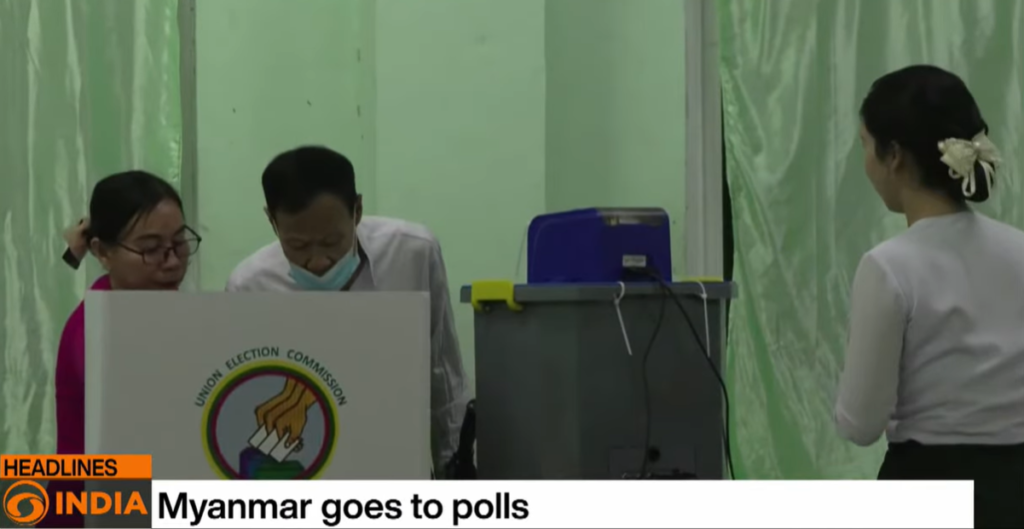
Naypyitaw, December 28, 2025 — Myanmar’s military junta staged its first general election since the 2021 coup, but the exercise has been widely condemned as illegitimate. With the National League for Democracy (NLD) banned, large swathes of the country excluded due to civil war, and voter turnout strikingly low, the polls have raised serious questions about Myanmar’s political future.
From Coup to Crisis
The military seized power in February 2021, overthrowing Aung San Suu Kyi’s elected government and plunging the nation into turmoil. Suu Kyi remains in detention, while her party, the NLD, which won a landslide in 2020, has been dissolved. Since then, Myanmar has faced civil war, economic collapse, and international isolation.
The junta promised elections as part of its “roadmap to democracy.” Critics, however, argue the process is designed to entrench military dominance rather than restore civilian rule.
Structure of the Polls
- Phased Voting: Conducted in three stages — December 28, 2025, January 11, 2026, and January 25, 2026.
- Scope: Out of 692 constituencies, polling was cancelled in 65 townships due to conflict.
- Candidates: Around 5,000 candidates from 57 parties are contesting seats in the Lower House, Upper House, and state/regional assemblies.
- Turnout: Reports from Yangon and Mandalay suggest low voter turnout, with many citizens skeptical of the process.
Junta’s Narrative
Senior General Min Aung Hlaing, the junta chief, cast his vote in Naypyitaw, displaying his ink-marked finger to symbolize legitimacy. State media hailed the election as a “historic step” toward democracy, emphasizing the military’s role in safeguarding national unity.
Criticism and International Reaction
- Human Rights Groups: Amnesty International and Human Rights Watch dismissed the polls as “neither free nor fair.”
- Opposition Forces: Ethnic armed groups and pro-democracy activists rejected the process, calling it a ploy to consolidate junta rule.
- United Nations: Expressed concern over the exclusion of the NLD and suppression of dissent.
- Western Diplomats: Warned that the election could deepen divisions and prolong instability.
Risks and Challenges
- Civil War: Fighting continues across multiple regions, making polling impossible in large areas.
- Legitimacy Crisis: With the most popular party banned, the election risks being seen as symbolic.
- Public Trust: Many citizens remain disillusioned, fearing the process is designed to entrench military dominance.
What Lies Ahead
The Union Parliament formed after the three phases will elect a new president, who will then form a Union Government. Analysts predict that the outcome will likely consolidate military control rather than usher in genuine democratic reform.
For ordinary citizens, the election offers little hope of change. Instead, it underscores the widening gap between the junta’s narrative of stability and the lived reality of conflict, repression, and economic hardship.