
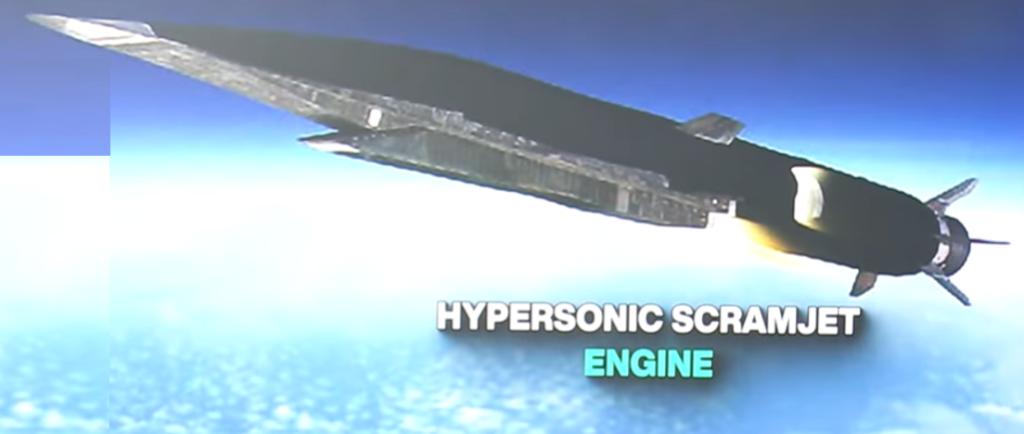
Scramjet Engine Breakthrough by India
Scramjet Engine technology has propelled India into the elite hypersonic powers club, joining the United States, Russia, and China. The Defence Research and Development Organisation (DRDO) achieved a historic milestone with the successful 12-minute scramjet engine test, marking India’s entry into advanced hypersonic propulsion.
Scramjet Engine Explained
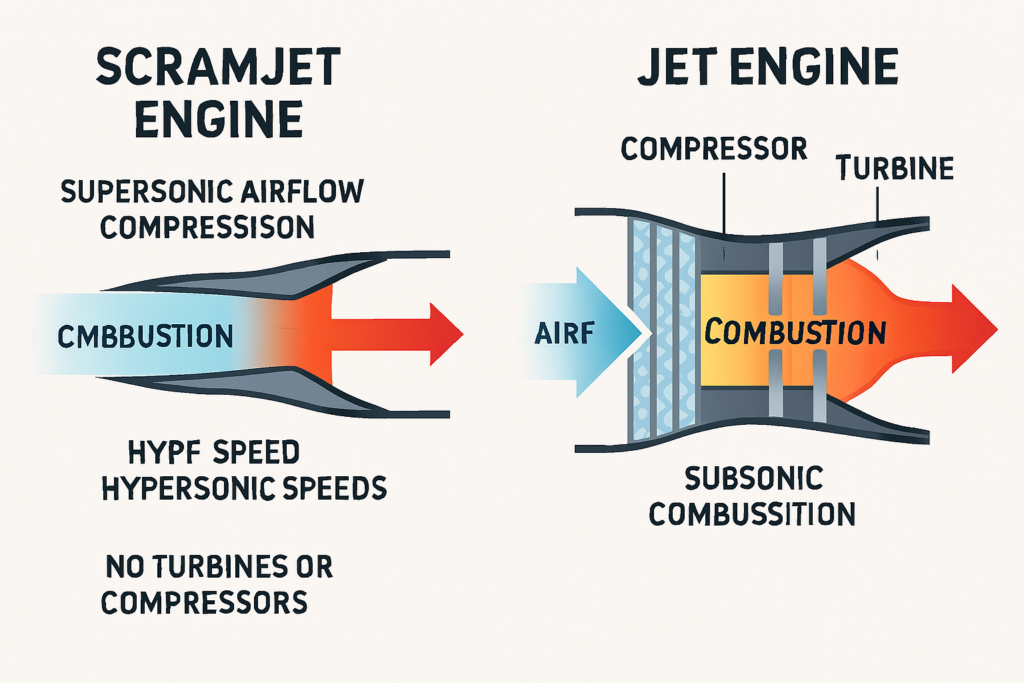
- A Scramjet Engine (Supersonic Combustion Ramjet) is an air-breathing propulsion system designed for speeds above Mach 5.
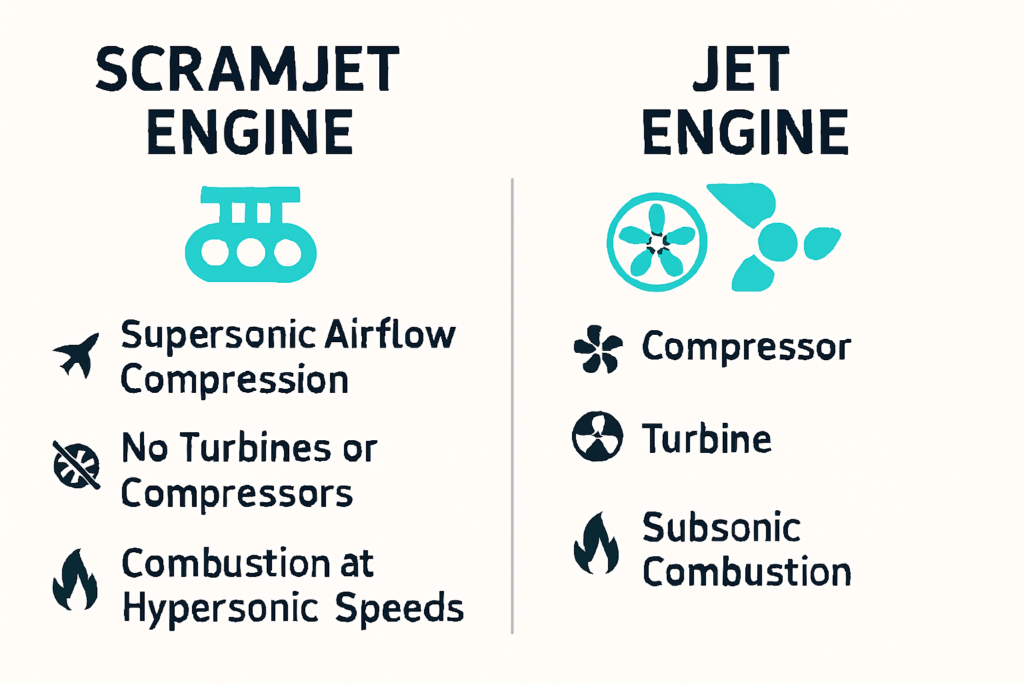
- Unlike conventional jet engines, scramjets have no turbines or compressors.
- They rely on supersonic airflow compression before fuel combustion, enabling sustained hypersonic flight.
- This makes scramjets ideal for hypersonic cruise missiles and future spaceplanes.
DRDO Scramjet Test: India’s Hypersonic Leap
- The DRDO scramjet test at Hyderabad’s Scramjet Connect Pipe Test (SCPT) facility ran continuously for 12 minutes, a world-class achievement.
- This endurance proves India’s ability to develop hypersonic cruise missiles with long-range strike capability.
- The test builds on earlier subscale scramjet trials, showing rapid progress in scaling up indigenous technology.
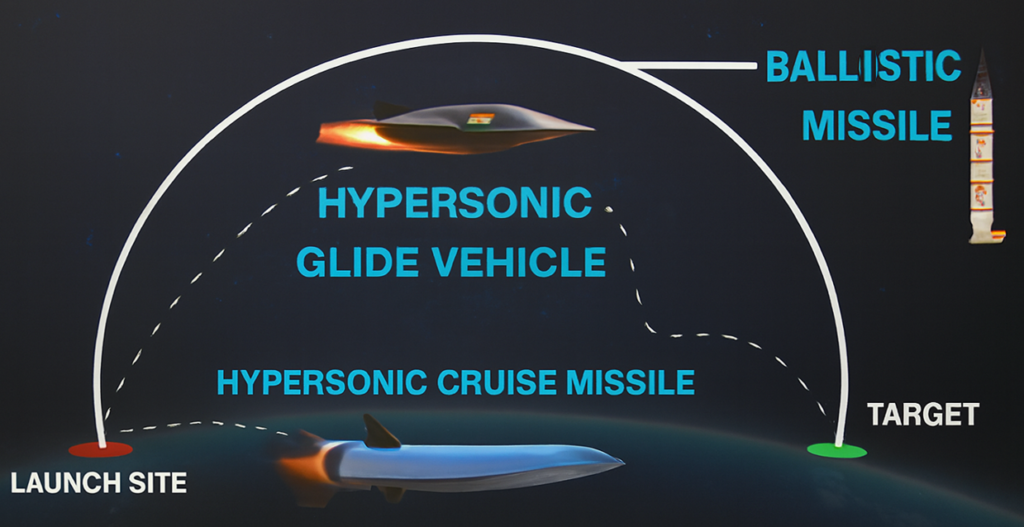
India Hypersonic Power: Strategic Significance
- Hypersonic cruise missiles powered by scramjets can exceed 6,100 km/h, making them nearly impossible to intercept.
- India’s scramjet breakthrough strengthens its deterrence posture against regional adversaries.
- Joining the hypersonic powers club enhances India’s global defense credibility.
- The success highlights India’s self-reliance in defense technology, reducing dependence on imports.
Scramjet Engine vs Conventional Jet Engines
| Feature | Scramjet Engine | Jet Engine |
|---|---|---|
| Speed | Hypersonic (Mach 5+) | Subsonic/Supersonic (Mach 2–3) |
| Moving Parts | None | Thousands (compressors, turbines) |
| Efficiency | Best at hypersonic speeds | Best at lower speeds |
| Applications | Hypersonic missiles, spaceplanes | Fighter jets, commercial aircraft |
Challenges in Hypersonic Cruise Missiles Development
- Thermal management: Extreme heat at Mach 5+ requires advanced cooling systems.
- Material science: High-temperature alloys and composites must withstand stress.
- Integration: Scramjets need boosters to reach ignition speeds.
- Flight validation: Ground tests must be followed by real-world trials.
Global Hypersonic Powers Context
- United States: DARPA programs developing scramjet missiles.
- Russia: Operationalized Avangard hypersonic glide vehicle.
- China: Demonstrated scramjet prototypes and hypersonic glide vehicles.
- India: With the DRDO scramjet test, India now stands among these hypersonic leaders.
Future of Scramjet Engine in India
- India aims to develop hypersonic cruise missiles with ranges beyond 1,000 km.
- Scramjet technology could support low-cost space launch systems.
- The breakthrough boosts Make in India and showcases indigenous defense innovation.
Conclusion: India Hypersonic Power Era
The Scramjet Engine success marks India’s entry into the elite hypersonic powers club. With DRDO’s sustained scramjet test, India has proven its ability to develop hypersonic cruise missiles and advanced aerospace systems. This achievement is not just technological—it is a strategic leap into the future of warfare and space innovation.