
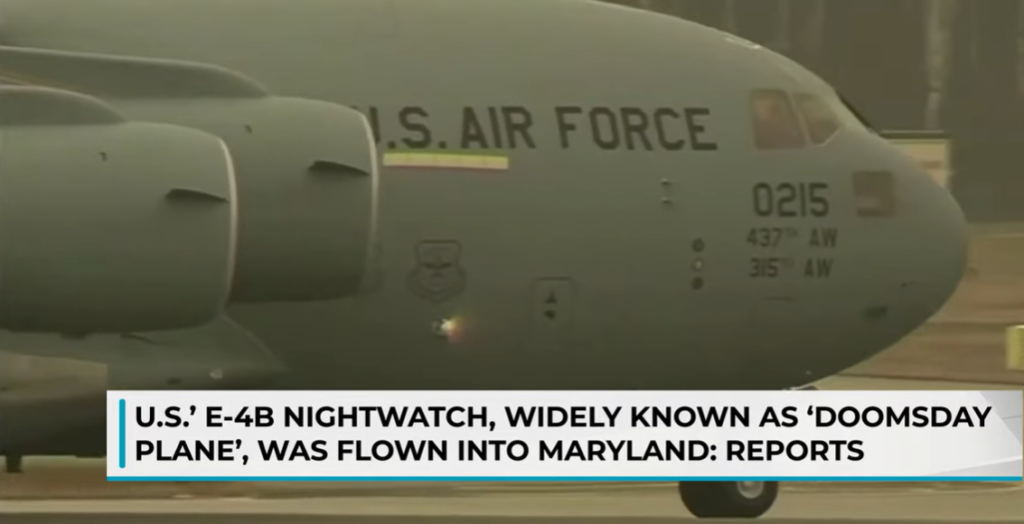
US Doomsday Plane: A Cold War Legacy Returns
The US Doomsday Plane, officially known as the Boeing E‑4B Nightwatch, stunned aviation enthusiasts and analysts when it made a rare landing at Los Angeles International Airport (LAX) in January 2026. This marked the first public appearance in 51 years, a moment that immediately sparked speculation about its purpose and timing.
Nicknamed the “Flying Pentagon,” the aircraft was designed during the Cold War to serve as a mobile command center in the event of nuclear war or catastrophic emergencies. Its sudden visibility in Los Angeles raised questions about readiness, deterrence, and global tensions.
US Doomsday Plane Features and Capabilities
The US Doomsday Plane is a modified Boeing 747‑200, hardened against nuclear threats and equipped with advanced communication systems.
Key features include:
- EMP protection: Built to withstand electromagnetic pulses from nuclear blasts.
- Global communications: Satellite links allow uninterrupted contact with military forces worldwide.
- Command and control: Capable of directing U.S. nuclear forces and ensuring continuity of government.
- Crew capacity: Can carry senior military officials, communications staff, and even the President if required.
Only four E‑4Bs exist, making sightings exceptionally rare.
Rare Appearance in Los Angeles
The US Doomsday Plane’s rare appearance in Los Angeles was historic. Aviation fans captured live footage as the aircraft touched down at LAX, with Airline Videos Live broadcasting the event.
The plane reportedly flew from Offutt Air Force Base in Nebraska to Camp Springs, Maryland, before arriving in California. Its presence at a major civilian airport was unusual, as the E‑4B typically operates discreetly from military bases.
Why the US Doomsday Plane Appeared Now

The Pentagon offered no official explanation for why the US Doomsday Plane was deployed instead of a standard government aircraft. This silence fueled speculation:
- Global tensions: The sighting coincided with heightened geopolitical strain, including U.S.–Russia friction and crises in Venezuela.
- Training drills: Analysts suggest the flight may have been part of routine readiness exercises.
- Symbolic deterrence: Others argue the visible deployment was a subtle message to adversaries about U.S. preparedness.
Whatever the reason, the timing amplified curiosity and concern.
US Doomsday Plane History and Cold War Roots
The US Doomsday Plane program began in the 1970s, at the height of the Cold War. Its mission was clear: ensure continuity of government if Washington were incapacitated by nuclear attack.
For decades, the aircraft operated in secrecy, rarely seen by the public. Its sudden appearance in Los Angeles after 51 years of hidden service underscores both its enduring relevance and the shifting dynamics of modern geopolitics.
Symbolism of the US Doomsday Plane
The US Doomsday Plane’s rare appearance carried symbolic weight:
- Reassurance: For Americans, it demonstrated that contingency plans remain intact.
- Deterrence: For adversaries, it signaled that U.S. command and control would survive even in worst‑case scenarios.
- Transparency vs. secrecy: The public sighting blurred the line between classified readiness and visible deterrence.
Public Fascination and Media Coverage
The US Doomsday Plane quickly became a trending topic. Aviation enthusiasts celebrated the rare glimpse, while analysts debated its implications.
- Media outlets emphasized the uniqueness of the sighting, noting that only four such planes exist.
- Observers speculated whether the deployment was linked to ongoing crises or simply logistical.
- Social media buzz amplified public fascination, turning the Doomsday Plane into a symbol of Cold War legacy meeting modern geopolitics.
Broader Implications of the US Doomsday Plane Appearance
The US Doomsday Plane’s rare appearance in Los Angeles raises important questions:
- Continuity of government: How prepared is the U.S. for catastrophic scenarios today?
- Geopolitical signaling: Was the sighting meant to reassure allies or warn adversaries?
- Future visibility: Will the E‑4B remain largely hidden, or will public sightings become more common?
For Washington, the operation was a reminder of resilience. For adversaries, it was a subtle warning that bluffs can be called and readiness remains intact.
Conclusion: US Doomsday Plane After 51 Years
The US Doomsday Plane’s rare appearance in Los Angeles after 51 years was more than an aviation spectacle. It was a reminder of Cold War legacies, modern geopolitical tensions, and America’s enduring commitment to continuity of government.
Whether a routine drill or a deliberate show of strength, the sighting underscored the symbolic power of the E‑4B Nightwatch. In an era of uncertainty, the Flying Pentagon remains a potent emblem of resilience — and its sudden visibility has ensured that the world is watching.