
India’s Growth Defies Oil Shocks, US Outlook Weakens — this phrase captures the contrasting trajectories of two major economies amid global turmoil. As Middle East instability drives oil prices higher, India demonstrates resilience with projected growth of 6.8%, while the United States faces mounting risks of inflation, consumer strain, and recessionary pressures.
India’s Growth Defies Oil Shocks, US Outlook Weakens as the global economy enters another uncertain phase marked by volatile crude prices, slowing consumer demand in advanced economies, and concerns over recession risks in the United States. While many emerging markets remain vulnerable to rising energy costs, India continues to demonstrate resilience through robust domestic demand, policy reforms, infrastructure spending, and a rapidly expanding services sector.
For investors, policymakers, and businesses worldwide, this divergence is becoming increasingly significant. India is positioning itself as one of the brightest growth engines of the global economy, while the US outlook appears clouded by inflation concerns, slowing hiring, and tighter financial conditions.
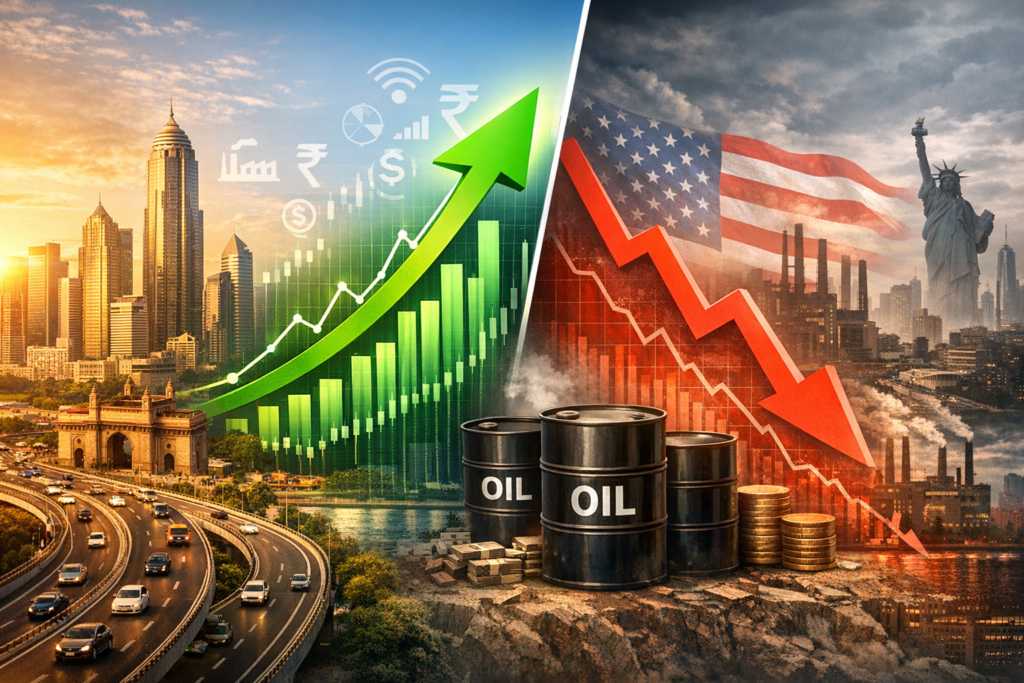
India’s Growth Defies Oil Shocks
India’s ability to sustain growth despite energy market volatility is a testament to its strong domestic fundamentals.
- Robust GDP Projection: India’s GDP is expected to expand at 6.8%–7% in FY27, following a strong 7.6% in FY26.
- Drivers of Resilience:
- Expanding infrastructure investments.
- Rising domestic consumption.
- Diversified energy sourcing strategies.
- Policy Buffers: The Reserve Bank of India’s cautious monetary stance and government subsidies help cushion the impact of oil shocks.
India’s Growth Defies Oil Shocks, US Outlook Weakens Through Domestic Demand
One of the biggest reasons for India’s resilience is domestic demand. Unlike export-heavy economies that depend heavily on global trade cycles, India benefits from internal consumption powered by its 1.4 billion population.
Retail sales, travel, housing demand, automobile purchases, and digital transactions continue to support growth momentum. Urban consumption remains solid, while rural demand is expected to improve with better monsoon conditions and policy support.
This domestic demand cushion means that even if external shocks hit trade flows, India can continue expanding faster than many developed economies.

US Outlook Weakens Under Oil Shocks
While India’s growth defies oil shocks, the US outlook weakens as energy volatility threatens economic stability.
- Inflationary Pressures: Rising fuel costs risk eroding consumer spending power.
- Federal Reserve Dilemma: Persistent inflation may force prolonged high interest rates.
- Growth Concerns: Analysts warn of slower GDP expansion and possible recession if oil prices remain elevated.
Comparative Snapshot — India vs US
| Factor | India (FY27) | United States (2026) |
|---|---|---|
| GDP Growth | 6.8%–7% | Slowing, recession risk |
| Oil Dependency | High, but diversified sourcing | High, reliant on imports |
| Inflation Outlook | Moderately contained | Elevated, Fed under pressure |
| Policy Buffer | Fiscal subsidies, RBI stance | Fed rate hikes, limited fiscal space |
| Resilience Drivers | Domestic demand, infrastructure | Consumer spending, tech sector |
Global Spillovers of Oil Shocks
India’s growth defies oil shocks, but global spillovers remain significant:
- Energy Markets: Brent crude volatility impacts both economies.
- Trade Flows: U.S. imports face cost escalation, while India’s exports may gain competitiveness.
- Financial Markets: Emerging markets like India attract capital inflows, while U.S. equities face volatility.
Risks for India Despite Resilience
- Continued reliance on imported oil remains a vulnerability.
- Inflationary pressures could rise if crude spikes persist.
Risks for the US Economy
- Prolonged inflation may erode consumer confidence.
- Political uncertainty around Middle East policy could amplify risks.
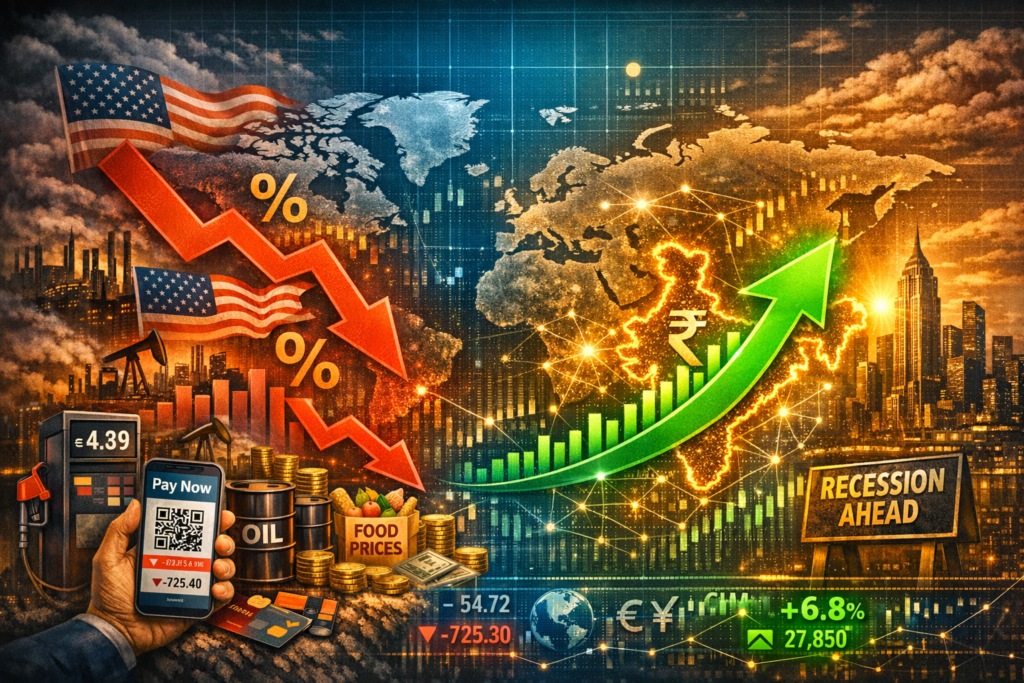
India’s Growth Defies Oil Shocks, US Outlook Weakens: Future Outlook
India appears well-positioned to remain among the fastest-growing major economies. Structural reforms, demographic strength, infrastructure expansion, and digital leadership are creating momentum that can outlast temporary oil shocks.
Meanwhile, the US economy may continue growing at a slower pace unless productivity gains, lower inflation, and policy support revive momentum.
The bigger story for global markets is clear: economic leadership is becoming more diversified, and India is emerging as a central pillar of that shift.

Conclusion — India Anchors Growth, US Faces Fragility
India’s Growth Defies Oil Shocks, US Outlook Weakens — the phrase encapsulates a shifting global narrative. India’s firm growth trajectory highlights its resilience in navigating crises, supported by strong fundamentals and proactive policy. The U.S., however, faces a fragile outlook, with oil shocks threatening to derail recovery.
This contrast underscores how emerging economies like India are increasingly positioned as anchors of global growth, while advanced economies grapple with vulnerabilities tied to energy and geopolitics.