
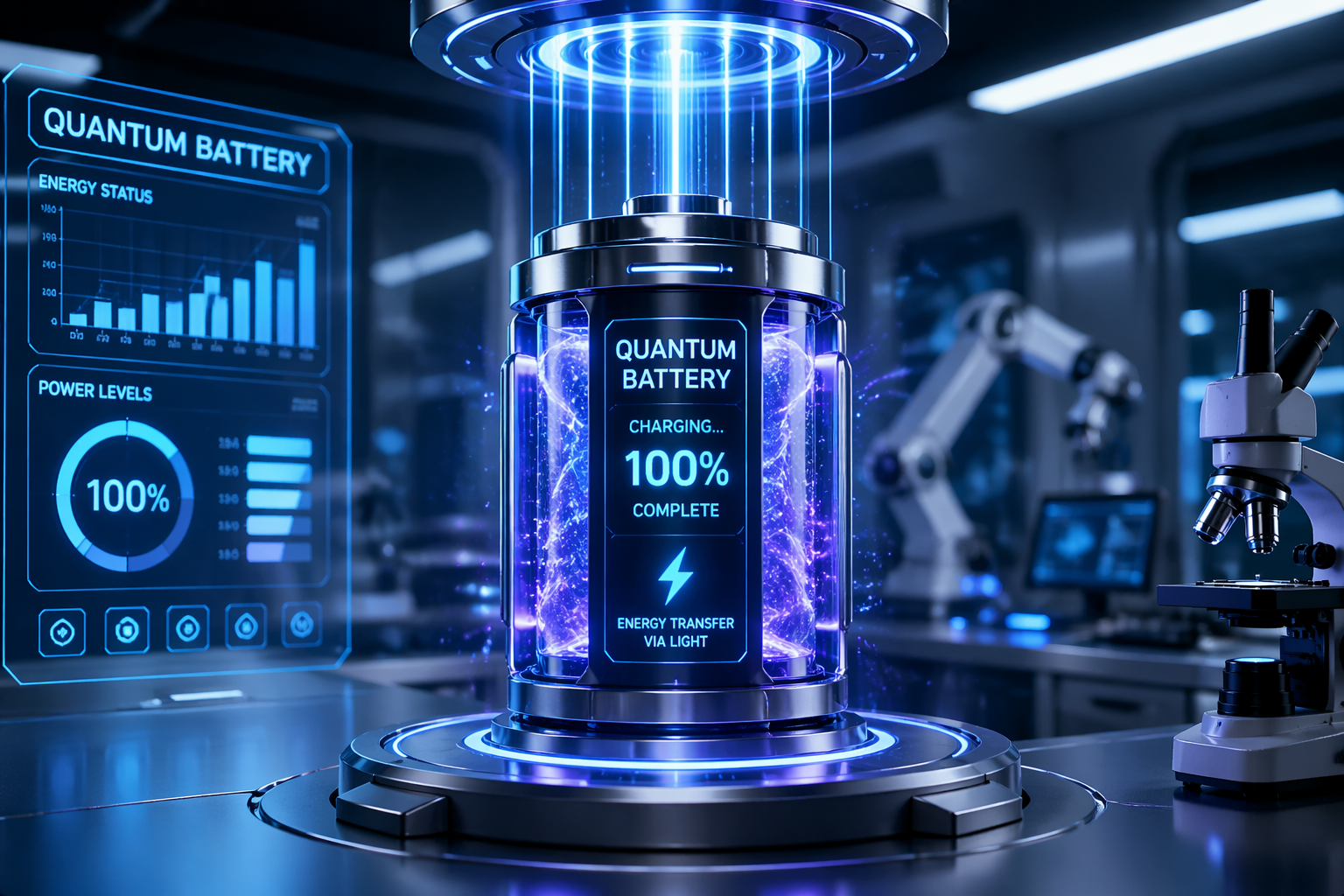
Quantum Battery Breakthrough: Charges in Seconds with Light is reshaping the future of energy storage. Scientists have unveiled a prototype that uses quantum mechanics and light to achieve ultra‑fast charging, potentially transforming consumer electronics, electric vehicles, and renewable energy systems. This innovation could mark the beginning of a new era where charging delays become obsolete.
Institutions Involved: CSIRO, RMIT, and University of Melbourne.
Prototype Achievement: First working quantum battery demonstrated at room temperature.
Charging Speed: Proof-of-concept charged in a quadrillionth of a second in lab tests.
Wireless Potential: The quantum battery can be charged using laser-based energy transfer, opening the door to true over-the-air charging for smartphones, wearable devices, electric vehicles, and other next-generation technologies.
Unlike traditional lithium-ion batteries that rely on chemical reactions to store and release energy, quantum batteries harness the strange principles of quantum physics. Scientists now report that by using carefully controlled pulses of light, these futuristic batteries can charge in seconds instead of hours.
This innovation could reshape industries, reduce dependence on fossil fuels, and accelerate the global transition to clean energy.
Quantum Battery Breakthrough: Understanding the Concept
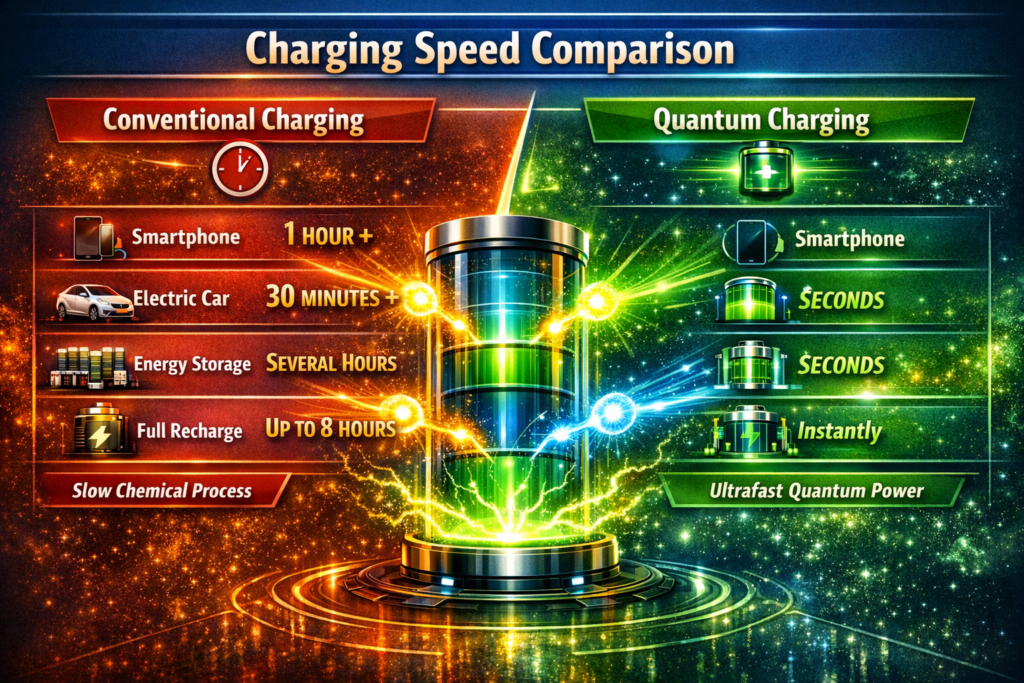
Unlike conventional lithium‑ion batteries, which rely on chemical reactions, quantum batteries harness quantum superposition and light‑matter interactions. This allows them to absorb and store energy almost instantaneously. The larger the battery, the faster it charges—a phenomenon known as superextensive charging.
Quantum Battery Breakthrough: The Science Behind It
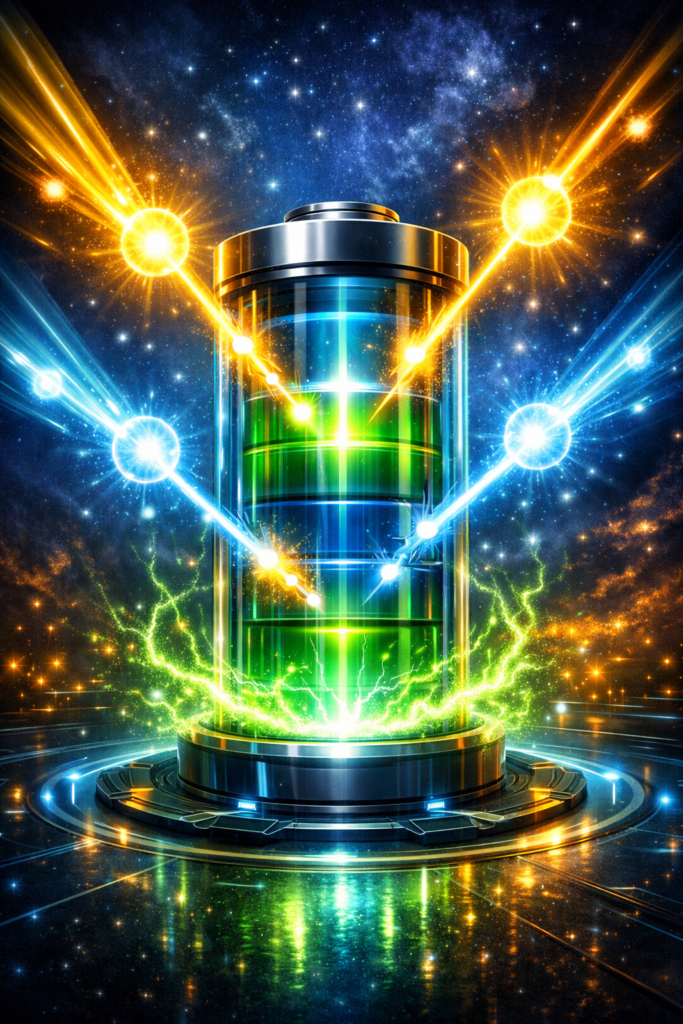
- Superposition: Quantum states enable simultaneous energy absorption across multiple pathways.
- Photon Excitation: Light directly excites quantum states, bypassing chemical limitations.
- Room Temperature Operation: Unlike many quantum technologies, this battery functions without extreme cooling.
This breakthrough demonstrates that quantum batteries can be charged in a quadrillionth of a second under laboratory conditions, proving their potential for real‑world applications.
Quantum batteries work differently:
1. Energy Stored in Quantum States
Particles can exist in multiple states at once through superposition. This enables faster energy storage mechanisms.
2. Collective Charging
When multiple quantum cells interact together, they may charge faster as a group than individually.
3. Light-Driven Power Input
Researchers use lasers or photon pulses to rapidly excite the battery material, transferring energy almost instantly.
4. Reduced Resistance
Because energy transfer is more direct, losses from heat and resistance may be reduced.
This is why the Quantum Battery Breakthrough: Charges in Seconds with Light has created such excitement among engineers and investors.
Quantum Battery Breakthrough: Why It Matters
- Consumer Electronics: Smartphones and laptops could charge instantly. Imagine plugging in your phone for 10 seconds and getting a full day’s charge.
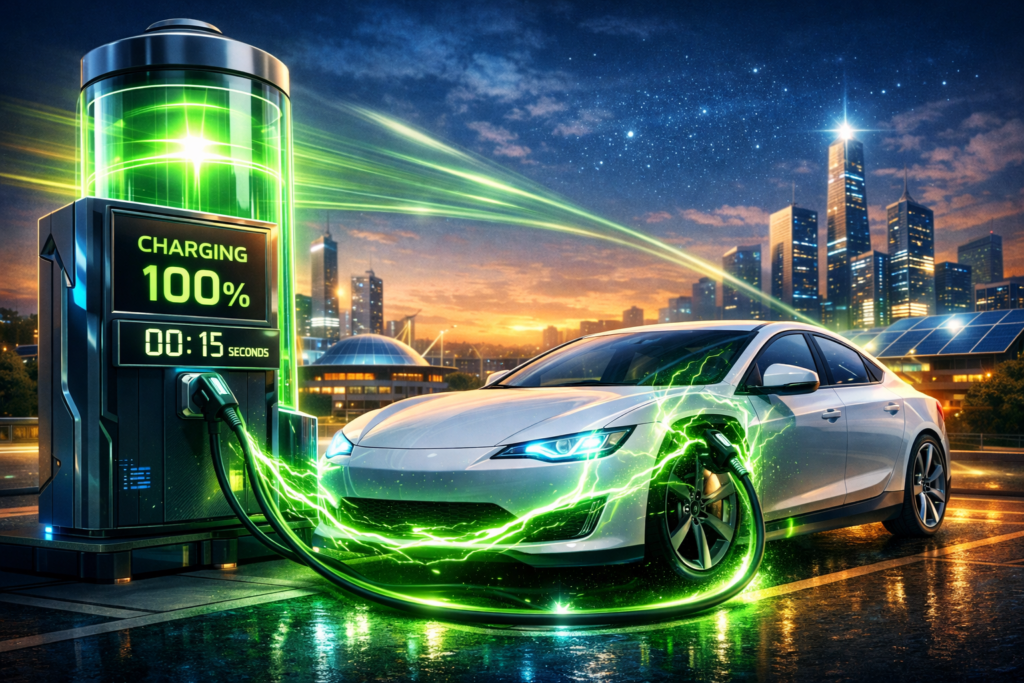
- Electric Vehicles: Cars may recharge in seconds, eliminating charging station queues.
- Renewable Energy: Solar and wind power systems need efficient storage. Fast-charging quantum batteries could improve grid reliability.
- Sustainability: Reduced reliance on rare earth metals and toxic chemicals.
- Space and Defense Applications : Compact, ultra-fast energy storage is critical in satellites, drones, and advanced defense systems.
The Quantum Battery Breakthrough: Charges in Seconds with Light represents a leap toward sustainable, efficient, and wireless energy ecosystems.
Quantum Battery Breakthrough: Future Applications
- Wireless Charging Ecosystems: Devices remain in a constant charging state.
- Smart Cities: Infrastructure powered by quantum batteries integrated with renewable grids.
- Medical Devices: Pacemakers and implants could recharge wirelessly.
- Space Exploration: Lightweight, fast‑charging systems for spacecraft.

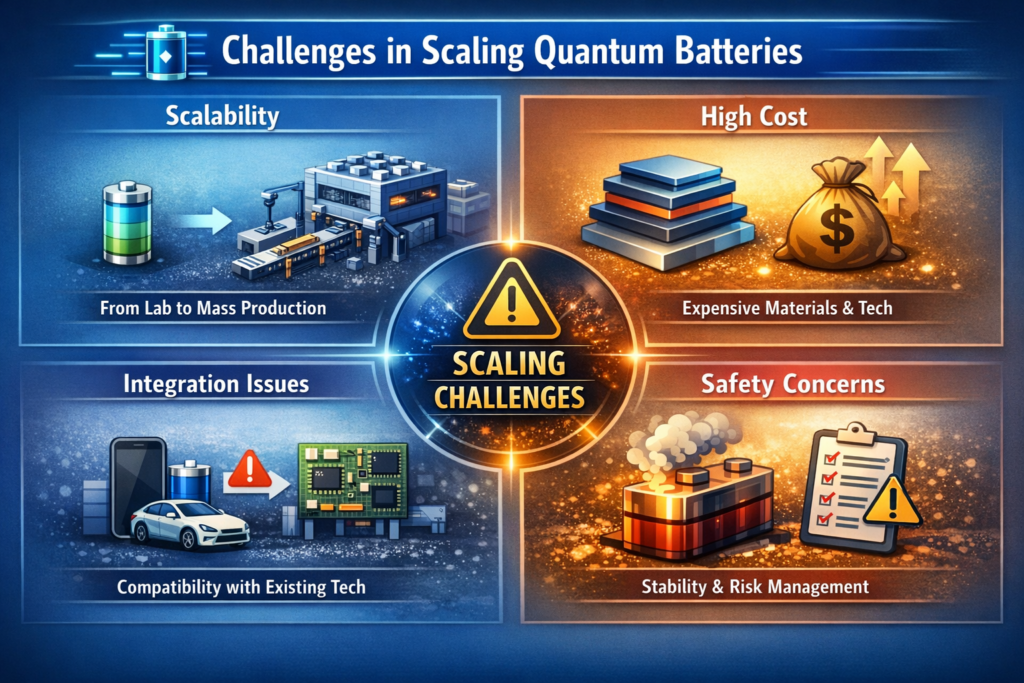
Quantum Battery Breakthrough: Challenges Ahead
Despite its promise, several hurdles remain:
- Scalability: Moving from prototypes to mass production. What works in the lab must be scaled for millions of devices.
- Integration: Compatibility with existing infrastructure.
- Cost: Advanced quantum materials and precision engineering may initially be expensive.
- Safety: Long‑term stability and controlled energy release must be tested. Any new battery system must meet strict global safety standards.
Which Industries Could Benefit First?
The first real-world applications of the Quantum Battery Breakthrough: Charges in Seconds with Light may appear in premium and industrial markets before consumer electronics.
Likely Early Adopters:
- Aerospace companies
- Medical devices
- Defense systems
- Luxury EV manufacturers
- Data centers
- High-performance electronics
Mass-market smartphones and household devices may follow later.
Quantum Battery Breakthrough: The Road Ahead
The Quantum Battery Breakthrough: Charges in Seconds with Light is not just a scientific milestone—it’s a paradigm shift. If successfully scaled, it could redefine how humanity powers devices, vehicles, and entire cities. Instant charging, wireless energy transfer, and sustainable storage are no longer science fiction but a tangible future.
FAQs
What is a quantum battery?
A battery that stores energy using quantum mechanical effects instead of standard chemical reactions.
Can it really charge in seconds?
Early research suggests ultra-fast charging may be possible under controlled laboratory conditions.
When will consumers see it?
Likely several years away, depending on commercialization progress.
Is it better than lithium-ion?
Potentially faster and more efficient, but still early-stage technology.