
India’s First Flex-Fuel Car: 7 Big Benefits Revealed
Introduction
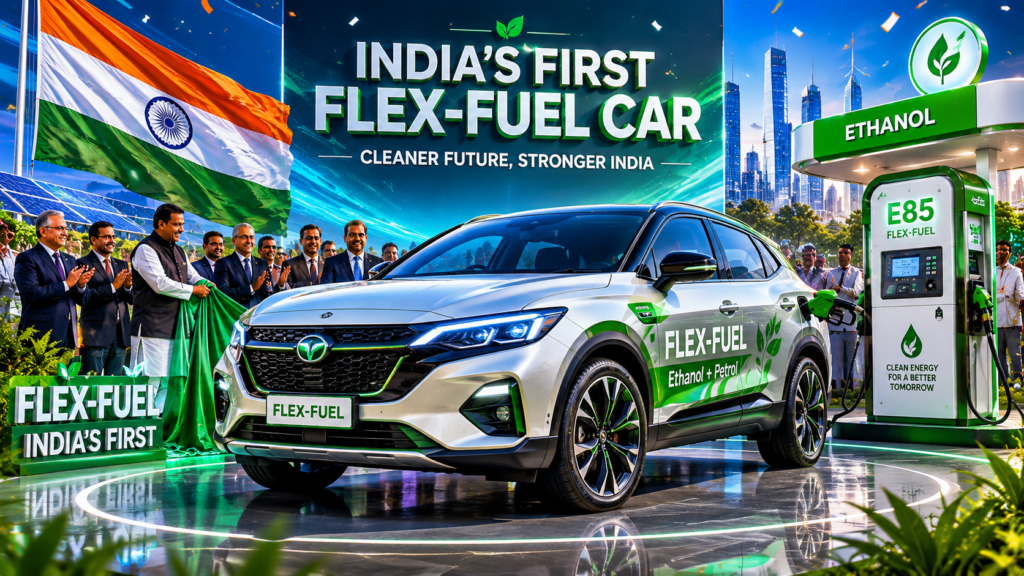
India’s automotive industry is undergoing a major transformation, and India’s First Flex-Fuel Car: 7 Big Benefits Revealed is a topic attracting immense attention among consumers, policymakers, and environmental experts alike. As the country seeks to reduce dependence on imported crude oil and promote cleaner fuels, flex-fuel technology has emerged as one of the most promising solutions.
India’s First Flex-Fuel Car: 7 Big Benefits Revealed
The Big Launch of India’s First Flex-Fuel Car
- Launch Timeline: Public showcase on June 4, followed by the official launch on June 5 (World Environment Day).
- Venue: Taj Palace, New Delhi
- Model Expected: Likely based on the popular WagonR or Fronx platform.
- Fuel Flexibility: Compatible with E20 to E100 ethanol blends, while also supporting conventional petrol.
- Expected Price Range: Around ₹7 lakh to ₹10 lakh (ex-showroom).
The launch of India’s first flex-fuel passenger car marks a significant milestone in the nation’s journey toward sustainable mobility. With rising fuel prices and growing environmental concerns, flex-fuel vehicles (FFVs) offer a practical alternative that can benefit both consumers and the economy.
Having followed the Indian automobile sector for years, I believe this development could be as important as the rise of electric vehicles in reshaping transportation choices. In this article, we explore India’s First Flex-Fuel Car: 7 Big Benefits Revealed, how the technology works, and why it matters for India’s future.
What Is a Flex-Fuel Car?
A flex-fuel vehicle is designed to operate on more than one type of fuel. Typically, these vehicles can run on:
- Petrol
- Ethanol blends
- E20 (20% ethanol, 80% petrol)
- E85 (85% ethanol, 15% petrol)
- E100 (100% ethanol in some configurations)
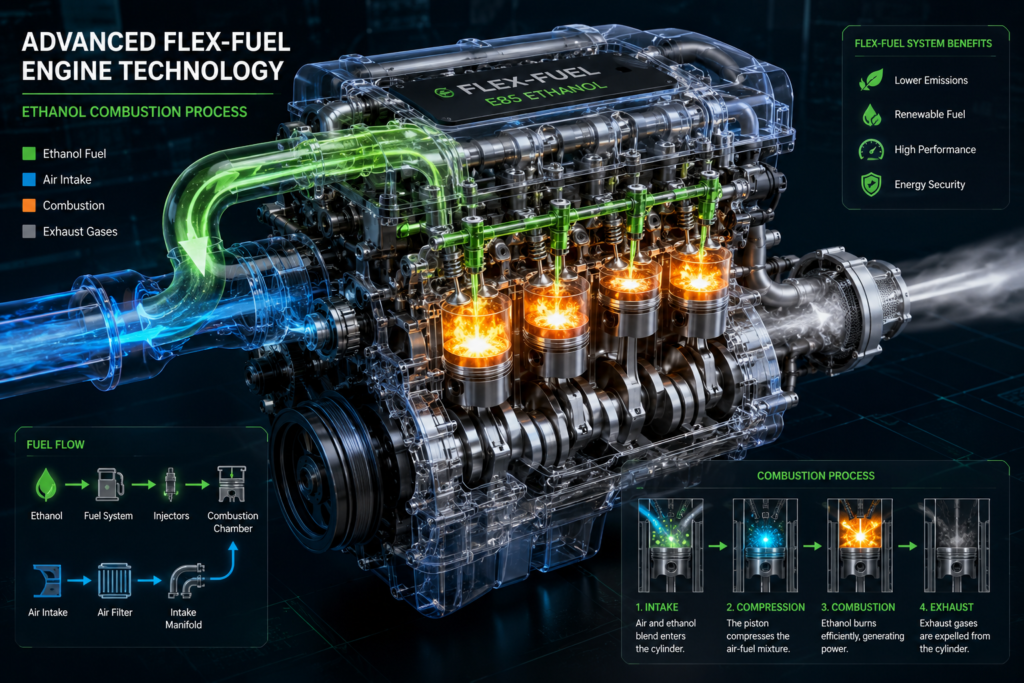
Special sensors and engine management systems automatically detect the fuel blend and adjust engine performance accordingly.
The significance of India’s First Flex-Fuel Car: 7 Big Benefits Revealed lies in its ability to support the government’s ambitious ethanol-blending targets while providing consumers with greater fuel flexibility.
Why India Is Promoting Flex-Fuel Technology
India imports nearly 85% of its crude oil requirements. This dependence exposes the economy to global oil price fluctuations and geopolitical uncertainties.
The government has therefore focused on:
- Ethanol blending programs
- Alternative fuel technologies
- Energy diversification
- Reduced carbon emissions
- Support for farmers through biofuel production
The introduction of India’s first flex-fuel car aligns perfectly with these national objectives.
India’s First Flex-Fuel Car: 7 Big Benefits Revealed
Now let’s explore the seven biggest advantages of this revolutionary technology.
1. Lower Fuel Costs for Consumers
One of the most attractive aspects of India’s First Flex-Fuel Car: 7 Big Benefits Revealed is the potential for lower fuel expenses.
Ethanol is generally cheaper to produce than petrol because it is derived from agricultural products such as:
- Sugarcane
- Corn
- Grain
- Agricultural residues
As ethanol production scales up in India, consumers may benefit from lower fuel prices compared to conventional petrol.
Why It Matters
For daily commuters, even a modest reduction in fuel costs can result in significant annual savings.
Benefits include:
- Reduced transportation expenses
- Better affordability
- Protection from oil price spikes
This makes flex-fuel vehicles particularly appealing for middle-class households.
2. Reduced Dependence on Crude Oil Imports
Another major highlight of India’s First Flex-Fuel Car: 7 Big Benefits Revealed is enhanced energy security.
India spends billions of dollars annually importing crude oil. By increasing ethanol usage, the country can:
- Reduce foreign exchange outflows
- Lower import dependence
- Improve trade balance
- Strengthen energy independence
National Economic Impact
Reduced oil imports can help:
- Stabilize the rupee
- Improve fiscal health
- Strengthen economic resilience
This benefit extends beyond vehicle owners and positively impacts the entire economy.
3. Significant Reduction in Carbon Emissions
Environmental sustainability is one of the strongest arguments supporting flex-fuel technology.
Ethanol is considered a renewable fuel because it is produced from plant-based sources.
Environmental Benefits
Compared to traditional fossil fuels, ethanol can contribute to:
- Lower greenhouse gas emissions
- Reduced carbon footprint
- Cleaner combustion
- Improved air quality
As India works toward its climate commitments, widespread adoption of flex-fuel vehicles could become an important part of the solution.
This is one of the most compelling reasons behind India’s First Flex-Fuel Car: 7 Big Benefits Revealed.

4. Higher Income Opportunities for Farmers
One often-overlooked advantage of India’s First Flex-Fuel Car: 7 Big Benefits Revealed is its positive impact on rural India.
Ethanol production creates additional demand for agricultural feedstocks such as:
- Sugarcane
- Maize
- Damaged grains
- Agricultural waste
How Farmers Benefit
Growing demand can lead to:
- Better crop prices
- Stable income streams
- Increased rural investment
- Job creation
India’s ethanol ecosystem can transform agriculture into a significant contributor to clean energy production.
This creates a win-win situation for both farmers and the transportation sector.
5. Existing Infrastructure Can Be Utilized
Unlike electric vehicles, which require widespread charging infrastructure, flex-fuel vehicles can leverage much of the existing fuel distribution network.
Infrastructure Advantages
Petrol stations can gradually introduce:
- E20 fuel
- E85 fuel
- Ethanol dispensing systems
This means the transition can happen faster and more economically.
Consumers do not need to worry about:
- Range anxiety
- Long charging times
- Limited charging networks
As a result, adoption barriers remain relatively low.
6. Strong Engine Performance
Many consumers assume alternative fuels compromise performance, but modern flex-fuel engines are highly sophisticated.
A key aspect of India’s First Flex-Fuel Car: 7 Big Benefits Revealed is that these vehicles maintain strong performance characteristics.
Performance Advantages
Ethanol offers:
- Higher octane rating
- Better combustion characteristics
- Reduced engine knocking
- Smooth acceleration
Advanced engine control systems automatically optimize performance based on the fuel blend being used.
Drivers can enjoy both efficiency and performance without sacrificing convenience.
7. Supports India’s Green Energy Transition
Perhaps the most strategic benefit highlighted in India’s First Flex-Fuel Car: 7 Big Benefits Revealed is its role in India’s broader clean-energy transition.
India is simultaneously investing in:
- Electric mobility
- Green hydrogen
- Biofuels
- Renewable energy
- Sustainable transportation
Flex-fuel vehicles provide an immediate and practical pathway toward reducing emissions without waiting for complete electrification.
Bridge Technology
Flex-fuel vehicles can serve as a bridge between:
Traditional Fossil Fuel Era → Cleaner Biofuel Era → Fully Sustainable Mobility
This balanced approach allows India to achieve environmental goals while maintaining economic growth.
How Flex-Fuel Cars Compare with Electric Vehicles
| Feature | Flex-Fuel Cars | Electric Vehicles |
|---|---|---|
| Refueling Time | Minutes | 30 mins–8 hours |
| Infrastructure | Existing Fuel Stations | Charging Network Needed |
| Range Anxiety | Minimal | Possible |
| Fuel Source | Ethanol & Petrol | Electricity |
| Initial Cost | Lower | Higher |
| Long-Distance Travel | Convenient | Improving |
Both technologies have important roles to play in India’s mobility future.
Rather than competing, they can complement each other.
Challenges That Need Attention
Although India’s First Flex-Fuel Car: 7 Big Benefits Revealed presents numerous advantages, some challenges remain.
1. Ethanol Supply Expansion
India must significantly increase ethanol production capacity.
2. Distribution Infrastructure
Fuel stations need investment to offer higher ethanol blends.
3. Consumer Awareness
Many buyers are still unfamiliar with flex-fuel technology.
4. Vehicle Availability
More automakers must introduce flex-fuel models across segments.
Addressing these challenges will accelerate adoption nationwide.
Future Outlook for Flex-Fuel Vehicles in India
The future appears promising.
Government initiatives supporting:
- Ethanol blending
- Biofuel investments
- Energy security
- Emission reduction
are creating favorable conditions for flex-fuel vehicle growth.
Industry experts expect:
- More FFV launches
- Wider ethanol availability
- Increased consumer acceptance
- Lower operating costs
As production scales up, flex-fuel vehicles could become a mainstream choice for Indian consumers.
The launch highlighted in India’s First Flex-Fuel Car: 7 Big Benefits Revealed may only be the beginning of a larger transformation.
Expert Perspective
Having tracked automotive innovation for years, I see flex-fuel technology as one of the most practical solutions currently available for India.
While electric vehicles dominate headlines, flex-fuel vehicles offer immediate benefits without requiring massive behavioral changes from consumers.
The combination of:
- Lower emissions
- Energy security
- Farmer benefits
- Existing infrastructure compatibility
makes this technology uniquely suited to India’s current economic and environmental needs.
The significance of India’s First Flex-Fuel Car: 7 Big Benefits Revealed extends far beyond a single vehicle launch—it represents a strategic shift in India’s transportation future.
Frequently Asked Questions (FAQs)
What is India’s first flex-fuel car?
India’s first flex-fuel car is a vehicle capable of operating on petrol as well as high ethanol blends such as E85, supporting the country’s biofuel and clean-energy goals.
What fuel does a flex-fuel vehicle use?
A flex-fuel vehicle can use petrol, ethanol, or various combinations of both fuels.
Is ethanol cheaper than petrol?
In many cases, ethanol can be produced at a lower cost than petrol, potentially reducing fuel expenses for consumers.
Are flex-fuel cars environmentally friendly?
Yes. Ethanol-based fuels generally produce lower greenhouse gas emissions compared to conventional fossil fuels.
Do flex-fuel vehicles require special fueling stations?
Existing fuel stations can be upgraded to provide higher ethanol blends, making infrastructure expansion relatively straightforward.
Can flex-fuel cars replace electric vehicles?
Not necessarily. Both technologies serve different purposes and can coexist as part of India’s broader clean transportation strategy.
Why is India promoting ethanol fuel?
India aims to reduce oil imports, support farmers, improve energy security, and lower carbon emissions through increased ethanol usage.
Conclusion
India’s First Flex-Fuel Car: 7 Big Benefits Revealed demonstrates how innovation can simultaneously address economic, environmental, and energy-security challenges. From lower fuel costs and reduced oil imports to cleaner emissions and greater support for farmers, the advantages are substantial.
As India accelerates its transition toward sustainable mobility, flex-fuel technology is poised to become an important pillar of the nation’s transportation ecosystem. The launch of India’s first flex-fuel car is not just another automotive milestone—it is a glimpse into a cleaner, more self-reliant future for the country.