
Introduction
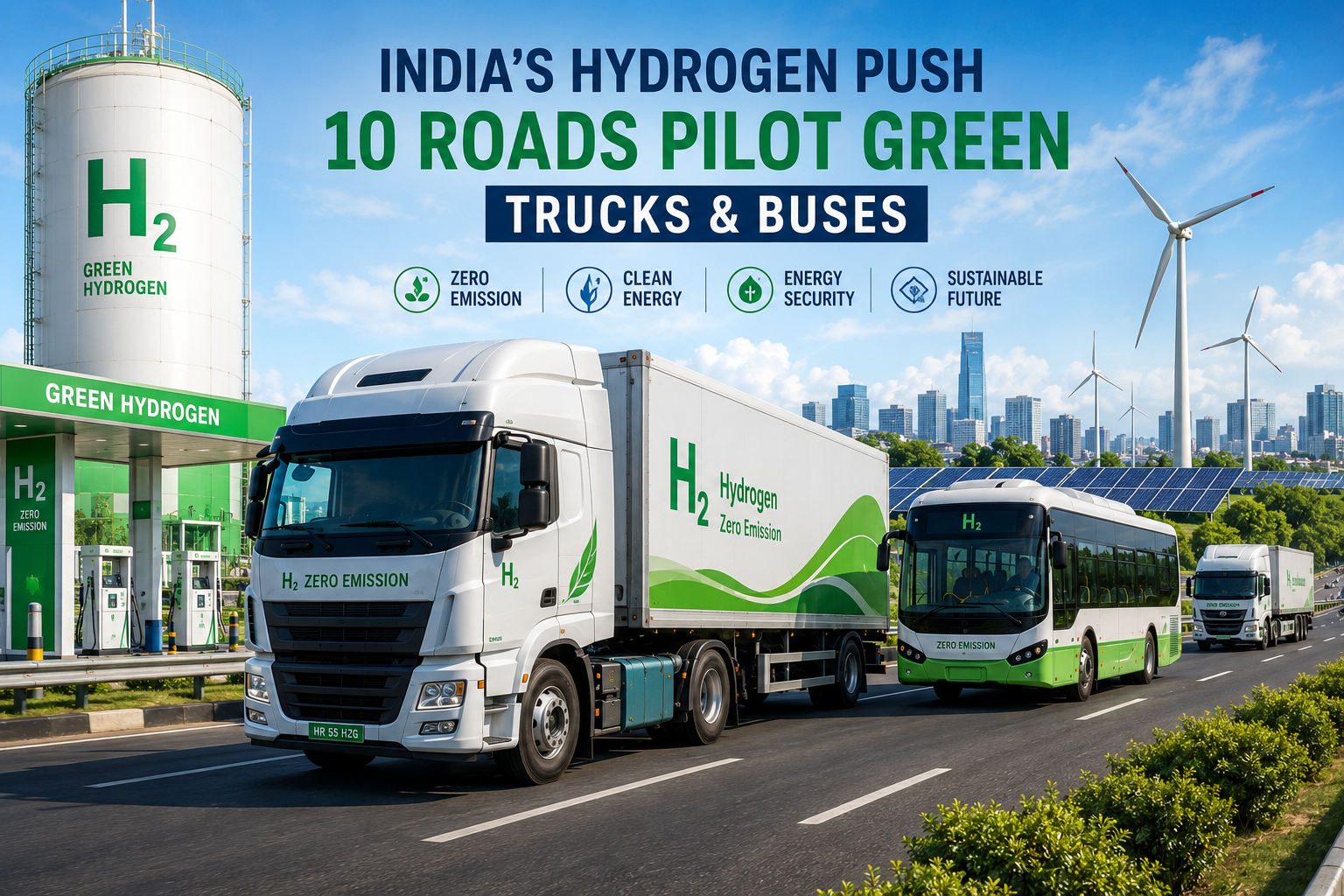
India’s Hydrogen Push: 10 Roads Pilot Green Trucks & Buses
A new era of green mobility is taking shape across India’s transportation sector.With ambitious climate goals, rising fuel import bills, and growing freight demand, the country is now exploring hydrogen as a major alternative fuel. The latest initiative, India’s Hydrogen Push: 10 Roads Pilot Green Trucks & Buses, marks a significant milestone in the nation’s journey toward sustainable mobility.
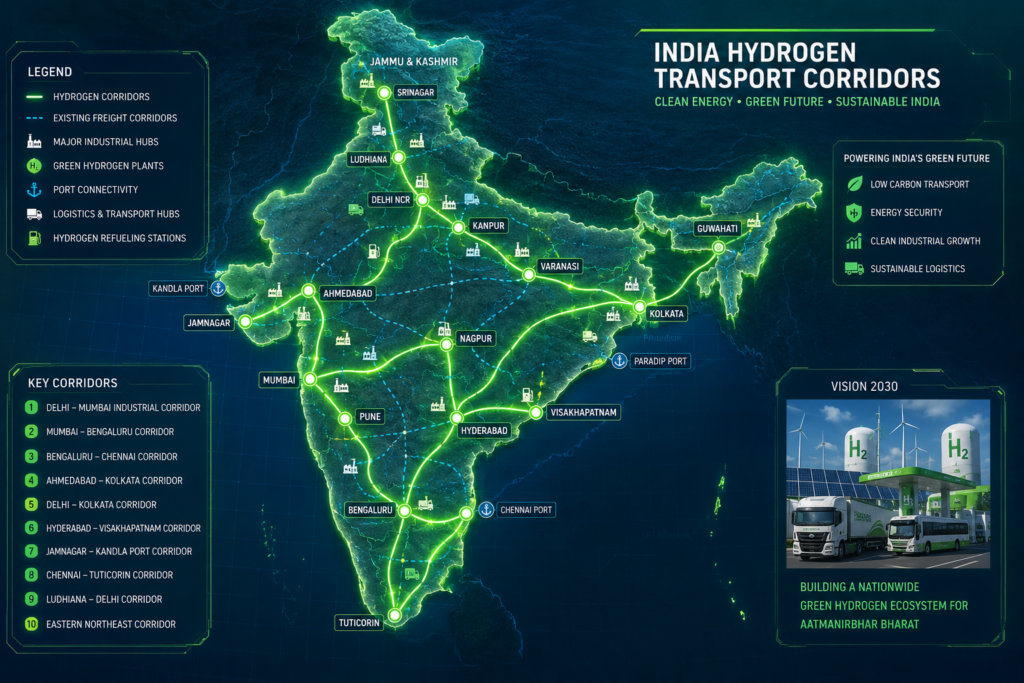
The pilot project aims to deploy hydrogen-powered trucks and buses across ten strategic transport corridors. These routes will serve as real-world testing grounds for hydrogen fuel-cell and hydrogen internal combustion engine (H2-ICE) vehicles. The initiative is expected to generate critical data on vehicle performance, fuel efficiency, infrastructure requirements, and commercial viability.
As someone who has closely followed India’s energy transition for years, I see this initiative as one of the most important transportation experiments in the country’s modern history. If successful, it could transform logistics, public transport, and industrial mobility while reducing dependence on imported fossil fuels.
Understanding India’s Hydrogen Push
The government has been aggressively promoting green hydrogen under the National Green Hydrogen Mission, which aims to position India as a global leader in hydrogen production and utilization.
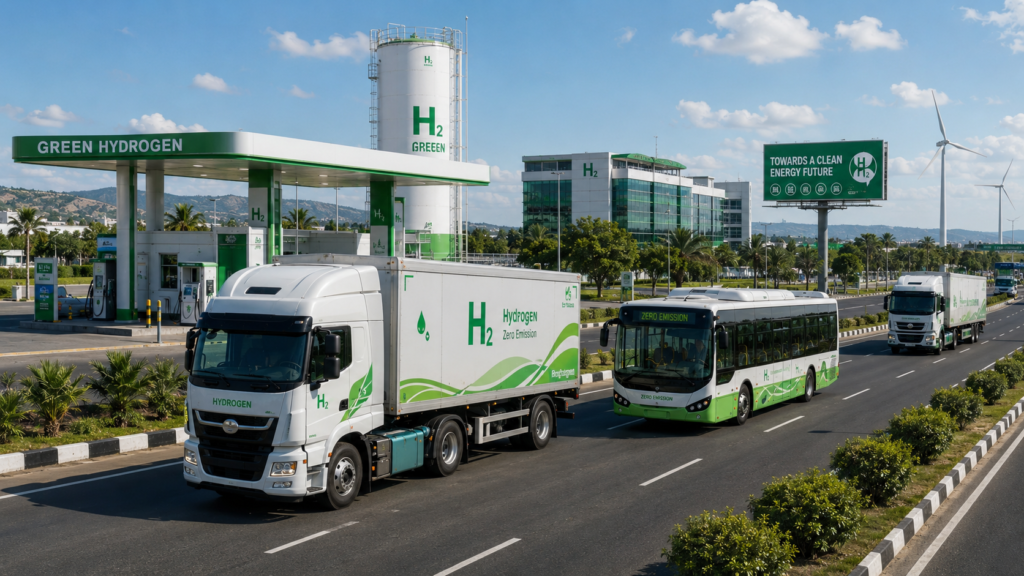
Under India’s Hydrogen Push: 10 Roads Pilot Green Trucks & Buses, hydrogen-powered commercial vehicles will operate on selected routes connecting industrial hubs, ports, logistics centers, and urban regions.
The primary objectives include:
- Testing hydrogen vehicle performance in Indian conditions
- Evaluating long-distance freight operations
- Developing hydrogen refueling infrastructure
- Reducing transportation emissions
- Encouraging domestic manufacturing
- Creating a hydrogen mobility ecosystem
This pilot is not merely about introducing new vehicles. It is about building an entire value chain—from hydrogen production and storage to transportation and consumption.
India’s Hydrogen Push: 10 Roads Pilot Green Trucks & Buses
Why Hydrogen Matters for India’s Transport Sector
Transportation contributes significantly to India’s carbon emissions. Heavy-duty trucks and buses account for a disproportionate share of fuel consumption due to long operating hours and high payload requirements.
Battery-electric vehicles are gaining popularity for passenger transport, but challenges remain for heavy commercial vehicles:
- Long charging times
- Limited driving range
- Heavy battery weight
- Infrastructure constraints
Hydrogen offers several advantages:
Faster Refueling
Hydrogen vehicles can be refueled within minutes compared to hours for many electric trucks.
Longer Range
Many hydrogen-powered trucks can travel hundreds of kilometers on a single fill.
Higher Payload Capacity
Unlike battery-heavy vehicles, hydrogen systems often allow greater cargo-carrying capacity.
Zero Tailpipe Emissions
Fuel-cell vehicles emit only water vapor, making them highly attractive for sustainable transportation.
These advantages explain why India’s Hydrogen Push: 10 Roads Pilot Green Trucks & Buses is receiving considerable attention from policymakers and industry stakeholders.
The 10 Strategic Transport Corridors
The selected routes are expected to connect major industrial and commercial centers where freight movement is substantial.
Potential corridor categories include:
Port-to-Industrial Routes
These corridors transport raw materials and finished goods between ports and manufacturing zones.
Mining Corridors
Heavy trucks operating in mining regions can benefit from hydrogen technology due to high daily mileage.
Urban Bus Networks
Hydrogen buses may be deployed in metropolitan areas to reduce urban air pollution.
Industrial Freight Routes
Dedicated freight corridors connecting factories and logistics parks are ideal testing grounds.
By deploying vehicles on diverse routes, authorities can assess hydrogen technology under different operating conditions.
How Hydrogen Fuel Cell Vehicles Work
To understand India’s Hydrogen Push: 10 Roads Pilot Green Trucks & Buses, it helps to understand the underlying technology.
A hydrogen fuel-cell vehicle stores compressed hydrogen in onboard tanks.
The process works as follows:
- Hydrogen enters the fuel cell.
- Oxygen is drawn from the atmosphere.
- An electrochemical reaction generates electricity.
- Electricity powers the electric motor.
- Water vapor is released as the only emission.
Unlike conventional combustion engines, fuel cells do not burn fuel directly.
Benefits include:
- High efficiency
- Quiet operation
- Zero tailpipe pollution
- Long operational range
These characteristics make fuel-cell vehicles particularly attractive for heavy transport applications.
Green Hydrogen: The Fuel Behind the Revolution
A major highlight of India’s Hydrogen Push: 10 Roads Pilot Green Trucks & Buses is the government’s emphasis on utilizing green hydrogen to decarbonize heavy transportation.
Hydrogen can be produced through various methods:
Grey Hydrogen
Produced from natural gas with significant carbon emissions.
Blue Hydrogen
Produced from natural gas with carbon capture technology.
Green Hydrogen
Generated using renewable electricity and water electrolysis.
Green hydrogen is considered the cleanest option because renewable energy powers the production process.
India’s abundant solar and wind resources provide a strong foundation for large-scale green hydrogen production.
India’s Hydrogen Push: 10 Roads Pilot Green Trucks & Buses
Economic Benefits of the Hydrogen Mobility Mission
The initiative could create substantial economic opportunities.
Reduced Fuel Imports
India spends billions of dollars annually importing crude oil.
Locally produced hydrogen could reduce:
- Oil dependency
- Trade deficits
- Energy security risks
New Manufacturing Opportunities
The hydrogen economy requires:
- Electrolyzers
- Fuel cells
- Storage systems
- Refueling stations
- Specialized vehicles
This could stimulate domestic manufacturing and support the Make in India initiative.
Job Creation
The hydrogen value chain may generate jobs across:
- Engineering
- Manufacturing
- Infrastructure development
- Research and development
- Operations and maintenance
The long-term economic impact of India’s Hydrogen Push: 10 Roads Pilot Green Trucks & Buses could be substantial.
Environmental Impact
India has committed to ambitious climate targets and net-zero goals.
Hydrogen-powered transportation can help reduce:
Carbon Emissions
Heavy-duty vehicles are among the largest emitters within the transport sector.
Air Pollution
Hydrogen fuel-cell vehicles emit only water vapor.
Noise Pollution
Electric drivetrains operate more quietly than diesel engines.
Urban Health Burden
Cleaner transportation can contribute to improved public health outcomes.
India’s Hydrogen Push: 10 Roads Pilot Green Trucks & Buses marks a major milestone in advancing sustainable transportation for both urban centers and industrial corridors.
Infrastructure Challenges Ahead
While the potential is enormous, several challenges remain.
Limited Refueling Stations
Hydrogen infrastructure is still in its infancy.
High Production Costs
Green hydrogen remains more expensive than conventional fuels.
Storage and Transportation
Hydrogen requires specialized handling and storage systems.
Vehicle Costs
Hydrogen trucks and buses currently cost more than diesel alternatives.
However, technological improvements and economies of scale are expected to reduce costs over time.
Many experts believe early pilot projects are essential for accelerating market adoption.
Industry Participation and Private Sector Interest
India’s Hydrogen Push: 10 Roads Pilot Green Trucks & Buses
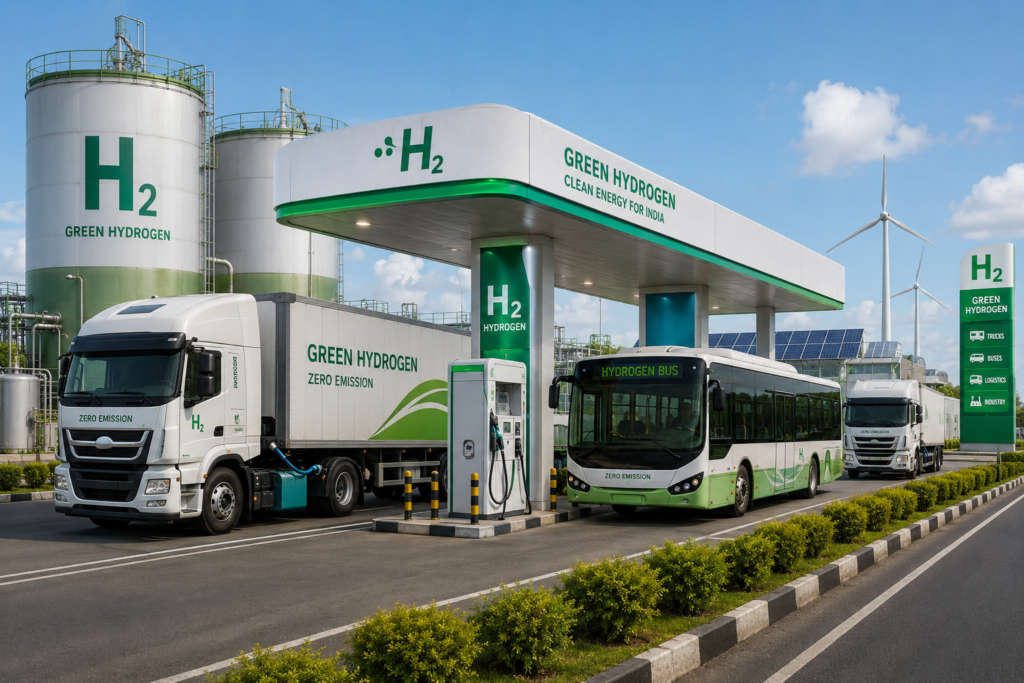
Several Indian companies are actively investing in hydrogen technologies.
Major sectors involved include:
- Energy companies
- Automobile manufacturers
- Commercial vehicle makers
- Infrastructure developers
- Industrial gas providers
Partnerships between government agencies and private firms will be critical for the success of India’s Hydrogen Push: 10 Roads Pilot Green Trucks & Buses.
Collaboration can accelerate:
- Technology development
- Infrastructure deployment
- Cost reductions
- Commercial adoption
Global Hydrogen Trends and India’s Position
Countries worldwide are investing heavily in hydrogen mobility.
Notable examples include:
- Japan
- South Korea
- Germany
- China
- United States
India possesses unique advantages:
Renewable Energy Capacity
Large-scale solar and wind resources can power green hydrogen production.
Growing Freight Market
India’s logistics sector continues to expand rapidly.
Manufacturing Potential
Domestic production capabilities can support a complete hydrogen ecosystem.
Policy Support
Government incentives are encouraging investment in hydrogen projects.
As global demand for clean fuels grows, India could emerge as both a major producer and consumer of green hydrogen.
What Success Would Look Like
The pilot project’s success will likely be measured through:
Operational Performance
- Vehicle uptime
- Reliability
- Range consistency
Cost Competitiveness
Comparison with diesel alternatives.
Infrastructure Efficiency
Performance of hydrogen production and refueling systems.
Emission Reduction
Quantifiable environmental benefits.
Scalability
Potential for nationwide deployment.
If the outcomes are positive, India’s Hydrogen Push: 10 Roads Pilot Green Trucks & Buses could pave the way for large-scale commercial adoption across the country.
Future Outlook
India’s Hydrogen Push: 10 Roads Pilot Green Trucks & Buses
The future of hydrogen mobility in India looks promising.
Over the next decade, we may witness:
- Thousands of hydrogen trucks on highways
- Hydrogen-powered intercity buses
- Dedicated hydrogen logistics corridors
- Expansion of green hydrogen production facilities
- Increased private-sector investment
The transportation sector is undergoing one of the most significant transformations in its history.
Hydrogen has the potential to become a cornerstone of India’s clean mobility strategy, complementing electric vehicles and renewable energy initiatives.
Conclusion
India’s Hydrogen Push: 10 Roads Pilot Green Trucks & Buses represents much more than a transportation experiment. It is a strategic effort to build a cleaner, more secure, and technologically advanced energy future.
By testing hydrogen-powered trucks and buses on real-world transport corridors, India is taking a practical approach toward evaluating one of the most promising clean-fuel technologies available today.
While challenges related to infrastructure and cost remain, the potential rewards are substantial. Reduced emissions, lower oil dependence, enhanced energy security, and new industrial opportunities could reshape the country’s transportation landscape.
From my perspective as an observer of India’s energy transition, this initiative may eventually be remembered as the starting point of a hydrogen-powered freight revolution. If executed effectively, India’s Hydrogen Push: 10 Roads Pilot Green Trucks & Buses could become a model for emerging economies worldwide seeking sustainable mobility solutions.
Frequently Asked Questions (FAQs)
1. What is India’s Hydrogen Push: 10 Roads Pilot Green Trucks & Buses?
It is a pilot initiative to deploy hydrogen-powered trucks and buses on ten strategic transport routes to evaluate performance, efficiency, and infrastructure needs.
2. Why is hydrogen being used for trucks and buses?
Hydrogen offers fast refueling, long driving range, higher payload capacity, and zero tailpipe emissions, making it suitable for heavy commercial vehicles.
3. What is green hydrogen?
Green hydrogen is produced using renewable energy sources such as solar and wind power through the electrolysis of water.
4. How does a hydrogen fuel-cell vehicle work?
It combines hydrogen and oxygen in a fuel cell to generate electricity that powers the vehicle, producing only water vapor as a byproduct.
5. Will hydrogen replace diesel trucks in India?
Not immediately. Hydrogen technology is currently in the pilot stage, but successful trials could lead to wider adoption over time.
6. What are the biggest challenges for hydrogen mobility?
Major challenges include high fuel costs, limited refueling infrastructure, storage requirements, and vehicle affordability.
7. How will this initiative benefit India?
Benefits include lower emissions, reduced oil imports, improved energy security, job creation, and support for domestic manufacturing.
8. Can hydrogen and electric vehicles coexist?
Yes. Hydrogen is particularly suitable for heavy-duty transport, while battery-electric vehicles may dominate shorter-distance passenger mobility.