
RBI Dollar Swap Surges: $72.8B Boost to Forex
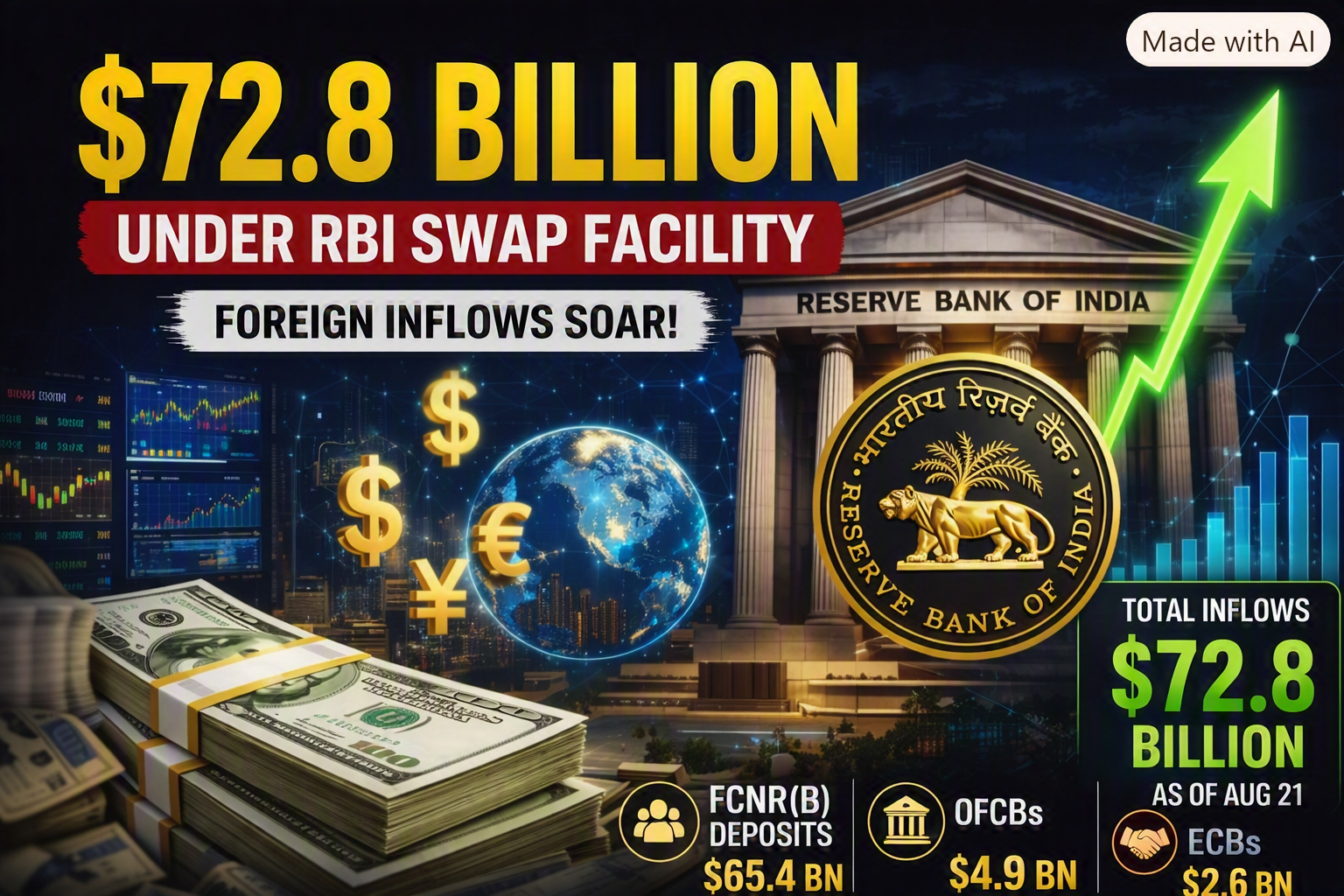
RBI Dollar Swap Surges: $72.8B Boost to Forex has emerged as a major development in India’s foreign-exchange market, with authorised dealer banks mobilising $72.848 billion through the reserve Bank of India’s special USD-INR forex swap facility by August 21, 2026.
The latest RBI data shows that Foreign Currency Non-Resident (Bank), or FCNR(B), deposits accounted for $65.397 billion, making them the dominant source of the Foreign Currency inflows. Overseas Foreign Currency Borrowings (OFCBs) contributed another $4.860 billion, while External Commercial Borrowings (ECBs) added $2.591 billion.
The speed of mobilisation has been particularly notable. Banks had raised around $40.8 billion by July 31 and $56.9 billion by August 13 before the total climbed above $72.8 billion by August 21.
The development gives India an important additional source of foreign-currency liquidity at a time when global markets remain sensitive to interest rates, oil prices, geopolitical risks and movements in the US dollar.

What Is Driving the $72.8 Billion Forex Inflow?
The RBI’s special swap facility was introduced on June 8, 2026, covering three important sources of foreign-currency funding: FCNR(B) deposits, ECBs and OFCBs. The facility was designed to encourage banks to bring additional foreign currency into India’s financial system.
The latest numbers show that the strategy has received a much stronger response than initially expected.
Of the total $72.848 billion:
| Source | Inflow |
|---|---|
| FCNR(B) deposits | $65.397 billion |
| OFCBs | $4.860 billion |
| ECBs | $2.591 billion |
| Total | $72.848 billion |
FCNR(B) deposits represent almost 90% of the total mobilisation, clearly establishing non-resident deposits as the central driver of the scheme.
The large FCNR(B) response suggests that Indian banks have been highly successful in attracting foreign-currency deposits, particularly from non-resident customers.
RBI Dollar Swap Surges as FCNR(B) Deposits Lead
The most important feature of the RBI dollar swap programme is the extraordinary contribution from FCNR(B) deposits.
FCNR(B) accounts allow eligible non-residents to maintain deposits in specified foreign currencies rather than directly taking currency risk on the rupee. For banks, these deposits represent an important source of foreign-currency funding.
The RBI’s latest figures show that FCNR(B) mobilisation reached $65.397 billion by August 21, up from $52.3 billion as of August 13. That means banks added roughly $13.1 billion through this route in just one week.
This acceleration helps explain why the central bank decided to shorten the FCNR(B) mobilisation window.
The RBI had initially planned to keep the FCNR(B) component open until September 30. It subsequently brought the deadline forward to August 31, 2026, reflecting the strong response and large volume of foreign-currency mobilisation.
Why Are Banks Attracting FCNR(B) Deposits?
Several factors have encouraged banks to participate aggressively.
First, the RBI’s swap arrangement provides banks with a mechanism to convert foreign-currency resources into rupee liquidity while managing their currency exposure.
Second, banks have been able to use their extensive overseas and NRI networks to attract foreign-currency deposits.
Third, the special facility reduces some of the funding and hedging challenges normally associated with bringing foreign-currency resources into the domestic banking system.
The combination has created a powerful incentive for banks to accelerate fundraising before the FCNR(B) deadline.

How the RBI Dollar Swap Facility Works
The mechanism behind the RBI forex swap facility is important for understanding why the headline figure should not simply be interpreted as a permanent $72.8 billion addition to India’s wealth.
Under the arrangement, participating banks mobilise eligible foreign-currency funds and enter into transactions with the RBI. The central bank receives the foreign currency while the banks obtain rupee liquidity.
The transactions are structured as swaps, meaning that there is a future obligation associated with the foreign currency received by the RBI.
This distinction matters.
A foreign-exchange swap can provide immediate liquidity and strengthen the central bank’s foreign-currency position without representing the same thing as a permanent, unconditional increase in net external assets.
Nevertheless, the facility is strategically important because it brings foreign-currency resources into the banking system and provides the RBI with greater flexibility in managing market liquidity.
RBI Dollar Swap Surges and India’s Forex Reserves
The latest development comes alongside a substantial increase in India’s foreign-exchange reserves.
India’s forex reserves rose by $9.905 billion to $716.90 billion during the week ended August 14, according to RBI data reported after the latest reserve update.
The increase followed a rise of about $14.1 billion in the previous week, taking reserves above the $700-billion level. The latest increase was supported in part by foreign-currency inflows associated with the FCNR(B) mobilisation programme.
This gives the RBI greater external liquidity at a time when currency markets remain volatile.
Large reserves can help a central bank manage sudden changes in capital flows, external financing conditions and currency-market pressures.
However, the relationship between the swap scheme and reserves needs to be understood carefully.
The $72.8 billion figure represents foreign-currency mobilisation under the facility. It should not automatically be treated as a $72.8-billion permanent increase in India’s net forex reserves.
Why $72.8 Billion Matters for the Indian Economy
The scale of the inflow has implications beyond the foreign-exchange market.
1. Greater Dollar Liquidity
A stronger supply of foreign currency can improve liquidity conditions for banks and financial institutions.
This is particularly important for businesses involved in international trade, overseas borrowing and cross-border transactions.
2. Stronger External Buffer
Higher foreign-currency availability gives India a larger buffer against external shocks.
India is heavily dependent on imports of crude oil and other commodities, which means global dollar movements can have a direct effect on domestic inflation and the current account.
3. Better Banking-System Funding
The facility allows banks to tap foreign-currency sources and use the resulting liquidity within the banking system, subject to applicable regulations.
This can diversify banks’ funding sources beyond domestic deposits.
4. Support for Currency Stability
The availability of foreign currency gives the RBI another tool for maintaining orderly conditions in the forex market.
It does not guarantee a particular rupee-dollar exchange rate, but it can improve the central bank’s ability to respond to periods of excessive volatility.
5. Stronger Investor Confidence
A robust external liquidity position can reassure international investors that India has sufficient foreign-currency resources to manage external pressures.
The RBI Dollar Swap Surges Story Is Bigger Than the Headline
The RBI Dollar Swap Surges: $72.8B Boost to Forex story is not simply about a large number appearing in the central bank’s data.
It reflects a broader strategy by the RBI to strengthen India’s external financial position.
The timing is also significant.
Global markets remain vulnerable to sudden changes in US monetary policy, energy prices and geopolitical conditions. India’s import bill can rise sharply when crude oil prices increase, while foreign portfolio investors can rapidly move money across emerging markets when global risk appetite changes.
Against that backdrop, a strong foreign-currency buffer can provide valuable protection.
The RBI’s Governor Sanjay Malhotra had indicated that the central bank expected around $80 billion of inflows through subsidised swap windows, according to a Reuters report published earlier this month.
The latest $72.848-billion figure therefore puts actual mobilisation close to that broader expectation.
Why Did the RBI Shorten the FCNR(B) Deadline?
One of the most interesting aspects of the programme is the RBI’s decision to close the FCNR(B) mobilisation window earlier than originally planned.
The initial deadline was September 30, but the RBI subsequently moved it forward to August 31.
The decision indicates that the central bank believes the programme has already attracted a substantial volume of foreign currency.
There are also policy trade-offs.
Reuters reported that analysts viewed the strong inflows as reducing the need to keep the facility open for longer, while also pointing to issues such as external liabilities, liquidity management and the cost associated with the forward component of the arrangement.
In other words, more foreign currency is not automatically better if the cost and future obligations associated with obtaining it become too high.
The RBI therefore has to balance three objectives:
- attracting sufficient foreign currency;
- maintaining domestic liquidity conditions;
- avoiding unnecessary future external liabilities or funding costs.
What Happens After August 31?
The FCNR(B) component of the facility is scheduled to close for new mobilisation on August 31, 2026.
However, the swap facility covering ECBs and OFCBs remains available until December 31, 2026.
This means the headline figure could still change as additional eligible inflows arrive through the remaining channels.
The final FCNR(B) figure will be closely watched because banks added approximately $13 billion during the latest week of reported data.
If that pace continues before the August 31 deadline, the final total could move materially above the current $65.4 billion.
RBI Forex Strategy

Impact on the Indian Rupee
The RBI dollar swap initiative also has implications for the Indian rupee.
The rupee has faced pressure from several external factors, including elevated oil prices, global dollar strength and importer demand. Reuters reported in August that the rupee had depreciated around 6.5% year-to-date, making it one of Asia’s weaker-performing currencies during the period.
Additional foreign-currency liquidity can help the RBI respond to periods of disorderly market conditions.
However, the swap programme alone cannot determine the direction of the rupee.
Currency movements depend on a wide range of factors, including:
- crude oil prices;
- US Federal Reserve policy;
- India’s trade balance;
- foreign portfolio investment;
- domestic inflation;
- global risk sentiment;
- India’s current-account position;
- dollar demand from importers.
The RBI can manage liquidity and reduce excessive volatility, but it cannot permanently override underlying economic forces.
Potential Benefits for Indian Banks
Indian banks stand to gain from the broader foreign-currency funding ecosystem created by the programme.
Banks with strong NRI franchises and international operations are particularly well positioned to attract FCNR(B) deposits.
The scheme can help them diversify funding sources and improve access to foreign currency.
Reuters reported that several major Indian banks were accelerating overseas fundraising following the RBI’s decision to shorten the swap-window timeline.
This suggests that the impact of the programme extends beyond the initial deposits themselves.
Banks may continue exploring international borrowing, bonds and other foreign-currency funding channels as they adjust to the changing liquidity environment.
Potential Risks and Trade-Offs
Despite the positive headline, the programme also carries risks that investors should understand.
External Liability Risk
Foreign-currency deposits and borrowings create future repayment obligations.
Banks must manage maturity mismatches and currency exposure carefully.
Hedging Costs
The economics of a foreign-currency swap depend on interest-rate and forward-market conditions.
A facility that appears attractive initially can still create significant costs over its full life.
Liquidity Management
Large foreign-currency inflows can influence domestic rupee liquidity.
The RBI must ensure that the resulting liquidity conditions remain consistent with monetary-policy objectives.
Temporary Rather Than Permanent Support
Because swaps involve future transactions, the foreign-currency benefit should not be interpreted as a permanent increase in India’s external wealth.
Global Market Dependence
Foreign-currency funding conditions remain sensitive to global interest rates and investor sentiment.
RBI Dollar Swap Surges: What Investors Should Watch
For investors and economists, several indicators will be important over the coming months.
First, the final amount mobilised before the FCNR(B) window closes will reveal how much additional foreign currency banks were able to attract.
Second, the trajectory of India’s forex reserves will show how the inflows translate into the broader external liquidity position.
Third, movements in the rupee will indicate whether improved dollar availability is helping reduce pressure in the currency market.
Fourth, banks’ overseas borrowing activity could reveal whether lenders are continuing to use international funding markets after the special FCNR(B) window closes.
Finally, the eventual cost of the swap arrangements will be important when evaluating the programme’s long-term effectiveness.
India’s External Position Gets a Major Liquidity Cushion
The latest RBI data reinforces the strength of India’s external financial position.
Foreign-exchange reserves above $700 billion provide a substantial cushion against external shocks, while the special swap programme has created another channel for attracting foreign currency.
The $72.8-billion mobilisation also demonstrates the depth of India’s overseas deposit base and the willingness of banks to participate in policy initiatives designed to strengthen foreign-currency liquidity.
The programme has therefore become an important part of India’s broader forex-management strategy in 2026.
What the $72.8 Billion Milestone Means for Ordinary Indians
For ordinary Indian consumers, the RBI swap scheme may appear distant from everyday life.
But foreign-exchange liquidity can have indirect effects on several areas of the economy.
A stable currency can reduce imported inflation pressures, particularly for products linked to crude oil, natural gas, electronics and other internationally traded commodities.
Businesses that import raw materials can also benefit from more orderly currency-market conditions.
Indian students paying overseas tuition fees, families sending money abroad and companies making international payments are all affected by rupee-dollar movements.
Therefore, while the RBI dollar swap programme operates primarily through banks and financial markets, its effects can eventually reach consumers and businesses.
Expert View: A Powerful but Targeted RBI Tool
The latest numbers suggest that the RBI’s special swap facility has achieved its immediate objective of attracting significant foreign-currency inflows.
But its success should be measured by more than the headline amount.
The key questions will be whether the facility improves banking-sector funding conditions, strengthens India’s external liquidity, supports orderly currency-market conditions and does so at a reasonable cost.
The central bank’s decision to shorten the FCNR(B) window suggests that policymakers believe the programme has already achieved a substantial portion of its intended objective.
At the same time, continued access for ECBs and OFCBs provides a longer runway for additional foreign-currency mobilisation.
Conclusion: RBI Dollar Swap Surges to a Major Forex Milestone
The RBI Dollar Swap Surges: $72.8B Boost to Forex milestone marks one of the most significant foreign-currency mobilisation efforts undertaken by India’s banking sector in 2026.
By August 21, authorised dealer banks had mobilised $72.848 billion, including $65.397 billion from FCNR(B) deposits, $4.860 billion through OFCBs and $2.591 billion through ECBs.
The response has been strong enough for the RBI to bring forward the FCNR(B) deadline to August 31, while the ECB and OFCB components remain open until December 31.
The programme provides India with stronger foreign-currency liquidity, supports the banking system and adds resilience to the country’s external financial position.
However, the $72.8-billion figure should be understood as mobilised foreign-currency inflows under a swap facility, rather than an equivalent permanent addition to net forex wealth.
The next stage will be equally important: how the RBI manages the liquidity, costs and future obligations associated with the facility.
For now, the message from the data is clear: India has successfully attracted a substantial wave of foreign currency, giving the RBI another powerful tool to manage external financial risks and maintain stability in the forex market.
Frequently Asked Questions (FAQs)
1. What is the RBI dollar swap scheme?
The RBI dollar swap scheme is a special USD-INR forex facility introduced in June 2026 to encourage foreign-currency inflows through FCNR(B) deposits, ECBs and OFCBs.
2. How much money has the RBI dollar swap scheme attracted?
Authorised dealer banks had mobilised $72.848 billion by August 21, 2026, according to RBI data.
3. How much came from FCNR(B) deposits?
FCNR(B) deposits accounted for $65.397 billion, making them the largest component of the total inflow.
4. What are ECBs and OFCBs?
ECBs are External Commercial Borrowings, while OFCBs are Overseas Foreign Currency Borrowings. Both are foreign-currency funding channels covered by the RBI facility.
5. When does the FCNR(B) window close?
The FCNR(B) mobilisation window closes on August 31, 2026. The ECB and OFCB components remain eligible until December 31, 2026.
6. Will the $72.8 billion permanently increase India’s forex reserves?
Not necessarily. The figure represents foreign-currency mobilisation through a swap facility. Because swaps involve future obligations, it should not automatically be treated as a permanent increase in net foreign assets.
7. Can the RBI dollar swap scheme support the rupee?
It can improve foreign-currency liquidity and provide the RBI with greater flexibility in managing market conditions. However, the rupee is influenced by many factors, so the scheme cannot independently determine its exchange rate.
8. Why are FCNR(B) deposits important?
FCNR(B) deposits provide banks with foreign-currency funding and allow eligible non-residents to maintain deposits in permitted foreign currencies.
9. What is the significance of India’s forex reserves?
Large forex reserves provide a buffer against external shocks, including higher oil prices, capital outflows, global financial volatility and sudden currency-market pressures.
10. What should investors watch next?
Investors should monitor the final FCNR(B) mobilisation figure, India’s forex reserves, rupee movements, overseas borrowing by Indian banks and the eventual cost of the swap programme.
My View: RBI Dollar Swap Surges: $72.8B Boost to Forex:
The RBI’s dollar swap scheme has emerged as a powerful stabilizer, drawing $72.8 billion in inflows and lifting India’s forex reserves to historic highs. This surge underscores investor confidence in India’s financial system and highlights the central bank’s proactive stance in shielding the rupee from global volatility. While rising oil prices remain a challenge, the scale of mobilization reflects strong resilience and positions India to nevigate external shocks with greater assurance.