
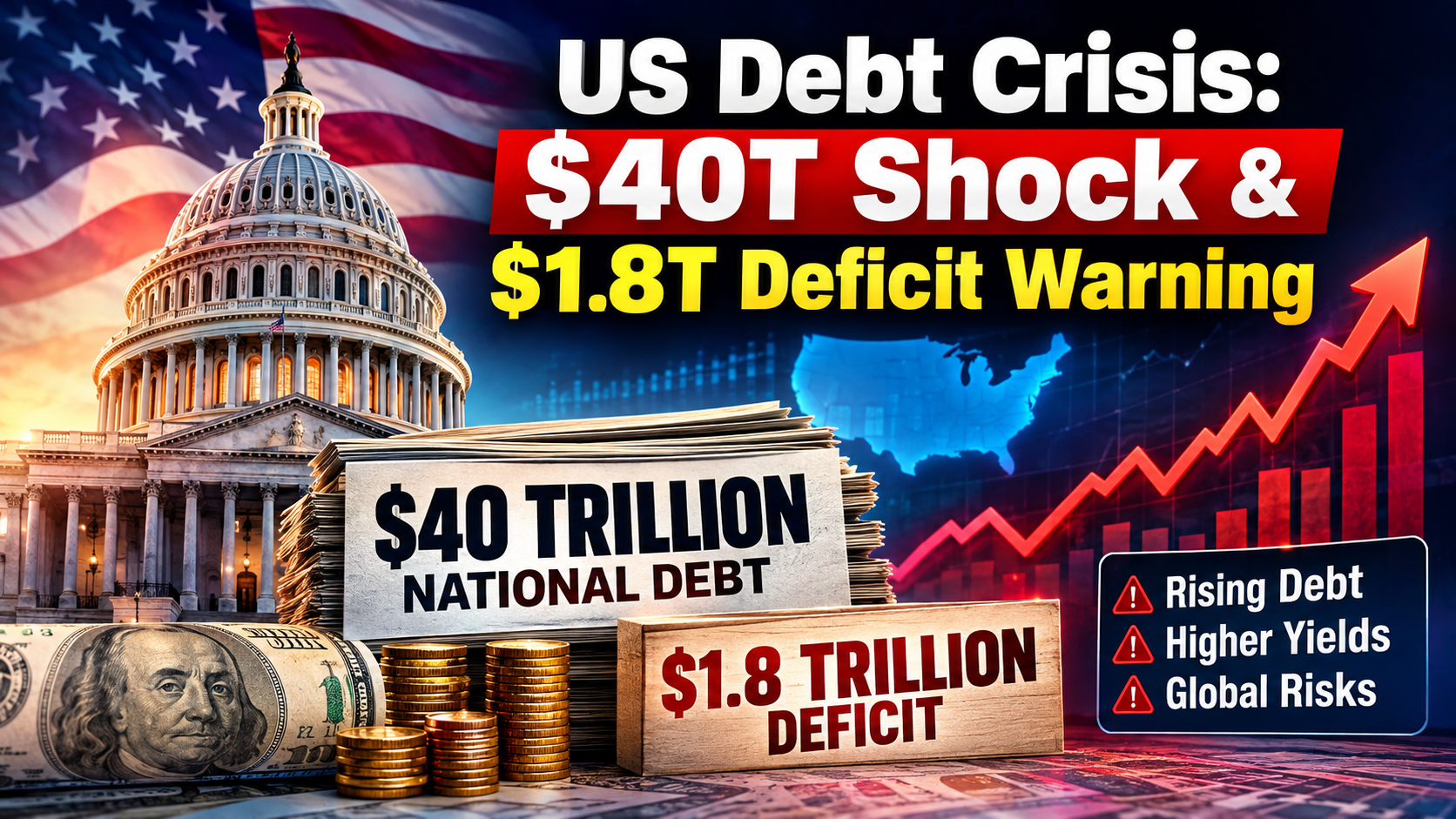
US Debt Crisis: $40T Shock & $1.8T Deficit Warning:
Why It Matters-
US Debt Crisis: $40T Shock & $1.8T Deficit Warning has become one of the most important fiscal stories for global investors in August 2026. The United States has crossed a historic threshold, with gross national debt surpassing $40 trillion for the first time. At the same time, the federal deficit is running at roughly $1.8 trillion, highlighting the scale of America’s continuing borrowing needs.
The $40 trillion milestone is more than a symbolic number. It arrives at a time when long-term Treasury yields are elevated, government interest expenses are increasing, and investors are becoming increasingly sensitive to America’s fiscal trajectory.
The concern is note that the United States is suddenly unable to pay its debt. The dollar remains the world’s dominant reserve currency, U.S. Treasury securities remain among the world’s most liquid financial assets, and the American economy retains enormous economic capacity.
The bigger question is whether the U.S. can continue accumulating debt at this pace without eventually forcing markets to demand significantly higher interest rates.
That is the heart of the US Debt Crisis: $40T Shock & $1.8T Deficit Warning.
US National Debt

US Debt Crisis: $40T Shock & $1.8T Deficit Warning Explained
The first thing investors need to understand is the difference between national debt and the federal budget deficit.
The national debt is the accumulated amount the U.S. government owes. The budget deficit is the amount by which government spending exceeds revenue during a particular fiscal year.
In simple terms:
Deficit = new borrowing added during a period.
Debt = accumulated borrowing over time.
Therefore, a $1.8 trillion deficit adds to an already enormous debt burden.
The Treasury reported that U.S. gross national debt moved above $40 trillion in August 2026. Reuters reported that the total included approximately $32.3 trillion in debt held by the public and about $7.8 trillion in intragovernmental holdings.
The speed of the increase is particularly important. The debt had crossed $39 trillion only months earlier and $38 trillion before that, demonstrating how rapidly America’s borrowing requirement has expanded.
This acceleration makes the US Debt Crisis: $40T Shock & $1.8T Deficit Warning a serious issue for markets rather than simply a political talking point.
Why the $40 Trillion Debt Milestone Is So Important
A country’s debt cannot be evaluated only by looking at its absolute dollar value.
Economists also consider debt relative to GDP, the government’s ability to collect revenue, interest costs and the expected growth of the economy.
For the United States, the debt-to-GDP ratio is already historically high.
The Congressional Budget Office projects that debt held by the public will rise from about 101% of GDP in 2026 to 120% by 2036 under its baseline assumptions. CBO also projects that the debt could eventually reach 175% of GDP over the following two decades.
That creates a long-term challenge.
If the economy grows faster than debt, the burden can become easier to manage.
But if debt grows faster than economic output, the government must devote an increasing amount of future revenue to servicing that debt.
This is why investors are closely watching the US Debt Crisis: $40T Shock & $1.8T Deficit Warning.
Debt-to-GDP Graphic

$1.8 Trillion Deficit Adds Fuel to the US Debt Crisis
The second major warning sign is the federal deficit.
The Congressional Budget Office’s February 2026 baseline projected a $1.9 trillion federal deficit for fiscal year 2026, equal to approximately 5.8% of GDP. CBO expects the deficit to increase to $3.1 trillion by 2036.
More recent Treasury-related reporting has shown borrowing approaching the $1.8 trillion level during the first ten months of fiscal 2026.
That distinction is important because the frequently cited $1.8 trillion figure refers to borrowing/deficit developments during the current fiscal year, while CBO’s full-year baseline forecast is $1.9 trillion.
Either way, the direction is clear: the U.S. is running exceptionally large deficits outside a traditional wartime or deep-recession environment.
That makes the US Debt Crisis: $40T Shock & $1.8T Deficit Warning especially significant.
US Debt Crisis: $40T Shock & $1.8T Deficit Warning and Interest Costs
Perhaps the most dangerous part of the debt equation is not the principal itself.
It is the interest bill.
When interest rates were extremely low, the U.S. government could refinance large amounts of debt at relatively inexpensive rates.
The environment has changed.
Higher Treasury yields mean newly issued and refinanced debt can become more expensive.
CBO projects that net interest costs will rise from around $1 trillion in 2026 to $2.1 trillion by 2036, increasing from 3.3% to 4.6% of GDP.
That creates a potentially self-reinforcing cycle:
More debt → more interest payments → larger deficits → more borrowing → even more debt.
This is one of the central risks highlighted by the US Debt Crisis: $40T Shock & $1.8T Deficit Warning.
Recent CBO data cited by Fortune showed net interest on public debt had reached approximately $963 billion between October 2025 and July 2026, equivalent to more than $3 billion a day over that period.
Why Treasury Yields Are the Market’s Biggest Warning
The U.S. Treasury market sits at the center of global finance.
Treasury securities influence:
- Mortgage rates
- Corporate borrowing costs
- Bank financing
- Government borrowing
- Equity valuations
- Emerging-market capital flows
- Currency markets
- Global bond yields
When long-term Treasury yields rise, borrowing becomes more expensive across the financial system.
Recent reporting has shown renewed selling pressure in long-term U.S. government bonds, with the 30-year Treasury yield moving above 5.2% during the current period of market stress.
The problem is that higher yields can make the fiscal situation even more difficult.
Imagine the U.S. Treasury needs to refinance trillions of dollars of maturing debt. If investors demand higher yields, the government must pay more interest on new borrowing.
That increases future deficits.
The US Debt Crisis: $40T Shock & $1.8T Deficit Warning therefore has a direct connection to the bond market.
Treasury Bond Market

How the US Debt Crisis Could Affect the Dollar
The U.S. dollar has a unique advantage.
It is the dominant global reserve currency, and a huge share of international trade and financial transactions is conducted in dollars.
That gives Washington considerable borrowing flexibility.
But fiscal deterioration can gradually challenge investor confidence.
If international investors begin demanding greater compensation for holding U.S. assets, the dollar could face pressure.
A weaker dollar could have several consequences.
First, imported goods become more expensive for American consumers.
Second, commodities priced in dollars can become more expensive for foreign buyers.
Third, emerging-market countries with dollar-denominated liabilities may face higher repayment costs.
Fourth, investors may increasingly diversify into gold, other currencies or alternative assets.
The dollar does not need to collapse for these effects to matter.
Even a gradual decline can influence global capital flows.
US Debt Crisis: $40T Shock & $1.8T Deficit Warning for Global Markets
The consequences extend far beyond the United States.
America’s financial markets are deeply connected with the rest of the world.
When Treasury yields rise, global investors often reassess the attractiveness of equities, emerging-market bonds and other risk assets.
Higher U.S. yields can encourage capital to move toward dollar-denominated investments.
That can weaken emerging-market currencies.
For countries such as India, Brazil, Indonesia and South Africa, this can create additional pressure through exchange rates, foreign capital flows and imported inflation.
India is particularly sensitive because it imports large quantities of crude oil, which is priced primarily in dollars.
If the dollar strengthens while oil prices remain elevated, India’s import bill can rise.
This illustrates why the US Debt Crisis: $40T Shock & $1.8T Deficit Warning is not merely a U.S. domestic issue.
Why Stock Markets Could Face Pressure
Stocks are also affected by government bond yields.
Investors generally compare the potential return from equities with the return available from relatively safer government securities.
If Treasury yields rise substantially, investors may demand higher returns from stocks.
That can put downward pressure on valuations.
Growth and technology stocks can be particularly sensitive because their valuations often depend heavily on expected earnings far into the future.
Higher interest rates reduce the present value of those future cash flows.
The current environment is also unusual because private-sector borrowing is increasing at the same time that government borrowing remains enormous.
Growing investment in artificial intelligence infrastructure has encouraged technology companies to raise large amounts of capital.
That means government and corporate borrowers can compete for investor money.
This dynamic makes the US Debt Crisis: $40T Shock & $1.8T Deficit Warning relevant to equity investors as well as bond investors.
Is a US Debt Crisis Actually Coming?
The word “crisis” needs to be used carefully.
Crossing $40 trillion does not mean the United States is automatically facing an imminent default.
America has several major advantages.
1. The Dollar Is the World’s Leading Reserve Currency
The global financial system remains heavily dependent on dollars.
2. Treasury Markets Are Extremely Deep
U.S. government bonds remain among the most liquid assets available to global investors.
3. The U.S. Economy Is Enormous
America has substantial productive capacity, technological leadership and deep capital markets.
4. The Government Borrows in Its Own Currency
The U.S. is not comparable to an emerging-market country that has borrowed heavily in a foreign currency.
However, these advantages do not eliminate fiscal risk.
They simply mean the adjustment process could be slower and different from a conventional sovereign-debt crisis.
The real danger is a gradual deterioration in confidence, followed by permanently higher borrowing costs.
US Debt Crisis: $40T Shock & $1.8T Deficit Warning for the Federal Reserve
The Federal Reserve faces a difficult policy environment.
If economic growth slows, the Fed may want to cut interest rates.
But if inflation remains elevated, aggressive rate cuts could reignite price pressures.
Meanwhile, persistent government deficits can support demand and increase Treasury issuance.
That creates a difficult balancing act.
Scenario 1: Growth Weakens
The Fed could cut rates, reducing some borrowing costs.
Scenario 2: Inflation Remains High
The Fed may need to keep monetary policy restrictive.
Scenario 3: Treasury Yields Stay High
Government borrowing costs could remain elevated even if short-term rates fall.
Scenario 4: Fiscal Reform Improves Confidence
Long-term yields could decline if investors believe deficits will become more manageable.
This final scenario would be the most positive outcome for markets.
Why Gold Is Gaining Attention
Gold often attracts investors during periods of uncertainty involving currencies, inflation and government debt.
The current environment contains all three themes.
The U.S. debt milestone has coincided with concerns over fiscal sustainability and higher long-term bond yields. Recent market commentary has also linked deteriorating public finances to increased interest in gold.
Gold has another advantage: it does not depend on the creditworthiness of a government.
However, gold does not generate interest income.
Therefore, if real Treasury yields rise substantially, bonds can become more attractive.
The direction of gold will depend on the balance between inflation expectations, real yields, dollar strength and investor confidence.
Gold and Dollar

What Is Driving America’s Debt Higher?
There is no single cause.
The U.S. fiscal problem has accumulated over many years through a combination of spending, tax policy, economic shocks, entitlement costs, defense spending and rising interest payments.
The COVID-19 pandemic produced an enormous fiscal response.
Economic stimulus helped prevent a deeper collapse but also contributed significantly to the subsequent debt increase.
More recently, tax and spending decisions have continued to influence the fiscal trajectory.
Reuters reported that U.S. debt has more than doubled since 2017, when gross national debt stood at approximately $19.95 trillion.
Meanwhile, CBO says deficits from 2026 through 2035 are projected to total approximately $23.1 trillion under its February baseline.
This shows that the challenge is structural.
It cannot easily be solved through one year’s spending cuts.
Social Security, Medicare and Mandatory Spending
One of the biggest challenges is that much of the federal budget is tied to mandatory programs.
Social Security and Medicare represent enormous long-term commitments.
As America’s population ages, these programs face increasing pressure.
That makes fiscal adjustment politically difficult.
Cutting discretionary spending alone is unlikely to completely solve the problem.
The government would eventually need to address the broader relationship between:
Revenue + mandatory spending + discretionary spending + interest costs.
That is why the US Debt Crisis: $40T Shock & $1.8T Deficit Warning cannot be reduced to one administration or one political party.
The fiscal trajectory has developed over decades.
Could Economic Growth Solve the Debt Problem?
Economic growth can certainly help.
If nominal GDP expands rapidly, government revenue can increase while debt becomes smaller relative to the economy.
Higher productivity can also improve wages, corporate profits and tax receipts.
However, relying exclusively on growth is risky.
CBO’s projections show that even with economic growth, deficits remain large and debt held by the public continues to rise relative to GDP.
Therefore, growth is part of the solution, but probably not the entire solution.
A sustainable fiscal strategy would likely require some combination of stronger growth, spending reforms and revenue measures.
US Debt Crisis: $40T Shock & $1.8T Deficit Warning for India
For Indian investors and businesses, developments in the U.S. Treasury market deserve close attention.
There are several transmission channels.
Rupee
Higher U.S. yields can strengthen the dollar and create pressure on the Indian rupee.
Foreign Investment
Global investors may shift capital toward U.S. assets when Treasury yields rise.
Oil
A stronger dollar and geopolitical uncertainty can affect crude oil prices and India’s import bill.
Indian Bonds
Global bond yields influence investor expectations about India’s own interest-rate environment.
Equities
Foreign institutional investors may become more selective when U.S. risk-free returns increase.
This does not mean India’s markets must fall whenever U.S. debt rises.
India has its own growth drivers, domestic demand and monetary-policy framework.
But the U.S. remains the world’s largest financial market, so its fiscal conditions matter.
What Can the US Do to Stabilize Its Finances?
There is no painless solution.
Policymakers have several broad options.
1. Reduce Spending
Lower spending growth can reduce future deficits.
2. Increase Revenue
Higher tax receipts can narrow the fiscal gap.
3. Improve Economic Growth
Productivity-enhancing reforms can expand the tax base.
4. Reform Entitlement Programs
Long-term Social Security and Medicare reforms could address major future spending pressures.
5. Lower Interest Costs
A credible fiscal strategy could eventually reduce risk premiums and borrowing costs.
6. Encourage Private Investment
Productivity growth can help the economy expand without relying entirely on government spending.
The challenge is political.
Every major fiscal reform creates winners and losers.
That makes meaningful deficit reduction extremely difficult.
Can the $40 Trillion Debt Trigger a Global Financial Shock?
It could contribute to one, but there is no certainty that it will.
The biggest risk would be a sudden loss of confidence in the Treasury market.
A severe bond selloff could cause yields to rise rapidly.
Higher yields could then trigger:
Higher government interest costs → tighter financial conditions → lower asset valuations → weaker investment → slower economic growth.
That could create stress across global markets.
However, Treasury securities remain deeply embedded in the global financial system.
Central banks, pension funds, banks, insurers and institutional investors hold them for liquidity and safety.
Therefore, a sudden abandonment of Treasuries would be an extreme scenario rather than the base case.
The more probable risk is a prolonged period of higher yields and greater market volatility.
US Debt Crisis: $40T Shock & $1.8T Deficit Warning — What Investors Should Watch
Investors should monitor several indicators closely.
Treasury 10-Year Yield
A sustained increase could signal stronger inflation or fiscal concerns.
Treasury 30-Year Yield
This is particularly important because long-term bonds are sensitive to inflation and fiscal risk.
Term Premium
An increasing term premium indicates investors want greater compensation for holding long-term government debt.
Dollar Index
A falling dollar could indicate declining confidence or changing global capital flows.
Gold
Strong gold demand can signal increasing concern about inflation, currencies or sovereign finances.
Treasury Auctions
Weak demand at government debt auctions could become an important warning signal.
Federal Deficit Data
Monthly deficit figures provide an early look at the pace of borrowing.
Together, these indicators can provide a better picture than the $40 trillion headline alone.
The Bigger Picture: Debt Is a Slow-Burning Risk
The most important lesson from the US Debt Crisis: $40T Shock & $1.8T Deficit Warning is that fiscal crises do not always arrive overnight.
They can develop gradually.
Debt increases.
Interest costs rise.
Yields move higher.
Investors demand greater compensation.
Fiscal flexibility declines.
Eventually, policymakers may discover that fewer options remain during the next recession or emergency.
That is why the $40 trillion milestone matters.
It is not necessarily a prediction of immediate collapse.
It is a warning about declining fiscal room.
US Debt Crisis: $40T Shock & $1.8T Deficit Warning — Conclusion
The US Debt Crisis: $40T Shock & $1.8T Deficit Warning represents one of the biggest financial challenges facing the global economy in 2026.
America’s gross national debt has crossed $40 trillion, while the federal deficit is approaching the $1.8 trillion range during the current fiscal year. CBO’s baseline projects a full-year 2026 deficit of $1.9 trillion and warns that debt held by the public could reach 120% of GDP by 2036.
The most immediate concern is the growing cost of servicing the debt.
As Treasury yields rise, refinancing becomes more expensive. Higher interest payments can increase deficits, creating another round of borrowing.
For global markets, the consequences could appear through Treasury yields, the dollar, equities, gold, emerging-market currencies and capital flows.
For India, the most important channels are likely to be the rupee, crude oil prices, foreign portfolio flows and global interest rates.
Still, the United States retains major financial advantages. The dollar’s reserve-currency role and the enormous liquidity of Treasury markets provide Washington with considerable flexibility.
The real question is therefore not whether America can survive a $40 trillion debt burden.
It is whether policymakers can restore confidence that debt will eventually stabilize relative to the economy.
If they can, the current shock could become a powerful reminder that fiscal reform works.
If they cannot, the US Debt Crisis: $40T Shock & $1.8T Deficit Warning could evolve into a much larger global market challenge.
Frequently Asked Questions (FAQ)
What is the US Debt Crisis: $40T Shock & $1.8T Deficit Warning?
The phrase refers to the combination of America’s gross national debt exceeding $40 trillion and the federal deficit approaching $1.8 trillion during fiscal 2026. The figures highlight the country’s growing borrowing and interest-cost challenges.
Has US national debt really crossed $40 trillion?
Yes. The U.S. national debt surpassed $40 trillion in August 2026, according to Treasury data reported by multiple major news organizations.
Is the US facing an immediate debt default?
No. The $40 trillion milestone does not mean the United States is about to default. The U.S. has a large economy, deep capital markets and the world’s dominant reserve currency. The greater concern is long-term fiscal sustainability and rising borrowing costs.
Why is the $1.8 trillion deficit important?
A deficit of approximately $1.8 trillion means government spending substantially exceeds revenue. Persistent deficits require additional borrowing and increase the national debt.
How does US debt affect global markets?
Higher U.S. borrowing can contribute to higher Treasury yields. Because Treasury rates influence global borrowing costs, the effects can spread to currencies, equities, emerging markets, commodities and corporate debt.
Could US debt weaken the dollar?
It could contribute to dollar weakness if investors become concerned about the long-term fiscal outlook. However, the dollar’s reserve-currency role and the depth of U.S. financial markets remain major supporting factors.
Why are Treasury yields important?
Treasury yields determine the cost of borrowing for the U.S. government and influence mortgage rates, corporate borrowing costs, stock valuations and global financial conditions.
Is gold a hedge against US debt concerns?
Gold can benefit when investors are worried about inflation, currency weakness or fiscal instability. However, gold does not pay interest, so higher real bond yields can reduce its relative attractiveness.
How could the US debt problem affect India?
The main channels include the rupee-dollar exchange rate, foreign investment flows, global bond yields and crude oil prices. A stronger dollar and higher U.S. yields can create additional pressure on emerging markets.
What can reduce the US debt burden?
Possible solutions include stronger economic growth, spending reforms, higher government revenues, entitlement reforms and policies that reduce the growth of interest costs. No single measure is likely to solve the problem.
Key Takeaways
- U.S. national debt has crossed $40 trillion.
- The 2026 fiscal deficit is projected by CBO at $1.9 trillion.
- Debt held by the public is projected to reach 120% of GDP by 2036.
- Net interest costs are projected to rise sharply over the next decade.
- Higher Treasury yields could increase borrowing costs across the global economy.
- The dollar, gold, equities and emerging-market currencies could all respond to changes in U.S. fiscal expectations.
- India could feel the impact through the rupee, oil prices and foreign capital flows.
- The $40 trillion milestone is not an automatic debt crisis, but it is a significant warning about America’s shrinking fiscal flexibility.