
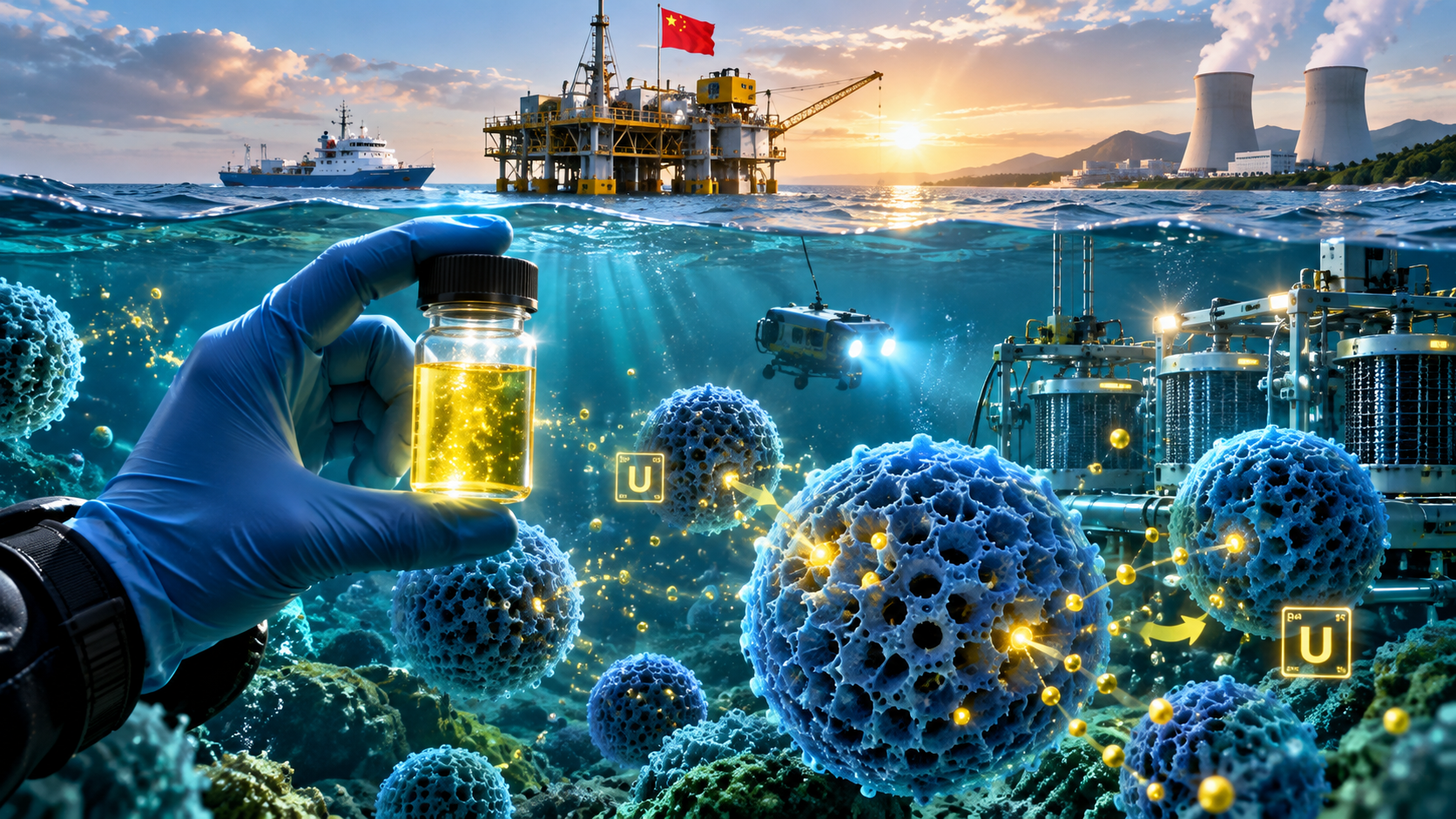
China’s Uranium Breakthrough: 8X Seawater Extraction Power
China’s Uranium Breakthrough: 8X Seawater Extraction Power is emerging as one of the most intriguing developments in the global race to secure future nuclear fuel. Chinese researchers have developed a new porous material called PhosCage that achieved a uranium uptake of up to 50.4 milligrams per gram from natural seawater– about 8.4 times the US Department of Energy benchmark of 6 milligrams per gram.
The breakthrough does not mean China has already created a commercial ocean-based uranium mining industry. Instead, it represents a significant materials-science advance that could help overcome one of the biggest obstacles to extracting uranium from seawater, capturing extremely dilute uranium selectively, efficiently and repeatedly.
The research was conducted by scientists at the Qingdao Institute of Bioenergy and Bioprocess Technology under the Chinese Academy of Sciences and was published in the Journal of Hazardous Materials. The study reports that PhosCage reached adsorption equilibrium in laboratory conditions in about five minutes and maintained performance through repeated adsorption-desorption cycles.
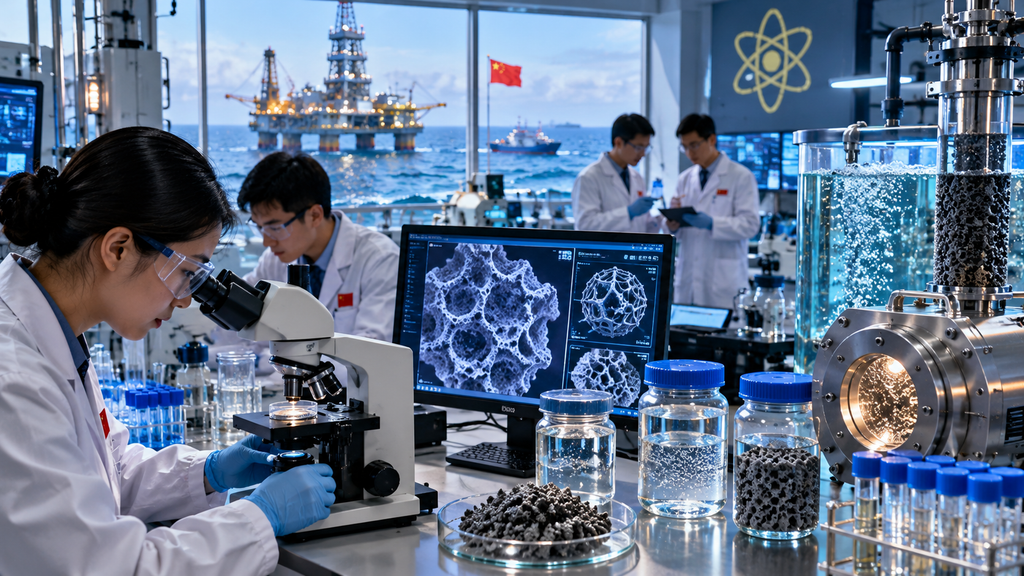
China’s Uranium Breakthrough: 8X Seawater Extraction Power Explained
At the heart of China’s Uranium Breakthrough: 8X Seawater Extraction Power is a material known as PhosCage.
PhosCage is a phosphate-functionalized porous organic cage. In simple terms, researchers created a microscopic cage-like structure containing phosphate-based chemical sites capable of binding uranium-bearing species in seawater.
The design addresses a long-standing problem in seawater uranium extraction.
Uranium is present throughout the world’s oceans, but its concentration is extraordinarily low. The challenge is therefore not simply finding uranium. It is developing a material that can locate and capture uranium while ignoring the much larger quantities of other dissolved substances in seawater.
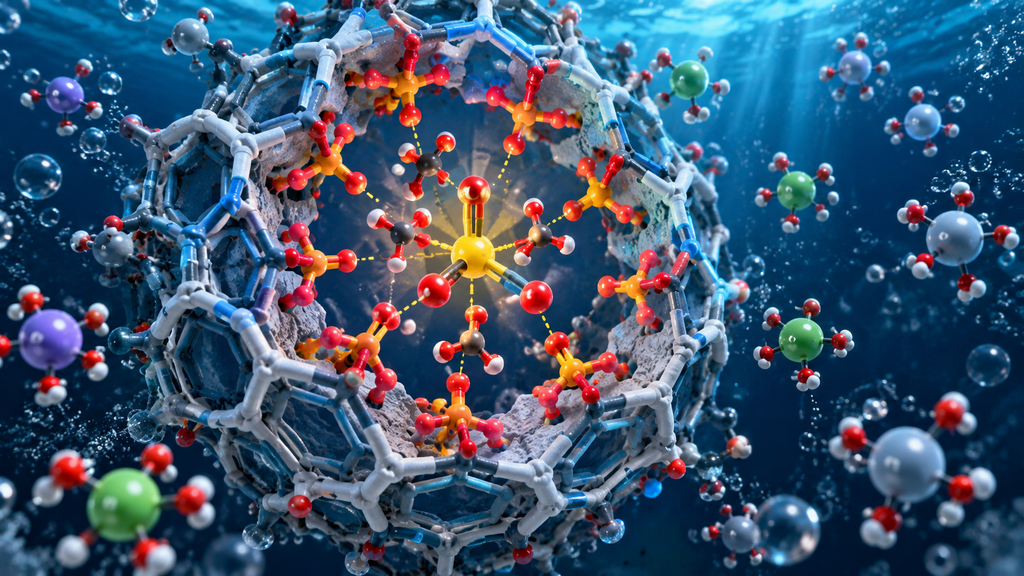
The Chinese research team designed phosphate adsorption clusters inside the nanoscale spaces of porous organic cages. According to the published research, this molecular architecture helps overcome the traditional trade-off between high binding capacity and rapid ion transport.
That combination is important because an adsorbent can theoretically contain many uranium-binding sites but still perform poorly if uranium ions cannot reach those sites quickly enough.
PhosCage attempts to solve both problems simultaneously.
The headline 50.4 mg/g result
In tests using natural seawater, PhosCage reached a maximum uranium extraction capacity of 50.4 mg per gram of adsorbent.
The researchers compare this result with a U.S. Department of Energy benchmark of 6 mg/g over 30 days, making the reported capacity approximately 8.4 times the benchmark.
This is the origin of the widely reported “eight times” figure.
However, the comparison needs to be understood correctly.
It is a comparison of adsorption capacity, not a claim that a future commercial facility would produce uranium eight times faster or eight times more cheaply than an American system.
That distinction is crucial when evaluating China’s Uranium Breakthrough: 8X Seawater Extraction Power.
Why Uranium From Seawater Is Such a Big Deal
The world’s nuclear industry depends on a reliable supply of uranium.
Traditional uranium production comes mainly from mining and processing ore deposits. As nuclear power expands, countries are increasingly interested in diversifying fuel supplies and developing technologies that could provide additional long-term resources.
The oceans offer an extraordinary theoretical resource.
Researchers have estimated that seawater contains roughly 4.5 billion tonnes of uranium, although it is distributed at extremely low concentrations. The enormous amount exists because the world’s oceans contain a vast quantity of water.
This creates an unusual resource equation.
There may be huge quantities of uranium in the ocean, but the uranium is so diluted that recovering it economically is exceptionally difficult.
That is why scientists have spent decades searching for better adsorbents.
The ideal material would need to:
- Capture uranium selectively.
- Work in real seawater.
- Resist competing ions.
- Avoid rapid degradation.
- Resist marine biofouling.
- Be reusable.
- Be inexpensive to manufacture.
- Consume relatively little energy.
- Be deployable at very large scale.
PhosCage addresses several of these challenges at the laboratory level.
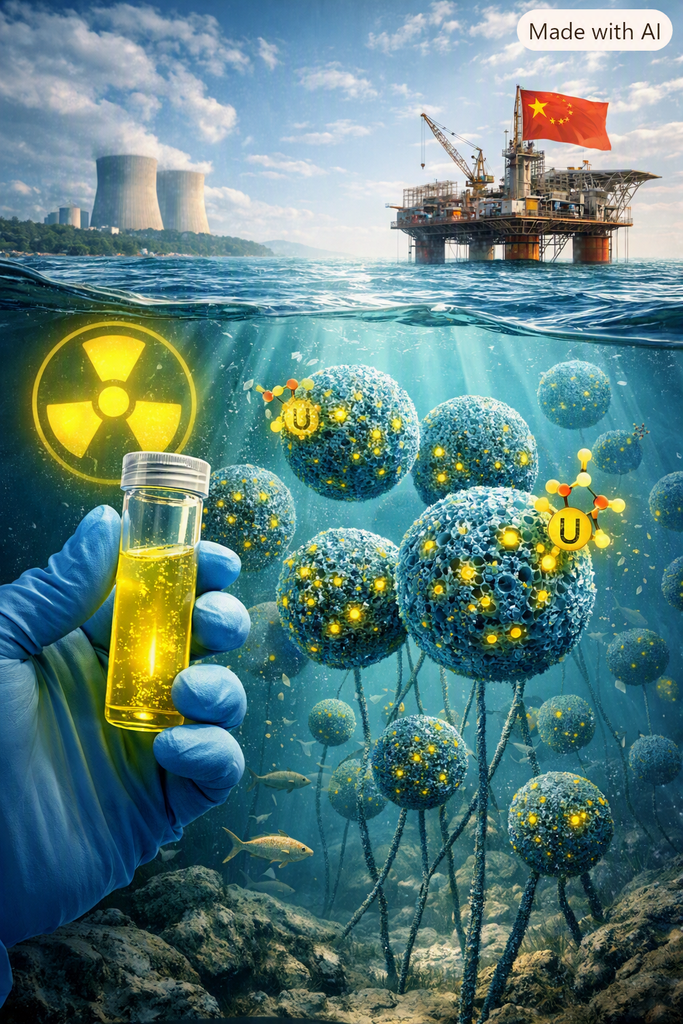
How PhosCage Captures Uranium
The chemistry behind China’s Uranium Breakthrough: 8X Seawater Extraction Power is particularly interesting.
Uranium in seawater is not simply floating around as isolated uranium atoms. It exists in chemically complex forms, including uranyl-carbonate species.
The researchers found that the phosphate groups incorporated into PhosCage can form strong interactions with uranium-bearing species.
Their analysis using techniques including time-of-flight secondary ion mass spectrometry, X-ray absorption methods and density functional theory helped identify the molecular mechanism behind uranium capture. The study describes strong directional tetradentate coordination and substantial charge transfer.
In simpler language, the material is designed so that its chemical binding sites fit uranium-containing species particularly well.
That selectivity is essential.
Seawater contains large quantities of sodium, magnesium, calcium and other ions. A material that indiscriminately captures everything would rapidly become ineffective.
PhosCage is designed to act more like a chemical trap.
China’s Uranium Breakthrough: 8X Seawater Extraction Power and Speed
Capacity is only one part of the story.
The researchers also reported unusually rapid adsorption kinetics.
Under laboratory conditions, PhosCage reached adsorption equilibrium in approximately five minutes. The published paper says this helps address the common conflict between binding-site density and ion transport found in many porous materials.
This could be important for future engineering.
If a material captures uranium efficiently but requires extremely long periods to reach useful loading, enormous quantities of adsorbent may be needed.
A faster material could potentially reduce the size or amount of material required for a particular operation.
But laboratory adsorption speed should not be confused with industrial throughput.
An ocean-scale system would have to account for water movement, currents, temperature changes, fouling, pressure, material handling, regeneration and uranium recovery.
From Powder to Reusable Beads
One of the most promising aspects of the research is that the scientists considered the practical limitations of deploying a fine powder in the marine environment.
A loose powder may perform extremely well in laboratory experiments but can be difficult to recover after exposure to seawater.
To address this, the team combined PhosCage with aramid nanofibres and produced composite aerogel microspheres known as AC-POC.
The resulting material is designed to be easier to handle and potentially more suitable for marine engineering applications.
The Chinese Academy of Sciences says the composite structure was developed partly to address issues involving powder deployment and microbial attachment.
This engineering step is important because commercial technology needs to move beyond an excellent laboratory powder.
It needs to become a material that can be:
- Manufactured consistently.
- Deployed in seawater.
- Retrieved efficiently.
- Regenerated.
- Reused.
- Recycled or safely disposed of.
AC-POC Shows the Path Toward Practical Deployment
The composite aerogel microsphere produced a lower but still notable uranium uptake compared with the laboratory PhosCage powder.
According to reporting on the study, AC-POC achieved a dynamic uranium extraction capacity of about 22.55 mg/g after 15 days in natural seawater, equivalent to about 3.8 times the U.S. DOE benchmark.
This number is important because it comes closer to a deployment-oriented test.
The material also demonstrated anti-biofouling characteristics. Its negatively charged surface can help reduce microbial attachment and biofilm formation, an important consideration for materials exposed to seawater for extended periods.
Marine biofouling can be a serious problem.
Microorganisms, algae and other biological matter can attach to surfaces and change the chemical and physical characteristics of an adsorbent.
A material that performs well initially but becomes covered in biological growth could lose much of its effectiveness.
China’s Uranium Breakthrough: 8X Seawater Extraction Power Is Not Commercial Mining Yet
This is perhaps the most important qualification.
China’s Uranium Breakthrough: 8X Seawater Extraction Power is a laboratory materials breakthrough—not proof that China can now commercially harvest uranium from the ocean.
The 50.4 mg/g result is impressive, but a commercially viable system would have to answer much bigger questions.
What would it cost?
The first question is economics.
Manufacturing an advanced porous organic cage at massive scale could be expensive. The cost of raw materials, synthesis, shaping, deployment and regeneration would all need to be calculated.
The material must ultimately compete with uranium obtained through conventional mining.
How much seawater must be processed?
Because uranium is extremely dilute, huge quantities of seawater would have to interact with the adsorbent.
The energy required to move, filter or circulate that water could become a major component of operating costs.
How long does the material last?
The study reports strong recycling performance, with the published research stating stable performance through at least 10 adsorption-desorption cycles for PhosCage.
That is encouraging, but commercial systems may need dramatically longer operational lifetimes.
What happens to the captured uranium?
Capturing uranium is only the first step.
The adsorbent eventually has to be regenerated and the uranium recovered in a concentrated form. That recovered material would then require further processing before it could become nuclear fuel.
Therefore, seawater extraction is not a complete nuclear-fuel solution by itself.
Why the Technology Could Matter for China
China is rapidly expanding its nuclear power capacity.
That makes uranium security increasingly strategic.
China has domestic uranium resources, but its nuclear industry also depends on international supplies. A future technology capable of recovering uranium from seawater could potentially provide an additional resource base.
The significance of China’s Uranium Breakthrough: 8X Seawater Extraction Power therefore extends beyond chemistry.
It is also about energy security.
If China eventually develops an economical seawater uranium extraction system, it could reduce some dependence on conventional uranium supply chains.
It could also provide Chinese companies and research institutions with intellectual property and manufacturing capabilities in an emerging nuclear-energy technology.
A New Chapter in the Global Uranium Race
China is not alone in exploring seawater uranium.
Scientists in the United States, Japan and other countries have researched uranium adsorbents for decades.
The U.S. has particularly extensive research into polymer-based adsorbents and other materials designed to capture uranium from seawater.
The Chinese result therefore represents another development in a broader international technology race.
The key question is no longer simply whether uranium can technically be extracted from seawater.
Scientists have demonstrated that.
The bigger question is:
Can uranium be extracted cheaply enough, efficiently enough and at a large enough scale to compete with conventional uranium mining?
That is the technological hurdle that remains.
China’s Uranium Breakthrough: 8X Seawater Extraction Power Could Support Nuclear Expansion
If seawater uranium extraction eventually becomes economical, the potential implications for nuclear power could be significant.
Nuclear reactors require reliable fuel supplies over many decades. Countries planning large reactor fleets therefore need to think about uranium availability alongside reactor technology.
An additional uranium resource could strengthen long-term planning.
For China, this could complement its broader nuclear strategy.
For other countries, it could create another potential source of fuel and reduce concerns about the geographic concentration of uranium mining and processing.
However, seawater extraction is more likely to become a supplementary resource than an immediate replacement for conventional uranium mining.
That distinction matters.
The existence of billions of tonnes of uranium dissolved in the oceans does not automatically make those tonnes economically recoverable.
Environmental Questions Will Also Matter
Any large-scale ocean-based extraction system would need environmental assessment.
Scientists and regulators would need to study:
- Effects on marine chemistry.
- Changes in local uranium concentrations.
- Interaction with microorganisms.
- Adsorbent degradation.
- Release of material into seawater.
- Disposal and recycling.
- Energy consumption.
- Impacts from large-scale infrastructure.
Even if the technology is chemically selective, industrial deployment could involve enormous quantities of adsorbent material and seawater.
Environmental sustainability would therefore need to be demonstrated alongside economic viability.
A technology designed to support low-carbon nuclear power would ideally have a relatively low environmental footprint itself.
Could Seawater Become a Giant Uranium Resource?
The answer is potentially—but not immediately.
The oceans contain an enormous theoretical uranium resource. The problem is that uranium is dispersed at extremely low concentrations.
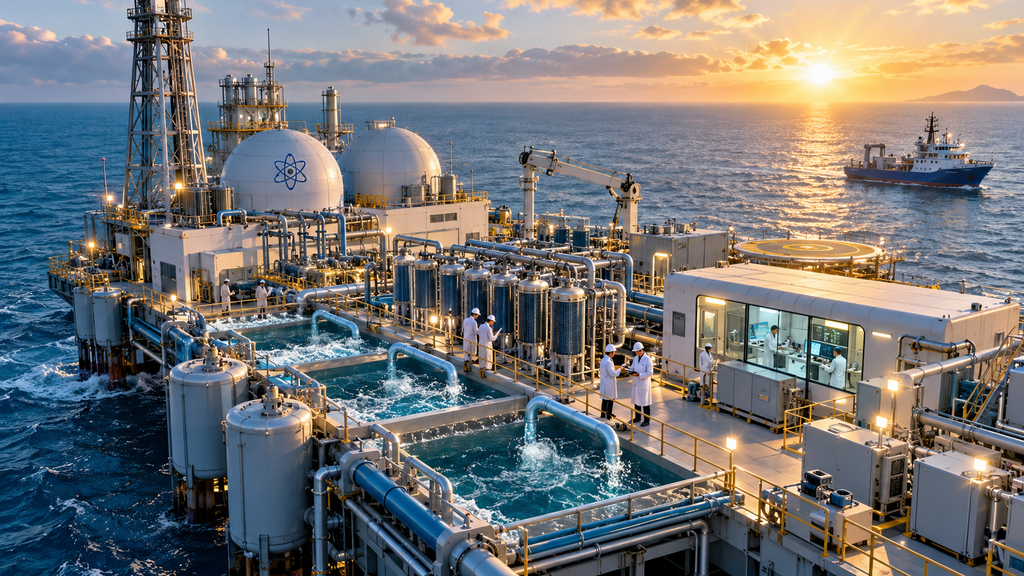
The importance of China’s Uranium Breakthrough: 8X Seawater Extraction Power is that it demonstrates a potentially better way of overcoming that dilution problem.
PhosCage combines:
- High uranium capacity.
- Rapid adsorption.
- Strong selectivity.
- Reusability.
- A molecularly engineered structure.
- Potential conversion into deployable composite beads.
The reported results do not eliminate the engineering challenge, but they move the technology forward.
What This Could Mean for Future Nuclear Fuel
The nuclear industry is entering a period of renewed global interest.
Many countries are looking at nuclear power as a source of reliable low-carbon electricity. Small modular reactors, advanced reactors and conventional large reactors are all receiving attention.
If nuclear generation expands substantially, fuel supply will become increasingly important.
Uranium extraction from seawater could potentially provide another layer of supply security.
The biggest advantage is the sheer scale of the theoretical resource.
Unlike a conventional ore body, the ocean is continuously mixed and contains uranium across enormous geographical areas.
But that advantage is also the challenge.
An ocean is not a concentrated mine.
The technology must effectively concentrate an extremely dilute resource without consuming more energy and money than the uranium is worth.
The 8X Number Needs Careful Interpretation
Headlines describing the result as “eight times faster” can be misleading.
The research reports a 50.4 mg/g adsorption capacity, compared with a 6 mg/g U.S. DOE benchmark.
That is approximately 8.4 times the benchmark capacity.
It does not mean the material is eight times faster in every sense.
In fact, the study separately reports extremely rapid equilibrium under laboratory conditions, while the natural seawater capacity was measured over a longer experimental period.
For readers evaluating China’s Uranium Breakthrough: 8X Seawater Extraction Power, this distinction is essential.
A strong headline reflects the scale of the reported result, but the underlying scientific measurement is more specific.
What Happens Next?
The next stage will be scaling.
Researchers need to determine whether the material can be produced economically in large quantities while preserving its performance.
They also need to test it for much longer periods under realistic marine conditions.
Future research will likely focus on:
Larger-scale manufacturing
The synthesis process needs to move from laboratory batches to industrial production.
Longer operating cycles
Researchers need to demonstrate that the material remains effective after many more regeneration cycles.
Real marine environments
Laboratory seawater experiments must eventually be complemented by extended field trials.
Lower regeneration costs
Recovering uranium from the adsorbent must be efficient enough to make the entire process economical.
Integrated processing
The adsorption stage needs to be connected with uranium recovery, purification and downstream fuel-cycle processes.
Only after these challenges are addressed will it become possible to evaluate commercial viability properly.
China’s Uranium Breakthrough: 8X Seawater Extraction Power — The Bigger Picture
The most important takeaway from China’s Uranium Breakthrough: 8X Seawater Extraction Power is not that China has suddenly unlocked billions of tonnes of cheap nuclear fuel.
The more significant development is that scientists have created a new molecular architecture that appears to solve several long-standing problems at once.
The reported 50.4 mg/g uranium capacity in natural seawater is substantial. The approximately 8.4× comparison with the U.S. DOE benchmark provides a clear indication of why the research has attracted international attention.
The conversion of the material into AC-POC composite microspheres is equally important because it moves the research toward practical deployment.
Still, major questions remain around economics, scale, durability, environmental impact and integration into the nuclear fuel cycle.
The technology should therefore be viewed as a promising research breakthrough rather than an immediately commercial uranium source.
If researchers can overcome those remaining hurdles, however, the implications could be substantial.
A future nuclear industry could potentially rely not only on uranium mines but also on advanced materials capable of recovering uranium dispersed throughout the world’s oceans.
That would transform the strategic concept of nuclear fuel availability.
Instead of treating uranium as a finite resource limited mainly by geological deposits, humanity could increasingly view seawater as a massive but technically difficult secondary uranium reservoir.
For China, the breakthrough could strengthen its position in advanced nuclear-materials research.
For the global nuclear industry, it could accelerate competition to develop cheaper, faster and more environmentally responsible methods of extracting uranium.
And for the future of nuclear energy, the biggest question may no longer be whether the oceans contain enough uranium.
It may be whether science can finally make that uranium economically accessible.
Key Facts at a Glance
| Metric | Reported result |
|---|---|
| New material | PhosCage |
| Material type | Phosphate-functionalized porous organic cage |
| Maximum uranium capacity in natural seawater | 50.4 mg/g |
| U.S. DOE comparison benchmark | 6 mg/g |
| Reported advantage | 8.4× benchmark |
| Laboratory adsorption equilibrium | About 5 minutes |
| Composite material | AC-POC |
| AC-POC dynamic capacity | 22.55 mg/g after 15 days |
| Reusability | At least 10 cycles reported for PhosCage |
| Research institution | Qingdao Institute of Bioenergy and Bioprocess Technology, CAS |
| Journal | Journal of Hazardous Materials |
The underlying study reports the 50.4 mg/g capacity, 5-minute laboratory equilibrium and 8.4× DOE comparison; the Chinese Academy of Sciences separately describes the engineering development of AC-POC for potential marine deployment.
Frequently Asked Questions
1. What is China’s Uranium Breakthrough: 8X Seawater Extraction Power?
China’s Uranium Breakthrough: 8X Seawater Extraction Power refers to research by Chinese scientists using a material called PhosCage to extract uranium from natural seawater at a reported capacity of up to 50.4 mg per gram of adsorbent. The researchers compare this with a U.S. DOE benchmark of 6 mg/g.
2. What is PhosCage?
PhosCage is a phosphate-functionalized porous organic cage designed to selectively capture uranium-bearing species from seawater. Its nanoscale architecture contains phosphate adsorption clusters that interact strongly with uranium complexes.
3. How much uranium can PhosCage extract?
The research reports a maximum capacity of 50.4 mg of uranium per gram of adsorbent in natural seawater. That is approximately 8.4 times the cited U.S. DOE benchmark of 6 mg/g.
4. Is China already mining uranium from the ocean commercially?
No. The research is still at the technology-development stage. The results demonstrate strong laboratory and natural-seawater performance, but commercial deployment would require major advances in scale, cost, durability, regeneration and environmental validation.
5. Why is seawater uranium extraction difficult?
Uranium occurs at extremely low concentrations in seawater and competes with many other dissolved ions. An effective adsorbent must selectively capture uranium without becoming overwhelmed by other substances.
6. Why is the 8.4× figure important?
The 8.4× figure comes from comparing PhosCage’s reported 50.4 mg/g natural-seawater capacity with a 6 mg/g U.S. DOE benchmark. It should not be interpreted as meaning a commercial system would automatically extract uranium eight times faster or eight times more cheaply.
7. What is AC-POC?
AC-POC is a composite aerogel microsphere created by combining PhosCage with aramid nanofibres. The design aims to make the adsorbent easier to deploy and retrieve while improving resistance to marine biofouling.
8. Could this technology reduce uranium shortages?
Potentially, but that remains uncertain. If seawater uranium extraction becomes economically viable, it could add another source of nuclear fuel and diversify global uranium supplies.
9. Could seawater uranium replace uranium mining?
It is unlikely to replace conventional mining in the near term. Seawater contains enormous quantities of uranium, but the resource is extremely dilute. Conventional mining remains much more concentrated and established.
10. What does this breakthrough mean for nuclear power?
If the technology can be scaled economically, it could strengthen long-term nuclear fuel security by opening access to a huge unconventional uranium resource. However, commercial viability has not yet been demonstrated.
Final Verdict
China’s Uranium Breakthrough: 8X Seawater Extraction Power is a significant scientific development because it combines high uranium uptake, rapid adsorption and strong selectivity in a material specifically designed for seawater.
The reported 50.4 mg/g capacity—8.4 times the cited U.S. DOE benchmark—makes PhosCage one of the more notable recent advances in seawater uranium extraction research.
But the real test begins now.
The future of this technology will depend on whether researchers can transform a high-performing laboratory material into a low-cost, durable and environmentally responsible industrial system.
If they succeed, the oceans could become an increasingly important strategic source of nuclear fuel.
For now, the breakthrough is best understood not as the arrival of ocean-based uranium mining, but as a potentially important step toward making one of Earth’s largest theoretical uranium resources technically accessible.