
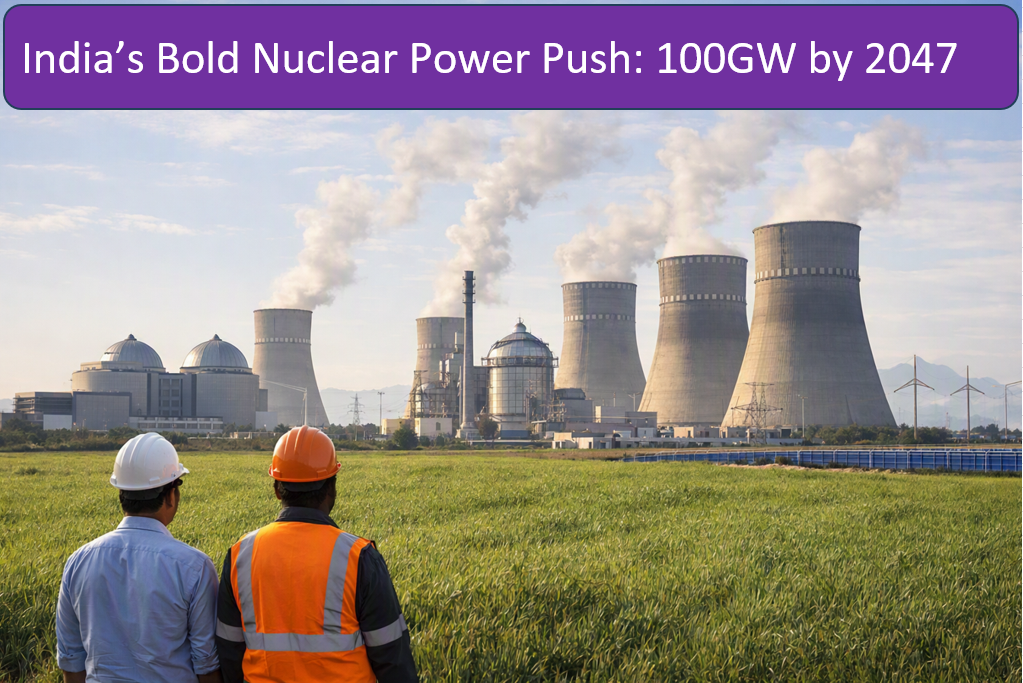
India’s Bold Nuclear Power Push: 100GW by 2047 — A New Energy Era
India’s Bold Nuclear Power Push: 100GW by 2047 has emerged as one of the country’s most ambitious long-term energy strategies. Prime Minister Narendra Modi has set a target of taking India’s nuclear power capacity to 100 GW by 2047, dramatically expanding the role of atomic energy in the country’s electricity mix.
The announcement represents a major shift in scale. India’s installed nuclear capacity is currently around 8.78 GW, meaning the country would need to add more than 90 GW over the next two decades to reach the 100 GW milestone.
The target is closely connected with India’s broader vision of Viksit Bharat, energy security and the country’s commitment to achieving net-zero emissions by 2070.
The government is also accelerating near-term reactor deployment. Five reactors are expected to be operationalised during the current decade, while India is targeting at least five indigenous Small Modular Reactors. or SMR’s by 2033.
The strategy is not simply about producing more electricity. It is about building a stronger domestic nuclear ecosystem involving reactor technology, manufacturing, research, investment and private-sector participation.
India’s Bold Nuclear Power Push: 100GW by 2047:
Why India Is Making a Bold Nuclear Power Push
India’s electricity requirements are rising rapidly.
Economic growth, urbanisation, manufacturing expansion, data centres, artificial intelligence infrastructure, electric vehicles, railways and green hydrogen production are expected to increase demand for reliable electricity.
At the same time, India is attempting to reduce its dependence on fossil fuels and expand clean energy.
Solar and wind power are central to this transition, but renewable generation is variable. Solar production falls after sunset, while wind generation depends on weather conditions.
Nuclear power offers a different characteristic: continuous, dispatchable, low-carbon electricity.
This makes nuclear energy potentially valuable as India builds a power system combining renewable generation with reliable sources capable of supporting the grid around the clock.
The government’s Nuclear Energy Mission therefore places nuclear power alongside renewable energy as an important component of India’s long-term clean-energy strategy. The mission was originally outlined in the Union Budget 2025-26 with the objective of reaching 100 GW of nuclear capacity by 2047.
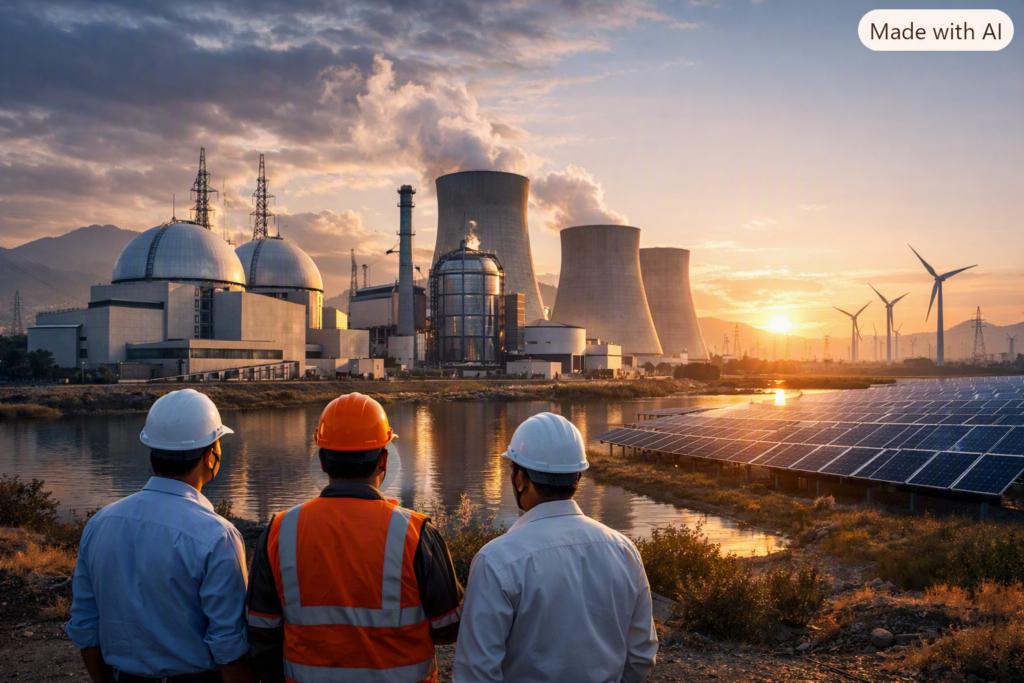
India’s Bold Nuclear Power Push: 100GW by 2047
The Scale of the Challenge
The numbers explain why the programme is so significant.
India has approximately 8.78 GW of nuclear capacity today. The long-term target is 100 GW.
That represents more than an eleven-fold increase.
Government planning has identified a phased pathway for expanding capacity. Earlier official projections indicated that nuclear capacity could reach around 22 GW by 2031-32, followed by further additions through indigenous reactors and new projects.
The challenge is not merely approving reactors.
Large nuclear projects require:
- Huge upfront capital expenditure
- Long construction timelines
- Highly specialised engineering
- Nuclear-grade manufacturing
- Fuel availability
- Regulatory approvals
- Skilled manpower
- Strong safety systems
- Waste-management infrastructure
- Reliable project financing
India therefore needs to transform its nuclear industry from a relatively small, government-dominated sector into a much larger industrial ecosystem.
That transformation is at the heart of the new policy direction.
India’s Bold Nuclear Power Push: 100GW by 2047 and Five New Reactors
One of the most immediate elements of the programme is the plan to operationalise five reactors during the current decade.
The near-term reactor additions are important because they can demonstrate India’s ability to execute projects faster while creating momentum for the much larger capacity expansion planned for the 2030s and 2040s.
India has decades of experience operating nuclear reactors, but scaling from today’s fleet to 100 GW will require a substantial increase in the speed and number of projects.
The Prototype Fast Breeder Reactor (PFBR) is another important milestone in India’s nuclear journey. Its significance extends beyond one individual project because it represents progress in India’s three-stage nuclear programme.
The success of these projects could provide technical and institutional experience for the much larger build-out ahead.
India’s Three-Stage Nuclear Programme
India’s nuclear strategy is unusual because the country has developed a long-term three-stage programme designed around its available nuclear resources.
The first stage relies heavily on Pressurised Heavy Water Reactors, or PHWRs.
The second stage involves fast breeder reactor technology.
The third stage is intended to make greater use of India’s thorium resources.
The programme was developed with the objective of building long-term energy independence and reducing dependence on imported nuclear fuel.
The current expansion therefore has a strategic dimension beyond electricity generation.
India is attempting to develop domestic expertise across reactor design, nuclear fuel, engineering, research and advanced reactor technologies.
The PFBR is particularly significant because it marks an important step toward the second stage of this programme.
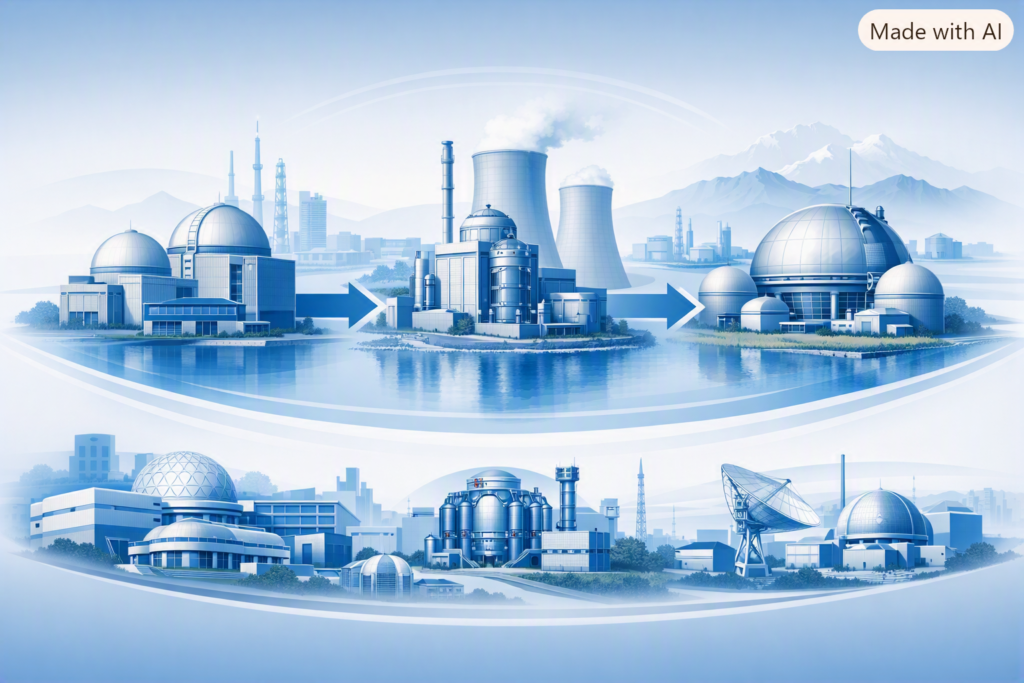
Small Modular Reactors: India’s Next Big Nuclear Opportunity
A major part of the new nuclear strategy is the development of Small Modular Reactors.
India has set a goal of developing and operationalising at least five indigenous SMRs by 2033.
SMRs are smaller nuclear reactors designed with modular construction and potentially more flexible deployment compared with conventional large-scale nuclear plants.
Their potential applications could include:
- Industrial power
- Captive electricity generation
- Replacement of fossil-fuel capacity
- Power for energy-intensive industries
- Support for hydrogen production
- Remote or specialised industrial applications
India is developing several indigenous reactor concepts, reflecting an attempt to build domestic intellectual property rather than relying entirely on imported technologies.
The development of SMRs could become particularly important if India wants to connect nuclear power with its industrial decarbonisation programme.
India’s Bold Nuclear Power Push: 100GW by 2047:
The Role of the SHANTI Act
The SHANTI Act is one of the most important policy developments supporting India’s nuclear expansion.
The Sustainable Harnessing and Advancement of Nuclear Energy for Transforming India framework changes the legal architecture governing India’s nuclear sector. The legislation replaces the earlier legal framework and is intended to enable broader participation in nuclear power.
The government wants greater participation from Indian private companies and joint ventures.
This is significant because the scale of the 100-GW target is unlikely to be achieved through the traditional government-led model alone.
The new framework is intended to create conditions in which private investment, technology partnerships and new business models can contribute to reactor development.
Recent government moves to establish detailed licensing and safety rules demonstrate that implementation of the new framework is now becoming a major focus. The government has sought stakeholder comments on proposed rules covering licensing, safety and financial security or insurance for nuclear damage.
This regulatory clarity will be crucial for investors.
Private Companies Enter India’s Nuclear Energy Sector
Private-sector participation could significantly change India’s nuclear industry.
Companies with experience in infrastructure, power generation, engineering and heavy manufacturing could potentially contribute capital and project-management capabilities.
Adani Power, for example, has indicated an ambition to develop up to 10 GW of nuclear capacity by 2035 and is evaluating reactor technologies and potential sites. The company has also stressed that project economics and regulatory clarity will be important factors.
Other major Indian industrial groups have also shown interest in the nuclear opportunity.
This could create a new competitive landscape.
Instead of relying primarily on one public-sector operator, India could eventually have several large nuclear developers operating alongside public-sector companies.
That could accelerate investment, although nuclear safety and regulatory standards will need to remain consistent regardless of ownership.
India’s Bold Nuclear Power Push: 100GW by 2047 and Energy Security
At the centre of India’s Bold Nuclear Power Push: 100GW by 2047 is the concept of energy security.
India imports a significant amount of its fossil-fuel requirements. International oil, gas and coal prices can be influenced by geopolitical conflicts, supply disruptions and global demand.
Nuclear power uses a different fuel system and can provide electricity over long operating periods.
Expanding domestic nuclear generation could therefore reduce some of India’s exposure to fossil-fuel volatility.
Energy security is especially important for a rapidly industrialising economy.
Manufacturing facilities, data centres, semiconductor plants, metro networks and advanced industrial operations require reliable electricity. Interruptions can have significant economic costs.
Nuclear power could become one of the sources supporting this dependable electricity base.
Nuclear Power and Renewable Energy Will Work Together
India’s nuclear programme should not be viewed as a replacement for solar or wind power.
Instead, the government is pursuing a combination of technologies.
India has a target of achieving 500 GW of renewable-energy capacity by 2030, while nuclear power is being developed as another source of low-carbon electricity.
The future power system could therefore look increasingly diversified:
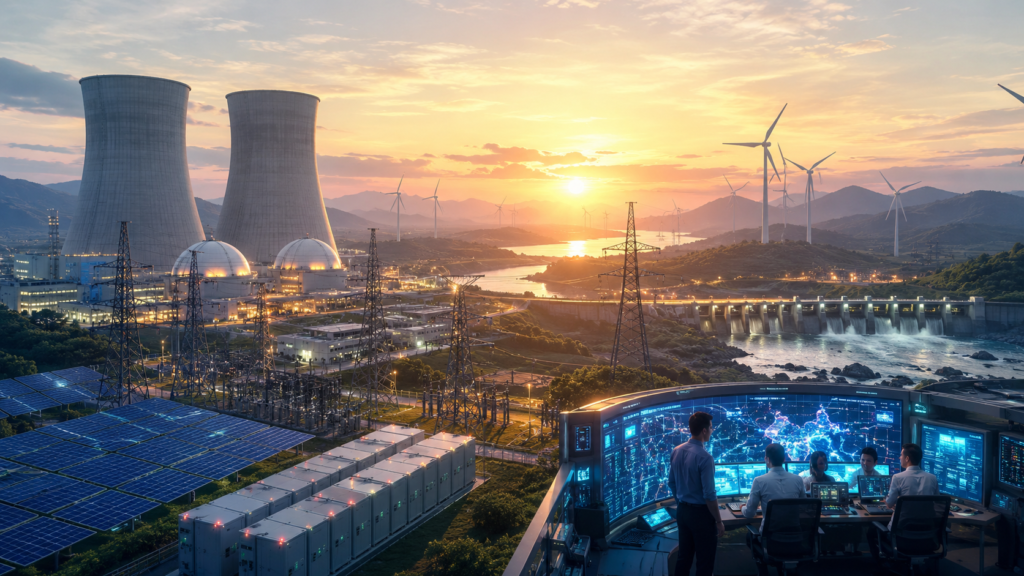
Solar + Wind + Nuclear + Hydro + Storage + Green Hydrogen
Solar and wind can provide large volumes of low-cost renewable electricity when conditions are favourable.
Nuclear can provide stable generation.
Hydropower and energy storage can improve flexibility.
Green hydrogen can use clean electricity to decarbonise sectors that are difficult to electrify directly.
This combination could make India’s energy system more resilient.
Nuclear Power’s Role in India’s Net-Zero 2070 Goal
India has committed to achieving net-zero emissions by 2070.
Reaching that objective will require substantial changes across electricity, transportation, industry and buildings.
Electricity demand is also expected to rise as more sectors become electrified.
That creates a difficult policy challenge: India needs more electricity while simultaneously lowering the emissions intensity of power generation.
Nuclear energy can contribute because reactors generate electricity without direct carbon emissions during operation.
NPCIL has already highlighted the emissions-avoidance contribution of India’s existing nuclear fleet. The company recently crossed a cumulative generation milestone of more than 1,000 billion units and estimated that this generation avoided around 860 million tonnes of carbon dioxide emissions.
The environmental case for nuclear power therefore becomes stronger when it is considered as part of a larger clean-energy system.
India’s Bold Nuclear Power Push: 100GW by 2047:
Building a Domestic Nuclear Manufacturing Ecosystem
Reaching 100 GW will require more than reactors.
India will need an extensive supply chain.
This could include:
- Heavy engineering companies
- Nuclear-grade steel manufacturers
- Precision component suppliers
- Turbine manufacturers
- Electrical equipment producers
- Construction companies
- Control-system developers
- Nuclear fuel suppliers
- Safety equipment manufacturers
- Engineering and consulting firms
A large domestic nuclear programme could therefore generate opportunities across India’s industrial economy.
It could also strengthen the Make in India agenda by creating demand for high-precision manufacturing.
The long-term objective is not simply to import reactor technology and equipment. India wants to build an ecosystem capable of designing, manufacturing, constructing and operating advanced nuclear facilities domestically.
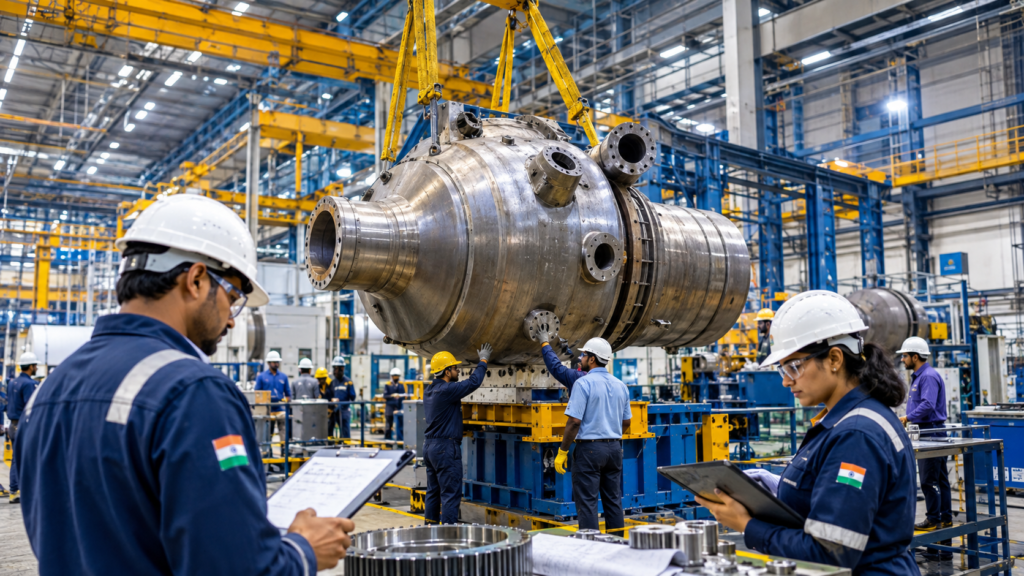
India’s Bold Nuclear Power Push: 100GW by 2047:
Jobs, Technology and Industrial Growth
The nuclear expansion could create employment across multiple skill levels.
Construction projects would require engineers, technicians, project managers, skilled workers and specialised contractors.
Operating nuclear facilities would require nuclear scientists, reactor operators, electrical engineers, mechanical engineers, safety specialists and maintenance professionals.
Research programmes could also create opportunities for scientists working in nuclear physics, materials science, thermal engineering, artificial intelligence, robotics and advanced manufacturing.
This is particularly relevant as India seeks to strengthen its high-technology manufacturing base.
The nuclear programme could therefore become part of a broader industrial strategy rather than remaining isolated within the electricity sector.
India’s Bold Nuclear Power Push: 100GW by 2047:
The Financing Challenge
One of the biggest challenges facing India’s Bold Nuclear Power Push: 100GW by 2047 will be financing.
Nuclear projects require large upfront investments and often have long construction periods before generating revenue.
Private investors will therefore need predictable regulations, financing structures and long-term power-purchase arrangements.
The government will also need to create conditions under which electricity generated by new nuclear plants remains affordable for consumers and distribution companies.
This issue is already being highlighted by prospective private developers.
Adani Power, for instance, has said that the choice of reactor technology will depend partly on whether electricity costs are viable for Indian consumers and distribution companies.
Therefore, the success of the nuclear mission will depend not only on engineering but also on economics.
Nuclear Safety Must Remain the Top Priority
Rapid expansion cannot compromise nuclear safety.
As India’s nuclear fleet grows, the regulatory system must become stronger and more sophisticated.
The government is developing rules covering licensing, safety requirements and financial protection associated with nuclear damage.
Safety considerations will influence:
- Reactor design
- Construction
- Fuel handling
- Waste management
- Emergency response
- Plant operation
- Decommissioning
Public confidence is equally important.
Large nuclear facilities are long-term infrastructure projects. Communities living near plants need transparent information about safety, emergency planning and environmental monitoring.
The 100-GW target will therefore have to be matched by a strong safety culture.
Nuclear Waste Management and Long-Term Responsibility
Another important issue is radioactive waste.
Nuclear power plants produce spent fuel and radioactive materials that require careful management.
India has experience with nuclear fuel-cycle management, but a much larger reactor fleet will inevitably increase the scale of the challenge.
Long-term waste management needs to be integrated into project planning from the beginning.
The goal should be to ensure that the environmental responsibilities associated with nuclear power are managed throughout the complete lifecycle of each facility.
What India’s Nuclear Expansion Means for Industry
The biggest impact may extend beyond electricity generation.
A larger nuclear fleet could support energy-intensive sectors that need dependable low-carbon power.
Potential beneficiaries include:
Data Centres
Data centres require electricity continuously. Nuclear power could potentially provide stable low-carbon generation for rapidly expanding digital infrastructure.
Green Hydrogen
Hydrogen production requires substantial electricity. Nuclear energy could potentially complement renewable sources for low-carbon hydrogen production.
Steel
Low-carbon steel production will require new energy and hydrogen technologies. Reliable electricity could support industrial decarbonisation.
Chemicals
Chemical manufacturing often requires continuous energy and heat. Advanced nuclear technologies could eventually provide both electricity and industrial heat.
Semiconductors
Chip manufacturing depends on highly reliable power quality. A diversified electricity system could support India’s ambitions in semiconductor manufacturing.
India’s Bold Nuclear Power Push: 100GW by 2047 Could Reshape the Grid
The significance of India’s Bold Nuclear Power Push: 100GW by 2047 extends beyond the nuclear industry itself.
A 100-GW nuclear fleet would change the structure of India’s electricity system.
It could provide a large source of firm low-carbon generation alongside renewable energy.
That could help reduce pressure on coal and gas plants during periods of low renewable generation, while also supporting rising electricity demand.
However, nuclear power will need to be integrated carefully with transmission infrastructure, storage, demand management and renewable generation.
The future grid will increasingly require sophisticated digital management.
Artificial intelligence, forecasting systems and advanced grid controls could help coordinate nuclear, renewable, storage and flexible demand.
India’s Bold Nuclear Power Push: 100GW by 2047:
Can India Really Reach 100GW by 2047?
The target is ambitious, but the government has established a multi-stage roadmap.
The immediate priority is increasing capacity from the current base and getting new reactors operational.
The next phase will require faster project execution and expanded manufacturing.
The longer-term phase will depend heavily on private-sector participation, SMRs, advanced reactor technologies and the successful development of India’s domestic supply chain.
The key factors will be:
- Faster project approvals
- Reliable financing
- Domestic manufacturing
- Technology development
- Regulatory clarity
- Nuclear safety
- Skilled workforce
- Efficient construction
- Fuel security
- Competitive electricity prices
If these conditions come together, India’s nuclear capacity could increase substantially over the next two decades.
India’s Bold Nuclear Power Push: 100GW by 2047:
India’s Nuclear Future: 2030, 2040 and 2047
The journey can broadly be understood in three phases.
By 2030
India will focus on completing projects already under development, operationalising additional reactors and establishing the regulatory and industrial foundation for wider participation.
By 2040
The nuclear industry could be substantially larger, with private companies, public-sector enterprises and joint ventures potentially operating multiple projects.
Advanced reactors and SMRs could also begin playing a more visible role.
By 2047
The ultimate objective is 100 GW of nuclear power capacity as India marks 100 years of independence.
The target would make nuclear energy one of the major pillars of India’s electricity system and support the country’s longer-term energy-security and climate objectives.
Global Significance of India’s Nuclear Strategy
India’s nuclear expansion could also have international implications.
A successful domestic nuclear manufacturing ecosystem could eventually support technology exports, engineering services and international partnerships.
India is already developing civil nuclear cooperation with other countries.
For example, an India-Australia civil nuclear cooperation arrangement announced in 2026 was described by the Indian government as complementary to the Nuclear Energy Mission and India’s 100-GW target.
International cooperation could help India access fuel resources, technology, investment and specialised expertise while allowing Indian companies to expand their capabilities.
Key Benefits of India’s 100GW Nuclear Target
The programme could deliver several long-term benefits if successfully implemented.
Energy Security
More domestic nuclear generation could reduce dependence on imported fossil fuels.
Reliable Electricity
Nuclear plants can provide continuous generation to complement variable renewable sources.
Lower-Carbon Growth
Nuclear energy can support economic expansion while limiting the carbon intensity of electricity.
Industrial Development
The construction of reactors could strengthen India’s heavy engineering and manufacturing sectors.
Technology Advancement
Advanced nuclear research could accelerate innovation in materials, robotics, safety and energy systems.
Employment
Large nuclear projects could create direct and indirect jobs across engineering, construction and manufacturing.
Strategic Autonomy
Domestic nuclear technology can strengthen India’s technological self-reliance.
India’s Bold Nuclear Power Push: 100GW by 2047:
Major Risks and Challenges
Despite its potential, the programme faces significant challenges.
Cost overruns: Large infrastructure projects can become more expensive than originally planned.
Construction delays: Nuclear plants can take many years to complete.
Regulatory complexity: Strong safety standards are essential but projects also need predictable approval processes.
Public acceptance: Communities need transparency and confidence in nuclear safety.
Financing: Long project timelines can make nuclear investment difficult without appropriate financing structures.
Technology selection: India must balance domestic technology development with access to proven international designs.
Waste management: Long-term radioactive waste management requires careful planning.
Grid integration: Large nuclear plants need suitable transmission infrastructure.
These challenges do not make the 100-GW target impossible, but they show why implementation will be as important as policy announcements.
The Bigger Picture: India’s Energy Strategy for 2047
India’s nuclear programme should be understood as one part of a much larger energy transformation.
The country is simultaneously expanding solar power, wind power, hydropower, battery storage, green hydrogen and transmission infrastructure.
The objective is to build an electricity system capable of supporting a much larger economy.
Nuclear power can contribute the reliable low-carbon component of that system.
Renewables can provide massive volumes of clean electricity.
Storage can provide flexibility.
Hydrogen can help decarbonise heavy industry.
Digital technologies can make the grid smarter.
Together, these technologies could create a much more resilient energy system.
Conclusion: A High-Stakes Nuclear Mission
India’s Bold Nuclear Power Push: 100GW by 2047 represents a fundamental change in the country’s approach to nuclear energy.
From a current capacity of around 8.78 GW, India is aiming for 100 GW within two decades. The strategy combines new conventional reactors, five indigenous SMRs targeted by 2033, greater private-sector participation, domestic manufacturing and continued development of India’s three-stage nuclear programme.
The ambition is enormous.
But so is India’s future electricity requirement.
If the country succeeds in executing projects efficiently while maintaining the highest safety standards, nuclear energy could become a major pillar of India’s energy security, industrial growth and clean-energy transition.
The real test now is implementation.
The next few years will determine whether India’s nuclear programme can move from ambitious targets to large-scale construction. If that transition succeeds, the 100-GW goal could become one of the defining components of India’s energy story as the country approaches its centenary of independence in 2047.
Frequently Asked Questions (FAQ)
1. What is India’s nuclear power target for 2047?
India aims to increase its nuclear power capacity to 100 GW by 2047. The target is part of the government’s Nuclear Energy Mission and broader Viksit Bharat strategy.
2. What is India’s current nuclear power capacity?
India currently has approximately 8.78 GW of installed nuclear power capacity. The government plans a major expansion over the next two decades.
3. How many nuclear reactors will India add this decade?
The government has announced plans for five reactors to be operationalised during the current decade as part of the acceleration of India’s nuclear programme.
4. What are Small Modular Reactors?
Small Modular Reactors, or SMRs, are smaller nuclear reactor designs intended to offer potentially more flexible deployment and modular construction. India is targeting at least five indigenous SMRs by 2033.
5. What is the SHANTI Act?
The SHANTI Act is India’s new legal framework for the nuclear sector. It is intended to facilitate wider participation, including Indian private companies and joint ventures, while establishing a modern regulatory framework.
6. Why does India need more nuclear power?
India’s electricity demand is expected to increase as manufacturing, digital infrastructure, transportation and industrial activity expand. Nuclear power can provide reliable low-carbon electricity alongside solar and wind.
7. Can nuclear power help India achieve net zero by 2070?
Nuclear power can contribute to India’s net-zero pathway by providing low-carbon electricity and reducing reliance on fossil-fuel generation. It is expected to work alongside renewable energy rather than replace it.
8. Who will build India’s future nuclear plants?
The future nuclear programme is expected to involve government entities, public-sector companies, joint ventures and private-sector participants. NPCIL remains a major player, while companies such as Adani Power have announced nuclear ambitions.
9. What is the three-stage nuclear programme?
India’s three-stage programme is a long-term strategy involving Pressurised Heavy Water Reactors, fast breeder reactors and eventually advanced systems designed to make greater use of India’s thorium resources.
10. When will India reach 100 GW of nuclear capacity?
The government’s long-term target is to achieve 100 GW of nuclear power capacity by 2047. Reaching the goal will depend on project execution, investment, technology, regulation, manufacturing and safety.
My View:-
India’s Bold Nuclear Power Push: 100GW by 2047– reflects a strategic leap toward clean energy independence. By targeting 100 GW by 2047, the government is signaling confidence in nuclear technology as a stable, long-term power source. The integration of fast breeder and thorium reactors demonstrates scientific maturity and foresight. This initiative not only strengthens India’s energy security but also positions the nation as a global leader in sustainable innovation.