
India’s BRICS Exports Surge 34%: 5 Key Trade Wins
India’s BRICS Exports Surge 34%: 5 Key Trade Wins is emerging as one of the important trade stories of the first five months of India’s 2026-27 financial year. India’s exports to the four core BRICS economies-China, South Africa, Brazil and Russia- rose sharply during April-August 2026-27, reaching $19.9 billion, compared with $14.9 billion in the corresponding period a year earlier.
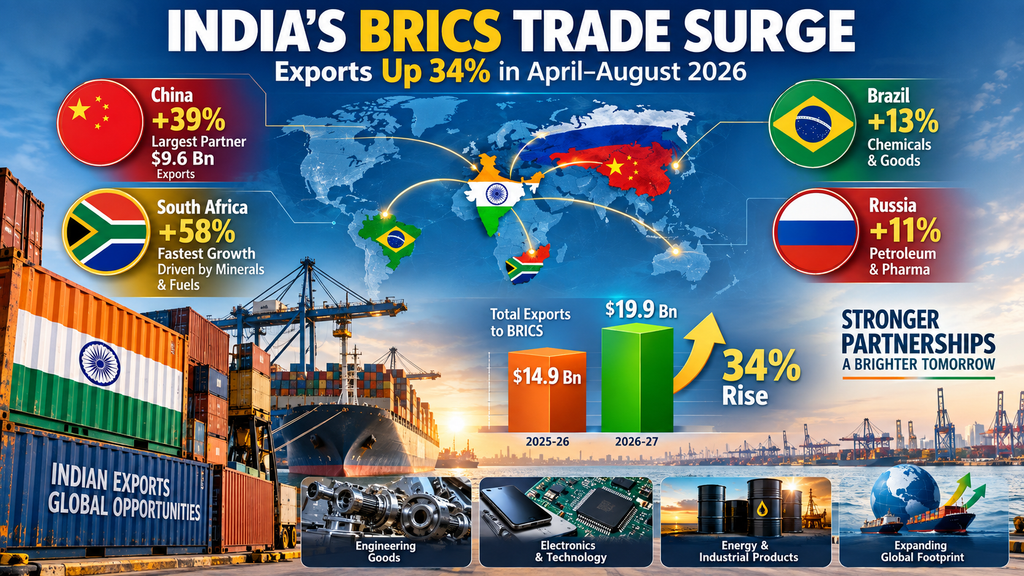
The increase represents a 34% year-on-year rise, highlighting stronger export momentum across some of India’s major emerging-market destinations.
China was the largest contributor among the four core markets, with Indian exports rising 39% to $9.6 billion. South Africa recorded an even faster percentage increase, with exports rising 58%, while exports to Brazil and Russia increased 13% and 11% respectively.
The latest numbers underline the growing importance of BRICS markets for Indian exporters and come at a time when the grouping is expanding its economic cooperation in areas such as trade facilitation, supply chains, digital commerce and cross-border payments.
India’s BRICS Exports Surge 34%: 5 Key Trade Wins
India’s BRICS Exports Surge 34% to $19.9 Billion
The central figure behind the latest trade story is the 34% increase in India’s exports to the four core BRICS economies.
According to Commerce Ministry data reported in September 2026, exports to China, South Africa, Brazil and Russia increased from $14.9 billion in April-August 2025-26 to $19.9 billion in April-August 2026-27.
The increase also raised the combined share of these four countries in India’s overall exports. Their share increased from 8.1% to 9.2% during the corresponding five-month period.
That change is important because it shows that the growth is not simply about a larger dollar value. The four core BRICS markets are accounting for a larger portion of India’s export basket.
India’s BRICS Exports Surge 34%: 5 Key Trade Wins
India’s BRICS Exports: Key Numbers at a Glance
| Market | Export growth | Key figure |
|---|---|---|
| China | 39% | $9.6 billion |
| South Africa | 58% | Fastest growth |
| Brazil | 13% | Double-digit growth |
| Russia | 11% | Double-digit growth |
| Core BRICS total | 34% | $19.9 billion |
The figures demonstrate that growth was broad-based across the four core markets rather than being driven exclusively by China.
5 Key Trade Wins Behind India’s BRICS Export Surge
The latest numbers reveal several important developments for India’s international trade strategy. From stronger access to China’s market to rapid growth in South Africa, the data provides five major takeaways.
1. China Becomes the Biggest Contributor to India’s BRICS Exports
The first major trade development is China’s contribution.
Indian exports to China rose 39% to $9.6 billion during April-August 2026-27. China therefore represented the largest export market among the four core BRICS economies during the period.
The increase is particularly significant because India-China trade has traditionally involved a substantial imbalance, with Indian imports from China much larger than Indian exports to China.
Higher Indian shipments to China could therefore provide opportunities for Indian businesses to increase their presence in one of the world’s largest markets.
The important question going forward will be whether the recent increase can be sustained and whether it represents a wider expansion across manufactured products, electronics, engineering goods, industrial materials and other export categories.
A sustained increase would potentially give Indian manufacturers more opportunities to participate in Asian supply chains.
2. South Africa Records the Fastest Growth
The second major development is South Africa.
While China recorded the largest export value among the four core BRICS economies, South Africa recorded the fastest growth rate at 58% during April-August 2026-27.
That makes South Africa an important market to watch in India’s broader BRICS trade strategy.
India and South Africa have long maintained commercial relationships across sectors including automobiles, pharmaceuticals, chemicals, machinery, engineering products, food products and other manufactured goods.
The latest growth indicates that Indian exporters are finding additional opportunities in the South African market.
South Africa also provides Indian companies with an important commercial gateway into the wider African market. Although exports to one country should not automatically be interpreted as evidence of broader continental trends, stronger India-South Africa trade can create opportunities for companies already seeking to expand their African operations.
For Indian exporters, the combination of geographic access, established business relationships and BRICS-level cooperation makes South Africa an important market within the grouping.
3. Brazil and Russia Deliver Double-Digit Export Growth
The third trade win is the simultaneous growth in exports to Brazil and Russia.
Indian exports to Brazil increased 13%, while shipments to Russia rose 11% during April-August 2026-27.
Although these growth rates are lower than the increases recorded in China and South Africa, both markets still delivered double-digit growth.
Brazil is particularly relevant to India because it is the largest economy in Latin America and offers opportunities across agriculture, chemicals, pharmaceuticals, engineering goods, automotive products and industrial inputs.
Russia remains significant because of India’s long-standing economic relationship with the country, particularly in energy, pharmaceuticals, machinery, chemicals, agricultural products and other sectors.
The simultaneous expansion across Brazil and Russia demonstrates that India’s export growth within the original BRICS framework is geographically diversified.
This matters for exporters because dependence on a single foreign market can increase exposure to demand shocks, regulatory changes and geopolitical disruptions.
A broader market base can provide companies with additional channels for international growth.
4. The Share of Core BRICS Markets in India’s Exports Has Increased
The fourth major development is the increase in the combined share of the four core BRICS economies.
During April-August 2026-27, China, South Africa, Brazil and Russia accounted for 9.2% of India’s total exports, compared with 8.1% in the same period of 2025-26.
This means the BRICS story is not simply about the headline 34% increase.
It also reflects a change in the composition of India’s export destinations.
A rising share indicates that these markets are becoming relatively more important within India’s overall export basket.
For policymakers, this can support efforts to improve market access, customs procedures, logistics connectivity and trade facilitation.
For businesses, it can encourage companies to study consumer demand and regulatory requirements in BRICS economies more closely.
However, the increase should still be viewed in the context of India’s total export performance. A five-month period provides an important snapshot, but it is not sufficient on its own to establish a long-term structural trend.
Continued growth over several quarters would provide stronger evidence of sustained export diversification.
5. BRICS Expansion Creates a Larger Potential Market
The fifth trade win is connected to the changing structure of BRICS itself.
BRICS originally consisted of Brazil, Russia, India, China and South Africa. The grouping subsequently expanded, adding Egypt, Ethiopia, Iran, the United Arab Emirates and Saudi Arabia, while Indonesia joined in 2025. Several additional countries have also become BRICS partner countries.
The expansion gives Indian businesses access to a wider network of emerging markets.
These countries represent diverse economic structures and demand patterns. Energy, minerals, agriculture, manufacturing, pharmaceuticals, technology, engineering products and services are among the areas where trade opportunities can potentially develop.
The broader BRICS network also gives India additional channels for economic engagement with markets outside its traditional export destinations.
However, membership in a multilateral grouping does not automatically translate into higher trade. Businesses still need competitive products, reliable logistics, favourable market access, appropriate standards and effective payment mechanisms.
That distinction is important when evaluating the latest export figures.
India’s BRICS Exports Surge 34%: Why China’s 39% Growth Matters
The China number deserves particular attention.
Indian exports to China increased 39% to $9.6 billion in the first five months of FY2026-27.
China is one of the world’s largest manufacturing economies and a major participant in global supply chains. Greater access to the Chinese market could therefore provide opportunities for Indian companies capable of supplying competitively priced industrial and consumer products.
At the same time, India continues to import substantial volumes from China.
Therefore, higher exports to China should be viewed as one component of the broader bilateral trade relationship rather than as evidence that the trade imbalance has disappeared.
For Indian policymakers and exporters, the longer-term objective would involve expanding the range and value of products India can competitively sell in China.
Electronics, engineering products, industrial inputs and other manufactured goods could become increasingly important if Indian companies continue strengthening production capabilities.
What Is Driving India’s BRICS Export Growth?
Several factors can help explain the recent momentum, although the available five-month data does not establish that one single factor caused the entire increase.
India’s BRICS Exports Surge 34%: 5 Key Trade Wins
Stronger Demand for Industrial Products
Industrial products and intermediate goods play an important role in international supply chains.
India’s expanding manufacturing base can allow exporters to supply machinery, components, metals, chemicals and other industrial inputs to overseas markets.
As manufacturing activity increases across emerging economies, demand for these products can also rise.
Electronics and Technology Manufacturing
Electronics has become an increasingly important component of India’s export strategy.
India has invested heavily in domestic electronics manufacturing, semiconductor-related capabilities and technology production.
Higher exports of electronics can help move the country’s export basket toward higher-value manufactured products.
The latest broader export data also showed growth in electronics shipments to markets outside BRICS, indicating that the trend is not confined to a single trade bloc.
Energy and Mineral Products
India’s BRICS Exports Surge 34%: 5 Key Trade Wins
Energy products and minerals also remain important contributors to India’s international trade.
Recent Commerce Ministry data cited in reports showed strong growth in exports to Japan and South Korea, with mineral fuels among the products contributing to the increase.
This suggests that India’s export growth is occurring across multiple product categories and geographical markets.
BRICS Trade Beyond Merchandise Exports
India’s BRICS Exports Surge 34%: 5 Key Trade Wins
The future of India-BRICS economic cooperation is not limited to physical goods.
Services could become another important component.
India has a globally competitive information technology and business-services industry. Expanded digital trade cooperation could therefore create opportunities for Indian software companies, technology providers and professional-services firms.
Cross-border payments are another important area.
Faster and more efficient payment mechanisms can reduce transaction friction for exporters and importers. However, developing such systems requires coordination on regulations, financial infrastructure, currency settlement and compliance.
Customs cooperation is similarly important.
Simplifying documentation and improving customs procedures can reduce the time and cost associated with international trade.
The BRICS economic agenda has increasingly included discussions around trade facilitation, digital services, supply chains, MSMEs, agricultural trade and cross-border payments.
India’s BRICS Exports Surge 34% While Other Markets Also Grow
The BRICS growth is occurring alongside stronger export performance in several non-BRICS markets.
During April-August 2026-27, India’s exports to Japan rose 43% to $3.43 billion, while exports to Italy increased by about 30% to $3.92 billion. Shipments to South Korea rose 22% to $3.21 billion.
The Japan increase was supported by higher exports of mineral fuels, electronics and aluminium. Mineral fuel exports to Japan increased by $231.7 million, or 76%, according to the reported Commerce Ministry data.
Exports to South Korea were supported by minerals, fuels, electronics, aluminium, iron and steel and chemicals.
These numbers provide useful context.
India’s export growth is not occurring exclusively within BRICS. The country is simultaneously expanding trade with major Asian and European economies.
That diversification can become important as Indian companies seek to reduce concentration risks and develop multiple international markets.
India’s BRICS Exports Surge 34% vs Broader BRICS Growth
Another important distinction is the difference between the four core BRICS economies and the expanded BRICS grouping.
The 34% increase applies specifically to exports to China, South Africa, Brazil and Russia during April-August 2026-27.
For the broader 11-member BRICS grouping, India’s exports were reported at $34.5 billion during April-July 2026, compared with $30.5 billion a year earlier, representing approximately 13% growth.
The comparison demonstrates that the core four markets have recently recorded faster export growth than the broader grouping.
This is an important point for readers because headlines referring simply to “BRICS exports” can otherwise create confusion about which countries and period are included.
For accurate reporting, the 34% figure should be associated with the four core markets and the April-August period.
How India Could Build on the Export Momentum
India’s BRICS Exports Surge 34%: 5 Key Trade Wins
The latest figures create opportunities, but sustaining export growth will depend on several practical factors.
Improve Product Competitiveness
Indian exporters need competitive pricing, consistent quality and reliable delivery schedules to retain overseas buyers.
Expand Higher-Value Manufacturing
Moving beyond commodities and low-value products toward electronics, engineering goods, advanced materials and technology-intensive products can increase the value generated by exports.
Strengthen Logistics
Port capacity, shipping connectivity, warehousing and multimodal transportation remain important components of export competitiveness.
Support MSME Exporters
Small and medium-sized businesses can benefit from easier access to export finance, market intelligence, digital platforms and compliance support.
Expand Market-Specific Strategies
China, Brazil, South Africa and Russia have very different consumer markets, regulatory environments and business structures.
Indian companies therefore need country-specific strategies rather than treating BRICS as one single market.
India’s BRICS Exports Surge 34%: 5 Key Trade Wins
Challenges That Could Affect Future BRICS Exports
Despite the strong numbers, several challenges remain.
Trade Barriers
Different technical standards, certification requirements, tariffs and regulations can increase the cost of entering foreign markets.
Currency and Payment Risks
Exchange-rate movements can affect exporter margins. International payment arrangements also need to remain efficient and predictable.
Geopolitical Uncertainty
Global geopolitical developments can influence shipping routes, energy prices, financial transactions and consumer demand.
Logistics Costs
Export competitiveness depends heavily on the cost and reliability of moving goods from factories to foreign customers.
Trade Imbalances
India’s trade relationship with several BRICS members remains unbalanced. Increasing exports is therefore important, but the composition of bilateral trade also matters.
India’s BRICS Exports Surge 34%: 5 Key Trade Wins
What the 34% BRICS Export Growth Means for Indian Businesses
For Indian businesses, the latest figures provide several areas to monitor.
Manufacturers can explore demand in emerging markets, particularly for industrial and intermediate products.
Technology companies can examine opportunities created by expanding digital trade.
Pharmaceutical companies can seek additional market access in developing economies.
Engineering companies can participate in infrastructure and industrial supply chains.
Agricultural exporters can investigate demand for processed food and agricultural products.
Energy and mineral companies can also benefit from changing demand patterns, subject to international prices and regulatory conditions.
The broader lesson is that India’s export strategy is increasingly connected to multiple emerging markets rather than being dependent on a small number of traditional destinations.
India’s BRICS Exports Surge 34%: What Comes Next?
The next several months will be important for determining whether the latest export increase develops into a sustained trend.
The 34% increase to $19.9 billion provides a strong five-month snapshot. China’s 39% growth and South Africa’s 58% increase demonstrate particularly strong momentum, while Brazil and Russia have also posted double-digit growth.
However, trade data can fluctuate because of commodity prices, seasonal demand, exchange rates, individual shipments and changing market conditions.
Therefore, future monthly and quarterly data will provide a clearer picture of whether the recent performance represents a temporary acceleration or a longer-term change in India’s export relationship with the BRICS economies.
The expansion of BRICS also means that Indian exporters have a larger network of potential markets to explore.
India’s BRICS Exports Surge 34%: 5 Key Trade Wins
Conclusion
India’s BRICS Exports Surge 34%: 5 Key Trade Wins captures a significant development in India’s international trade performance during the first five months of FY2026-27.
Exports to the four core BRICS economies—China, South Africa, Brazil and Russia—rose from $14.9 billion to $19.9 billion, representing a 34% increase.
China was the largest contributor, with exports rising 39% to $9.6 billion. South Africa delivered the fastest percentage growth at 58%, while Brazil and Russia recorded increases of 13% and 11%.
The combined share of the four markets in India’s total exports also increased from 8.1% to 9.2%.
The figures indicate that BRICS markets are becoming more important destinations for Indian exporters. At the same time, strong export growth to Japan, Italy and South Korea demonstrates that India is pursuing a broader market-diversification strategy.
The next challenge will be sustaining the momentum through greater manufacturing competitiveness, stronger logistics, higher-value exports, improved market access and deeper trade facilitation.
For India, the latest BRICS export numbers are therefore not just a headline figure. They provide an important snapshot of how the country’s exporters are expanding their presence across major emerging economies.
India’s BRICS Exports Surge 34%: 5 Key Trade Wins
Frequently Asked Questions
1. How much did India’s exports to core BRICS countries increase?
India’s exports to China, South Africa, Brazil and Russia increased 34% to $19.9 billion during April-August 2026-27, compared with $14.9 billion during the corresponding period of 2025-26.
2. Which BRICS country recorded the highest value of Indian exports?
China was the largest destination among the four core BRICS economies, with Indian exports reaching $9.6 billion during April-August 2026-27.
3. How much did India’s exports to China grow?
India’s exports to China increased 39% during April-August 2026-27, reaching approximately $9.6 billion.
4. Which core BRICS market recorded the fastest export growth?
South Africa recorded the fastest growth rate, with Indian exports increasing 58% during the first five months of FY2026-27.
5. How much did India’s exports to Brazil and Russia grow?
Indian exports to Brazil increased 13%, while exports to Russia increased 11% during April-August 2026-27.
6. What share of India’s exports went to the four core BRICS countries?
The combined share of China, South Africa, Brazil and Russia in India’s total exports increased to 9.2%, compared with 8.1% in the corresponding period a year earlier.
7. Is the 34% figure for all BRICS countries?
No. The 34% figure refers specifically to the four core BRICS economies—China, South Africa, Brazil and Russia—during April-August 2026-27.
8. Has BRICS expanded beyond the original five countries?
Yes. BRICS has expanded substantially since its original Brazil, Russia, India, China and South Africa membership. Egypt, Ethiopia, Iran, the UAE, Saudi Arabia and Indonesia have joined, while additional countries have become partner countries.
9. Why is the growth in exports to China significant for India?
China is one of the world’s largest economies and manufacturing markets. Higher Indian exports can provide additional opportunities for Indian manufacturers and exporters, although the broader India-China trade relationship continues to include a substantial trade imbalance.
10. What could determine whether India’s BRICS export growth continues?
Future performance will depend on factors including global demand, product competitiveness, manufacturing capacity, logistics, trade barriers, exchange rates, market access and geopolitical conditions.
MY View
India’s BRICS Exports Surge 34%: 5 Key Trade Wins
India’s 34% surge in BRICS exports signals stronger demand for Indian goods across major emerging markets. China’s 39% growth and South Africa’s 58% rise highlight expanding opportunities for Indian exporters and greater trade diversification. The trend could strengthen India’s position in global supply chains and open new markets for manufacturers. Sustaining this momentum will depend on competitiveness, product quality, logistics and continued market access.