
UPSC Civil Services Exam: 7 Powerful Steps to Success:
Introduction: Understanding the UPSC Journey
The UPSC Civil Services Exam: 7 Powerful Steps to Success is more than a competitive examination. It is a multi-stage selection process through which candidates compete for several important civil services in India.
Every year, a large number of aspirants begin preparing for the Civil Services Examination with the goal of joining services such as the Indian Administrative Service (IAS), Indian Police Service (IPS), Indian Foreign Service (IFS) and various Central Civil Services.
But success in the UPSC examination is not achieved by simply studying more books or memorising more facts. Aspirants need to understand the complete examination structure, plan their preparation, practise answer writing, develop analytical skills and remain consistent over a long period.
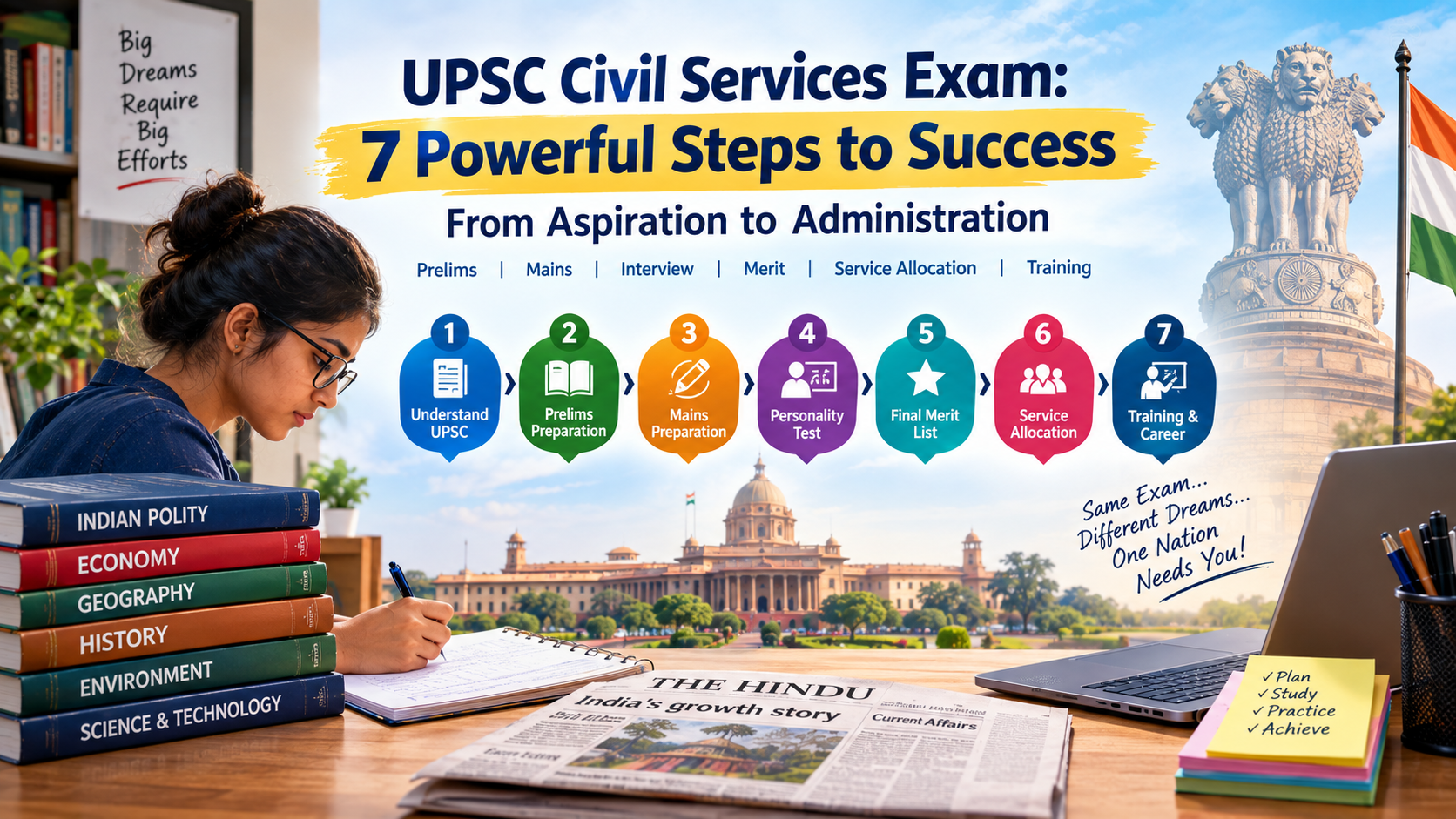
The journey can broadly be understood through seven powerful steps:
- Understand UPSC and the examination structure
- Prepare strategically for the Preliminary Examination
- Build a strong foundation for the Main Examination
- Master answer writing, Essay and Optional Subject
- Prepare effectively for the Personality Test
- Understand final merit and service allocation
- Prepare for the responsibilities that begin after selection
This guide explains each stage and shows how an aspirant can approach the complete journey.
1. Understand the UPSC Civil Services Exam
The first step toward success is understanding what the examination actually involves.
The Union Public Service Commission, commonly known as UPSC, is a constitutional body. Article 315 of the Constitution provides for the Union and State Public Service Commissions, while Article 320 deals with their functions.
UPSC conducts several examinations for recruitment to different services. Among the various examinations conducted by the UPSC, the Civil Services Examination is one of the most prominent.
Through the Civil Services Examination, candidates can be considered for services including IAS, IPS, IFS and various Central Civil Services, subject to the applicable rules, vacancies and allocation process.
An important distinction should be remembered: UPSC conducts the examination and recommends candidates, while service allocation is a separate administrative process.
Know the three major examination stages
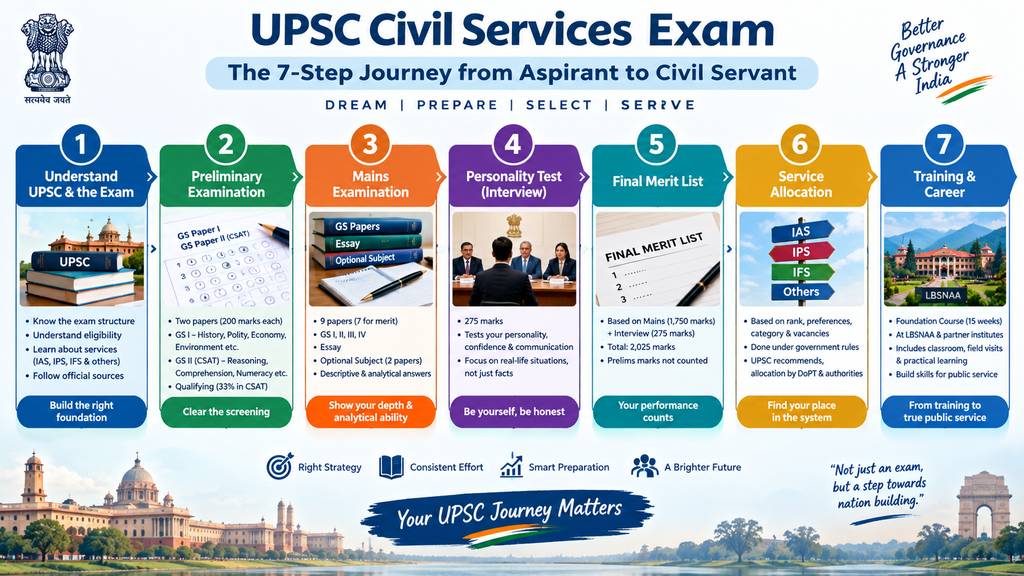
The Civil Services Examination is conducted in three main stages:
Stage 1: Preliminary Examination
This is primarily a screening stage.
Stage 2: Main Examination
The Mains examination is a descriptive written stage that plays a crucial role in determining the final merit.
Stage 3: Personality Test
This is the final assessment stage, commonly known as the UPSC Interview.
Understanding these stages prevents one of the most common mistakes made by new aspirants: preparing for the entire examination as though every paper has the same purpose.
2. Build a Winning Strategy for UPSC Prelims
The second step in the UPSC Civil Services Exam: 7 Powerful Steps to Success is developing a practical strategy for the Preliminary Examination.
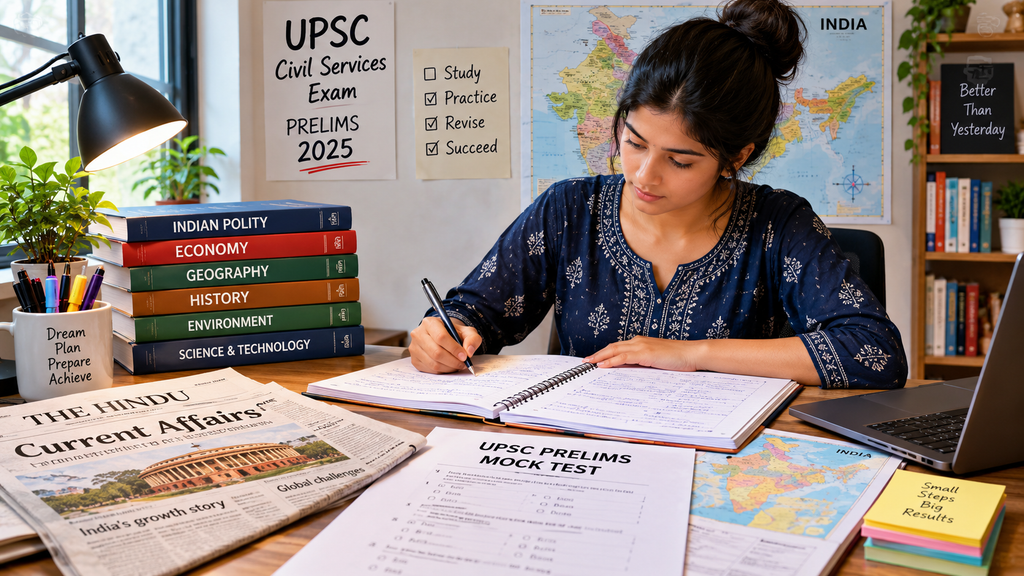
The Preliminary Examination consists of two papers:
- General Studies Paper I
- General Studies Paper II, commonly known as CSAT
Both papers carry 200 marks.
General Studies Paper I covers broad areas including history, geography, polity, economy, environment, science and technology, and current affairs.
CSAT covers areas such as comprehension, logical reasoning, analytical ability, decision-making, problem-solving, basic numeracy and data interpretation.
CSAT is qualifying in nature, with a minimum qualifying requirement of 33%.
Why Prelims strategy matters
Prelims is different from Mains.
In Prelims, candidates generally have to choose the correct answer from multiple options. This shows that having knowledge alone is not sufficient.
A candidate also needs:
- Accuracy
- Elimination skills
- Time management
- Question-selection ability
- Regular revision
- Mock-test practice
Another important point is that Preliminary Examination marks are not added to the final merit.
Therefore, an aspirant should approach Prelims as a screening stage while maintaining preparation for the subsequent Main Examination.
Use previous-year question papers
Previous-year question papers are among the most useful resources for understanding UPSC’s examination pattern.
They can help aspirants identify:
- Frequently tested themes
- Question framing
- Conceptual areas
- Difficulty level
- Changing trends
- Areas requiring deeper study
Aspirants should not merely solve previous papers. They should analyse why an option is correct or incorrect.
3. Build a Strong Foundation for UPSC Mains
The third step in the UPSC Civil Services Exam: 7 Powerful Steps to Success is preparing for the Main Examination from the beginning rather than waiting until after Prelims.
The Main Examination changes the nature of the competition.
Instead of selecting answers from multiple choices, candidates must write structured and analytical responses.
The Main Examination includes nine written papers, comprising qualifying papers and papers that contribute to merit.
The merit component includes:
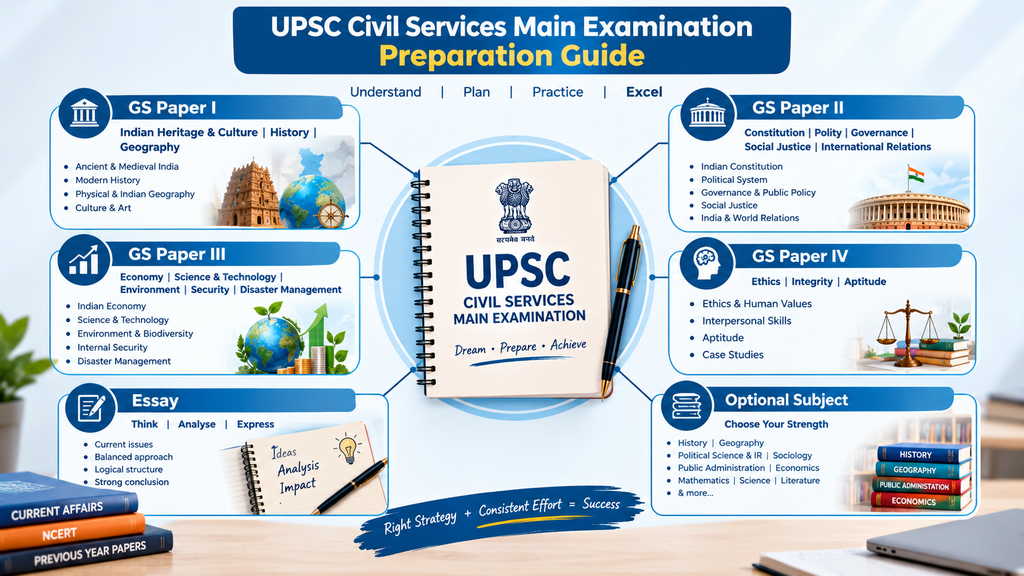
- Essay
- General Studies Paper I
- General Studies Paper II
- General Studies Paper III
- General Studies Paper IV
- Optional Subject Paper I
- Optional Subject Paper II
GS Paper I
GS Paper I covers:
- Indian Heritage and Culture
- History
- Geography
GS Paper II
GS Paper II focuses on:
- Constitution
- Polity
- Governance
- Social Justice
- International Relations
GS Paper III
GS Paper III includes:
- Economy
- Science and Technology
- Environment
- Biodiversity
- Security
- Disaster Management
GS Paper IV
GS Paper IV deals with:
- Ethics
- Integrity
- Aptitude
The challenge is not simply to know these subjects.
Aspirants need to connect static knowledge with contemporary issues.
For example, studying the Constitution should not remain limited to memorising Articles. Candidates should also understand how constitutional principles relate to governance, rights, institutions and contemporary public-policy questions.
UPSC Civil Services Exam: 7 Powerful Steps to Success:
Read with an answer-writing mindset
While studying, ask:
What could UPSC ask about this topic?
Then consider:
- What is the issue?
- What are its causes?
- What are its effects?
- What are the challenges?
- What are the government measures?
- What can be done?
- What would be a balanced conclusion?
This approach gradually converts information into usable examination knowledge.
4. Master Answer Writing, Essay and Optional Subject
The fourth step is to develop the ability to convert knowledge into high-quality written answers.
This is where many candidates discover that knowing an answer and writing an effective answer are two different skills.
An effective UPSC answer should generally have:
- A clear introduction
- Logical structure
- Relevant arguments
- Appropriate examples
- Multiple dimensions
- Balanced analysis
- A practical conclusion
Practise regularly
Aspirants can begin with short answers before moving toward complete examination-length answers.
For example:
Question: Discuss the challenges associated with urbanisation in India.
Instead of simply listing problems, an answer can consider:
- Economic dimensions
- Social dimensions
- Environmental impact
- Infrastructure
- Governance
- Migration
- Housing
- Public transportation
- Possible solutions
This multidimensional approach is useful across several General Studies papers.
Essay preparation
Essay writing requires a different approach.
An essay should demonstrate:
- Understanding
- Logical progression
- Multiple perspectives
- Examples
- Balance
- Clarity
- A coherent conclusion
Avoid treating an essay as a collection of disconnected facts.
A good essay should feel like a structured argument.
Choosing the Optional Subject
The optional subject is another major component of the Main Examination.
The UPSC framework includes subjects such as:
- History
- Geography
- Political Science and International Relations
- Sociology
- Public Administration
- Economics
- Mathematics
- Science subjects
- Engineering subjects
- Literature subjects
Candidates should study the official syllabus and previous-year questions before making a decision.
The optional subject should not be selected merely because another candidate scored well in it.
Consider factors such as:
- Personal interest
- Academic background
- Availability of study material
- Syllabus size
- Previous familiarity
- Ability to sustain preparation
- Previous-year question patterns
UPSC Civil Services Exam: 7 Powerful Steps to Success — The Middle of the Journey
At the middle of the UPSC Civil Services Exam: 7 Powerful Steps to Success, preparation should move beyond collecting information.
The focus should gradually shift toward application.
An aspirant who has studied hundreds of topics but cannot structure an answer under time pressure may struggle in the Main Examination.
Similarly, a candidate who knows current affairs but cannot connect them with the syllabus may find it difficult to use that knowledge effectively.
This is why revision, answer writing and mock testing should become regular parts of preparation.
5. Prepare Smartly for the UPSC Personality Test
The fifth step in the UPSC Civil Services Exam: 7 Powerful Steps to Success is preparation for the Personality Test.
The Personality Test is commonly called the UPSC Interview, although the official terminology is “Personality Test.”
According to the examination framework, the Personality Test carries 275 marks.
It is not simply a test of factual information.
The assessment can involve how a candidate:
- Understands an issue
- Expresses an opinion
- Handles a difficult question
- Considers different perspectives
- Approaches public-service situations
- Communicates clearly
Do not confuse the Personality Test with a quiz
An interview board may discuss issues related to the candidate’s background, education, interests, current affairs and broader national or international developments.
The objective should not be to memorise hundreds of model answers.
Instead, candidates should develop the ability to think clearly and respond honestly.
Develop balanced thinking
Civil servants work with complex situations where there may not always be one simple answer.
Therefore, candidates should practise looking at issues from different perspectives.
For example, when discussing a public policy, consider:
- Benefits
- Challenges
- Stakeholder impact
- Implementation difficulties
- Financial implications
- Social consequences
- Possible improvements
This develops analytical thinking that can be useful both in the examination and in public administration.
6. Understand Final Merit and Service Allocation
The sixth step is understanding what happens after the examination.
Many aspirants assume that clearing UPSC automatically means receiving a particular service.
The process is more structured.
Preliminary Examination marks are used for screening and are not added to the final merit.
The final ranking is based on the applicable Main Examination merit marks and Personality Test marks.
The source material describes the total as:
1,750 Main Examination merit marks + 275 Personality Test marks = 2,025 marks.
After the final result, service allocation is a separate stage.
Factors can include:
- Candidate rank
- Service preferences
- Category
- Available vacancies
- Applicable government rules
Therefore, candidates should understand the difference between:
Examination → Recommendation → Final ranking → Service allocation → Training
These are connected stages, but they are not identical processes.
Why Rank Matters
The final ranking can be an important factor in service allocation because candidates are considered within the applicable allocation framework.
This is why preparation should not be based only on the objective of “clearing Prelims.”
A serious aspirant should think about the complete process from the beginning.
The objective is to progress through each stage while developing the skills required for the next one.
7. Prepare for Life After Selection
The seventh and final step in the UPSC Civil Services Exam: 7 Powerful Steps to Success is understanding that selection is not the end of the journey.
After selection and service allocation, candidates enter training.
The Department of Personnel and Training states that successful candidates allocated Group A services and the Indian Forest Service are nominated for the Foundation Course at LBSNAA and partner institutions. The Foundation Course is described by DoPT as a 15-week programme.
The course introduces officer trainees to India’s political, economic, social and administrative environment while encouraging coordination and cooperation across services.
For IAS officer training, the Lal Bahadur Shastri National Academy of Administration in Mussoorie has a significant role.
Why training matters
Civil servants operate in real-world administrative environments.
Their responsibilities can involve:
- Government programmes
- Public services
- Policy implementation
- Infrastructure
- Education
- Health
- Agriculture
- Welfare
- Disaster management
Training therefore needs to move beyond theoretical knowledge.
Field exposure and practical understanding can help officers understand how government systems operate on the ground.
Technology and the Changing Role of Civil Servants
Modern public administration is increasingly influenced by technology.
Digital governance, online public services, digital payments, Direct Benefit Transfer, data-based decision-making and digital grievance systems have changed the relationship between government and citizens.
As a result, the modern civil servant increasingly operates in an environment where knowledge of technology and data can complement traditional administrative skills.
This is also relevant to the broader capacity-building approach represented by Mission Karmayogi.
According to the Department of Personnel and Training, the National Programme for Civil Services Capacity Building aims to strengthen competencies in the civil services. Its iGOT Karmayogi platform supports online, face-to-face and blended learning.
The broader objective is continuous learning and capacity building.
Civil Services and Disaster Management
One of the important areas of public administration is disaster management.
During floods, cyclones, earthquakes, pandemics or other emergencies, different government departments and agencies may have to coordinate their activities.
Administrative responsibilities can include:
- Relief operations
- Logistics
- Healthcare
- Public safety
- Resource deployment
- Communication
- Coordination with local authorities
This illustrates why civil service preparation should not be viewed only through the lens of an examination.
The broader purpose is to prepare people for complex public responsibilities.
UPSC Civil Services Exam: 7 Powerful Steps to Success:
Common Mistakes UPSC Aspirants Should Avoid
Even a strong preparation plan can fail if an aspirant repeatedly makes avoidable mistakes.
1. Studying without understanding the syllabus
The syllabus should remain the foundation of preparation.
Before starting a topic, identify where it fits within the official syllabus.
2. Ignoring previous-year questions
Previous papers reveal how the examination tests concepts.
3. Reading too many sources
Collecting resources is not the same as completing preparation.
Choose reliable sources and revise them repeatedly.
4. Delaying answer writing
Answer writing should begin before the Main Examination.
5. Neglecting revision
Without revision, even extensive study can become difficult to recall.
6. Treating current affairs separately from static subjects
Current affairs become more useful when connected with concepts from the syllabus.
7. Ignoring CSAT
Although CSAT is qualifying, failing to meet its qualifying standard can prevent progression.
8. Preparing only for Prelims
UPSC is a multi-stage process. Preparation should eventually address Mains and the Personality Test as well.
A Practical UPSC Preparation Framework
Aspirants can organise preparation around a simple cycle:
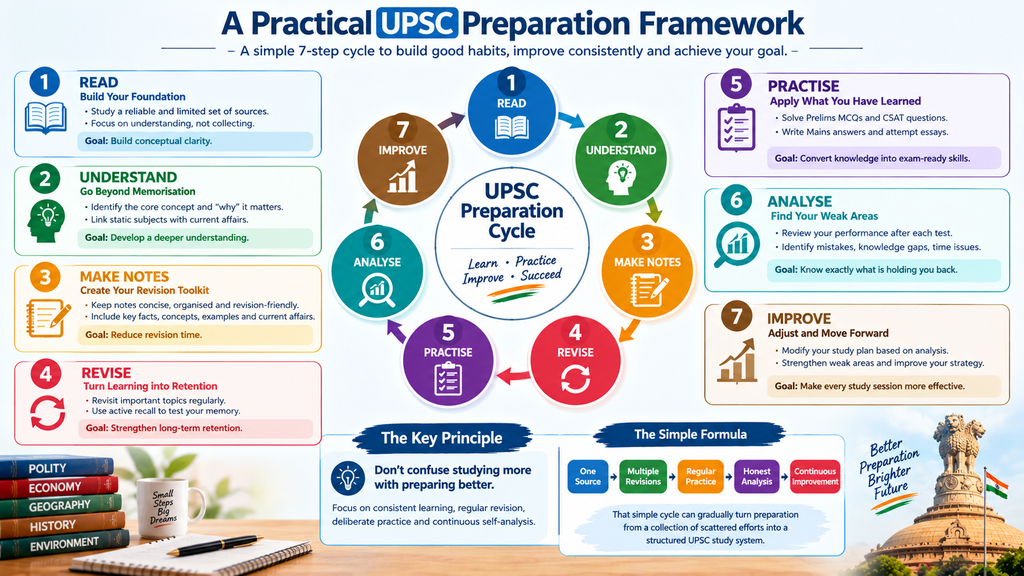
Read → Understand → Make notes → Revise → Practise → Analyse → Improve
This cycle can be repeated for each subject.
For example:
Step 1: Read
Study a reliable source.
Step 2: Understand
Identify the core concept.
Step 3: Make notes
Keep notes concise and revision-friendly.
Step 4: Revise
Return to the topic regularly.
Step 5: Practise
Solve questions or write answers.
Step 6: Analyse
Identify mistakes and knowledge gaps.
Step 7: Improve
Modify the strategy based on performance.
Consistency is more important than constantly changing resources.
UPSC Preparation and Time Management
Aspirants often ask how many hours they should study every day.
There is no single number that guarantees success.
The more useful question is:
How effectively are those study hours being used?
A productive schedule should include a combination of:
- Static subject preparation
- Current affairs
- Revision
- Question practice
- Answer writing
- Mock tests
- Optional subject preparation
The exact distribution can change according to the candidate’s stage of preparation.
A beginner may need more time for foundational learning, while a candidate approaching Mains may need greater emphasis on answer writing and revision.
The Bigger Picture: Why Civil Services Matter
The UPSC journey is connected to the broader functioning of India’s public administration.
Civil servants contribute to the implementation of government policies and programmes.
They can work across areas such as:
- Education
- Healthcare
- Agriculture
- Infrastructure
- Welfare
- Public finance
- Law and order
- Disaster management
- Digital governance
This is why the Civil Services Examination tests different abilities rather than relying on a single examination format.
The Preliminary Examination tests objective knowledge and aptitude at the screening stage.
The Main Examination tests written expression, analysis and subject understanding.
The Personality Test examines broader personality dimensions relevant to public service.
Final Takeaway: UPSC Is a Journey, Not Just an Exam
The UPSC Civil Services Exam: 7 Powerful Steps to Success can be understood as a journey involving preparation, screening, written assessment, personality assessment, final ranking, service allocation and training.
The seven steps are:
- Understand the UPSC examination
- Develop a strong Prelims strategy
- Build a solid Mains foundation
- Master answer writing, Essay and Optional
- Prepare for the Personality Test
- Understand merit and service allocation
- Prepare for training and public-service responsibilities
Aspirants should remember that success is not based on one book, one coaching institute or one strategy.
It depends on how effectively a candidate understands the syllabus, studies relevant material, revises consistently, practises questions, improves weaknesses and adapts to the demands of each stage.
The most important lesson is simple:
Prepare for the examination, but understand the purpose behind the examination.
The ultimate journey extends from aspirant to candidate, candidate to selected officer, and selected officer to public servant.
Frequently Asked Questions About the UPSC Civil Services Exam
1. What is the UPSC Civil Services Exam?
The UPSC Civil Services Examination is a national-level competitive examination conducted by the Union Public Service Commission for recruitment/recommendation to various civil services, including IAS, IPS, IFS and other Central Civil Services under the applicable rules.
2. What are the main stages of the UPSC examination?
The examination has three broad stages: Preliminary Examination, Civil Services Main Examination and Personality Test.
3. Are Prelims marks counted in the final merit?
No. Preliminary Examination marks are used for screening and are not included in the final merit calculation.
4. What is CSAT?
CSAT refers to General Studies Paper II in the Preliminary Examination. It covers areas such as comprehension, reasoning, analytical ability, decision-making, problem-solving, numeracy and data interpretation. It is qualifying in nature.
5. How many papers are there in UPSC Mains?
The Civil Services Main Examination consists of nine written papers, including qualifying papers and papers that contribute to merit.
6. What subjects are included in UPSC General Studies?
The four General Studies papers broadly cover Indian heritage and culture, history, geography, polity, governance, social justice, international relations, economy, technology, environment, biodiversity, security, disaster management, ethics, integrity and aptitude.
7. What is the UPSC Personality Test?
The Personality Test is the final assessment stage commonly known as the UPSC Interview. It evaluates broader aspects such as understanding, expression, perspective and approach to public-service situations.
8. How is the final merit prepared?
The final merit is based on the applicable marks from the Main Examination merit papers and Personality Test. Preliminary Examination marks are not included in the final merit.
9. Is service allocation the same as UPSC selection?
No. UPSC conducts the examination and recommends candidates. Service allocation is a separate administrative process based on the applicable rules, preferences, vacancies and other relevant factors.
10. What happens after UPSC selection?
After selection and service allocation, successful candidates undergo training. DoPT describes a 15-week Foundation Course for eligible officer trainees allocated to relevant Group A services and the Indian Forest Service.
11. Is answer writing important for UPSC?
Yes. The Main Examination is descriptive, so candidates need to develop the ability to write clear, structured, analytical and relevant answers within the available time.
12. What is the most important strategy for UPSC preparation?
There is no single strategy that works identically for every aspirant. A strong approach generally combines syllabus-based study, reliable resources, previous-year questions, revision, practice, answer writing, mock tests and continuous improvement.