
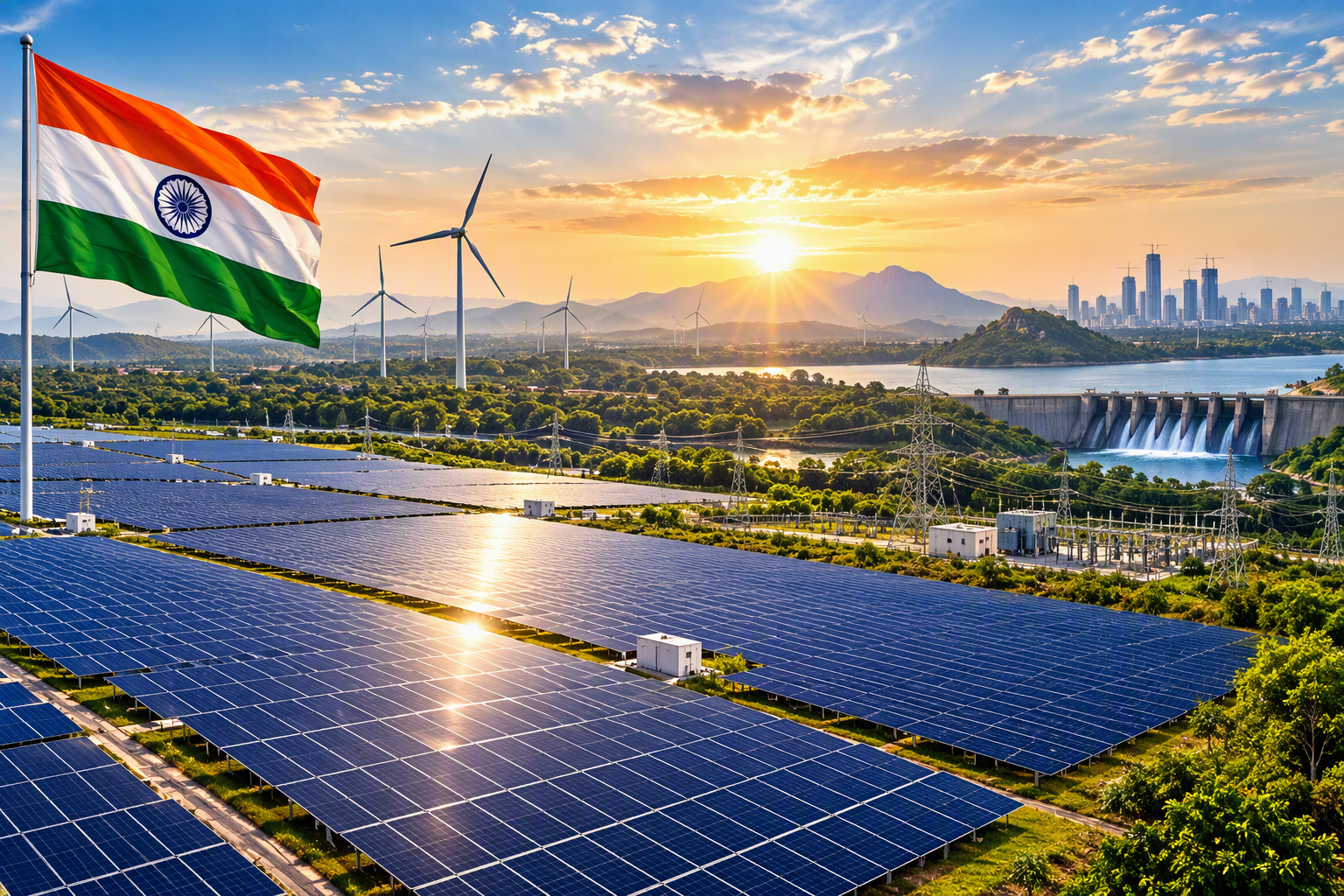
India’s Green Energy Revolution 2026: Major Developments Transforming India’s Sustainable Future
India is witnessing a major transformation in its energy sector. From expanding solar and wind power capacity to developing green hydrogen, bioenergy and nuclear technologies, the country is taking significant steps towards building a cleaner, more secure and sustainable energy future. India’s Green Energy Revolution 2026: Major Developments reflects the growing importance of clean energy in the country’s economic development and long-term environmental strategy.
As one of the world’s fastest-growing major economies, India faces increasing electricity demand due to industrialisation, urbanisation, infrastructure development and rising household consumption. Meeting this demand while reducing carbon emissions has become an important national priority.
The latest developments demonstrate that India’s Green Energy Revolution 2026: Major Developments is not simply about increasing renewable electricity generation. It is also about strengthening energy security, encouraging domestic manufacturing, creating employment opportunities and reducing dependence on imported fossil fuels.
India’s renewable energy expansion is attracting global attention. Solar parks, offshore wind projects, rooftop solar installations, green hydrogen initiatives and modern electricity infrastructure are creating new opportunities for sustainable economic growth.
This article explores India’s Green Energy Revolution 2026: Major Developments, including the latest renewable energy statistics, government initiatives, major achievements, emerging technologies and future opportunities.
India’s Green Energy Revolution 2026: Major Developments at a Glance
India has achieved several important milestones in renewable and non-fossil energy capacity.
According to the Ministry of New and Renewable Energy (MNRE), the country’s renewable energy infrastructure continued expanding during 2026.
The following figures provide an overview of India’s energy landscape.
| Energy indicator | Latest reported figure |
|---|---|
| Total installed electricity capacity | Approximately 552 GW (July 2026) |
| Non-fossil fuel capacity | 300.50 GW (July 31, 2026) |
| Share of non-fossil capacity | More than 54% |
| Solar power capacity | 164.59 GW (July 31, 2026) |
| Wind power capacity | 58.14 GW (July 31, 2026) |
| Hydropower capacity | 57.24 GW |
| Bio-power capacity | 11.75 GW |
| Nuclear power capacity | 8.78 GW |
These figures show the scale of India’s transition towards cleaner energy sources. Importantly, installed capacity represents the maximum potential electricity generation under suitable conditions, not the actual electricity generated throughout the year.
India’s Green Energy Revolution 2026: Major Developments also highlights the country’s progress towards its target of achieving 500 GW of non-fossil fuel-based installed electricity capacity by 2030.
1. India’s Green Energy Revolution 2026: Major Developments in Solar Power
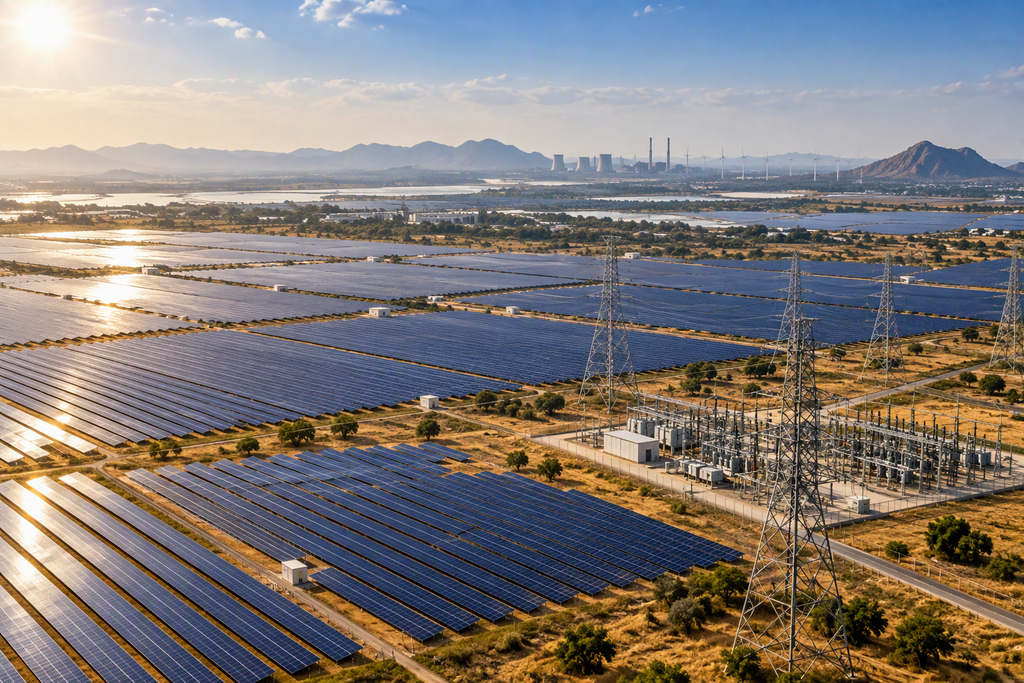
Solar energy has become one of the strongest drivers of India’s renewable energy expansion.
The country receives abundant sunlight across most regions, creating favourable conditions for large-scale solar power generation. Government support, declining technology costs and increasing domestic manufacturing have accelerated solar installations.
India’s installed solar capacity increased from approximately 2.8 GW in 2014 to 164.59 GW by July 31, 2026.
This remarkable expansion demonstrates how solar energy has become a central component of the country’s electricity strategy.
India is also investing in different types of solar installations, including:
- Large-scale solar parks.
- Rooftop solar systems.
- Floating solar power projects.
- Off-grid solar installations.
- Solar-powered agricultural pumps.
These projects are helping expand electricity access and reduce dependence on conventional energy sources.
PM Surya Ghar: Muft Bijli Yojana
One of the most important government initiatives supporting household solar adoption is the Pradhan Mantri Surya Ghar: Muft Bijli Yojana.
Launched in February 2024, the scheme has a financial outlay of ₹75,021 crore and aims to support rooftop solar installations for one crore households.
According to government figures available in August 2026:
- Approximately 51.58 lakh households were benefiting from rooftop solar installations.
- Around ₹28,024 crore in subsidies had been transferred to beneficiaries.
- Nearly 19 lakh households were receiving zero electricity bills.
- Approximately 14.8 GW of rooftop solar capacity had been commissioned under the scheme.
The programme is expected to encourage more households to generate their own electricity and reduce monthly power expenses.
Floating Solar Projects: A New Development
Another important development is the Pradhan Mantri Surya Sarovar Yojana, approved on July 31, 2026, with an allocation of ₹5,070 crore, according to the government factsheet.
The initiative targets 5,000 MW of floating solar photovoltaic projects integrated with energy storage systems.
These projects are expected to include a minimum two-hour storage duration.
Floating solar installations can utilise suitable water bodies to generate electricity while reducing the need for additional land.
India’s Solar Energy Expansion
2. India Renewable Energy Growth 2026: Expansion of Wind Power
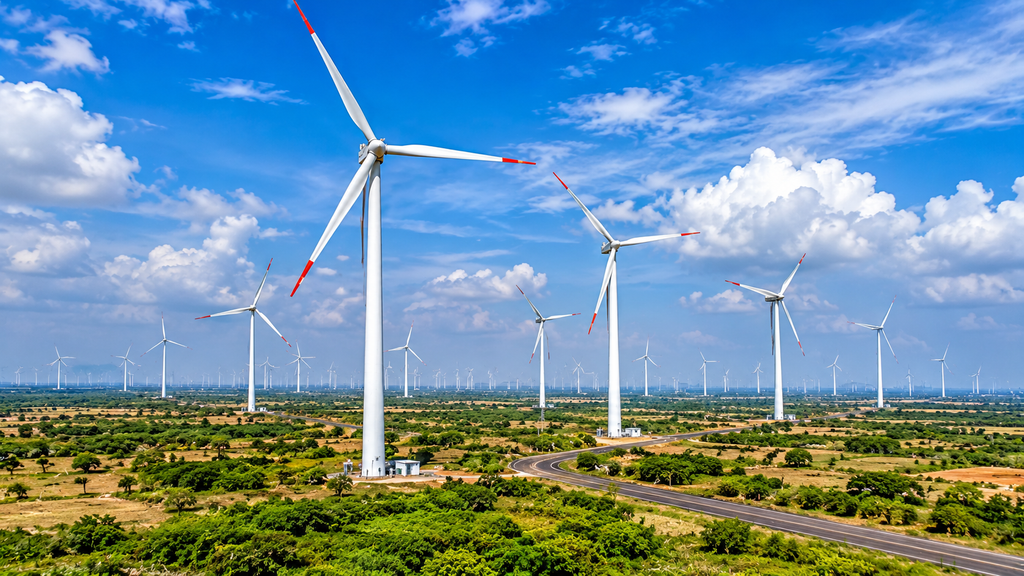
Wind energy is another major contributor to India’s renewable energy development.
States such as Gujarat, Tamil Nadu, Karnataka, Maharashtra and Rajasthan have considerable wind energy potential.
Wind power complements solar electricity because wind generation patterns can differ from solar generation patterns. This helps diversify the renewable energy mix and improve electricity supply management.
India ranks fourth globally in installed wind power capacity.
According to the government figures for July 31, 2026:
- Installed wind capacity reached 58.14 GW.
- India added 6.05 GW during financial year 2025–26.
- Around 28 GW of additional wind capacity was under implementation.
- Domestic wind turbine manufacturing capacity reached approximately 24 GW.
The annual addition of 6.05 GW represents India’s highest-ever annual wind capacity addition.
Offshore Wind Energy Opportunities
India is also exploring offshore wind energy opportunities along its western and southern coastlines.
Offshore wind projects can benefit from stronger and more consistent wind conditions. However, their development requires substantial investment in specialised vessels, ports, seabed surveys, transmission infrastructure and advanced turbines.
In June 2024, the Union Cabinet approved a ₹7,453 crore scheme to support 1 GW of offshore wind energy projects.
Further development of this sector could strengthen India’s renewable electricity capacity and create new opportunities for domestic engineering and manufacturing industries.
Wind Energy Infrastructure
3. Green Hydrogen: A Major Opportunity for India’s Clean Energy Future
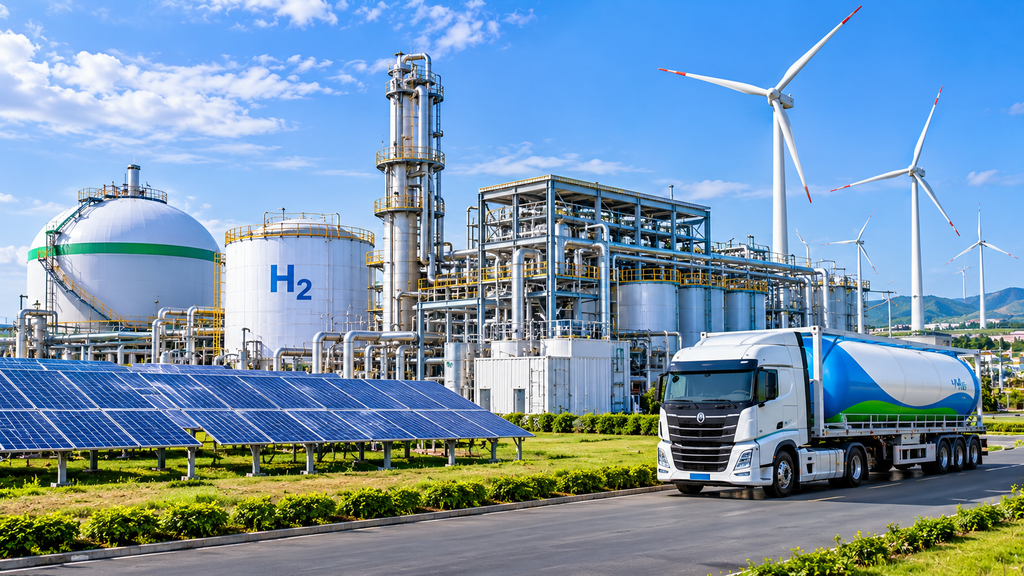
Green hydrogen is emerging as an important technology for reducing emissions in industries where direct electrification is difficult.
It is produced by splitting water through electrolysis using renewable electricity.
Unlike conventional hydrogen production methods that rely on fossil fuels, green hydrogen can offer a low-emission alternative when its production and supply chains are managed sustainably.
Potential applications include:
- Fertiliser manufacturing.
- Petroleum refining.
- Steel production.
- Heavy-duty transportation.
- Shipping and industrial processes.
National Green Hydrogen Mission
The Government of India launched the National Green Hydrogen Mission in January 2023 with an approved financial outlay of ₹19,744 crore.
Its primary objective is to develop India into a global hub for green hydrogen production, utilisation and exports.
The mission targets annual green hydrogen production of at least five million metric tonnes by 2030.
According to government information published in October 2026:
- Approximately 8,000 tonnes per annum of green hydrogen production capacity had been commissioned by February 2026.
- Incentives had been awarded for 3,000 MW per annum of electrolyser manufacturing capacity.
- Twelve pilot projects were planned for deploying 70 hydrogen-powered vehicles.
- These projects cover 21 routes and include hydrogen refuelling infrastructure.
The mission is also supporting research, domestic manufacturing, industrial applications and skill development.
India’s Green Energy Revolution 2026: Major Developments demonstrates how green hydrogen could become an important part of India’s future industrial and transportation systems.
India’s Green Hydrogen Mission
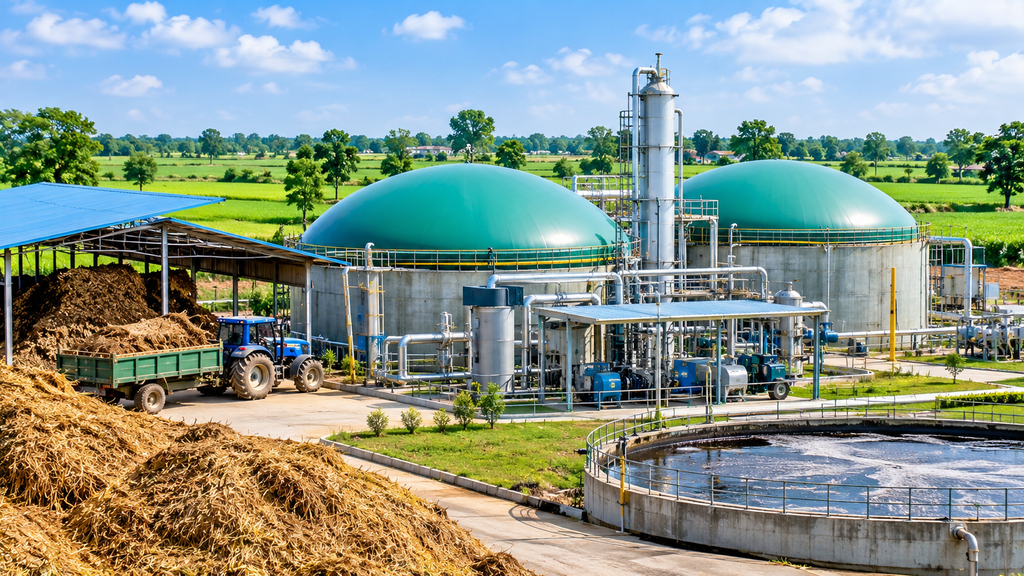
4. Bioenergy: Converting Agricultural Waste into Clean Energy
Bioenergy is becoming an important part of India’s strategy to develop a circular and sustainable economy.
India generates substantial quantities of agricultural residues, organic waste and biomass. These resources can be utilised to produce electricity, biogas and compressed biogas.
The development of bioenergy projects can help address two challenges simultaneously: waste management and energy security.
According to the figures provided in the government’s July–August 2026 energy overview:
- Bio-power capacity reached 11.75 GW.
- A total of 1,929 compressed biogas plants had been registered by August 13, 2026.
- Of these, 217 plants had been commissioned.
- Another 357 plants were under construction.
- Grid-connected waste-to-energy capacity reached 324.24 MW.
- Off-grid waste-to-energy capacity stood at 554.16 MW.
GOBARdhan and the National Bioenergy Programme
The National Bioenergy Programme supports biomass, biogas and waste-to-energy projects through financial assistance.
Another important initiative is the GOBARdhan programme, which promotes the conversion of organic waste into valuable resources, including biogas and organic manure.
These initiatives can strengthen rural economies, improve waste management and create additional income opportunities for farmers and local communities.
India’s Bioenergy Development
5. Hydropower: Strengthening India’s Electricity Grid
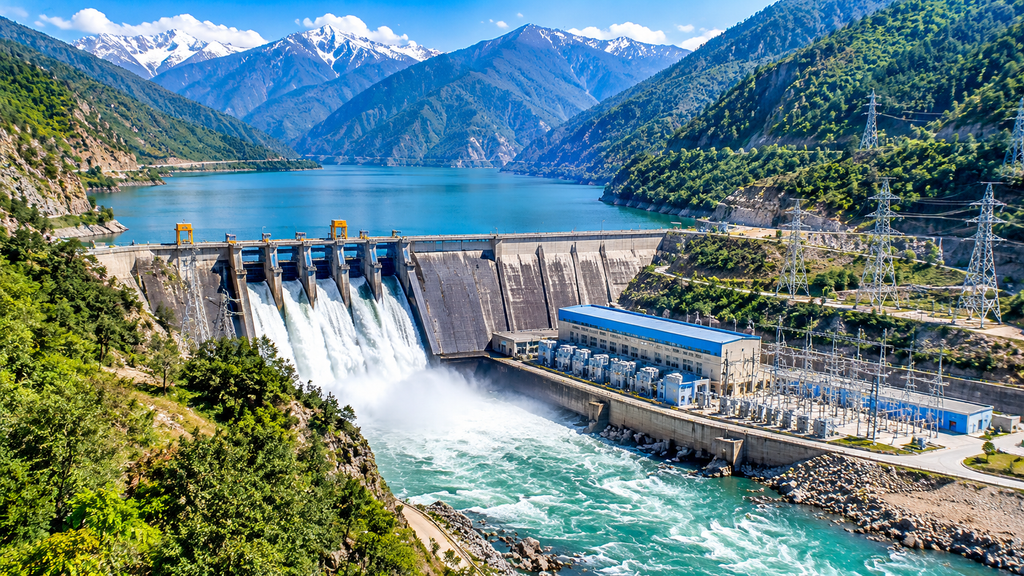
Hydropower remains an important source of renewable electricity.
One of its major advantages is its ability to provide flexible power generation and support electricity grid stability.
This becomes particularly important as India increases its dependence on solar and wind energy, both of which can experience fluctuations in generation.
According to the July 2026 figures, India’s combined large and small hydropower capacity stood at 57.24 GW.
Small Hydropower Development Scheme
The government has approved the Small Hydropower Development Scheme with an allocation of ₹2,584.60 crore.
The scheme aims to add approximately 1,500 MW of small hydropower capacity through projects ranging from 1 MW to 25 MW.
Special attention is being given to hilly and northeastern regions.
These projects can improve local electricity availability and support economic development in geographically challenging areas.
India’s Green Energy Revolution 2026: Major Developments therefore includes not only solar and wind power but also the modernisation and expansion of established renewable energy sources.
Hydropower Infrastructure
6. Nuclear Energy: India’s Long-Term Clean Power Strategy
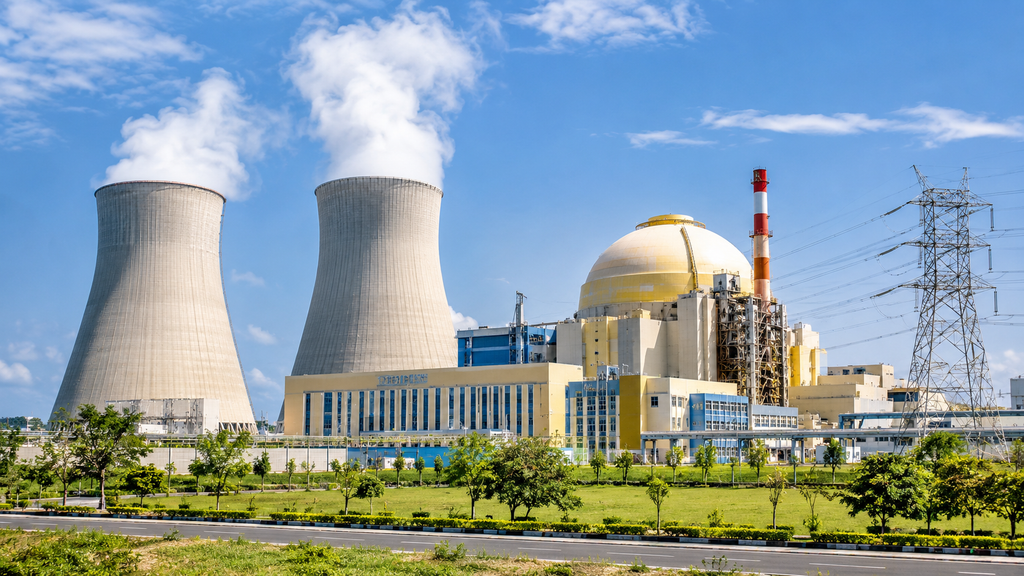
Nuclear energy is another important component of India’s long-term electricity strategy.
It provides electricity through controlled nuclear reactions and can contribute to low-carbon power generation.
According to the July 2026 government overview, India’s installed nuclear power capacity stood at approximately 8.78 GW.
Nuclear Energy Mission and the 2047 Target
India aims to increase its nuclear power capacity to 100 GW by 2047.
The Nuclear Energy Mission includes support for the design, development and deployment of Small Modular Reactors, or SMRs.
The government has allocated ₹20,000 crore towards this objective.
India is also developing indigenous reactor technologies, including 700 MW and 1,000 MW designs, while pursuing international cooperation.
Another significant development occurred on April 6, 2026, when the Prototype Fast Breeder Reactor at Kalpakkam achieved first criticality.
Nuclear power could play an important role in diversifying India’s energy mix and providing reliable low-carbon electricity alongside renewable energy sources.
India’s Nuclear Energy Development
7. India Renewable Energy Growth 2026: Domestic Manufacturing and Employment
India’s clean energy transition is also creating significant opportunities for domestic manufacturing and employment.
The expansion of solar parks, wind farms, battery storage and green hydrogen facilities requires specialised equipment and advanced technologies.
These include:
- Solar photovoltaic modules.
- Wind turbines and components.
- Battery energy storage systems.
- Electrolysers.
- Power electronics.
- Electricity transmission equipment.
- Grid management technologies.
Government initiatives, including Production Linked Incentive programmes, are designed to strengthen domestic manufacturing capacity in selected clean energy sectors.
India’s solar module manufacturing capacity has also expanded considerably. Government figures reported for March 2026 placed domestic manufacturing capacity at approximately 172 GW.
This industrial expansion can help reduce import dependence, improve supply chain resilience and support India’s ambition to become a major global clean energy manufacturing hub.
The sector also creates employment opportunities in engineering, construction, project management, manufacturing, installation and maintenance.
8. India’s Green Energy Revolution 2026: Challenges and Future Opportunities
Despite significant achievements, India’s clean energy transition faces several challenges.
Understanding these challenges is important for evaluating the country’s long-term renewable energy growth.
Energy Storage and Grid Modernisation
Solar and wind generation depend on weather and natural conditions. Therefore, India needs more battery storage, pumped-storage hydropower and advanced grid management systems.
Land Availability and Project Approvals
Large renewable energy projects require suitable land, environmental clearances and transmission connectivity. Delays can increase project costs and affect implementation timelines.
Financial and Investment Requirements
Renewable energy projects require substantial long-term capital. Access to affordable financing and predictable government policies will be essential for attracting domestic and international investors.
Domestic Technology and Supply Chains
India needs continued investment in research, innovation and advanced manufacturing to reduce dependence on imported components and strengthen domestic technological capabilities.
Affordable Electricity
The energy transition must benefit households, farmers and industries. Clean electricity should become increasingly affordable while maintaining the financial sustainability of electricity distribution companies.
Addressing these challenges will determine how effectively India can translate its renewable energy ambitions into long-term economic and environmental benefits.
9. India’s Green Energy Revolution 2026: The Road Towards Viksit Bharat 2047
India’s long-term development vision, Viksit Bharat 2047, places strong emphasis on infrastructure, economic growth, technological advancement and sustainability.
Clean energy will be an essential part of this transformation.
The country’s renewable energy expansion can support several national priorities:
- Energy independence: Reducing dependence on imported fossil fuels.
- Industrial development: Supporting domestic clean technology manufacturing.
- Employment generation: Creating new opportunities in renewable energy industries.
- Environmental protection: Reducing emissions intensity and improving air quality.
- Technological innovation: Encouraging research in batteries, hydrogen and advanced electricity systems.
- Rural development: Expanding decentralised energy solutions and bioenergy projects.
The government has also committed to achieving 500 GW of non-fossil fuel-based installed electricity capacity by 2030.
As the country moves towards 2047, continued investment in clean energy, modern electricity infrastructure and emerging technologies will be important for achieving sustainable economic growth.
Conclusion: India’s Green Energy Revolution Is Shaping the Future
India’s energy transition represents one of the most important developments in the country’s economic and industrial transformation.
The rapid expansion of solar and wind power, the development of green hydrogen, increasing bioenergy capacity, hydropower investments and nuclear energy initiatives demonstrate the country’s commitment to building a more sustainable energy system.
However, achieving long-term success will require more than increasing installed capacity. India must also strengthen energy storage, modernise electricity networks, encourage domestic manufacturing, mobilise investment and ensure affordable electricity for all.
India’s Green Energy Revolution 2026: Major Developments highlights how clean energy is becoming a strategic priority for economic growth, energy security and environmental sustainability.
With continued policy support, technological innovation and public-private cooperation, India has the potential to become one of the world’s leading clean energy economies.
The journey towards Viksit Bharat 2047 will depend significantly on how successfully the country transforms its energy ambitions into reliable, affordable and sustainable electricity for future generations.
Frequently Asked Questions (FAQs)
1. What is India’s Green Energy Revolution 2026?
India’s Green Energy Revolution 2026 refers to the country’s ongoing transformation towards cleaner energy through solar, wind, hydropower, bioenergy, green hydrogen and nuclear power development.
2. What is India’s renewable energy target for 2030?
India aims to achieve 500 GW of installed non-fossil fuel-based electricity capacity by 2030.
3. What is India’s solar power capacity in 2026?
India’s installed solar capacity reached 164.59 GW as of July 31, 2026, according to government figures.
4. What is the National Green Hydrogen Mission?
The National Green Hydrogen Mission is a government initiative launched in January 2023 with an outlay of ₹19,744 crore. It aims to establish India as a global hub for green hydrogen production, utilisation and exports.
5. What is the PM Surya Ghar Muft Bijli Yojana?
It is a government rooftop solar scheme launched in February 2024 to support solar installations for one crore households, with a financial outlay of ₹75,021 crore.
6. Why is wind energy important for India?
Wind energy diversifies India’s electricity generation, complements solar power and supports the country’s renewable energy expansion.
7. What are the major challenges facing India’s renewable energy sector?
Major challenges include energy storage, transmission infrastructure, financing, land availability, technology development and maintaining affordable electricity.
8. How will green energy support Viksit Bharat 2047?
Green energy can strengthen energy security, support domestic manufacturing, create employment, reduce emissions and contribute to sustainable economic development.
Official External Sources and References
- Ministry of New and Renewable Energy (MNRE): https://mnre.gov.in/
- Press Information Bureau – India’s 300 GW Non-Fossil Fuel Milestone: https://www.pib.gov.in/PressReleasePage.aspx?PRID=2296782
- Government of India – India’s Energy Journey: https://www.pib.gov.in/FactsheetDetails.aspx?ModuleId=16&id=150868
- National Green Hydrogen Mission – Government Updates: https://www.pib.gov.in/PressNoteDetails.aspx?ModuleId=3&NoteId=160593&id=160593
- Ministry of Power: https://powermin.gov.in/
- Central Electricity Authority: https://cea.nic.in/
- International Renewable Energy Agency (IRENA): https://www.irena.org/