
Gujarat Rain Fury: 1 Dead, 1,200 Rescued as Floods Spread
Gujarat Rain Fury: 1 Dead, 1,200 Rescued has become the defining headline from the state as relentless monsoon rainfall triggered severe flooding, waterlogging and major disruptions across several districts on July 23, 2026. The situation has been critical in South Gujarat, where Valsad district recorded an extraordinary spell of rainfall and emergency teams launched large-scale rescue and evacuation operations in area.
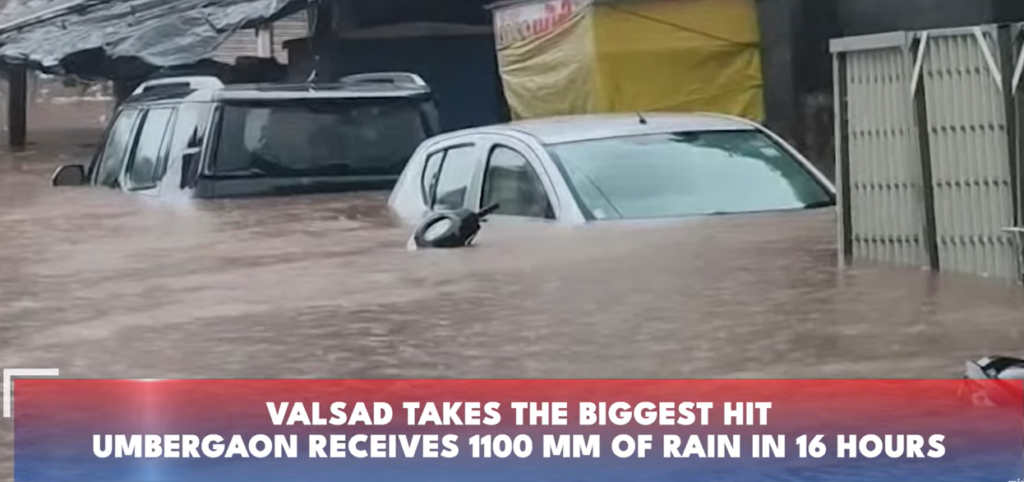
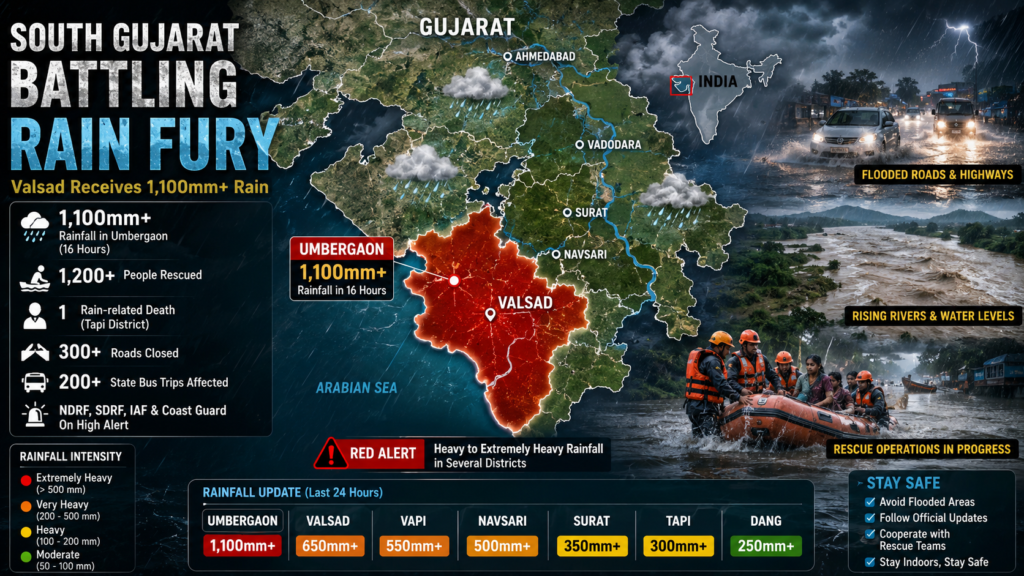
According to officials cited by PTI, around 1,200 people have been rescued from rain-affected areas, while hundreds of others have been shifted to safer locations. At least one rain-related death was reported in Tapi district. The State Emergency Operation Centre reported that Umbergaon taluka in Valsad received more than 1100 mm of rainfall in near about 16 hours, making it one of the worst-hit locations during the latest monsoon spell.
The extreme rainfall has affected roads, rail services, bus operations and electricity supply. Several low-lying areas have been inundated, while floodwaters have forced authorities to intensify rescue operations. Disaster-response teams have been deployed in affected districts, with the NDRF and SDRF leading rescue efforts and the Indian Air Force and Coast Guard kept on standby for possible airlifting operations if weather conditions permit.
Gujarat Rain Fury: 1 Dead, 1,200 Rescued in Major Emergency
The scale of the disaster became clear as heavy rainfall continued across South Gujarat. The latest reports indicate that the Gujarat Rain Fury: 1 Dead, 1,200 Rescued situation has affected multiple districts, Valsad emerging as the extreme rainfall center from the extreme weather event.
Valsad’s Umbergaon taluka experienced an extraordinary rainfall spell, with more than 1100 mm recorded between 6 am on Wednesday, and 10 am on Thursday, according to State Emergency Operation Centre data cited by PTI. Several other talukas in Valsad also received more than 600 mm during the same period.
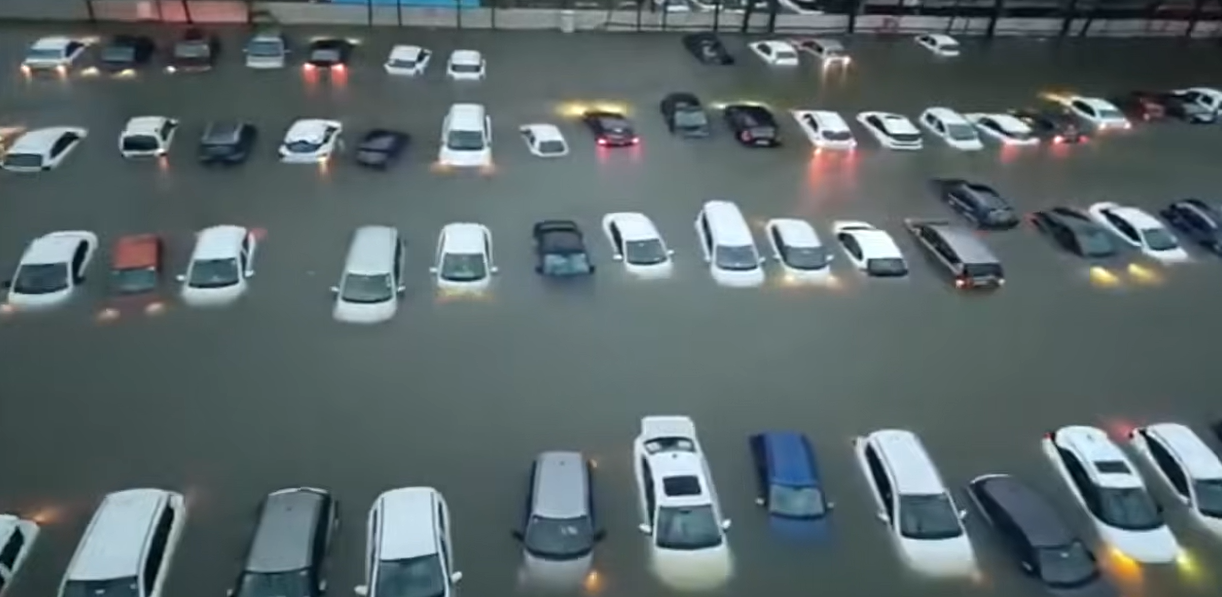
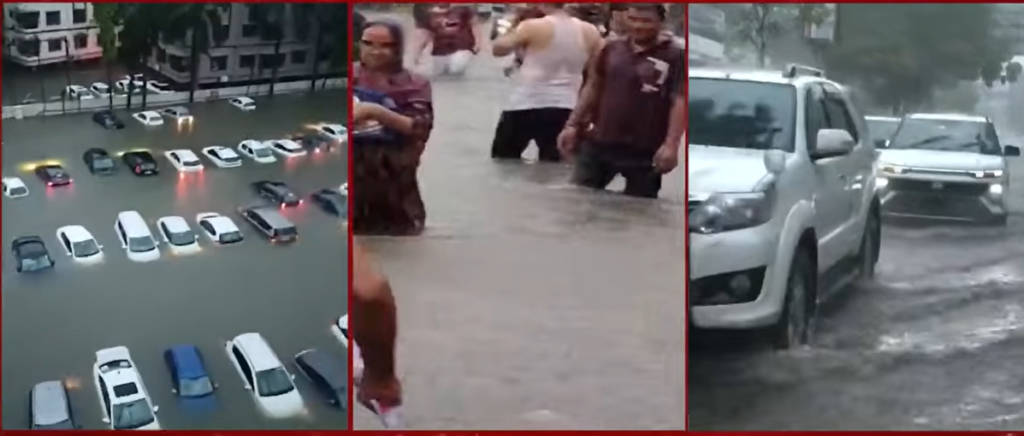
The intense downpour overwhelmed the drainage systems and caused water to accumulate rapidly in low-lying areas. In Vapi, part of Valsad district, images and videos showed vehicles submerged in floodwater, highlighting the severity of the situation.
The flooding also affected residential areas and commercial locations, leaving residents dependent on emergency teams for evacuation. The authorities have urged people in venerable areas to follow official instructions and avoid unnecessary travel.
Key developments at a glance
Gujarat Rain Fury Hits Valsad Hardest
The most dramatic impact of the Gujarat Rain Fury: 1 Dead, 1,200 Rescued emergency has been reported from Valsad district.
Umbergaon recorded more than 1,100 mm of rain over approximately 16 hours, according to SEOC data. The volume of water falling over such a short period created a rapidly developing flood situation in several locations.
The situation was particularly challenging because rainfall was not limited to one isolated pocket. Several other parts of Valsad district also experienced extremely heavy rainfall, adding pressure to roads, drainage systems and local infrastructure.
The heavy rain caused rivers and other water bodies to swell, while low-lying localities faced waterlogging. In some areas, residents had to be evacuated as water levels increased.
Vapi, a major industrial city in Valsad district, also witnessed severe flooding. Reports and visuals from the city showed vehicles submerged in a flooded parking area, providing a stark indication of the intensity of the rainfall.
Why 1,100 mm rainfall is significant
Rainfall exceeding 1,100 mm in such a short period is exceptionally intense. The problem is not simply the total amount of rainfall but the speed at which the water accumulates.
When large volumes of rain fall within hours:
- Drainage systems can become overwhelmed.
- Rivers and streams can rise rapidly.
- Low-lying communities can flood quickly.
- Roads may become impassable.
- Electricity infrastructure can be affected.
- Rescue teams may struggle to reach isolated communities.
The Valsad situation demonstrates how extreme rainfall can quickly transform a monsoon event into a major disaster-management challenge.
Gujarat Rain Fury Rescue Operations Save 1,200 People
The rescue operation has become one of the largest immediate responses to the latest Gujarat Rain Fury: 1 Dead, 1,200 Rescued crisis.
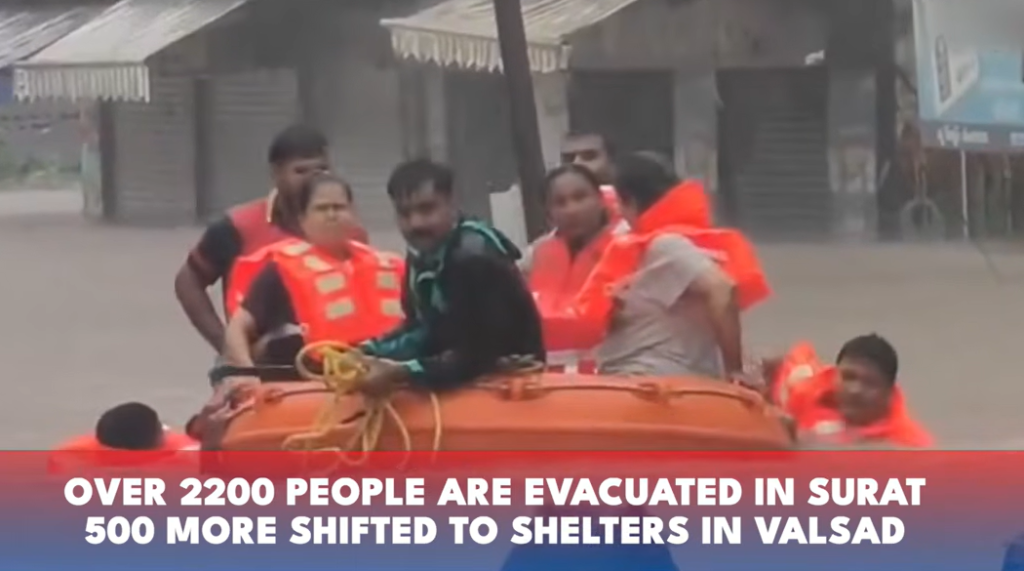
Officials said around 1,200 people had been rescued from rain-hit areas, while hundreds more were moved to safer locations. Rescue operations were carried out through coordination between district administrations, police personnel, disaster-response teams and local volunteers.
The National Disaster Response Force and State Disaster Response Force have been deployed in the worst-affected districts. Teams have been positioned in Valsad, Surat and Navsari, with additional resources mobilised as rainfall intensity increased.
The scale of the operation reflects the rapidly changing conditions on the ground. When roads are flooded and bridges or causeways become unsafe, traditional transport becomes difficult. In such circumstances, rescue teams often have to use boats and specialised equipment to reach stranded residents.
Authorities have also kept the Indian Air Force and Coast Guard on alert. According to officials, people could be airlifted if necessary once weather conditions become suitable for such operations.
The immediate objective remains to prevent further loss of life, evacuate residents from vulnerable areas and provide emergency assistance to those affected by flooding.
One Death Reported as Gujarat Rain Fury Intensifies
The latest Gujarat Rain Fury: 1 Dead, 1,200 Rescued emergency has also resulted in at least one reported rain-related death.
A death was reported in Tapi district as heavy rainfall affected southern parts of the state. The incident underlines the potentially deadly risks associated with rapidly rising water levels, swollen rivers and flooding.
Authorities have repeatedly urged residents to exercise extreme caution during heavy rainfall. People should avoid flooded roads and never attempt to cross rapidly moving water, even if the depth appears manageable.
The danger is particularly high at night when floodwater can conceal open drains, damaged roads, broken bridges and other hazards.
The reported death has added urgency to the state’s rescue and relief operations, with officials focusing on vulnerable communities and areas at risk of further flooding.
Gujarat Rain Fury Disrupts Roads, Buses and Rail Services
The effects of the Gujarat Rain Fury: 1 Dead, 1,200 Rescued crisis have extended far beyond residential flooding.
According to the Relief Commissioner cited by PTI, more than 300 roads were temporarily closed, while over 200 state-run bus trips were affected. Power outages were also reported in several locations.
The transportation disruption has created difficulties for commuters, emergency services and supply chains.
South Gujarat is an important economic and industrial region, and major roads and railway connections link the area with Mumbai and other parts of western India. When heavy rainfall affects these networks, the consequences can extend beyond the immediately flooded areas.
Rail services were also affected as water levels rose near railway infrastructure in the Umbergaon region. Several trains were reportedly short-terminated, short-originated or diverted, while other services faced cancellations.
For passengers, the disruption has meant delays and changes to planned journeys. Railway authorities have advised passengers to check the latest service information before travelling through affected sections.
Schools and Colleges Face Closures Amid Heavy Rain
The continuing Gujarat Rain Fury: 1 Dead, 1,200 Rescued situation has also disrupted education.
With heavy to extremely heavy rainfall forecast in several parts of Gujarat, authorities have ordered educational institutions to close in affected areas as a precautionary measure.
Schools, colleges and other educational institutions in parts of the state have faced closures or restrictions as officials seek to reduce travel during dangerous weather conditions.
The closure of educational institutions is particularly important during flooding because students often travel from residential areas to schools by road. Waterlogging can make these journeys risky, while sudden flooding can create additional dangers.
Authorities in districts under severe weather warnings are continuing to monitor conditions and may take further decisions based on rainfall forecasts, road accessibility and local flood situations.
Parents and students are advised to rely on official district administration announcements for information about closures and reopening.
Gujarat Rain Fury Raises Concerns in Vadodara and Dahod
While South Gujarat has been at the centre of the latest crisis, the wider weather system has also raised concerns in central and eastern Gujarat.
Vadodara and Dahod have experienced weather-related disruptions as heavy rainfall warnings remain in place. The India Meteorological Department has issued alerts covering several districts, reflecting the possibility of continued heavy rainfall.
The situation in these areas is being closely monitored because rainfall in upstream regions can contribute to rising water levels in rivers and streams.
Dahod, Panchmahal and Mahisagar were among districts placed under red alert conditions according to information reported by PTI, while several other districts received orange and yellow alerts.
The combination of saturated ground, additional rainfall and rising water levels can increase the risk of flash flooding and localised inundation.
Residents are therefore being advised to remain alert even if their immediate locality has not experienced severe flooding.
Gujarat Rain Fury: 1 Dead, 1,200 Rescued as South Gujarat Faces Red Alert
The phrase Gujarat Rain Fury: 1 Dead, 1,200 Rescued captures the seriousness of the situation, but the crisis is still developing.
Red alerts have been issued for several districts in South Gujarat amid forecasts of heavy to extremely heavy rainfall. Valsad, Navsari, Surat and Tapi have been among the districts under close monitoring, while additional alerts have been issued for other parts of the state.
A red alert means authorities must prepare for potentially dangerous weather conditions and take precautionary measures.
For residents, this means staying updated with official forecasts and local administration instructions.
People living in low-lying areas should be prepared for possible evacuation. Families should keep essential documents, medicines, drinking water, mobile phones and chargers accessible.
The most important safety principle is to avoid taking unnecessary risks.
Chief Minister Bhupendra Patel Reviews Flood Situation
Gujarat Chief Minister Bhupendra Patel reviewed the situation at the State Emergency Operation Centre in Gandhinagar as rainfall intensified across South Gujarat.
The Chief Minister received updates from officials and district collectors regarding rainfall, flood conditions and rescue operations. He also spoke with officials responsible for Valsad, Surat and Navsari.
The review focused on the need to move residents from low-lying and waterlogged areas to safer locations.
Patel also spoke with Union Home Minister Amit Shah, who assured the Gujarat government of central support for rescue, relief and evacuation operations.
The state government has also directed senior officials and ministers to coordinate with local administrations in affected districts.
Such coordination is critical during a major natural emergency because rescue operations require cooperation between multiple agencies.
NDRF, SDRF and Emergency Teams Mobilised
The disaster-response machinery has been expanded as the Gujarat Rain Fury: 1 Dead, 1,200 Rescued situation continues.
NDRF and SDRF teams have been deployed across several districts. Additional teams have been mobilised as rainfall intensified.
According to officials, Surat had multiple NDRF and SDRF teams deployed, while teams were also operating in Valsad. Additional NDRF teams were being mobilised for Navsari.
Teams were also kept on standby in other districts, including Amreli, Junagadh and Bhavnagar.
This multi-district deployment is important because severe rainfall can shift the focus of emergency operations rapidly. A district that is relatively stable in the morning can face flooding later if rivers rise or additional rainfall occurs upstream.
The presence of trained disaster-response personnel helps authorities conduct evacuations, rescue stranded residents and provide emergency support.
Surat and Navsari Also Face Flooding
Although Valsad recorded some of the most extreme rainfall, the Gujarat Rain Fury: 1 Dead, 1,200 Rescued emergency has affected a much wider area.
In Surat, around 1,500 residents were reportedly shifted to safer locations. Fire department personnel used boats to rescue people from waterlogged areas, while several low-lying communities faced flooding.
In Navsari, approximately 200 people stranded across 11 villages due to rising water levels in the Kaveri River were rescued and moved to safety, according to officials cited by PTI.
These evacuations demonstrate the importance of early action during heavy rainfall.
Moving residents before water levels become dangerously high can significantly reduce the risk of casualties.
Authorities are continuing to monitor river levels and vulnerable settlements while maintaining rescue teams in strategic locations.
Ahmedabad Also Sees Waterlogging
The latest Gujarat Rain Fury: 1 Dead, 1,200 Rescued developments have also affected Ahmedabad.
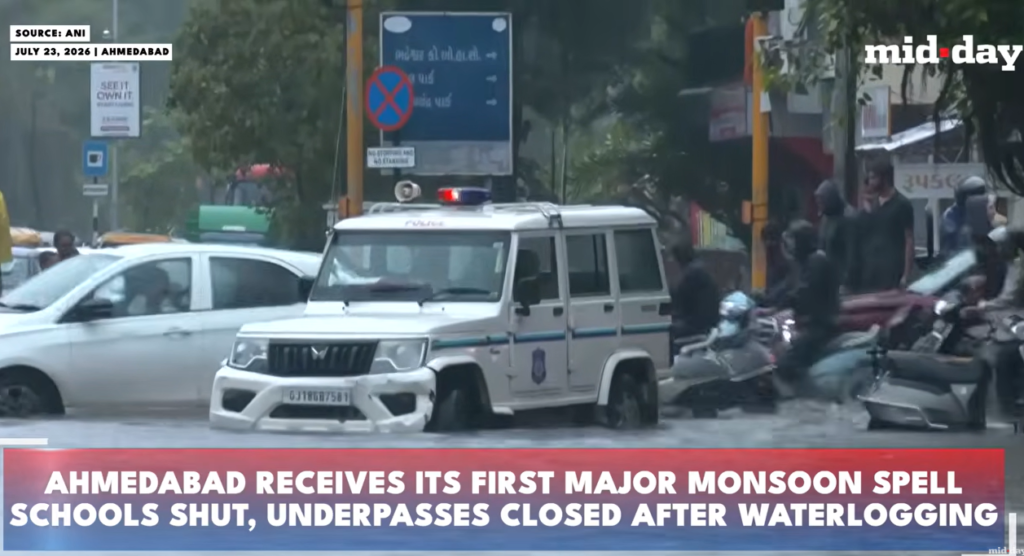
Heavy rainfall in the city led to waterlogging in several residential areas and the closure of some underpasses, causing disruption to daily life.
Although the most extreme rainfall was reported in South Gujarat, urban waterlogging can occur even after shorter periods of intense rainfall. When drainage networks cannot handle sudden rainfall, roads and underpasses can fill with water quickly.
The situation highlights the importance of urban flood management and effective drainage infrastructure, particularly as extreme rainfall events become a growing challenge for cities.
Gujarat Rain Fury Disrupts Mumbai-Gujarat Rail Connectivity
One of the major consequences of flooding has been disruption to railway services connecting Gujarat with Mumbai.
As water levels rose near railway infrastructure in South Gujarat, several train services were reportedly cancelled, diverted or short-terminated.
The Ahmedabad-Mumbai railway corridor is a critical transport route for passengers, workers and businesses. Disruptions can therefore have a significant economic impact.
Railway authorities have been monitoring water levels and infrastructure conditions before allowing normal operations to resume.
Passengers travelling through Valsad, Umbergaon and nearby areas should check updated railway information before beginning their journey.
The disruptions also demonstrate how extreme weather can affect critical infrastructure beyond the immediate flood zone.
Why Gujarat Is Facing Such Severe Monsoon Flooding
The current Gujarat Rain Fury: 1 Dead, 1,200 Rescued emergency is the result of an intense concentration of rainfall over a relatively short period.
Several factors can combine to create severe flooding:
1. Extreme Rainfall Intensity
When rainfall occurs at exceptionally high rates, drainage systems can quickly become overwhelmed.
2. Saturated Soil
If the ground has already absorbed substantial moisture, it becomes harder for additional rainfall to infiltrate naturally.
3. Swollen Rivers
Heavy rain across river catchment areas can cause water levels to rise rapidly downstream.
4. Urban Waterlogging
Cities with extensive paved surfaces have less natural absorption capacity, increasing surface runoff.
5. Low-Lying Settlements
Communities located near rivers, streams and low-lying areas are naturally more vulnerable to flooding.
6. Infrastructure Disruption
Flooding can damage roads, railway tracks, power systems and communication networks, making emergency response more difficult.
The combination of these factors can turn an intense rainfall event into a major disaster within hours.
What Residents Should Do During Gujarat Rain Fury
As the Gujarat Rain Fury: 1 Dead, 1,200 Rescued situation remains active, residents should prioritise safety.
Avoid Flooded Roads
Never attempt to drive through rapidly flowing floodwater. Vehicles can lose traction or be swept away.
Stay Away From Rivers
Do not approach swollen rivers, streams or reservoirs to take photographs or videos.
Follow Evacuation Orders
If local authorities instruct residents to move to safer locations, people should cooperate immediately.
Keep Emergency Supplies Ready
Families should keep drinking water, essential medicines, food, power banks and important documents ready.
Protect Electrical Equipment
Avoid contact with electrical appliances or wiring in waterlogged areas.
Monitor Official Alerts
Residents should follow updates from local authorities and the India Meteorological Department.
Do Not Spread Unverified Information
During a disaster, misinformation can create panic. People should rely on verified government and emergency-service updates.
Gujarat Rain Fury: The Road Ahead
The immediate challenge for Gujarat is to manage the continuing rainfall while ensuring the safety of vulnerable communities.
The Gujarat Rain Fury: 1 Dead, 1,200 Rescued crisis has already demonstrated the destructive potential of extreme monsoon rainfall. The rescue of around 1,200 people is a major emergency response achievement, but the reported death in Tapi serves as a reminder that the danger remains real.
Authorities are continuing to monitor rainfall forecasts, river levels and flood-prone areas. Rescue agencies remain on alert, while district administrations are coordinating evacuation and relief efforts.
The coming hours will be crucial. If rainfall intensity decreases, water levels may gradually recede and relief operations can shift toward recovery. However, additional heavy rainfall could worsen conditions in already saturated areas.
The priority remains the protection of human life.
Gujarat Rain Fury: 1 Dead, 1,200 Rescued — Key Takeaways
The latest situation can be summarised through several major developments:
- Gujarat has experienced a severe spell of monsoon rainfall.
- Around 1,200 people have been rescued.
- One rain-related death has been reported in Tapi district.
- Umbergaon recorded more than 1,100 mm of rainfall in approximately 16 hours.
- Valsad has emerged as one of the worst-affected districts.
- Surat and Navsari have also witnessed major rescue and evacuation operations.
- More than 300 roads were temporarily closed.
- Over 200 state bus trips were affected.
- Railway services between Gujarat and Mumbai were disrupted.
- Power outages were reported in several areas.
- NDRF and SDRF teams have been deployed.
- The IAF and Coast Guard have been placed on alert.
- Red alerts remain in effect for several districts.
- Residents have been advised to remain cautious and follow official instructions.
Frequently Asked Questions About Gujarat Rain Fury
What is the latest Gujarat Rain Fury situation?
The latest Gujarat Rain Fury: 1 Dead, 1,200 Rescued situation involves severe flooding and waterlogging across several parts of the state. Around 1,200 people have been rescued, while one rain-related death has been reported in Tapi district.
How much rain did Valsad receive?
Umbergaon taluka in Valsad district received more than 1,100 mm of rainfall in approximately 16 hours, according to State Emergency Operation Centre data cited by PTI.
How many people were rescued in Gujarat?
Around 1,200 people were rescued from rain-affected areas, while hundreds of others were shifted to safer locations.
Where was the rain-related death reported?
One rain-related death was reported in Tapi district during the latest spell of heavy rainfall.
Which Gujarat district was worst affected?
Valsad district, particularly Umbergaon, was among the worst-affected areas, with extremely heavy rainfall and widespread flooding and waterlogging.
Are schools and colleges closed in Gujarat?
Educational institutions have faced closures in some areas as authorities take precautionary measures amid heavy rainfall, flooding and weather alerts. Residents should check announcements from their local district administration for the latest information.
Which emergency teams are involved in rescue operations?
The NDRF and SDRF have been deployed in affected districts. The Indian Air Force and Coast Guard have also been placed on alert to assist if required.
Has transportation been affected by the Gujarat floods?
Yes. More than 300 roads were temporarily closed, over 200 state-run bus trips were affected, and several railway services were disrupted because of flooding and rising water levels.
Is more rain expected in Gujarat?
Weather alerts remain in place for several districts, with forecasts warning of further heavy to extremely heavy rainfall in parts of Gujarat. Residents should monitor the latest IMD and local administration advisories.
What should people do during the Gujarat Rain Fury?
Residents should avoid unnecessary travel, stay away from flooded roads and rivers, follow evacuation instructions, keep emergency supplies ready and rely on official sources for weather and safety updates.
Conclusion: Gujarat Faces a Critical Monsoon Challenge
The Gujarat Rain Fury: 1 Dead, 1,200 Rescued emergency has become one of the state’s most serious monsoon weather events of the season so far. The extraordinary rainfall in Valsad, widespread flooding across South Gujarat, disruption to roads and railways, and large-scale rescue operations have highlighted the severity of the situation.
With one death already reported and thousands of residents either rescued or moved to safer locations, the focus remains on preventing further casualties.
The coming period will test the state’s disaster-response capabilities as authorities continue monitoring rainfall, rivers and vulnerable communities. The coordinated deployment of NDRF, SDRF and other emergency agencies offers crucial support, but public cooperation remains equally important.
For residents, the message is simple: stay alert, avoid unnecessary risks and follow official instructions.
As Gujarat battles its latest extreme monsoon spell, the priority must remain the safety of every resident affected by the floods and relentless rainfall.
MY VIEW:
Gujarat has been hit by extreme monsoon rains, with Valsad recording 1,100 mm rainfall in a single day — among India’s highest ever. Death of one person confirm, and 1200 people rescues, while schools and colleges were shut upto Sunday in Vadadara and Dahod. Authorities have issued red alerts and deployed NDRF and Army teams for relief operations as heavy rain continues.