
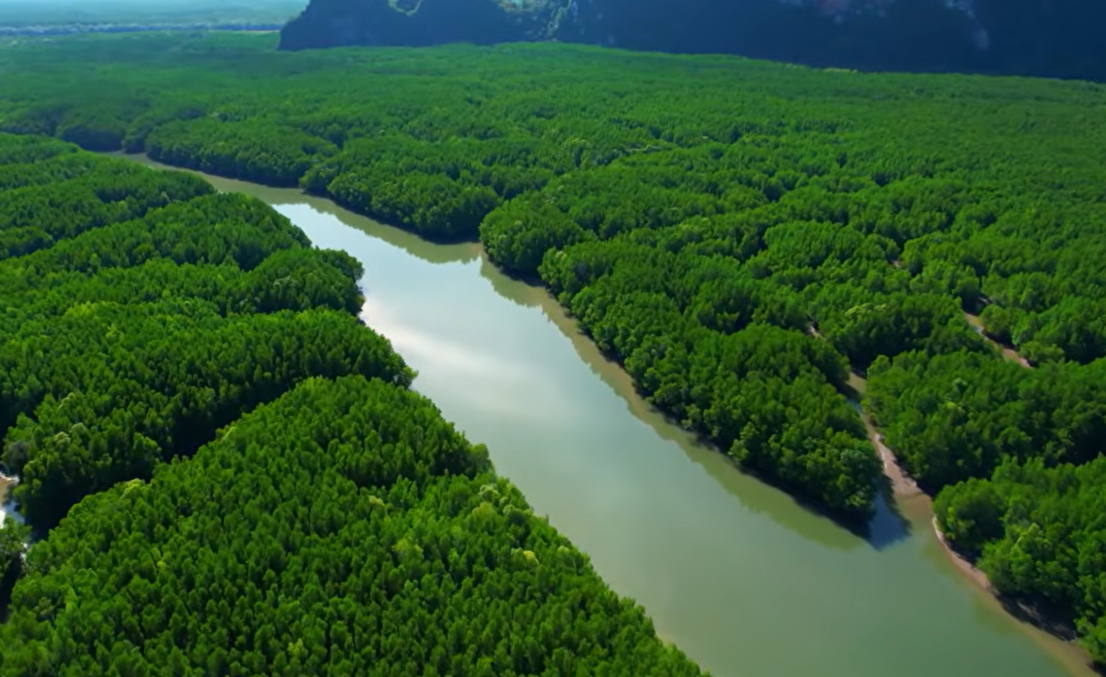
India Forest Cover 2025: Global Rank 9, Green Mission – Targets 2030 Restoration
India Forest Cover 2025 has emerged as an important milestone in the country’s environmental conservation journey. According to the Food and Agriculture Organization’s Global Forest Resources Assessment 2025, India has advanced to ninth position worldwide in total forest area, improving from tenth place in the previous assessment.
India has retained its 3rd place ranking worldwide in annual net forest area gain, reflecting the country’s continued efforts in afforestation, forest restoration and long-term environmental management.
At a time when climate change, biodiversity loss and land degradation are placing increasing pressure on natural ecosystems, India’s revised Green India Mission provides a renewed framework for restoring degraded landscapes.
The broader national ambition is to restore 25 million hectares of degraded forest and non-forest land by 2030. Achieving this goal will require coordinated action involving government institutions, forest-dependent communities, researchers, businesses and civil society.
However, rising forest area alone does not guarantee ecological recovery. Forest quality, native biodiversity, wildlife habitats and community participation remain equally important indicators of successful conservation.
India Forest Cover 2025: Key Highlights
The Global Forest Resources Assessment 2025 presents several important findings about India’s position in global forestry.
| Indicator | Reported figure |
|---|---|
| India’s global forest area ranking | 9th |
| Previous global ranking | 10th |
| Annual net forest area gain ranking | 3rd |
| India’s total forest area | Approximately 72.74 million hectares |
| Share of global forest area | Approximately 2% |
| Global forest area | Approximately 4.14 billion hectares |
| Global forest share of land area | Approximately 32% |
| National restoration ambition by 2030 | 25 million hectares |
These figures indicate India’s growing importance in global forest conservation.
Nevertheless, global forest area and India’s domestically measured forest cover are not identical statistical categories. Differences in definitions, assessment methods and reporting periods must be considered when comparing the two.
What Is the FAO Global Forest Resources Assessment 2025?
The Global Forest Resources Assessment, commonly known as FRA, is a major international assessment prepared by the Food and Agriculture Organization of the United Nations.
It evaluates the world’s forest resources and provides information on forest area, forest management, changes in land use and the environmental and economic significance of forests.
The 2025 assessment estimates that forests cover approximately 4.14 billion hectares worldwide, representing nearly 32% of the planet’s land area.
Five countries account for more than half of the world’s forests:
- Russian Federation
- Brazil
- Canada
- United States
- China
The distribution of global forests varies significantly between regions.
Europe accounts for approximately one-quarter of global forest area, while South America has a particularly high proportion of forest relative to its total land area.
Against this global background, India’s improved ranking represents an important development in international forest statistics.
Global Forest Resources

India Forest Cover 2025: Global Rank 9, Green Mission- Why Matters for Climate Action.
Forests play a fundamental role in regulating Earth’s climate.
Through photosynthesis, trees absorb atmospheric carbon dioxide and store carbon in vegetation, roots and soil.
Healthy forest ecosystems also regulate water cycles, reduce soil erosion, support biodiversity and provide essential resources to communities.
For India, maintaining and improving forest cover is particularly important because the country faces increasing pressure from population growth, infrastructure development, industrial expansion and changing weather patterns.
Forest conservation supports several national priorities, including:
- Reducing the effects of climate change.
- Improving ecological resilience.
- Protecting wildlife habitats.
- Supporting water conservation and soil health.
- Strengthening rural and tribal livelihoods.
- Contributing to international climate commitments.
The success of India Forest Cover 2025 should therefore be evaluated not only by the expansion of forested land but also by the ecological quality and long-term survival of restored landscapes.
Green India Mission 2030: Restoring 25 Million Hectares
One of the most significant developments in India’s environmental strategy is the renewed emphasis on the Green India Mission.
The National Mission for a Green India was launched in February 2014 as part of India’s broader climate action framework.
The mission focuses on protecting existing forests, restoring degraded ecosystems and improving environmental services.
The revised approach places greater emphasis on native species, community participation, ecological restoration, institutional capacity and innovative financing.
Key Priorities of the Green India Mission
1. Restoration of degraded land
Restoration efforts aim to improve ecological conditions in degraded forest landscapes and other suitable areas.
2. Native species conservation
Planting locally appropriate native trees can support biodiversity and improve the ecological stability of restored forests.
3. Community participation
Local communities, including tribal and forest-dependent populations, play an essential role in protecting and managing forest resources.
4. Capacity building
Training, technical expertise and improved forest management practices can help institutions implement restoration programmes effectively.
5. Sustainable financing
Long-term restoration requires reliable financial resources for planting, protection, monitoring and maintenance.
The broader 25-million-hectare restoration ambition is a national land-restoration commitment and should not be confused with a single scheme’s plantation target.
Green India Mission
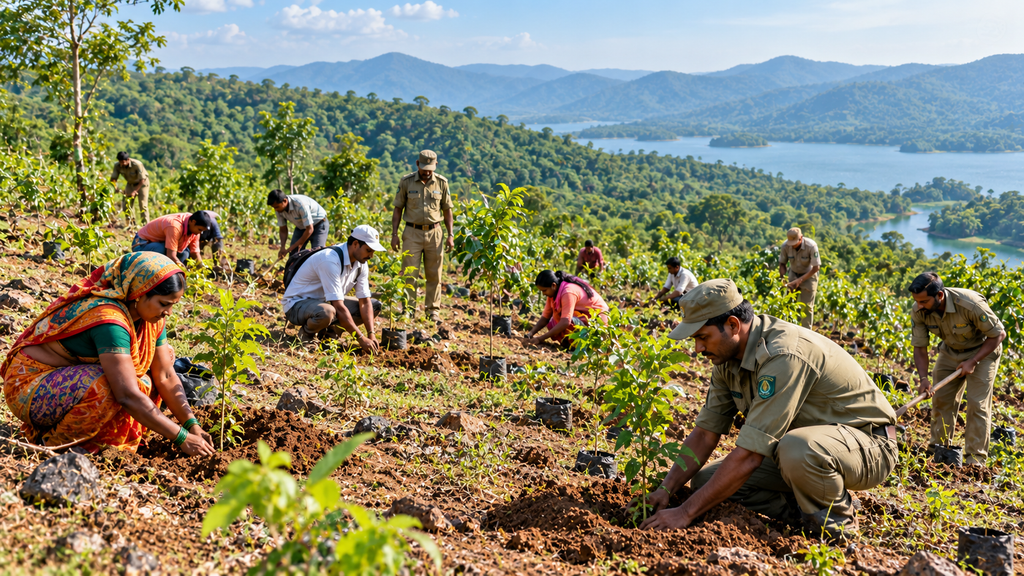
India State of Forest Report 2023: Forest Cover Growth
The India State of Forest Report 2023, published by the Forest Survey of India, provides an important domestic assessment of the country’s forest resources.
The report is part of a biennial assessment series that began in 1987.
The 2023 edition marks the eighteenth assessment.
According to the figures presented in the source material, India’s forest cover increased from approximately 698,712 square kilometres in 2013 to 715,343 square kilometres in 2023.
This represents an increase of approximately 16,631 square kilometres over the ten-year period.
| Year | Forest cover |
|---|---|
| 2013 | 698,712 sq. km |
| 2023 | 715,343 sq. km |
| Increase | 16,631 sq. km |
The increase reflects changes in India’s measured forest cover over the period.
However, forest cover statistics require careful interpretation. Satellite-based assessments can include tree-covered areas outside traditionally recognized natural forests.
Consequently, an increase in measured forest cover does not necessarily mean that all categories of natural forests or wildlife habitats have improved.
Forest and Tree Cover: Understanding the Difference
Forest cover generally refers to land meeting specified canopy-density and area criteria, regardless of legal ownership.
Tree cover includes smaller tree-covered patches outside areas classified as forest cover.
This distinction is important when evaluating environmental performance because the two categories are measured and reported separately.
India Forest Cover 2025 and Carbon Sink Development
India’s forest and tree resources contribute to the country’s climate commitments by storing carbon.
The supplied source reports a forest and tree-cover carbon stock equivalent of approximately 30.43 billion tonnes of carbon dioxide.
It also identifies an additional carbon sink of approximately 2.29 billion tonnes of carbon dioxide equivalent since 2005.
India’s Nationally Determined Contribution includes a target to create an additional carbon sink of 2.5 billion to 3 billion tonnes of carbon dioxide equivalent through forest and tree cover by 2030.
These figures suggest that India has made substantial progress towards the lower end of its additional carbon sink target.
However, the total carbon stock and the additional carbon sink are different measurements and should not be treated as interchangeable.
Continued progress will depend on forest protection, regeneration, tree growth and the resilience of ecosystems under changing climatic conditions.
India’s Bamboo, Rubber and Agroforestry Resources
The Global Forest Resources Assessment 2025 also highlights India’s contribution to planted forests and tree-based production systems.
Bamboo Resources
The source estimates global bamboo resources at approximately 30.1 million hectares.
Asia accounts for around 21.2 million hectares, with India contributing approximately 11.8 million hectares.
Bamboo has considerable economic and ecological significance.
It supports industries such as furniture, construction materials, handicrafts, paper production and rural enterprises.
Bamboo-based livelihoods can also provide income opportunities for communities living near forest landscapes.
Rubber Plantations
India is reported to rank fifth globally in rubber plantation area, with approximately 831,000 hectares.
Rubber plantations support manufacturing industries, including automotive tyres, industrial products and consumer goods.
However, plantation expansion must be managed carefully to avoid replacing ecologically valuable natural habitats.
Agroforestry Development
Agroforestry combines trees with agricultural crops or livestock production.
The source identifies India and Indonesia as major contributors to Asia’s reported agroforestry area.
Agroforestry can help improve soil conditions, diversify farm incomes and increase tree cover across agricultural landscapes.
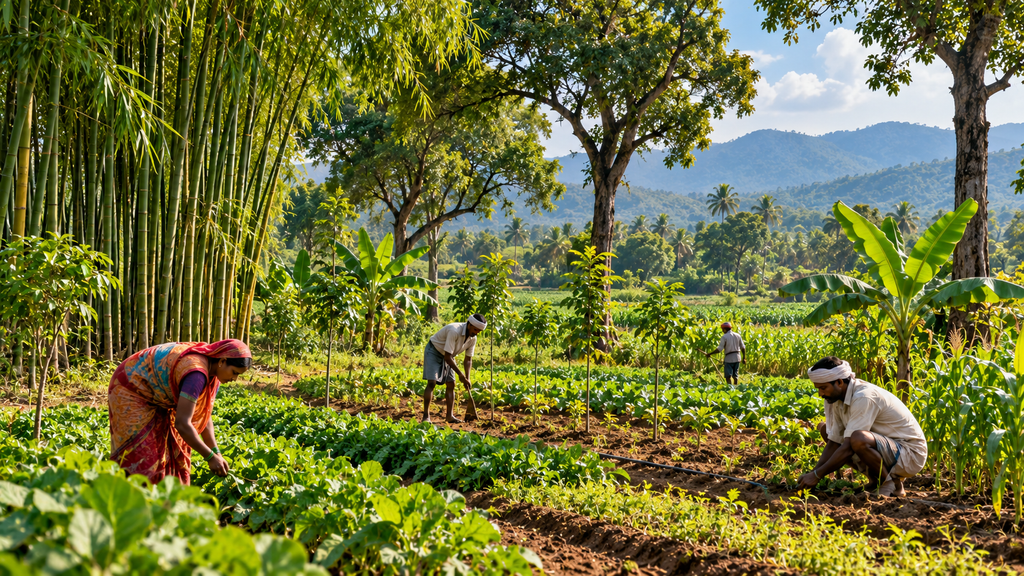
Agroforestry and Bamboo
India Forest Cover 2025: Global Rank 9, Green Mission: Government Schemes Supporting India’s Forest Conservation
India’s forest conservation efforts involve multiple central and state government programmes.
1. National Mission for a Green India
The mission supports forest protection, restoration and expansion through coordinated environmental management.
The source reports the release of approximately ₹944.48 crore to 17 states and one Union Territory for plantation and ecological restoration activities.
2. Nagar Van Yojana
Launched in 2020, Nagar Van Yojana focuses on developing green spaces in urban and peri-urban areas.
The source reports approval of 546 projects across 31 states and Union Territories, with an allocation of approximately ₹431.77 crore.
Urban forests can help reduce heat, improve recreational opportunities and support biodiversity within expanding cities.
3. School Nursery Programme
The School Nursery Programme promotes environmental awareness and tree planting among students.
The source reports that 743 projects were sanctioned across 19 states and Union Territories.
Such programmes can encourage environmental responsibility from an early age.
4. MISHTI Initiative
The Mangrove Initiative for Shoreline Habitats and Tangible Incomes, known as MISHTI, focuses on mangrove restoration and conservation.
Mangrove ecosystems protect coastal landscapes, support marine biodiversity and provide livelihood opportunities.
The initiative is particularly relevant for coastal states such as Gujarat, Odisha, West Bengal, Kerala and Andhra Pradesh.
5. Ek Ped Maa Ke Naam
Launched on World Environment Day, June 5, 2024, the Ek Ped Maa Ke Naam campaign encourages people to plant trees in honour of their mothers.
The initiative connects environmental responsibility with public participation.
However, the long-term environmental benefit depends on whether planted saplings survive and grow into healthy trees.
6. CAMPA
The Compensatory Afforestation Fund Management and Planning Authority supports activities intended to compensate for forest land diverted to non-forest purposes.
Its functions include financing compensatory afforestation and related conservation activities under the applicable legal framework.
7. National Action Plan on Forest Fires
The National Action Plan on Forest Fires, introduced in 2018, seeks to strengthen forest fire prevention, preparedness and management.
It emphasizes coordination, local capacity and measures to reduce forest fire risks.
Forest Fire Monitoring and Technology
Forest fires are a significant environmental concern in India.
They can damage vegetation, release stored carbon, threaten wildlife and affect communities living near forest areas.
According to the source, reported fire hotspots declined from 223,333 in 2021–22 to 203,544 in 2023–24.
This represents a decrease of approximately 8.9% between the two reporting periods.
However, fire hotspot counts should not be confused with the total area burned or the number of unique forest fire incidents.
The Forest Survey of India has improved forest monitoring through satellite-based mapping, forest fire alerts and national forest inventory activities.
Digital forest boundary mapping can also help strengthen forest assessment and administrative planning.
Forest Monitoring

India’s Forest Biodiversity: A Natural Heritage
India is recognized as one of the world’s megadiverse countries.
Despite occupying approximately 2.4% of global land area, India supports a substantial share of known global biodiversity.
The country’s forests vary significantly because of differences in geography, rainfall, temperature and altitude.
Western Ghats
The Western Ghats contain tropical evergreen and moist deciduous forests that support numerous plant and animal species.
Central Indian Forests
Central India contains extensive deciduous forests that provide habitats for tigers, leopards, deer and many other species.
Himalayan Forests
The Himalayan region contains forest ecosystems ranging from subtropical vegetation to temperate and alpine environments.
Sundarbans Mangroves
The Sundarbans are an important mangrove ecosystem that supports coastal biodiversity and helps protect vulnerable shorelines.
Dry and Arid Forests
India’s drier regions contain specialized vegetation adapted to limited rainfall and challenging climatic conditions.
Together, these ecosystems make forest conservation an essential component of India’s biodiversity strategy.
Wildlife Conservation and Forest Protection
Forests provide critical habitats for some of India’s most recognizable wildlife species.
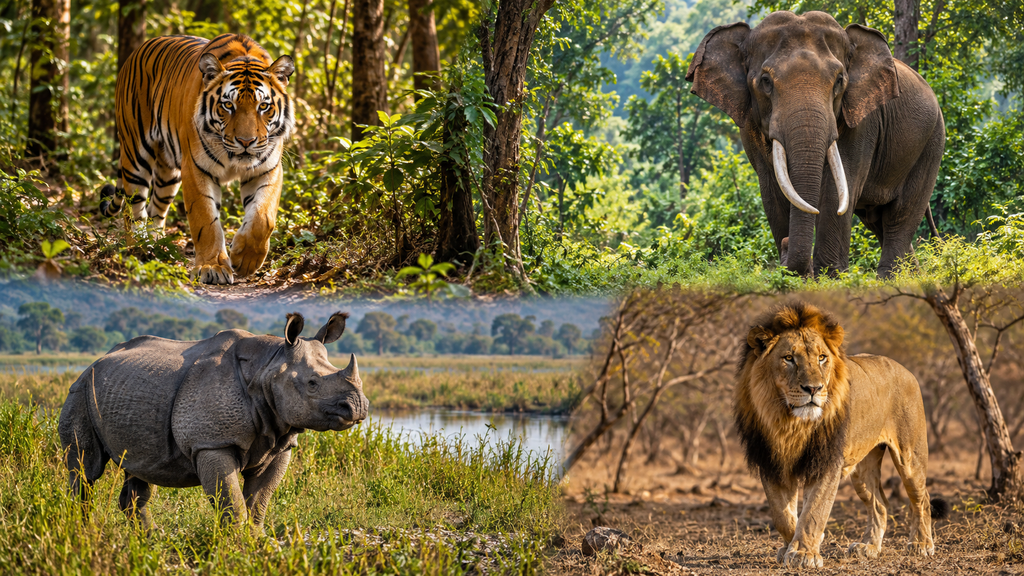
India supports major populations of Bengal tigers, Asiatic elephants, one-horned rhinoceroses, leopards and Asiatic lions.
The source highlights India’s importance as a tiger and Asiatic elephant range country.
It also notes that the Asiatic lion population in Gujarat increased from approximately 525 in 2015 to 674 in 2020.
These achievements demonstrate the value of protected habitats, wildlife monitoring and conservation programmes.
Nevertheless, wildlife conservation continues to face challenges involving habitat fragmentation, human–wildlife conflict, illegal hunting and pressure on ecological corridors.
Indian Wildlife
The Role of Tribal Communities in Forest Conservation
One of the most important aspects of India’s forest conservation system is the participation of tribal and forest-dependent communities.
Many communities possess generations of knowledge about local ecosystems, medicinal plants, seasonal resources and sustainable forest use.
Community participation can improve conservation outcomes by strengthening local monitoring, supporting responsible resource use and creating incentives to protect forest landscapes.
Joint Forest Management Committees and Eco-Development Committees are among the institutional mechanisms used to encourage local involvement.
However, effective conservation also requires respect for legally recognized community rights, equitable decision-making and access to livelihood opportunities.
Conservation programmes are more likely to succeed when local communities participate meaningfully in planning and implementation.
Major Challenges Facing India Forest Cover 2025
Despite progress in forest statistics and restoration initiatives, India continues to face substantial environmental challenges.
Deforestation and Land-Use Change
Agricultural expansion, infrastructure construction, mining and urban development can place pressure on forest ecosystems.
Forest Degradation
A forest may remain classified as forest cover while experiencing declining biodiversity, soil quality or ecological health.
Climate Change
Changes in rainfall, temperature and extreme weather patterns can affect forest regeneration and species distribution.
Human–Wildlife Conflict
As human settlements and infrastructure expand, interactions between wildlife and communities can become more frequent.
Plantation Quality
Monoculture plantations cannot automatically replace the ecological functions of diverse natural forests.
Long-Term Maintenance
Planting saplings is only the beginning of forest restoration.
Successful programmes require monitoring, protection and maintenance over many years.
These challenges show why India Forest Cover 2025 should be viewed as part of a continuing conservation effort rather than a final achievement.
How India Can Strengthen Forest Conservation by 2030
India’s future forest strategy can benefit from several complementary priorities.
Protecting existing natural forests: Preventing degradation and fragmentation is often more ecologically valuable than attempting to replace mature ecosystems through plantations.
Restoring native ecosystems: Restoration should reflect local ecological conditions and prioritize suitable native species.
Improving forest monitoring: Satellite technology, field surveys and transparent reporting can help evaluate restoration outcomes.
Supporting forest-dependent livelihoods: Conservation efforts should provide meaningful economic opportunities and respect community rights.
Strengthening climate resilience: Forest planning should account for changing rainfall patterns, rising temperatures and increasing environmental risks.
Measuring survival and ecological recovery: Plantation numbers alone are insufficient. Long-term indicators should include tree survival, biodiversity and ecosystem health.
Editorial View: Forest Growth Is Only One Measure of Success
India’s rise to ninth position in global forest area rankings is an encouraging development, but it should not be interpreted as proof that every forest ecosystem is becoming healthier.
The real measure of conservation success lies in the quality, resilience and biodiversity of forests.
India’s development ambitions require infrastructure, energy, housing and industrial growth. At the same time, these activities must be managed in ways that minimize irreversible environmental damage.
The Green India Mission and other restoration programmes offer an opportunity to integrate ecological protection with sustainable economic development.
Their success will depend on scientific planning, transparent implementation, adequate funding and meaningful community participation.
India Forest Cover 2025: Global Rank 9, Green Mission
Frequently Asked Questions
1. What is India’s global ranking in forest area in 2025?
According to the FAO Global Forest Resources Assessment 2025 cited in the source material, India ranks ninth globally in total forest area.
2. What is the total forest area of India in 2025?
The source reports approximately 72.74 million hectares of forest area under the FAO assessment.
3. What is the Green India Mission?
The National Mission for a Green India is a government initiative focused on forest protection, ecological restoration, improvement of forest cover and environmental services.
4. What is India’s forest restoration target for 2030?
India has a broader national ambition to restore 25 million hectares of degraded forest and non-forest land by 2030.
5. What is India’s position in annual net forest area gain?
The supplied FAO assessment summary places India third globally in annual net forest area gain.
6. What is the India State of Forest Report 2023?
The India State of Forest Report 2023 is the eighteenth biennial assessment of India’s forest resources prepared by the Forest Survey of India.
7. Why are mangroves important for India?
Mangroves support coastal biodiversity, reduce erosion, help protect shorelines and provide resources and livelihoods for coastal communities.
8. What is the MISHTI initiative?
MISHTI is a government initiative focused on mangrove restoration and conservation along India’s coastline.
9. How do forests contribute to India’s climate goals?
Forests absorb and store carbon dioxide, support ecosystem resilience and contribute to India’s additional carbon sink commitments.
10. Does increasing forest cover mean biodiversity is improving?
Not necessarily. Forest cover can increase without equivalent improvements in native biodiversity, habitat quality or ecosystem health.
Conclusion
India Forest Cover 2025: Global Rank 9, Green Mission, represents an important chapter in the country’s environmental journey. India’s improved global forest ranking, restoration ambitions and expanding conservation programmes demonstrate the scale of its efforts to protect natural resources.
The Green India Mission, improved forest monitoring, mangrove restoration and community participation provide important foundations for progress towards 2030.
However, lasting environmental success requires more than increasing the number of trees or the area classified as forest.
Protecting natural forests, restoring biodiversity, supporting forest-dependent communities and maintaining healthy ecosystems will ultimately determine whether India’s green ambitions translate into lasting ecological benefits.
India’s future growth and environmental sustainability need not be opposing goals. With effective planning and responsible implementation, both can advance together.
Reference sources for verification and external linking
- Food and Agriculture Organization — Global Forest Resources Assessment: https://www.fao.org/forest-resources-assessment/
- Forest Survey of India — India State of Forest Report: https://fsi.nic.in/
- Ministry of Environment, Forest and Climate Change: https://moef.gov.in/
- Press Information Bureau, Government of India: https://pib.gov.in/