
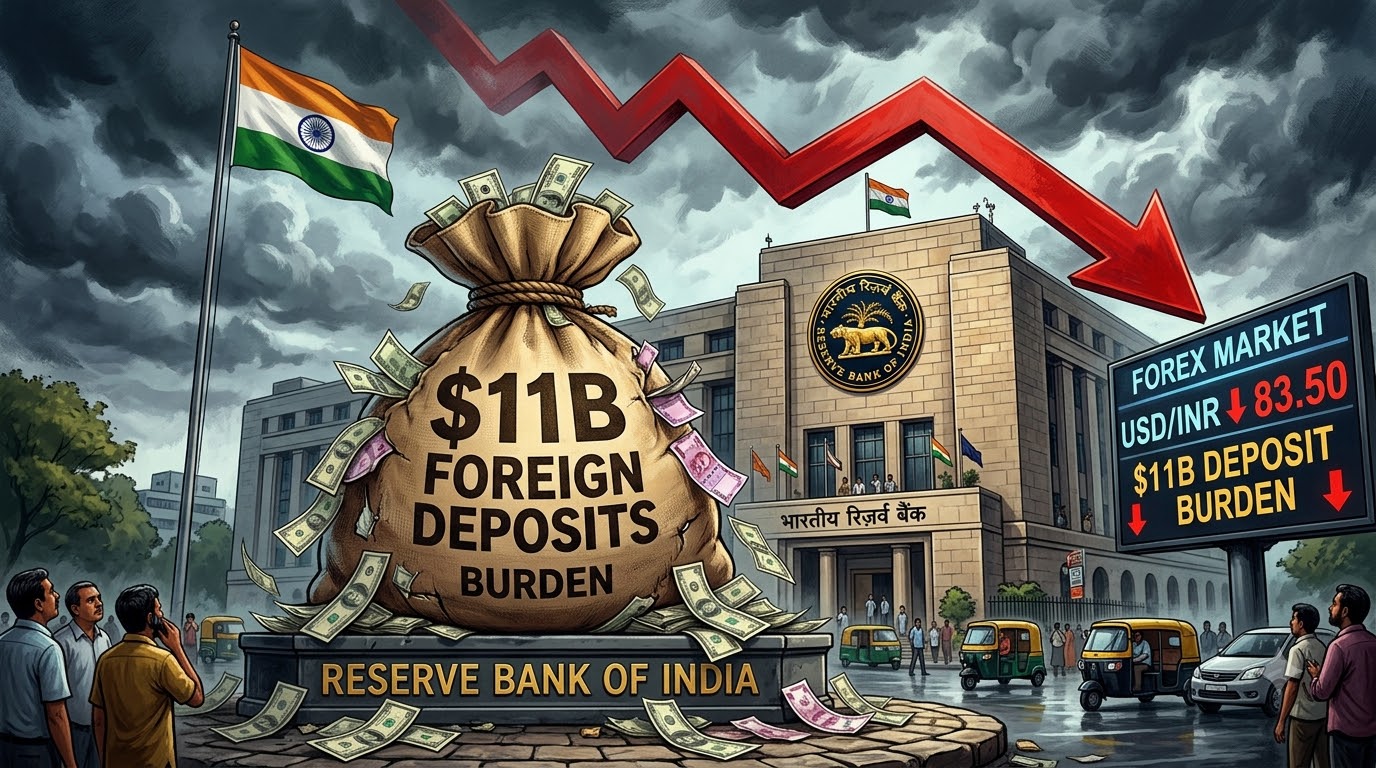
RBI $11 Billion Bill: 5 Risks of Foreign Deposit Plan:
RBI $11 Billion Bill: 5 Risks of Foreign Deposits Plan story has quickly become one of India’s most important financial developments of September 2026. The Reserve Bank of India (RBI) successfully attracted an extraordinary amount of foreign currency through a special programme designed to strengthen India’s external position and support the rupee.
But the success has created a new challenge.
Indian banks mobilised approximately $127.23 billion through Foreign Currency Non-Resident (Bank), or FCNR(B), deposits by August 31, 2026. Including overseas foreign-currency borrowings and external commercial borrowings, total foreign-currency mobilisation under the special arrangements reached about $136.38 billion.
The number are remarkable because the programme attracted far more than policymakers and market participants initially expected.
However, there is another side to the record inflow.
Economists estimate that the RBI’s support for the foreign-deposit programme could create a potential cost of around $10.6 billion, while a broader estimate of associated costs over five years has reached approximately ₹1.2 trillion, or around $12.7 billion. The exact eventual cost is uncertain because returns on the RBI’s dollar assets can offset part of the expense.
At the same time, the enormous inflow has produced a record surplus of rupee liquidity in India’s banking system.
This makes the RBI $11 Billion Bill more than a simple cost story. It is about the trade-off between strengthening foreign-exchange reserves today and managing liquidity, hedging expenses and future liabilities tomorrow.

RBI $11 Billion Bill: 5 Risks of Foreign Deposits Plan:
What Is the RBI $11 Billion Bill?
The RBI $11 Billion Bill refers to estimates of the potential financial cost associated with the central bank’s special foreign-currency mobilisation programme.
The RBI introduced a special USD-INR swap facility in June 2026 covering three major channels:
- FCNR(B) deposits
- Overseas Foreign Currency Borrowings (OFCBs)
- External Commercial Borrowings (ECBs)
The objective was to attract foreign currency into India at a time when the rupee was facing external pressure and policymakers were concerned about India’s balance-of-payments position.
The programme proved extraordinarily successful.
By August 31, banks had mobilised approximately $127.23 billion through FCNR(B) deposits, while OFCBs contributed about $5.26 billion and ECBs approximately $3.89 billion. This took the overall mobilisation figure to about $136.38 billion.
The FCNR(B) window was originally expected to remain open longer but was closed on August 31 after the response significantly exceeded expectations.
The key issue is that the RBI offered banks favourable swap conditions, effectively helping them manage the foreign-exchange risk associated with these deposits.
That support has a cost.
Why Did India Need the Foreign Deposit Plan?
The programme came against a difficult international backdrop.
The Indian rupee had been under pressure from several factors, including elevated crude-oil prices, global interest-rate uncertainty, foreign portfolio outflows and geopolitical tensions.
India imports a large share of its crude oil requirements. When oil prices rise sharply, the country’s dollar demand increases because importers need more foreign currency to pay for energy.
At the same time, capital outflows can put additional pressure on the rupee.
The RBI therefore needed sufficient foreign-exchange resources to intervene in the market when necessary.
The special deposit scheme offered an alternative source of foreign currency.
Instead of relying entirely on portfolio investment or conventional external borrowing, the RBI could tap India’s enormous overseas Indian savings base.
The result was much larger than expected.
Reuters reported that India’s special schemes generated $136.38 billion in foreign-exchange inflows, while forex reserves subsequently reached a record $729.33 billion by August 21.
That is the major positive side of the programme.
But the bigger the inflow, the greater the management challenge.
RBI $11 Billion Bill: 5 Risks of Foreign Deposits Plan:
RBI $11 Billion Bill: Risk 1 — High Hedging and Swap Costs
The first major concern behind the RBI $11 Billion Bill is the cost of protecting banks from currency risk.
FCNR(B) deposits are denominated in foreign currency. Banks accepting these deposits must eventually return the foreign currency to depositors when the deposits mature.
Normally, banks would need to manage the currency risk associated with these obligations.
The RBI’s special swap arrangement reduced that burden by offering favourable terms.
That was a powerful incentive for banks to attract foreign-currency deposits.
But it also transferred part of the economic cost to the central bank.
Economists have estimated that the hedging component alone could cost approximately $10.6 billion, depending on the assumptions used for currency movements and the duration of the transactions.
This does not mean the RBI will necessarily write a cheque for $10.6 billion.
The actual economic outcome will depend on:
- Exchange-rate movements
- Interest-rate differentials
- Dollar investment returns
- Swap pricing
- The maturity profile of deposits
- RBI intervention requirements
Therefore, the headline figure represents a potential economic cost rather than a guaranteed accounting loss.
Why the cost matters
Even a relatively small cost percentage becomes significant when applied to more than $127 billion.
A programme covering tens of billions of dollars can generate large financial consequences through small differences in interest rates and exchange rates.
This is why the RBI’s asset-management strategy will be critical.
RBI $11 Billion Bill: Risk 2 — Record Banking Liquidity
The second major risk is domestic liquidity.
When foreign currency enters the banking system and is swapped with the RBI, banks receive rupees.
That means the programme does not merely increase India’s foreign-exchange resources.
It can also increase rupee liquidity in the domestic financial system.
And that is exactly what happened.
By September 3, India’s banking-system liquidity surplus had reached approximately ₹9.7 trillion, or $102.7 billion. Reuters reported that this surpassed the previous post-COVID peak of around ₹9.2 trillion recorded in September 2021.
This creates a major monetary-policy challenge.
If banks have significantly more cash than they need, short-term market interest rates can fall.
That can make monetary policy less effective because the central bank’s policy rate may no longer transmit cleanly into money-market conditions.
Excess liquidity can also encourage:
- Higher bank lending
- Increased investment in financial assets
- Lower short-term borrowing costs
- Greater credit creation
- Potential inflationary pressure
The RBI therefore needs to absorb part of the excess liquidity.
RBI $11 Billion Bill: 5 Risks of Foreign Deposits Plan:
How Can the RBI Absorb the Excess Cash?
The central bank has several options.
Variable Rate Reverse Repo
The RBI can use longer-duration Variable Rate Reverse Repo operations to encourage banks to park excess funds with the central bank.
This can temporarily absorb liquidity without permanently changing the banking system’s structure.
Foreign-Exchange Sell/Buy Swaps
Banks have proposed FX sell/buy swaps as another way to remove excess rupees.
Under such an arrangement, the RBI sells dollars and receives rupees in the first leg of the transaction. The transaction is reversed later.
Indian banks have reportedly favoured this approach because it can absorb rupee liquidity without putting the same pressure on bond markets as large-scale government-security sales.
Cash Reserve Ratio
The RBI could also increase the Cash Reserve Ratio.
A higher CRR would require banks to keep a larger portion of deposits with the central bank.
However, banks have concerns about this approach because higher reserve requirements can reduce margins and potentially affect lending capacity.
Reuters reported that a 50-100 basis-point CRR increase could absorb roughly ₹1.4 trillion to ₹2.8 trillion of liquidity.
Government Bond Sales
Another option is for the RBI to sell government securities.
This would remove liquidity from the financial system but could push bond yields higher.
Higher yields could increase borrowing costs for the government and other borrowers.

RBI $11 Billion Bill: Risk 3 — Future Foreign-Currency Repayment
The third risk is the future liability created by the foreign deposits.
The $127 billion inflow should not be interpreted as free money.
FCNR(B) deposits are liabilities of banks.
Depositors have the right to receive their funds according to the terms of their deposits.
The maturity structure therefore matters enormously.
Many of the deposits mobilised through the special programme have maturities of three to five years.
That means today’s foreign-currency inflow creates future foreign-currency obligations.
This distinction is crucial.
A country receiving $127 billion in deposits is not equivalent to earning $127 billion through exports.
The money must ultimately be returned or rolled over.
What happens if the rupee weakens?
If the rupee depreciates significantly over the next three to five years, the domestic-currency value of the foreign-currency obligations could rise.
The RBI and banking system therefore need to maintain sufficient foreign-exchange liquidity.
India’s large forex reserves provide a significant buffer.
However, reserves must also support other external obligations, including:
- Oil imports
- Merchandise imports
- External debt payments
- Currency-market intervention
- Portfolio outflows
- Other external liabilities
The central bank therefore needs to balance present-day currency defence with future obligations.
RBI $11 Billion Bill: Risk 4 — Lower RBI Profits and Government Dividend
The fourth risk involves the RBI’s financial relationship with the government.
The RBI earns income from its foreign-exchange assets, government securities and other investments.
It also incurs expenses related to monetary operations and foreign-exchange management.
The special foreign-deposit programme could affect the RBI’s future income profile.
If hedging and liquidity-management costs are high, the central bank’s surplus available for transfer to the government could potentially be affected.
This matters because RBI dividend transfers have become an important source of non-tax revenue for the government.
The RBI transferred a record ₹2.87 trillion to the government in May 2026, according to recent reporting.
The good news is that the situation is not necessarily negative for the RBI.
The central bank now controls a substantially larger pool of foreign currency.
If those dollars are invested in interest-bearing assets, investment income could offset some or even much of the hedging cost.
This is one of the most important reasons analysts caution against interpreting the RBI $11 Billion Bill as a guaranteed net loss.
Could Dollar Investment Income Offset the Cost?
Yes, potentially.
The RBI can invest its foreign-exchange reserves in highly liquid international assets.
US Treasury securities, for example, can generate interest income.
If the RBI earns a sufficiently attractive return on the additional dollar assets, that income could reduce the effective cost of the foreign-deposit programme.
This creates an important financial calculation:
Gross hedging cost − investment income = potential net economic cost
The result will depend on market interest rates and the maturity structure of the RBI’s investments.
The central bank therefore has an opportunity to turn part of the foreign-currency inflow into a source of future income.
Recent reporting indicates that the government does not currently expect significant cost pain for the RBI because relatively high US Treasury yields could offset hedging expenses.
That makes the ultimate outcome far more nuanced than the headline $11 billion figure suggests.
RBI $11 Billion Bill: Risk 5 — Monetary Policy and Market Distortions
The fifth major risk is the potential impact on India’s financial markets.
The special scheme was designed for a specific purpose: increasing foreign-currency resources.
But because it produced such a large inflow, the consequences extend beyond the foreign-exchange market.
The resulting liquidity surplus can affect:
- Money-market rates
- Bank lending
- Government bond yields
- Credit growth
- Inflation expectations
- RBI policy transmission
- Asset prices
If the RBI absorbs too much liquidity too quickly, borrowing conditions could tighten.
If it absorbs too little, excess liquidity could remain in the system for longer.
The central bank therefore faces a delicate balancing act.

RBI $11 Billion Bill: 5 Risks of Foreign Deposits Plan:
The policy dilemma
Too much liquidity can weaken monetary-policy transmission.
Too little liquidity can unnecessarily tighten credit conditions.
The RBI has to find a middle path.
That is particularly important because India’s economic growth remains strong, while external risks are also elevated.
The challenge is not simply managing the foreign currency.
It is managing the interaction between foreign-exchange policy and domestic monetary policy.
The Positive Side of the Foreign Deposit Plan
Despite the risks, it would be wrong to view the programme entirely negatively.
The special deposit programme delivered several significant benefits.
1. Record Forex Inflows
The programme attracted approximately $136.38 billion across the covered foreign-currency channels, with FCNR(B) deposits accounting for the overwhelming majority.
2. Stronger Forex Reserves
India’s forex reserves reached a record $729.33 billion by August 21, according to Reuters.
A stronger reserve position provides the RBI with greater capacity to intervene during periods of rupee volatility.
3. Greater Rupee Defence Capacity
The RBI has recently used dollar sales to support the rupee amid pressure from oil prices and global developments.
The additional foreign-exchange resources provide greater flexibility for such intervention.
4. Stronger Role for GIFT City
GIFT City’s International Financial Services Centre also benefited significantly.
Approximately $53 billion, or around 42% of the $127.2 billion FCNR(B) mobilisation, was facilitated through International Banking Units at GIFT City.
This demonstrates the growing importance of India’s international financial infrastructure.
GIFT City

RBI $11 Billion Bill: 5 Risks of Foreign Deposits Plan:
Why Did FCNR(B) Deposits Surge So Dramatically?
One of the biggest surprises was the speed of mobilisation.
The final days of the programme saw an extraordinary rush.
FCNR(B) deposits increased by approximately $61.8 billion in the final 10 days, rising from about $65.4 billion on August 21 to approximately $127.2 billion by August 31.
Several factors contributed to this surge.
Attractive Deposit Rates
Banks were able to offer competitive rates on foreign-currency deposits.
Reports indicate that some banks offered rates around 6.25%-6.35% for three-to-five-year deposits under the special arrangement.
For overseas Indian savers, that created a powerful incentive.
Favourable RBI Swap Terms
The RBI’s support reduced some of the currency risk for banks.
That made the programme more attractive from the banking industry’s perspective.
Large Overseas Indian Savings Base
India has one of the world’s largest overseas populations.
The scale of India’s diaspora means that even a modest change in deposit incentives can generate very large capital flows.
Global Economic Uncertainty
Geopolitical tensions and uncertainty in international markets may also have encouraged investors to diversify their currency exposure.

GIFT City Emerges as a Major Winner
Another important development connected with the RBI $11 Billion Bill story is the rise of GIFT City as a foreign-currency financial centre.
International Banking Units operating in GIFT City’s IFSC handled a major portion of the FCNR(B) mobilisation.
By August 31, approximately $53 billion of the $127.2 billion FCNR(B) total had been channelled through these units.
This is significant because it shows that India’s financial infrastructure is becoming more capable of handling international capital flows.
The development could have long-term benefits beyond the current programme.
GIFT City can potentially support:
- International banking
- Foreign-currency lending
- Offshore-style financial services
- Global capital markets
- Cross-border financing
- International investment products
The 2026 deposit programme therefore has implications not only for RBI liquidity management but also for India’s ambition to develop a global financial centre.
RBI $11 Billion Bill: 5 Risks of Foreign Deposits Plan:
Could the RBI Have a Bigger Bill Than $11 Billion?
This is one of the most important questions for investors.
The answer depends on what is included in the calculation.
The approximately $10.6 billion estimate focuses on potential currency-hedging costs.
A broader estimate has placed the total economic impact at approximately ₹1.2 trillion over five years, equivalent to about $12.7 billion at the exchange rate used in the estimate.
But neither number should automatically be interpreted as a final loss.
Several variables could reduce the cost.
Higher Dollar Returns
If dollar investments earn strong returns, the RBI can offset some of the cost.
Rupee Stability
If the rupee remains relatively stable, currency-management costs may be lower than feared.
Lower Global Interest Rates
Changes in global interest rates can alter both investment returns and hedging costs.
Efficient Liquidity Management
The RBI can reduce the cost of sterilising excess rupee liquidity by choosing the most efficient tools.
The final financial result will therefore take years to become clear.
What Does the RBI $11 Billion Bill Mean for the Rupee?
The immediate effect is broadly supportive for the rupee.
More foreign currency gives the RBI greater firepower to intervene in the forex market.
The central bank has already been selling dollars to manage currency pressure.
Reuters reported that the RBI intervened again on September 4 as rising oil prices placed pressure on the rupee.
However, foreign-exchange reserves cannot permanently determine the value of the rupee.
Long-term currency performance depends on:
- Inflation differences
- Oil prices
- Interest-rate differentials
- Capital flows
- Trade balance
- Productivity
- Global dollar strength
- Investor confidence
Therefore, the programme provides a buffer, not a permanent solution.
RBI $11 Billion Bill: 5 Risks of Foreign Deposits Plan:
Could the Foreign Deposit Plan Create Inflation?
Potentially, but the outcome depends heavily on liquidity sterilisation.
If banks receive large amounts of rupee liquidity and the RBI does not absorb enough of it, excess money could stimulate credit growth.
That could contribute to inflationary pressure if demand rises faster than the economy’s productive capacity.
However, the RBI has multiple instruments available to manage this.
The current record liquidity surplus means the issue is already receiving attention.
The RBI is reportedly considering a combination of reverse repos, FX swaps, government-security operations and potentially CRR adjustments.
The central bank’s challenge is to remove excess liquidity without unnecessarily damaging economic growth.
What Investors Should Watch Next
Investors should monitor five indicators closely.
1. RBI Liquidity Operations
The frequency and size of reverse repos and other liquidity-absorption measures will indicate how aggressively the RBI wants to remove excess cash.
2. Rupee-Dollar Exchange Rate
The rupee’s reaction to oil prices and global dollar movements will reveal how much of the new forex buffer is being used.
3. Forex Reserves
A continued increase in reserves would indicate that the RBI is successfully retaining foreign-currency resources.
4. Government Bond Yields
Large-scale liquidity absorption through bond sales could affect government borrowing costs.
5. RBI Surplus Transfer
Future dividend transfers to the government will provide clues about the financial impact of the programme.
RBI $11 Billion Bill: 5 Risks of Foreign Deposits Plan:
RBI $11 Billion Bill: 5 Risks vs 5 Benefits
| Risks | Benefits |
|---|---|
| Potential hedging costs | Record forex mobilisation |
| Excess rupee liquidity | Stronger forex reserves |
| Future repayment obligations | Greater rupee defence capacity |
| Possible pressure on RBI surplus | Higher international banking activity |
| Monetary-policy complications | Boost for GIFT City |
The table demonstrates why the programme cannot simply be classified as either a success or a failure.
It has generated substantial strategic benefits while simultaneously creating new financial challenges.
Is the RBI $11 Billion Bill a Crisis?
No.
The phrase RBI $11 Billion Bill sounds alarming, but the situation should be interpreted carefully.
India is not facing an immediate $11 billion cash outflow.
The reported amount represents an estimated potential cost associated with the RBI’s support for the foreign-deposit programme.
The central bank has significant foreign-exchange assets against the liabilities created by the operation.
India also has a very large reserve cushion.
Therefore, the bigger issue is cost efficiency, not immediate solvency.
The RBI needs to make sure the return generated from the additional dollar assets and the macroeconomic benefits of stronger reserves justify the costs associated with the programme.
RBI $11 Billion Bill: What Happens Next?
The next phase is likely to be more complicated than the fundraising phase.
Attracting dollars was the easy part once the incentives proved successful.
Now the RBI has to manage the consequences.
The immediate focus will be domestic liquidity.
The banking system has an estimated ₹9.7 trillion surplus, making liquidity absorption a priority.
The RBI will also need to manage its forward foreign-exchange position.
According to Reuters, the central bank’s forward liabilities had risen significantly as a result of the currency operations associated with the programme.
The next few months will therefore provide important clues about the programme’s ultimate economic cost.
RBI $11 Billion Bill: 5 Risks of Foreign Deposits Plan:
Conclusion: RBI $11 Billion Bill Is a Trade-Off, Not a Simple Loss
The RBI $11 Billion Bill: 5 Risks of Foreign Deposit Plan highlights an important reality of central banking: policies designed to solve one problem can create another.
The RBI wanted more foreign currency.
It got substantially more than expected.
Banks mobilised approximately $127.23 billion through FCNR(B) deposits, while total mobilisation through the covered channels reached approximately $136.38 billion.
Forex reserves also climbed to a record level, giving the central bank greater protection against external shocks.
But the extraordinary success has produced five major risks:
- High hedging and swap costs
- Record domestic liquidity
- Future foreign-currency repayment obligations
- Potential pressure on RBI income and government dividends
- Complications for monetary-policy transmission
The estimated $10.6 billion cost is therefore only one part of the story.
The RBI can potentially offset a significant portion of the expense through returns on its dollar assets. At the same time, the stronger reserve position can reduce the need for expensive emergency currency intervention.
Ultimately, the programme’s success will be judged not by how many dollars India attracted, but by how efficiently those dollars are managed over the next three to five years.
For now, India’s external position is stronger, its forex reserves are at record levels, and the RBI has greater firepower to defend the rupee.
But the central bank now faces a new question:
Can it turn an unprecedented $127 billion foreign-currency inflow into a long-term economic advantage without allowing the associated costs and liquidity pressures to become a bigger problem?
That is the real story behind the RBI $11 Billion Bill.
RBI $11 Billion Bill: 5 Risks of Foreign Deposits Plan:
Frequently Asked Questions
What is the RBI $11 Billion Bill?
The RBI $11 Billion Bill refers to estimates of the potential cost associated with the central bank’s special foreign-currency deposit and swap programme. Estimates put the potential hedging cost at around $10.6 billion, while broader five-year cost estimates are higher.
How much money did India raise through FCNR(B) deposits?
Indian banks mobilised approximately $127.23 billion through FCNR(B) deposits by August 31, 2026.
What was the total foreign-currency mobilisation?
The total across FCNR(B) deposits, overseas foreign-currency borrowings and external commercial borrowings reached approximately $136.38 billion.
Why did the RBI introduce the special deposit scheme?
The programme was introduced to attract foreign currency, strengthen India’s external position and provide greater support for the rupee during a period of external economic pressure.
Is the $11 billion an immediate loss for the RBI?
No. The figure represents an estimated potential economic cost. Investment income earned on the additional dollar assets could offset some of the hedging and swap expenses.
Why is excess liquidity a problem?
The foreign-currency inflows generated substantial rupee liquidity in India’s banking system. Excess liquidity can push short-term interest rates lower and complicate the RBI’s monetary-policy operations.
How much excess liquidity is currently in the banking system?
The banking-system liquidity surplus reached approximately ₹9.7 trillion, or $102.7 billion, on September 3, 2026, according to Reuters.
What can the RBI do to absorb excess liquidity?
The RBI can use Variable Rate Reverse Repo operations, FX sell/buy swaps, government-security sales, Market Stabilisation Scheme instruments and potentially changes to the Cash Reserve Ratio.
Are FCNR(B) deposits permanent foreign investment?
No. FCNR(B) deposits are liabilities that banks must repay according to their maturity terms. Many deposits under the special programme have three-to-five-year maturities.
Will the programme strengthen the Indian rupee?
It can provide short- and medium-term support because it increases the RBI’s foreign-exchange resources. However, the rupee’s long-term direction will still depend on oil prices, capital flows, inflation, interest rates and global dollar conditions.
What role does GIFT City play in the programme?
GIFT City’s International Banking Units facilitated approximately $53 billion, or around 42%, of the FCNR(B) mobilisation under the special arrangement.
Is the RBI $11 Billion Bill a crisis for India?
Not necessarily. The issue is better understood as a financial and monetary-policy trade-off. India has gained substantial foreign-exchange resources, but the RBI must manage the cost, liquidity impact and future obligations efficiently.
Key Takeaways
RBI $11 Billion Bill: 5 Risks of Foreign Deposits Plan:
- $127.23 billion: FCNR(B) deposits mobilised
- $136.38 billion: Total foreign-currency mobilisation
- $10.6 billion: Estimated potential hedging cost
- ₹1.2 trillion: Broader estimated five-year cost in some analyses
- $729.33 billion: Record forex reserves reported for August 21
- ₹9.7 trillion: Banking-system liquidity surplus reported on September 3
- 3-5 years: Typical maturity range for the special FCNR(B) deposits
- $53 billion: Approximate FCNR(B) mobilisation facilitated through GIFT City
Bottom line: The RBI $11 Billion Bill is not simply a loss story. India’s record foreign-currency mobilisation has strengthened its external position, but the RBI now faces the difficult task of managing the resulting liquidity, hedging costs and future foreign-currency obligations.