
Vikram 1 Rocket Boosts VSEZ Tech Ecosystem with 5 Innovations
Introduction
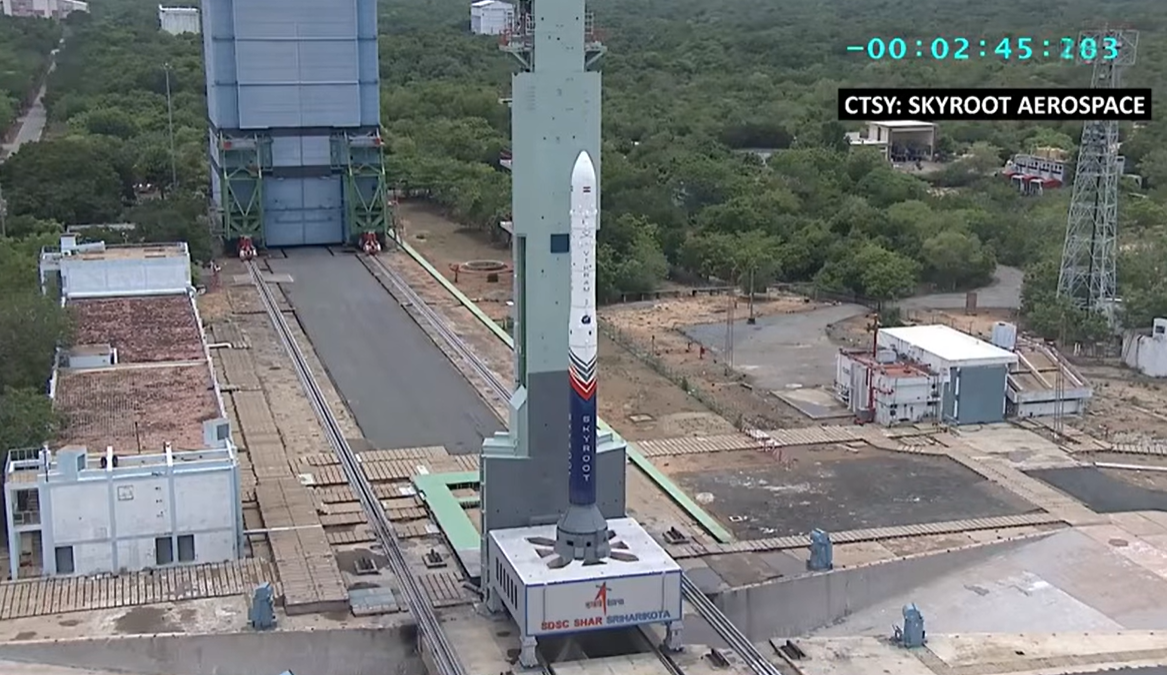
India’s private space industry is now entering in a transformative phase, and Vikram 1 Rocket Boosts VSEZ Tech Ecosystem with 5 Innovations has emerged as one of the most significant developments driving this momentum. As the country expands its commercial space capabilities, the Vikram 1 launch vehicle represents more than just a rocket – it symbolizes the rapid evolution of India’s deep-tech manufacturing, startup ecosystem, and advanced aerospace engineering.
Developed by Skyroot Aerospace, Vikram 1 is India’s first privately developed orbital launch vehicle designed to place small satellites into Low Earth Orbit (LEO). Its development has accelerated investments in research, manufacturing, testing infrastructure, and skilled talent, particularly within the Visakhapatnam Special Economic Zone (VSEZ) and its surrounding technology ecosystem.
Vikram 1 Rocket Boosts VSEZ Tech Ecosystem: 5 Innovations
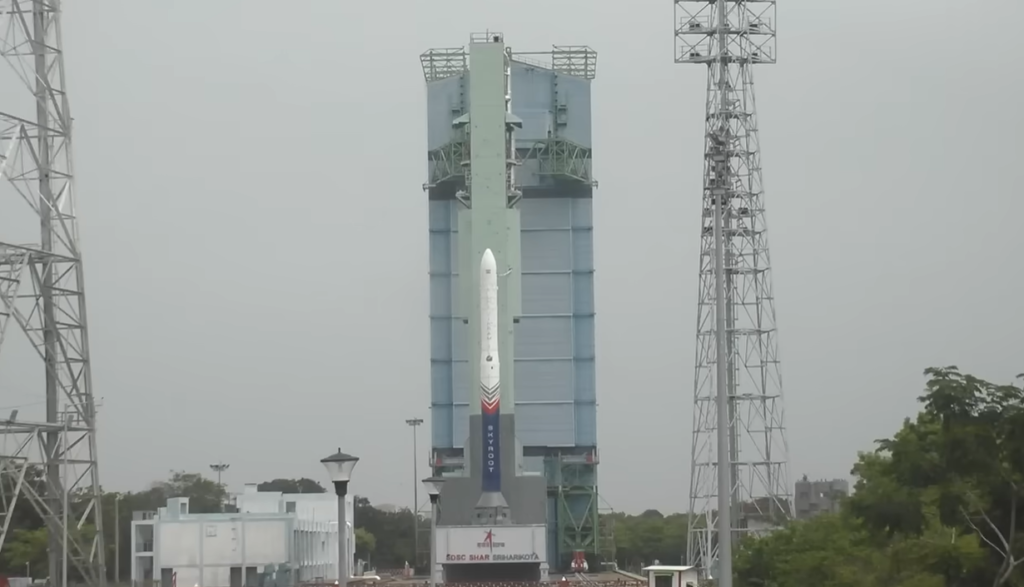
Dubbed “Mission Aagaman” (meaning arrival), the successful launch of Vikram-1 by Skyroot Aerospace marks a historic milestone for India’s private space industry. Vikram-1 has propelled India into an elite group of nations with indigenous private orbital launch capability. The success of Vikram-1 highlights India’s growing leadership in commercial space technology, strengthens the country’s global space ambitions, and demonstrates the technological excellence behind Vikram-1. As Vikram-1 enters operational service, it is expected to accelerate innovation, attract global customers, and establish Vikram-1 as a key player in the rapidly expanding small satellite launch market.
The impact extends far beyond a single launch mission. The rocket has encouraged collaboration between startups, component manufacturers, software developers, electronics firms, material science companies, and research institutions. These partnerships are helping to create an integrated aerospace ecosystem capable of supporting India’s ambitions to become a global hub for low-cost satellite launches and next-generation space technologies.
As demand increases gradually for launching small satellites continues to grow, India is uniquely taking his position to capitalize on this opportunity. The Vikram-1 programme demonstrates how innovation, private investment, supportive government policies, and indigenous engineering can work together to build a globally competitive space economy.
In this article, we explore how Vikram 1 Rocket Boosts VSEZ Tech Ecosystem with 5 Innovations, the technologies behind this launch, its role in strengthening India’s private space industry, and why it introduces a major milestone for the country’s future in commercial space exploration
Vikram 1 Rocket Boosts VSEZ Tech Ecosystem: 5 Innovations
What is Vikram-1 Rocket?
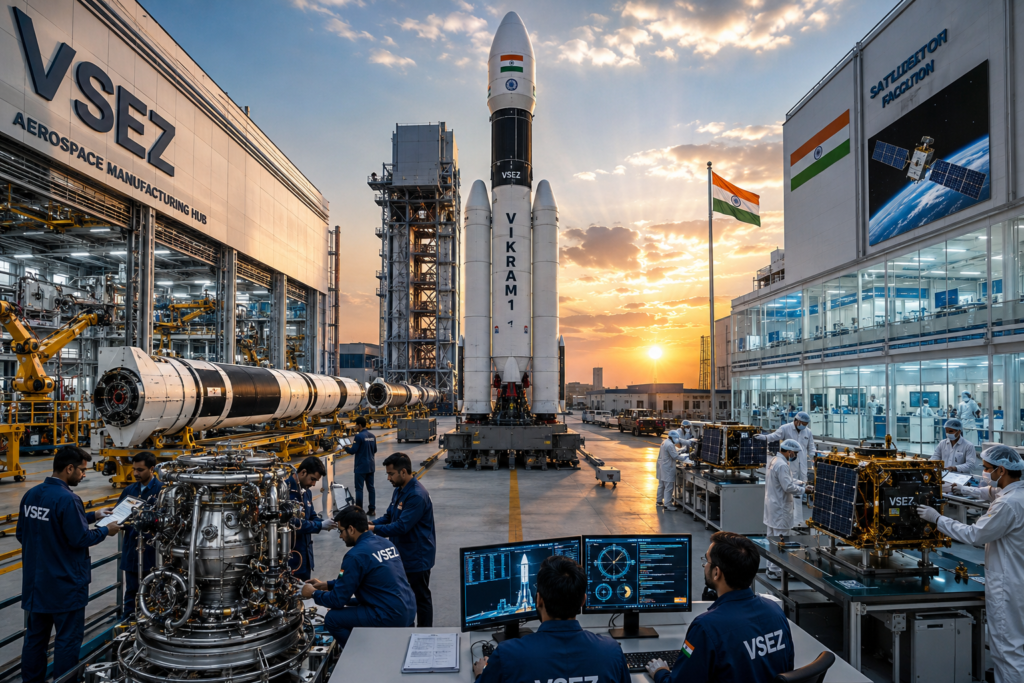
The Vikram-1 rocket is a small satellite launch vehicle developed by Skyroot Aerospace, one of India’s leading private space companies, It named after renowned Indian space Scientist Dr. Vikram Sarabhai, the Rocket is designed to provide reliable, cost-effective, and dedicated launch services for small satellites weighing upto 350 kg to Low Earth Orbit.
Traditional large launch vehicles that carry multiple payloads for different customers, Vikram-1 focuses on serving the rapidly growing small satellite market. This allows satellite operators greater flexibility for selecting launch schedules, orbital parameters, and mission requirements.
Key Features of Vikram-1
- Three stage launch vehicles powered by solid propulsion.
- Designed for launching small satellites into Low Earth Orbit (LEO).
- Built using lightweight carbon-composite structures.
- Advanced avionics and autonomous flight control systems.
- Modular design for faster manufacturing and assembly.
- Optimized for commercial satellite missions.
The increasing use of Earth observation satellites, communication constellations, weather monitoring systems, agricultural imaging, maritime surveillance, and Internet of Things (IoT) applications has significantly increased the global demand for small satellite launches. Vikram-1 aims to address this demand by offering dedicated launch opportunities at competitive costs.
Why Vikram-1 Matters for India’s Space Industry
For decades, India’s space programme was primarily driven by the Indian Space Research Organisation (ISRO). While ISRO achieved remarkable milestones—including missions to the Moon and Mars—the opening of the space sector to private participation has created new opportunities for innovation and commercial growth.
Vikram-1 represents this new phase of India’s space journey.
Instead of relying solely on government-led programmes, private companies are now contributing to rocket development, satellite manufacturing, propulsion systems, launch software, and mission operations. This diversification strengthens India’s position in the global commercial launch market while fostering a competitive environment that accelerates technological advancement.
The project also demonstrates India’s growing capability to develop sophisticated aerospace systems using domestic expertise, reducing dependence on imported technologies and supporting the broader vision of Atmanirbhar Bharat (Self-Reliant India).
Understanding the VSEZ Tech Ecosystem
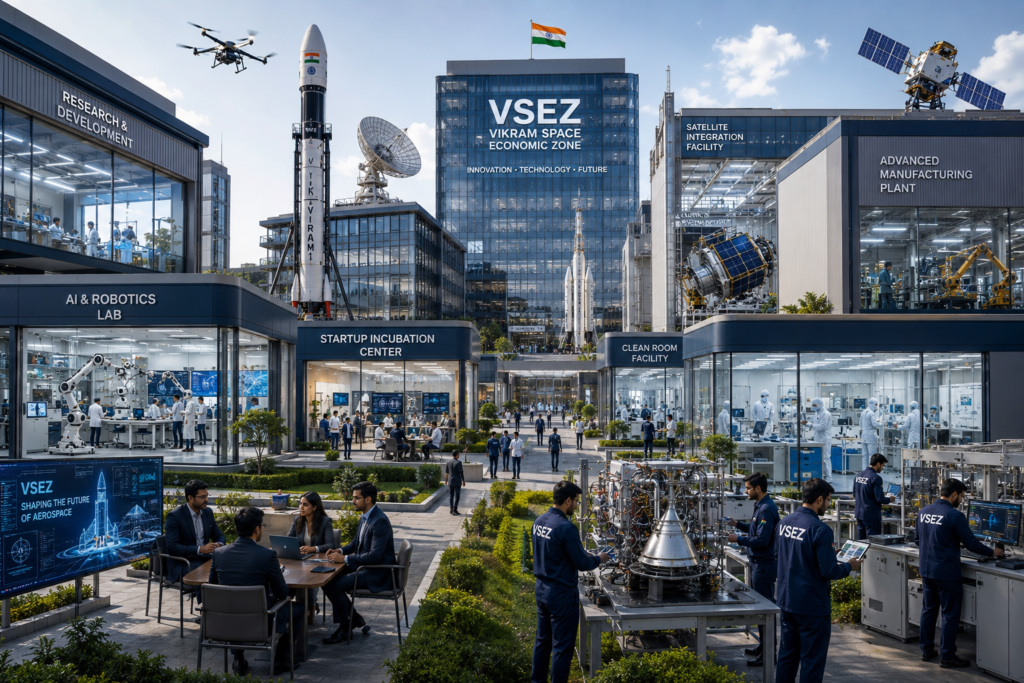
The Visakhapatnam Special Economic Zone (VSEZ) has evolved into a strategic hub for advanced manufacturing, electronics, engineering, and technology-driven industries. Its well-developed industrial infrastructure, connectivity, export-oriented policies, and skilled workforce make it an attractive destination for high-tech investments.
The growth of India’s private space sector has added a new dimension to the VSEZ ecosystem. Companies involved in precision engineering, electronics, composite materials, software development, automation, and aerospace components increasingly contribute to the broader supply chain supporting space technologies.
Key Strengths of the VSEZ Ecosystem
Advanced Manufacturing Infrastructure
Modern industrial facilities equipped with precision machining, additive manufacturing, and automation technologies enable the production of complex aerospace components that meet stringent quality standards.
Skilled Engineering Talent
The region benefits from a steady pipeline of engineers and researchers from nearby universities and technical institutes. Their expertise in mechanical engineering, electronics, materials science, computer science, and robotics supports the evolving needs of the aerospace industry.
Startup-Friendly Environment
Government initiatives promoting innovation and entrepreneurship have encouraged startups specializing in artificial intelligence, advanced materials, embedded systems, simulation software, and aerospace engineering to establish operations within the ecosystem.
Export Connectivity
As an export-oriented economic zone, VSEZ provides companies with efficient logistics, customs support, and access to global markets, making it easier to integrate into international aerospace supply chains.
Research Collaboration
Collaboration between industry, academic institutions, and government organizations accelerates research and development, enabling faster commercialization of innovative technologies.
The Connection Between Vikram-1 and VSEZ
The development of Vikram-1 has created opportunities for companies across the VSEZ ecosystem to contribute specialized products and services. These include:
- Precision-machined aerospace components.
- Carbon composite structures.
- Electronics and avionics assemblies.
- Embedded software development.
- Quality testing and inspection services.
- Simulation and digital engineering.
- Ground support equipment.
- Supply chain management.
This interconnected network of suppliers and innovators helps strengthen India’s domestic aerospace manufacturing capabilities while creating new business opportunities for small and medium-sized enterprises.
The ripple effects extend beyond the space sector. Investments in advanced manufacturing, robotics, artificial intelligence, and high-performance materials often benefit industries such as defence, automotive, renewable energy, and industrial automation, creating a multiplier effect across the broader economy.
Setting the Stage for Five Transformative Innovations
The success of Vikram-1 is not defined solely by its launch capabilities. Its true significance lies in the technological and economic innovations it inspires across the VSEZ ecosystem.
From lightweight composite materials and advanced propulsion systems to digital manufacturing, startup collaboration, and high-value job creation, the project is helping establish a modern aerospace ecosystem capable of competing on the global stage.
Vikram 1 Rocket Boosts VSEZ Tech Ecosystem with 5 Innovations
1. Advanced Composite Rocket Manufacturing
One of the biggest reasons Vikram 1 Rocket Boosts VSEZ Tech Ecosystem with 5 Innovations is the adoption of advanced composite manufacturing. Modern launch vehicles demand materials that are lighter, stronger, and more heat-resistant than conventional metals.
Vikram-1 extensively uses carbon-fibre composite structures, which significantly reduce the rocket’s overall weight while maintaining exceptional structural strength. A lighter rocket requires less fuel, improves payload capacity, and enhances launch efficiency—critical advantages in the competitive small-satellite launch market.
How VSEZ Benefits
The demand for composite materials has encouraged industries in and around VSEZ to invest in:
- Carbon-fibre fabrication
- Precision moulding technologies
- Automated curing systems
- Non-destructive testing (NDT)
- Aerospace-grade quality control
These capabilities are not limited to space applications. They also support sectors such as defence, aviation, renewable energy, and electric mobility, creating long-term industrial value.
Broader Economic Impact
The growing composite manufacturing ecosystem attracts investments in:
- Raw material processing
- Industrial automation
- Advanced robotics
- Quality certification laboratories
- Export-oriented manufacturing
This strengthens India’s ambition to become a global aerospace manufacturing destination.
2. Indigenous Propulsion and Precision Engineering
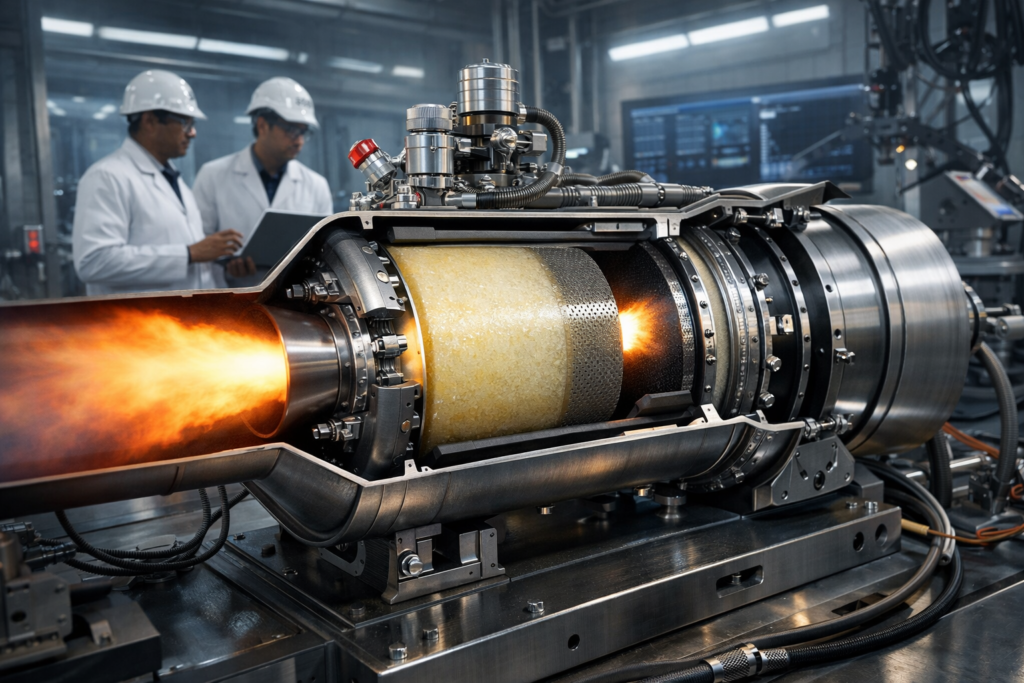
Rocket propulsion remains one of the most sophisticated engineering disciplines. Vikram-1 demonstrates India’s increasing capability to develop high-performance propulsion technologies using indigenous expertise.
The project requires thousands of precision-engineered components manufactured to extremely tight tolerances. This has accelerated growth among suppliers specializing in:
- CNC precision machining
- Aerospace alloys
- Thermal protection systems
- High-temperature materials
- Advanced sealing technologies
Why This Matters
Every propulsion component must withstand:
- Extreme temperatures
- High pressure
- Intense vibration
- Dynamic launch loads
Meeting these requirements has encouraged suppliers to upgrade machinery, adopt international quality standards, and invest in advanced inspection technologies.
Technology Spillover
These engineering capabilities benefit several industries, including:
- Defence manufacturing
- Gas turbines
- Nuclear engineering
- Marine engineering
- High-performance automotive systems
As a result, Vikram-1 serves as a catalyst for broader industrial modernization.
3. Digital Manufacturing and Industry 4.0 Integration
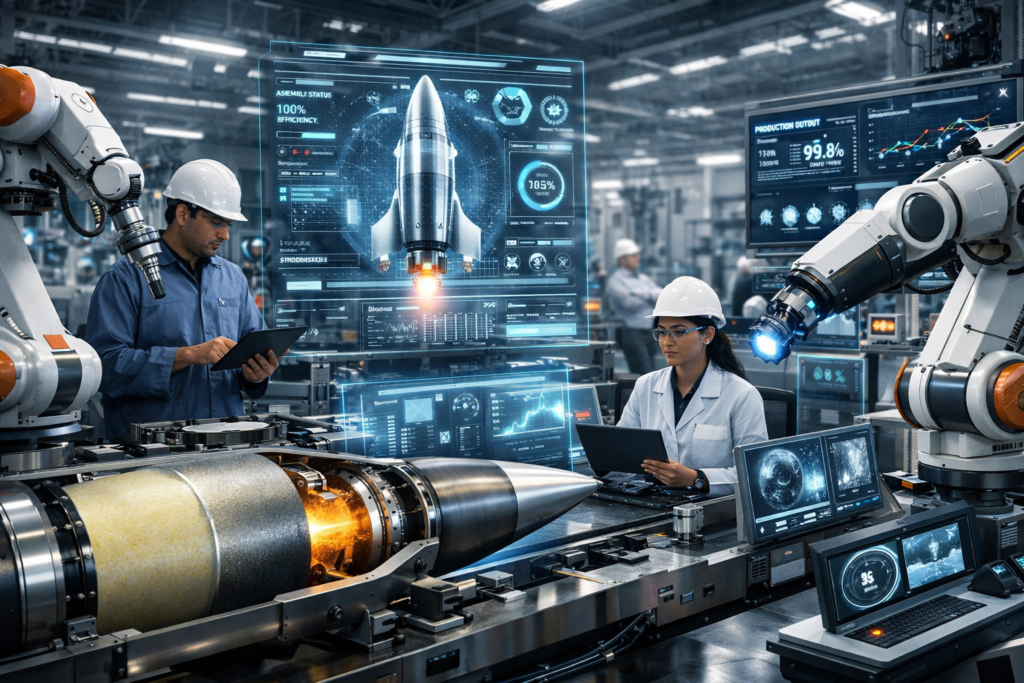
Modern rockets are designed as much with software as with hardware. Another major reason Vikram 1 Rocket Boosts VSEZ Tech Ecosystem with 5 Innovations is the widespread adoption of Industry 4.0 technologies.
Manufacturing increasingly relies on:
- Artificial Intelligence
- Machine Learning
- Digital Twins
- IoT-enabled production systems
- Predictive maintenance
- Automated inspection
Instead of relying solely on manual processes, engineers simulate rocket performance digitally before production begins.
Advantages
Digital manufacturing enables:
- Faster product development
- Lower production costs
- Higher reliability
- Improved quality control
- Reduced manufacturing errors
Impact on VSEZ
Technology companies within VSEZ now have opportunities to develop:
- Manufacturing software
- Industrial AI solutions
- Simulation platforms
- Embedded systems
- Industrial cybersecurity
- Cloud-based engineering tools
This expands the ecosystem beyond traditional manufacturing into high-value software development.
4. Startup Collaboration and Deep-Tech Innovation
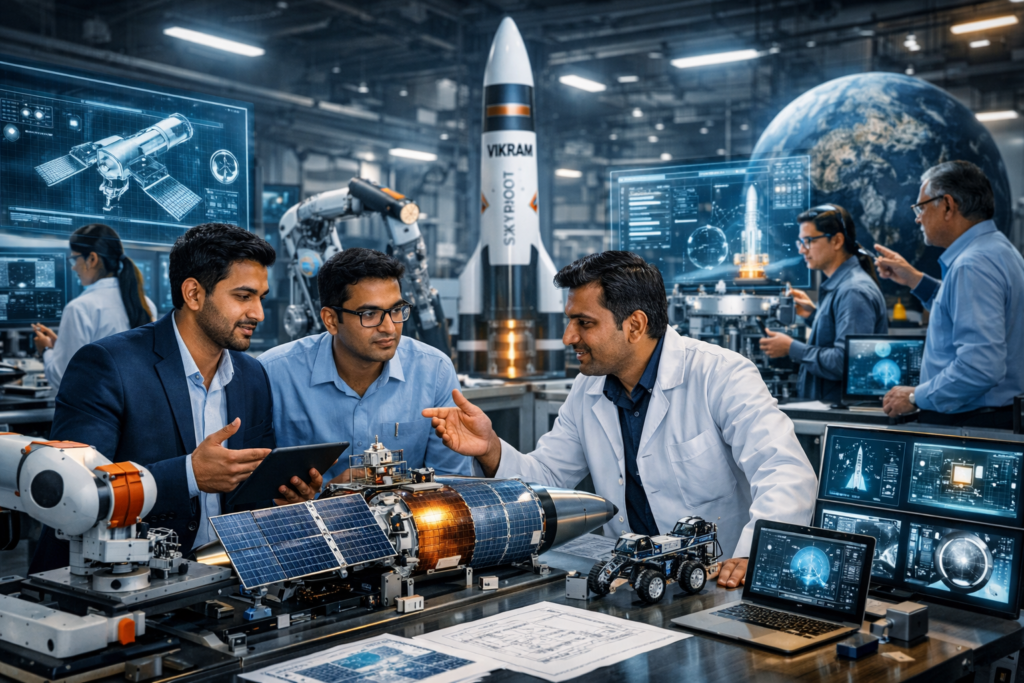
Unlike traditional government-led programmes, Vikram-1 reflects the strength of India’s growing startup-driven innovation model.
Rather than depending on a single organization, multiple startups contribute specialized expertise across different technology domains.
These include:
- Avionics
- Flight software
- Satellite electronics
- Artificial Intelligence
- Navigation systems
- Composite materials
- Advanced sensors
- Manufacturing automation
Building a Collaborative Ecosystem
This collaborative approach encourages:
- Technology transfer
- Faster innovation
- Lower development costs
- Greater flexibility
- Private investment
It also creates opportunities for universities, research institutions, and engineering colleges to work directly with industry.
Attracting Venture Capital
As India’s commercial space market expands, venture capital firms increasingly recognize the long-term potential of deep-tech startups.
Investment flows into:
- Space robotics
- Satellite analytics
- Launch technologies
- Earth observation
- AI-driven aerospace software
This strengthens the innovation ecosystem far beyond the rocket itself.
5. High-Skill Employment and Global Supply Chain Integration
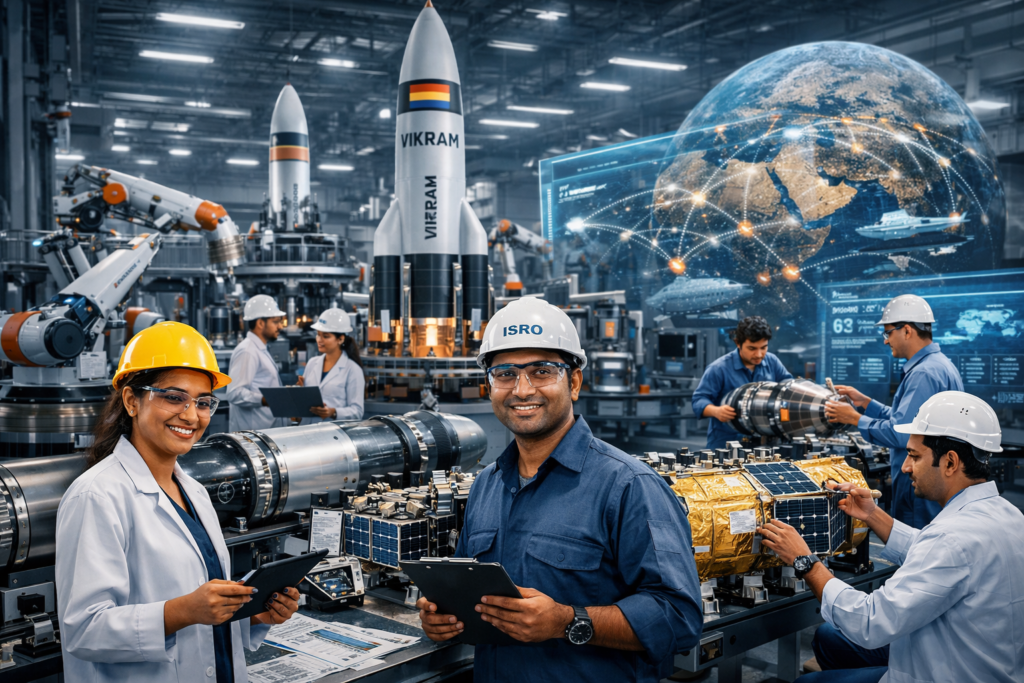
The fifth innovation extends beyond technology—it is about human capital.
The development of Vikram-1 creates demand for highly skilled professionals across multiple disciplines.
High-Demand Roles
- Aerospace Engineers
- Mechanical Engineers
- Electronics Engineers
- AI Specialists
- Data Scientists
- Software Developers
- Materials Scientists
- Robotics Engineers
- Quality Engineers
- Supply Chain Experts
These are among the highest-value jobs in the manufacturing economy.
Building a Space Talent Pipeline
Educational institutions increasingly align their curricula with emerging industry needs by offering specialized programs in:
- Rocket propulsion
- Aerospace structures
- Embedded systems
- AI for manufacturing
- Satellite engineering
- Mechatronics
- Computational fluid dynamics
This prepares the next generation of engineers for careers in India’s rapidly growing space sector.
Integration with Global Markets
International satellite operators seek reliable launch partners with efficient manufacturing ecosystems.
As VSEZ companies gain aerospace certifications and experience, they become eligible to participate in global supply chains supplying:
- Precision components
- Composite structures
- Electronics
- Ground systems
- Mission support technologies
This opens new export opportunities while enhancing India’s reputation as a trusted aerospace manufacturing hub.
Why These Five Innovations Matter Together
Each innovation strengthens a different pillar of the VSEZ technology ecosystem:
| Innovation | Impact |
|---|---|
| Advanced Composite Manufacturing | Lightweight, high-performance rocket structures |
| Indigenous Propulsion & Precision Engineering | Strengthens domestic manufacturing capabilities |
| Industry 4.0 & Digital Manufacturing | Faster, smarter, and more reliable production |
| Startup Collaboration | Accelerates innovation and attracts investment |
| High-Skill Employment | Builds a sustainable aerospace workforce and export ecosystem |
Together, these developments create a virtuous cycle where technology, talent, investment, and manufacturing reinforce one another, positioning India as a competitive player in the global commercial space industry.
Economic Impact of Vikram-1 on VSEZ and India’s Space Economy
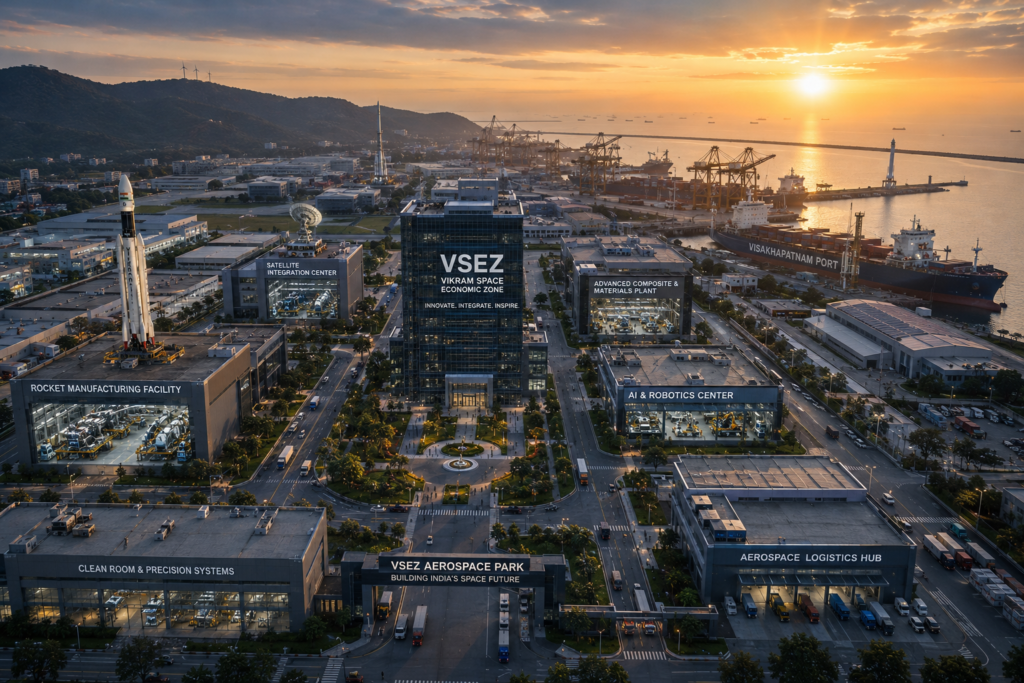
The significance of Vikram 1 Rocket Boosts VSEZ Tech Ecosystem with 5 Innovations extends well beyond technological advancement. It is also reshaping India’s space economy by creating new business opportunities, strengthening supply chains, attracting investments, and generating high-value employment.
The global space economy is expanding rapidly, driven by increasing demand for satellite communications, Earth observation, navigation services, climate monitoring, defence applications, and space-based Internet connectivity. Small satellites account for a significant share of this growth, making dedicated launch vehicles like Vikram-1 increasingly important.
As private companies participate more actively in launch services, VSEZ is emerging as a strategic manufacturing and technology hub that supports India’s ambition to capture a larger share of the international commercial launch market.
Strengthening India’s Aerospace Manufacturing Supply Chain
One of the most visible economic benefits of Vikram-1 is the development of an integrated domestic aerospace supply chain.
Instead of relying heavily on imported components, Indian companies are increasingly manufacturing:
- Precision aerospace components
- Composite structures
- Electronic systems
- Flight computers
- Sensors
- Thermal protection materials
- Ground support equipment
- Testing instruments
This localization helps reduce costs, improve supply chain resilience, and increase India’s technological self-reliance.
For VSEZ-based manufacturers, participation in the space sector also opens opportunities to supply products to defence, aviation, renewable energy, and advanced engineering industries.
New Opportunities for MSMEs and Startups
The Vikram-1 programme is not limited to large aerospace companies. Hundreds of Micro, Small and Medium Enterprises (MSMEs) can contribute specialized products and services.
Potential areas include:
- Precision machining
- Electronics manufacturing
- Industrial automation
- Embedded software
- Robotics
- Artificial Intelligence
- Composite materials
- Industrial design
- Quality certification
- Aerospace logistics
These businesses benefit from exposure to high-value manufacturing standards, enabling them to compete in global markets.
High-Value Employment Generation
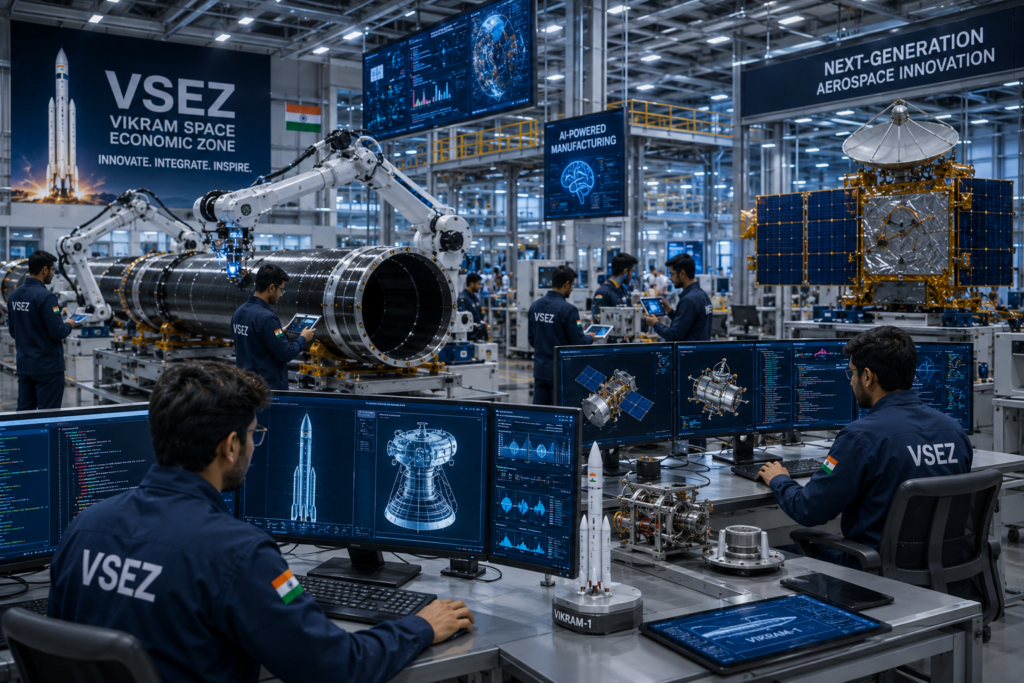
Unlike traditional manufacturing industries, aerospace creates high-skilled, knowledge-intensive jobs.
The growth of the Vikram-1 ecosystem is expected to increase demand for professionals such as:
- Aerospace Engineers
- Mechanical Engineers
- Electronics Engineers
- Data Scientists
- Artificial Intelligence Specialists
- Software Developers
- Materials Scientists
- Robotics Engineers
- Systems Engineers
- Project Managers
These careers typically involve advanced technical expertise, continuous innovation, and global collaboration, contributing to long-term economic growth.
Research and Development Ecosystem
A thriving aerospace industry depends on sustained investment in research and development (R&D).
The Vikram-1 programme encourages collaboration among:
- Universities
- Engineering colleges
- Research laboratories
- Technology startups
- Manufacturing companies
- Government agencies
Such partnerships accelerate innovation in propulsion, materials science, avionics, artificial intelligence, and satellite technologies.
Over time, these innovations can benefit sectors beyond aerospace, including healthcare, automotive, energy, and telecommunications.
Role of ISRO and IN-SPACe
India’s private space revolution has been made possible through policy reforms that encourage greater industry participation while maintaining regulatory oversight.
ISRO: Enabling Technology and Expertise
The Indian Space Research Organisation (ISRO) continues to play a vital role by sharing technical expertise, testing facilities, and decades of experience in launch vehicle development.
Its pioneering achievements have laid the foundation for a vibrant commercial space ecosystem where private companies can innovate and scale.
IN-SPACe: Facilitating Private Participation
The Indian National Space Promotion and Authorization Centre (IN-SPACe) serves as the regulatory and promotional body that enables private companies to access space infrastructure and participate in space activities.
Its role includes:
- Authorization of private space missions
- Industry facilitation
- Infrastructure access
- Policy support
- Technology collaboration
Together, ISRO and IN-SPACe are helping create a balanced ecosystem where public institutions and private enterprises complement one another.
How Vikram-1 Compares with Global Launch Providers
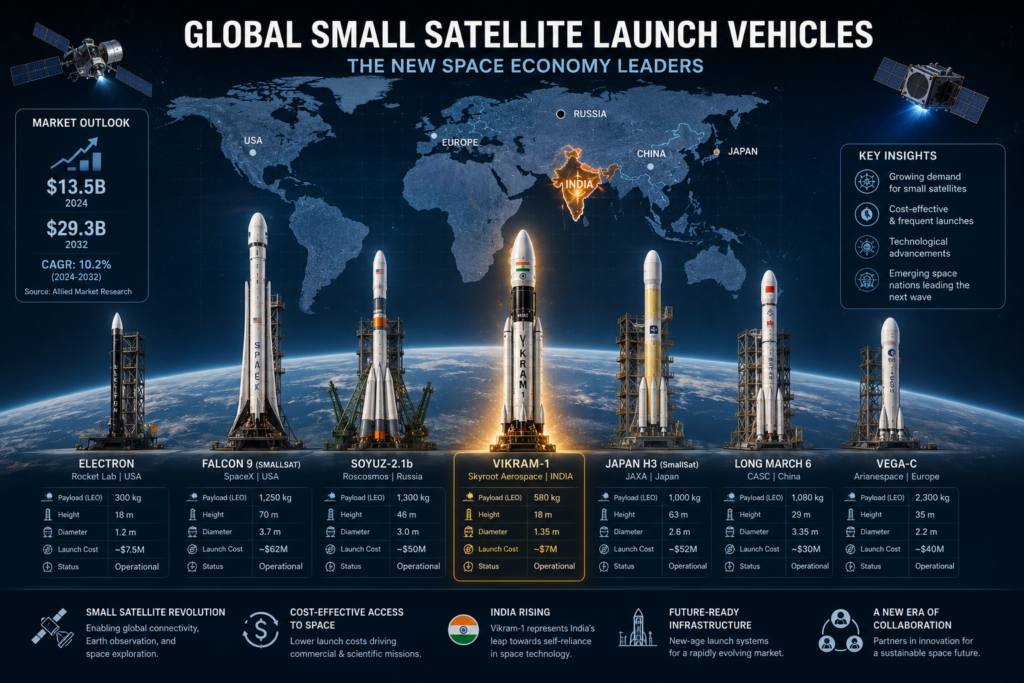
The commercial launch industry has become increasingly competitive, with companies worldwide developing dedicated small-satellite launch vehicles.
Here’s how Vikram-1 fits into the broader landscape:
| Company | Country | Primary Focus |
|---|---|---|
| Skyroot Aerospace | India | Small satellite launches |
| SpaceX | United States | Reusable medium and heavy launch vehicles |
| Rocket Lab | United States/New Zealand | Dedicated small satellite launches |
| Firefly Aerospace | United States | Small and medium launch services |
| Isar Aerospace | Germany | European commercial launch services |
While global players have established operational track records, India’s competitive strengths include:
- Cost-efficient engineering
- Highly skilled workforce
- Growing startup ecosystem
- Government support
- Strong manufacturing capabilities
- Expanding commercial satellite market
These advantages position India as a promising destination for affordable and reliable launch services.
Challenges Ahead
Despite the optimism, several challenges remain.
Scaling Manufacturing
Meeting growing commercial demand requires continuous investment in advanced production facilities, quality assurance, and automation.
Global Competition
International launch providers continue to innovate rapidly, particularly in reusable launch systems and rapid launch capabilities.
Talent Development
The industry must continue investing in education and specialized training to ensure a steady pipeline of skilled professionals.
Regulatory Evolution
As commercial space activities increase, regulations will need to evolve to support innovation while ensuring safety and compliance.
Addressing these challenges will be crucial for sustaining long-term growth.
Future Outlook
The future of India’s private space sector appears highly promising.
Several trends are expected to shape the next decade:
- Rising demand for dedicated satellite launches
- Expansion of satellite constellations
- Increased private investment
- Growth in reusable launch technologies
- Stronger collaboration between academia and industry
- Greater participation in global aerospace supply chains
Projects like Vikram-1 are likely to inspire further innovation, attract international partnerships, and strengthen India’s position in the global space economy.
Conclusion
The story behind Vikram 1 Rocket Boosts VSEZ Tech Ecosystem with 5 Innovations is not merely about a launch vehicle—it is about the emergence of a comprehensive innovation ecosystem.
By advancing composite manufacturing, indigenous propulsion, digital engineering, startup collaboration, and high-skilled employment, Vikram-1 demonstrates how private enterprise can complement national space ambitions. The resulting ecosystem has the potential to drive technological progress, create export opportunities, and foster sustainable economic growth.
As India continues to expand its presence in commercial space, initiatives like Vikram-1 and the evolving VSEZ technology ecosystem are expected to play a central role in shaping the country’s future as a globally competitive aerospace and innovation hub.
Frequently Asked Questions (FAQ)
1. What is Vikram-1 Rocket?
Vikram-1 is a privately developed small satellite launch vehicle by Skyroot Aerospace, designed to place small satellites into Low Earth Orbit (LEO).
2. What is the VSEZ Tech Ecosystem?
The VSEZ Tech Ecosystem refers to the network of advanced manufacturing companies, technology firms, startups, research institutions, and supporting industries operating in and around the Visakhapatnam Special Economic Zone.
3. Why is Vikram-1 important for India’s private space sector?
It showcases India’s growing capabilities in commercial launch services, indigenous aerospace technology, and private-sector innovation.
4. What are the five key innovations highlighted in this article?
The five innovations are:
- Advanced composite manufacturing
- Indigenous propulsion and precision engineering
- Digital manufacturing and Industry 4.0
- Startup collaboration and deep-tech innovation
- High-skill employment and global supply chain integration
5. How does Vikram-1 benefit Indian startups?
The project creates opportunities for startups working in avionics, AI, robotics, embedded systems, advanced materials, manufacturing automation, and satellite technologies.
6. What role do ISRO and IN-SPACe play?
ISRO provides technical expertise and infrastructure, while IN-SPACe facilitates and regulates private-sector participation in India’s space activities.
7. How does Vikram-1 support the Indian economy?
It promotes advanced manufacturing, generates skilled jobs, encourages research and development, strengthens domestic supply chains, and enhances India’s competitiveness in the global space market.
8. What is the future outlook for India’s commercial space industry?
With supportive policies, growing private investment, and increasing global demand for satellite launches, India is well-positioned to become a major player in the international commercial space sector.
MY VIEW:
Vikram 1 is India’s first privately developed orbital launch vehicle designed to place small satellites into Low Earth Orbit (LEO). It is developed by Skyroot Aerospace.
This development in private sector in India gains economic strength through job creation and developing startup ecosystem. It also builds technological independence with AI-driven manufacturing, satellite innovation, and strong research collaboration.
It also secures bolster national security and give India a voice on international level. In short, this ecosystem empowers India to become a global hub for affordable, innovative, and sustainable space technology.