
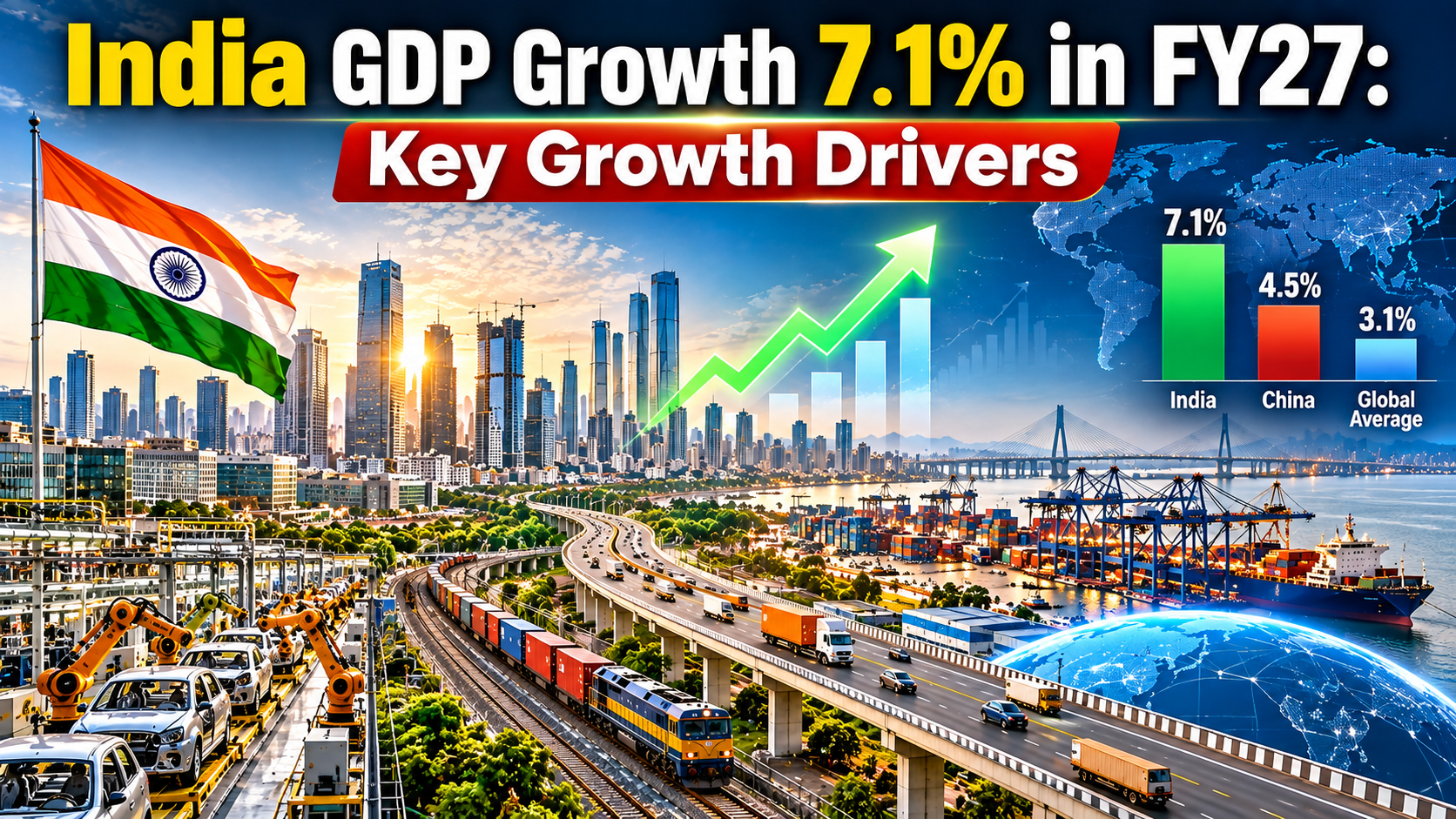
India GDP Growth 7.1% in FY27: Key Growth Drivers
Introduction:
India is strengthening its position in the global economy, with the World Bank projecting India GDP Growth of 7.1% in the financial year 2026–27 (FY27). The upward revision reflects resilient domestic demand, stronger exports and better-than-expected economic activity despite global uncertainty.
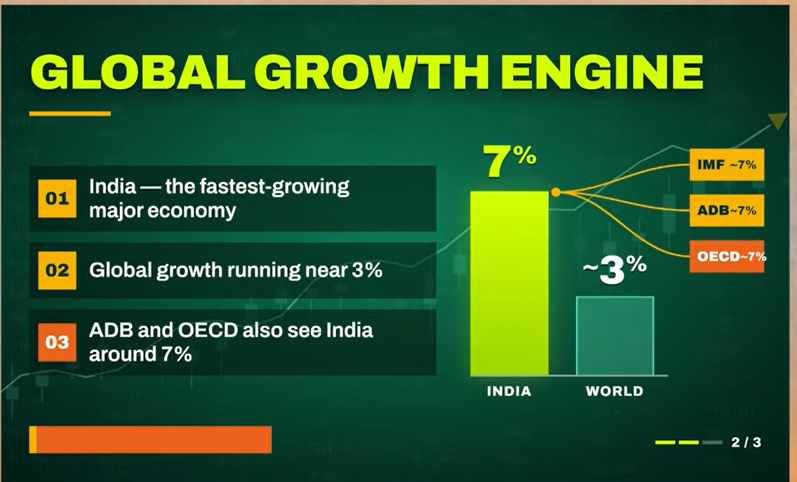
The latest forecast places India among the fastest-growing major economies. The International Monetary Fund (IMF), in its October 2026 World Economic Outlook, projects India’s growth at 7.0% for calendar year 2026, compared with 4.5% for China and 3.1% for the global economy. These figures cover different reporting periods, so they provide a broad comparison rather than a perfectly like-for-like assessment.
The World Bank’s October 6, 2026, India Development Update raised its FY27 forecast from 6.6% to 7.1%. Meanwhile, Deloitte India’s latest economic outlook, released on October 16, projects growth of 7.1% to 7.3% for the same financial year, supported by consumption, infrastructure spending and signs of improving private investment.
These projections highlight the importance of India’s domestic market, expanding services sector, infrastructure development and policy environment. However, sustaining this momentum will depend on managing inflation, external risks and employment challenges.
In this article, we examine India GDP Growth 7.1% in FY27: Key Growth Drivers, explain why India’s growth outlook is stronger than China’s and the global average, and explore what this means for businesses, investors and ordinary households.
India GDP Growth 7.1% in FY27: What the Latest Forecast Means
The World Bank’s revised projection represents an improvement of 0.5 percentage points over its previous estimate of 6.6%. This revision suggests that India’s economic activity has proved more resilient than previously anticipated.
According to the World Bank, strong domestic demand and exports are helping the economy withstand international headwinds. Industrial activity and investment have also contributed to the positive outlook.
Deloitte’s October 16 assessment adds to the optimism, identifying continued consumer spending, public infrastructure investment and an emerging recovery in private-sector investment as important growth drivers.
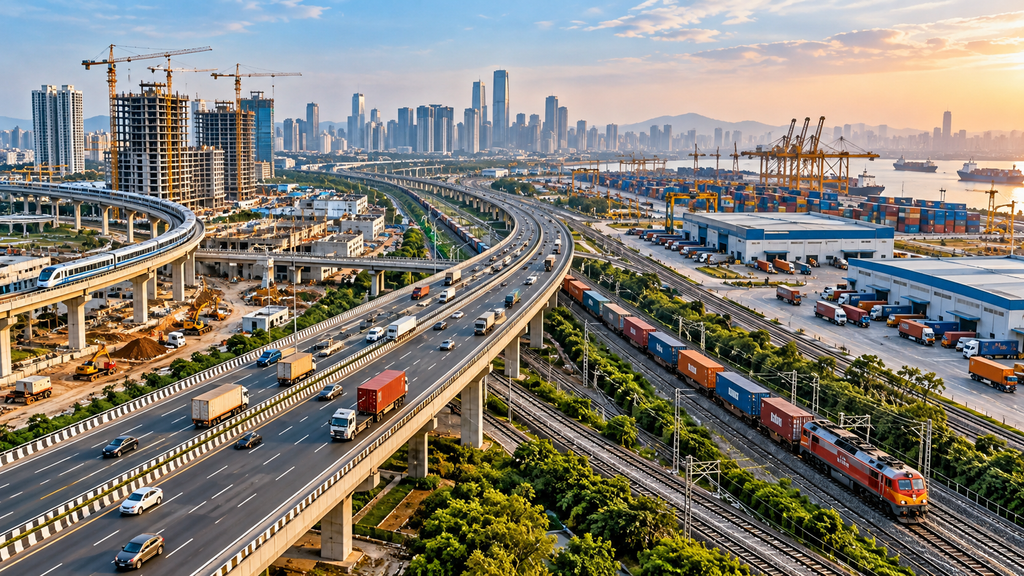
The IMF’s October forecast is also encouraging. It raised its projection for India’s calendar-year 2026 growth to 7.0%, reflecting strong domestic demand, services activity and investment related to artificial intelligence.
However, these numbers should be understood as economic forecasts, not confirmed final GDP results. Actual growth will depend on domestic demand, energy prices, weather conditions, international trade and investment decisions throughout the year.
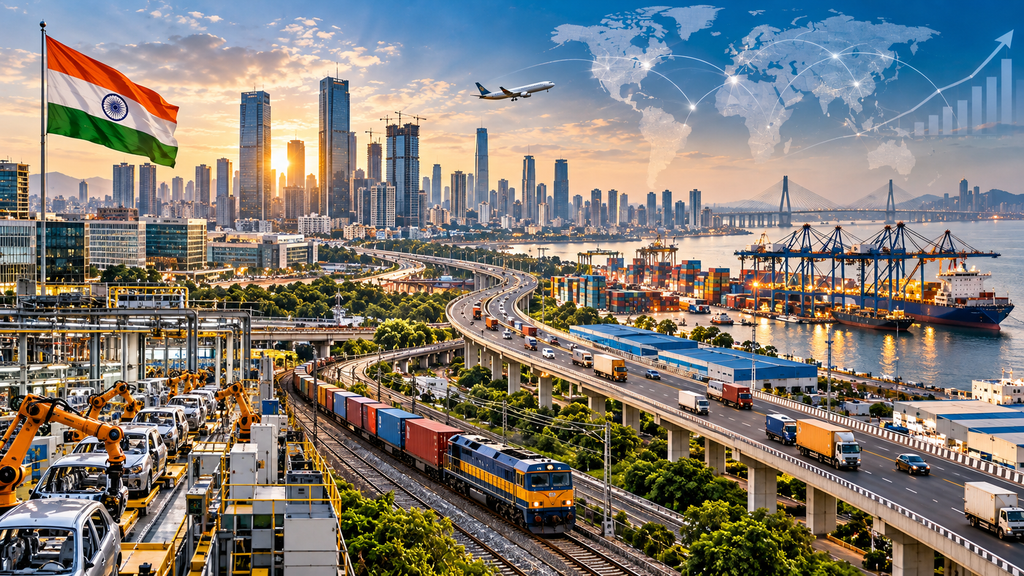
India GDP Growth 7.1%: Beats China and Global Average
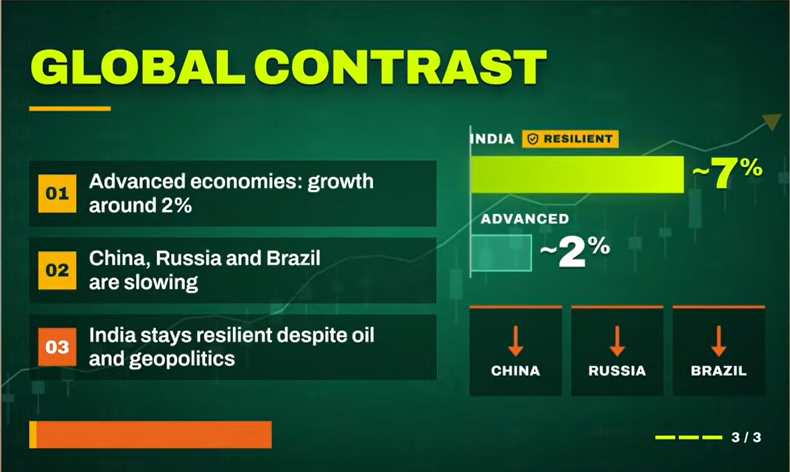
India’s growth outlook stands above the latest forecasts for China and the world economy. This comparison highlights India’s strong economic momentum, although differences in reporting periods must be considered.
| Economy | Growth forecast | Reporting period |
|---|---|---|
| India | 7.1% | FY27, World Bank |
| India | 7.0% | Calendar year 2026, IMF |
| China | 4.5% | Calendar year 2026, IMF |
| Global economy | 3.1% | Calendar year 2026, IMF |
Sources: World Bank India Development Update and IMF October 2026 outlook, reported by Reuters.
Based on the World Bank’s FY27 projection, India is expected to grow 2.6 percentage points faster than China’s 2026 forecast and four percentage points faster than projected global growth.
This does not mean India has overtaken China in total economic output. China’s economy remains considerably larger. Instead, the comparison indicates that India’s economy is projected to expand at a faster rate.
India’s growth performance is particularly important because the country has a large population, an expanding consumer market and significant opportunities to improve productivity, infrastructure and household incomes.
7 Key Growth Drivers Behind India’s Economic Expansion
1. Strong Domestic Consumption
Domestic consumption is one of the most important factors supporting India’s economic growth.
India has a large consumer market with demand across food, housing, transport, healthcare, education, consumer electronics and financial services. When household spending increases, businesses can sell more products and services, expand operations and create employment.
Consumption also supports indirect economic activity. For example, higher demand for automobiles can benefit manufacturers, component suppliers, transport companies, dealerships and service centres.
Government policies that support disposable incomes may provide additional assistance to consumption. Nevertheless, the strength of household demand depends on employment opportunities, wage growth, inflation and consumer confidence.
For India to maintain rapid growth, spending must remain sustainable and extend beyond higher-income households.
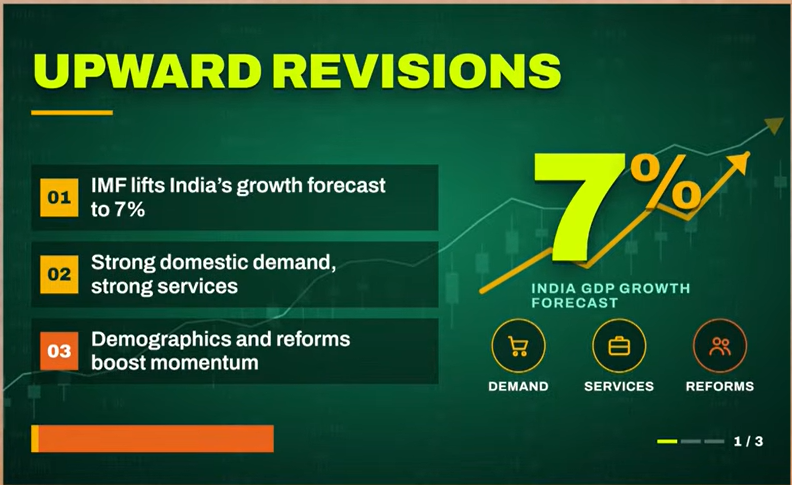
2. Infrastructure Investment
Infrastructure development is another major pillar of the India GDP Growth 7.1% in FY27 outlook.
Investment in highways, railways, airports, ports, power generation, urban transport and digital connectivity improves the economy’s productive capacity.
Construction projects create immediate demand for cement, steel, machinery, engineering services and labour. Once completed, improved infrastructure can reduce transportation costs, shorten delivery times and make businesses more competitive.
Better connectivity also helps smaller towns and rural areas access larger markets. Manufacturers can move products more efficiently, while agricultural producers may benefit from improved logistics and storage facilities.
However, the long-term benefits depend on timely project completion, effective public spending and the ability to attract private investment alongside government expenditure.
Infrastructure Development
3. Growth in the Services Sector
India’s services industry remains a major source of economic activity and export earnings.
Information technology, business-process management, financial services, consulting, telecommunications, professional services and digital platforms connect Indian businesses with customers around the world.
Indian technology companies provide software development, cloud services, cybersecurity, analytics and business support to international clients. These activities generate revenue and create demand for skilled professionals.
Global Capability Centres are another important contributor. These centres perform functions such as research, engineering, finance, technology development and data analysis for multinational companies.
The expansion of artificial intelligence could create new opportunities in software, automation and specialised services. At the same time, it may change existing job requirements, making workforce training and reskilling increasingly important.
A competitive services sector can help India earn foreign exchange, attract investment and develop higher-value employment.
4. Manufacturing and Industrial Activity
Manufacturing is important for transforming India’s growth momentum into broader employment and productivity gains.
Industries such as electronics, pharmaceuticals, automobiles, renewable-energy equipment, engineering goods and industrial machinery can strengthen domestic supply chains and expand exports.
Manufacturing growth also creates demand for transport, warehousing, maintenance, packaging and financial services.
Government efforts to improve industrial infrastructure and attract investment can support these industries. However, long-term competitiveness depends on affordable logistics, reliable electricity, skilled workers, efficient regulation and access to global markets.
India must also encourage smaller manufacturers to adopt modern machinery, digital systems and quality-control processes.
If these improvements continue, manufacturing can contribute to a more diversified economic structure and reduce dependence on a narrow range of industries.
5. Stronger Exports and International Trade
Exports have helped support India’s economic outlook despite global uncertainty.
India exports software services, pharmaceuticals, engineering products, chemicals, textiles, agricultural products and other goods. Strong export performance brings foreign-exchange earnings and supports employment in export-oriented industries.
Services exports are particularly significant because Indian companies can serve overseas customers without physically shipping a product across borders.
However, export performance remains sensitive to international demand, trade restrictions, shipping costs and geopolitical developments.
A broader export base, better logistics and stronger trade relationships can help Indian companies access new markets.
For sustained export growth, businesses also need predictable regulations, competitive production costs and the ability to meet international quality standards.
6. Digital Infrastructure and Artificial Intelligence
Digital infrastructure is becoming an increasingly important part of India’s economic development.
Digital payments, online public services, electronic business transactions and digital identity systems can reduce friction in economic activity. Small businesses can use digital platforms to reach customers, accept payments and manage operations more efficiently.
Artificial intelligence presents another opportunity.
The World Bank’s October 2026 India Development Update reported that private AI investment in India increased from $1.2 billion in 2024 to $4.1 billion in 2025. It also reported that employment in Global Capability Centres increased from 1.9 million professionals in 2024 to 2.36 million in 2025.
These developments indicate growing investment in technology and internationally connected business operations.
AI could improve productivity in healthcare, agriculture, manufacturing, education and financial services. Yet the economic benefits will depend on access to computing infrastructure, reliable electricity, worker training, data protection and affordable technology for smaller firms.
7. Policy Reforms and Private Investment
Public investment alone cannot sustain high economic growth indefinitely. Private-sector investment is essential for expanding productive capacity, creating jobs and introducing new technologies.
Businesses are more likely to invest when they have confidence in future demand, access to financing, reliable infrastructure and predictable regulations.
Reforms that simplify business procedures, improve logistics, support competition and strengthen access to credit can help attract investment.
Deloitte’s October 16 outlook identifies encouraging signs of a recovery in private investment as one of the factors supporting its FY27 projection.
If companies increase spending on factories, equipment, research and technology, the benefits can extend beyond the initial investment through productivity improvements and employment.
The key challenge is to ensure that investment translates into commercially sustainable projects and productive jobs rather than simply higher spending.
Why Is India’s Growth Outlook Stronger Than China’s?
India’s projected growth advantage reflects differences in economic structure, domestic demand and current challenges.
India benefits from a large domestic market, a growing services industry, infrastructure development and opportunities to expand manufacturing. Its young workforce can also support future growth, provided that workers receive suitable education and employment opportunities.
China continues to benefit from its manufacturing scale, advanced supply chains and export capacity. However, the IMF has highlighted weak domestic demand and persistent property-sector difficulties as challenges for China’s economy.
The IMF projects China’s growth at 4.5% in 2026 and 4.0% in 2027. It has also called for stronger fiscal support to help address weak demand and deflationary pressures.
India’s higher projected growth rate should therefore be understood as a difference in economic momentum, not evidence that India has become larger than China.
For India, the long-term opportunity is to use its growth advantage to strengthen productivity, manufacturing capabilities, exports and living standards.
How India’s Growth Compares With the Global Economy
The IMF’s October 2026 World Economic Outlook projects global growth of 3.1% in 2026. It identifies technology-related investment, including artificial intelligence, as a source of support while warning that geopolitical tensions, energy prices and financial risks could weaken the outlook.
India’s stronger projected growth reflects the contribution of its domestic economy and expanding services activity.
A large internal market can provide some protection when international demand weakens. Household spending and public investment may continue supporting activity even when some export markets face difficulties.
Nevertheless, India remains connected to the global economy. Higher crude oil prices can increase import costs, while slower growth among trading partners can affect exports.
Global financial volatility may also influence capital flows and investment decisions.
India’s growth advantage will be more durable if domestic productivity improves and businesses become increasingly competitive in international markets.
India GDP Growth 7.1% in FY27: Key Growth Drivers:
What Does Mean for Ordinary People?
A strong GDP growth rate can create economic opportunities, but the benefits depend on how growth translates into employment, wages and access to essential services.
Employment and Career Opportunities
Expanding businesses may recruit workers in manufacturing, technology, construction, healthcare, logistics, retail and financial services.
However, rapid GDP growth does not automatically guarantee sufficient employment. The economy must create jobs that match workers’ skills and provide sustainable incomes.
Opportunities for Small Businesses
Higher consumer demand and infrastructure development can benefit small retailers, suppliers, service providers and manufacturers.
Digital payments and online platforms may help smaller businesses reach customers and reduce transaction costs. Access to affordable finance and better business skills remains important.
Household Income and Inflation
Economic growth can improve household incomes when businesses expand and wages rise.
However, inflation can reduce purchasing power. If the cost of food, fuel, housing and healthcare increases faster than income, households may not experience a meaningful improvement in their standard of living.
Investment Opportunities
Strong economic activity may create opportunities across sectors such as infrastructure, manufacturing, financial services and technology.
Investors should still evaluate business fundamentals, valuations, financial risks and their own financial circumstances. A high national GDP growth rate does not guarantee that every company or investment will perform well.
Major Risks to India’s FY27 Economic Growth
Despite the positive outlook, India faces several challenges that could affect its growth trajectory.
Rising Crude Oil Prices
India relies heavily on imported crude oil. Higher prices can increase transport and production costs, put pressure on inflation and widen the import bill.
If energy prices remain elevated, households may have less money available for discretionary spending, while businesses may face lower profit margins.
Weather and Agricultural Uncertainty
Agriculture remains important for rural employment, food prices and demand in smaller towns.
Adverse rainfall conditions or an El Niño-related weather shock could affect agricultural output and rural incomes. Weaker harvests may also put upward pressure on food inflation.
Global Trade and Geopolitical Tensions
International conflicts, trade restrictions and supply-chain disruptions can increase uncertainty for exporters and investors.
Companies may delay investment decisions when they face unpredictable costs or weaker demand.
Employment and Skills Gaps
India needs to create enough productive jobs for its expanding workforce.
Education, vocational training, digital skills and stronger links between industry and educational institutions will be essential for ensuring that growth creates broad-based opportunities.
Uneven Distribution of Growth
GDP growth measures changes in total economic output, not how income is distributed among households.
The benefits of expansion may differ across states, industries and income groups. Improving healthcare, education, infrastructure and access to economic opportunities can help make growth more inclusive.
The World Bank has highlighted oil prices, weather-related pressures and financial-market volatility as important risks to India’s outlook.
India’s Economic Outlook for FY28 and Beyond
The medium-term outlook remains encouraging, although forecasts may change as economic conditions evolve.
The World Bank projects India’s growth at 7.2% in FY28 and 7.0% in FY29, assuming the external environment becomes more supportive.
To maintain strong economic momentum, India will need to encourage private investment, improve manufacturing competitiveness, expand services exports and develop a more skilled workforce.
Investment in infrastructure can improve productivity, while digital technology and AI may create new opportunities for businesses and public services.
India must also strengthen agricultural resilience, improve logistics and ensure that smaller firms can participate in economic growth.
The long-term objective should not simply be to achieve a high annual growth rate. It should be to translate economic expansion into higher productivity, better jobs, rising real incomes and improved living standards.
India GDP Growth 7.1% in FY27: Key Growth Drivers:
Frequently Asked Questions (FAQs)
1. What is India’s projected GDP growth rate in FY27?
The World Bank projects India’s GDP growth at 7.1% in FY27. Deloitte’s October 2026 outlook projects growth of 7.1% to 7.3%, while the IMF’s calendar-year 2026 forecast is 7.0%.
2. Why is India expected to grow faster than China?
India benefits from resilient domestic demand, services activity, infrastructure investment and opportunities in manufacturing and technology. China’s growth outlook is affected by weak domestic demand and property-sector challenges.
3. What is the global GDP growth forecast for 2026?
The IMF’s October 2026 World Economic Outlook projects global economic growth of 3.1% in 2026.
4. What are the main drivers of India’s economic growth?
Key drivers include domestic consumption, infrastructure investment, services exports, manufacturing, digital infrastructure, AI adoption and private-sector investment.
5. What risks could affect India’s FY27 GDP growth?
Higher crude oil prices, adverse weather, inflation, geopolitical tensions, global trade uncertainty and insufficient job creation could affect India’s growth outlook.
Conclusion
India’s projected GDP growth of 7.1% in FY27 reflects strong domestic demand, infrastructure investment, services activity and better-than-expected exports. The World Bank’s upward revision and Deloitte’s latest outlook reinforce the positive assessment of India’s economic momentum.
The comparison with China’s projected 4.5% growth and the global average of 3.1% highlights India’s position among the fastest-growing major economies. However, the figures cover different reporting periods and should be interpreted accordingly.
Maintaining this momentum will require continued investment, competitive industries, stronger exports, better workforce skills and effective management of energy and weather-related risks.
Ultimately, the real measure of India’s economic success will be whether rapid growth produces productive employment, higher household incomes and better living standards across the country.