
India’s Exports Soar 18% in May, Trade Deficit Hits $28.21B: What It Means for the Economy
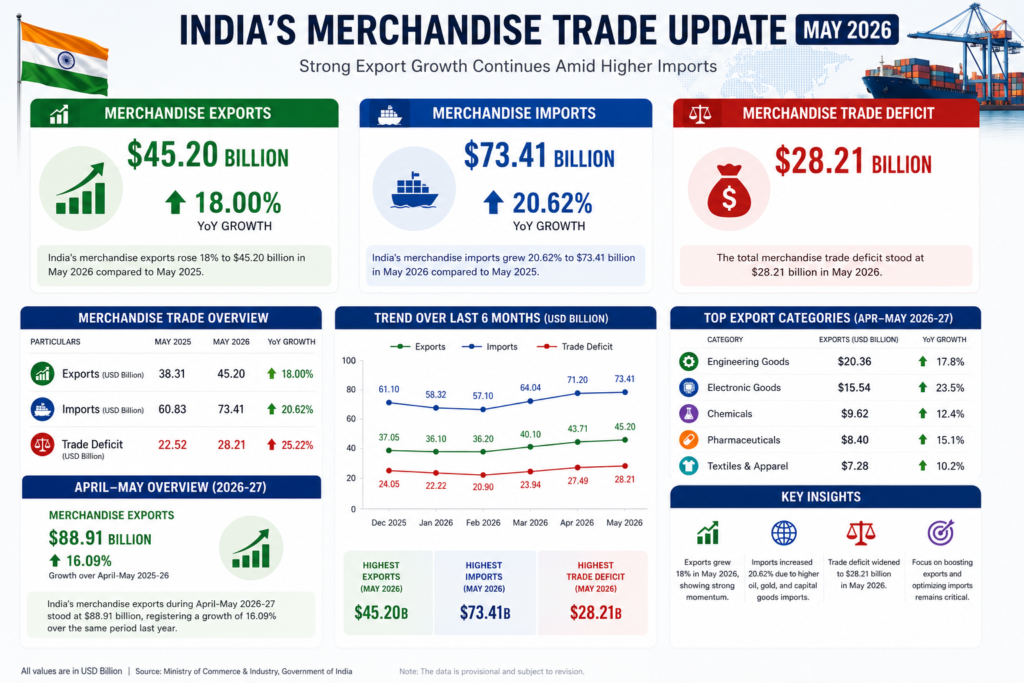
India’s external trade performance delivered a mixed signal in May as India’s Exports Soar 18% in May, Trade Deficit Hits $28.21B, highlighting both the strength of outbound shipments and the challenges posed by rising imports.
The latest trade data reflects growing international demand for Indian goods and services, particularly in sectors such as engineering products, electronics, pharmaceuticals, chemicals, and petroleum products. However, a sharp rise in imports—driven by energy requirements, gold purchases, industrial raw materials, and capital goods—pushed the trade deficit to $28.21 billion, one of the most closely watched economic indicators.
The development comes at a crucial time when India is positioning itself as a global manufacturing and export hub under initiatives such as Make in India, Production Linked Incentive (PLI) schemes, and expanded free trade agreements with strategic partners.
This article examines why India’s Exports Soar 18% in May, Trade Deficit Hits $28.21B, the sectors driving export growth, the reasons behind the widening deficit, and what this means for India’s economic outlook.
Understanding the Latest Trade Numbers
India recorded an impressive rise in exports during May, reflecting stronger global demand and increased competitiveness among domestic manufacturers.
Key Highlights
| Indicator | Performance |
|---|---|
| Export Growth | 18% Year-on-Year |
| Trade Deficit | $28.21 Billion |
| Major Export Drivers | Engineering, Electronics, Pharma |
| Major Import Drivers | Crude Oil, Gold, Machinery |
| Economic Impact | Strong Export Momentum with Import Pressure |
The headline figure that India’s Exports Soar 18% in May, Trade Deficit Hits $28.21B illustrates a complex trade environment where export growth remains robust but import demand is rising even faster.
Why India’s Exports Soar 18% in May
Several factors contributed to the remarkable increase in exports.
1. Strong Demand for Engineering Goods
Engineering products continue to be India’s largest export category.
Exports of:
- Industrial machinery
- Auto components
- Electrical equipment
- Manufacturing tools
witnessed significant growth as global industries sought diversified supply chains beyond traditional manufacturing centers.
Indian manufacturers have increasingly benefited from geopolitical shifts and supply-chain realignments.
2. Electronics Exports Continue to Surge
India’s electronics sector has emerged as one of the fastest-growing export industries.
Key contributors include:
- Smartphones
- Consumer electronics
- Semiconductor-related products
- Telecom equipment
Government incentives under PLI schemes have encouraged multinational companies to expand production within India.
As a result, electronics exports are becoming a critical pillar behind the trend that India’s Exports Soar 18% in May, Trade Deficit Hits $28.21B.
3. Pharmaceutical Sector Maintains Momentum
India remains one of the world’s largest suppliers of generic medicines.
Pharmaceutical exports grew due to:
- Increased healthcare spending globally
- Demand for affordable medicines
- Expanded market access
- Strong manufacturing capabilities
Indian pharmaceutical companies continue to strengthen their presence in developed and emerging markets alike.
4. Chemical and Specialty Product Exports
India’s chemical industry has gained international market share due to:
- Competitive pricing
- Strong production capacity
- Reliable supply chains
- Rising global demand
Specialty chemicals, agrochemicals, and industrial chemicals contributed significantly to export growth.
Why the Trade Deficit Expanded to $28.21 Billion
While exports grew strongly, imports increased at an even faster pace.
This explains why India’s Exports Soar 18% in May, Trade Deficit Hits $28.21B simultaneously.
Rising Crude Oil Imports
India imports nearly 85% of its crude oil requirements.
Factors increasing oil imports include:
- Growing domestic fuel demand
- Industrial expansion
- Transportation sector growth
- Global energy market volatility
Higher import volumes directly widen the trade deficit.
Gold Imports Increased
India remains one of the largest consumers of gold globally.
Gold imports rose because of:
- Strong retail demand
- Wedding season purchases
- Investment demand
- Anticipation of price movements
Gold imports have historically been a major contributor to India’s trade imbalance.
Capital Goods and Machinery Imports
Industrial growth often requires importing advanced machinery.
Major imported items include:
- Manufacturing equipment
- Industrial robots
- Precision machinery
- Semiconductor manufacturing tools
While these imports increase the deficit in the short term, they can improve productivity and exports in the long run.
Higher Demand for Raw Materials
Economic expansion increases demand for:
- Coal
- Copper
- Fertilizers
- Industrial minerals
These essential imports support domestic production but also contribute to a wider trade gap.
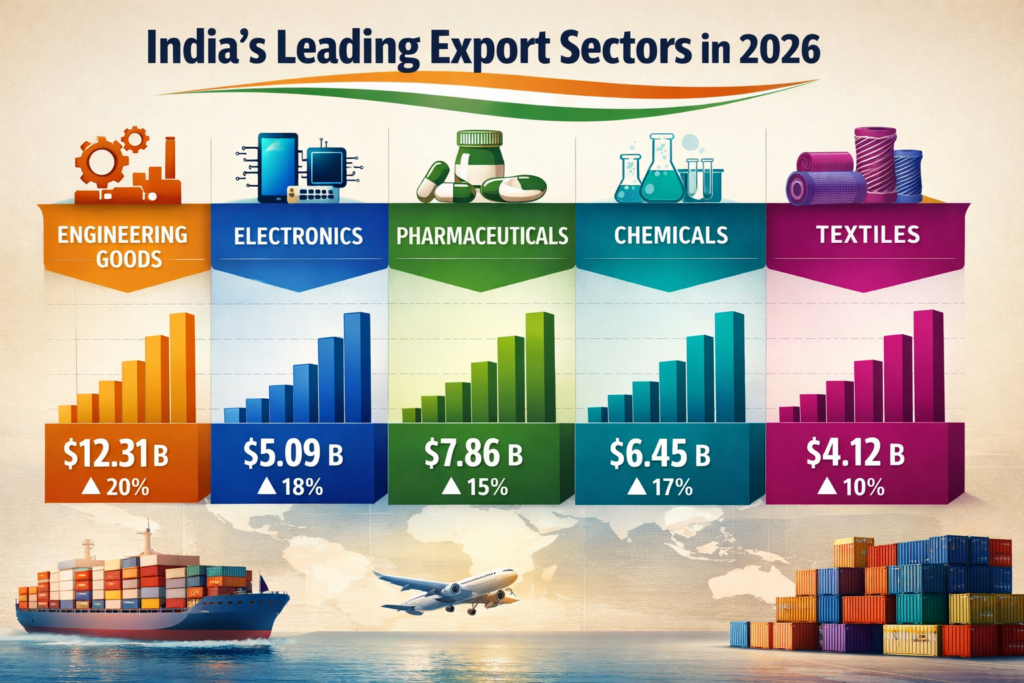
Sector-Wise Winners in India’s Export Growth
Several sectors played a crucial role in ensuring that India’s Exports Soar 18% in May, Trade Deficit Hits $28.21B.
Engineering Goods
The engineering sector remains India’s export champion.
Key Products
- Industrial machinery
- Heavy equipment
- Automotive components
- Electrical machinery
Electronics
The rapid growth of smartphone manufacturing has transformed India’s export profile.
Key Products
- Smartphones
- Consumer electronics
- Components
- Telecom devices
Pharmaceuticals
India’s pharmaceutical industry continues expanding globally.
Key Products
- Generic medicines
- Vaccines
- Active pharmaceutical ingredients
- Healthcare products
Chemicals
The chemical sector benefits from growing industrial demand worldwide.
Key Products
- Specialty chemicals
- Agrochemicals
- Industrial chemicals
- Petrochemicals
Textiles and Apparel
Textiles remain one of India’s largest employment-generating sectors.
Key Products
- Cotton garments
- Home textiles
- Technical textiles
- Fashion products
Impact on India’s Economy
The fact that India’s Exports Soar 18% in May, Trade Deficit Hits $28.21B has several implications.
Positive Effects
Foreign Exchange Earnings
Higher exports bring valuable foreign currency into the country.
Benefits include:
- Stronger external finances
- Improved investor confidence
- Better currency stability
Employment Growth
Export-oriented industries create jobs across:
- Manufacturing
- Logistics
- Warehousing
- Transportation
Millions of workers benefit from export expansion.
Manufacturing Expansion
Growing export demand encourages businesses to:
- Expand production
- Invest in technology
- Increase capacity
- Improve efficiency
This strengthens India’s industrial ecosystem.
Enhanced Global Competitiveness
Consistent export growth improves India’s reputation as a reliable supplier.
This attracts:
- Foreign direct investment
- Global manufacturing contracts
- Strategic partnerships
Concerns Associated with a Rising Trade Deficit
Despite export growth, policymakers must monitor trade deficits carefully.
Pressure on the Current Account
A large trade deficit can impact the current account balance.
Persistent deficits may require:
- More foreign investment inflows
- Higher external financing
- Increased foreign exchange reserves management
Currency Volatility Risks
If imports consistently exceed exports, pressure may emerge on the Indian rupee.
Currency volatility can affect:
- Inflation
- Business planning
- Import costs
Dependence on Imported Energy
India remains vulnerable to global energy price shocks.
Reducing dependence requires:
- Renewable energy investments
- Green hydrogen adoption
- Domestic energy production
Government Initiatives Supporting Export Growth
Several policy initiatives have contributed to the trend that India’s Exports Soar 18% in May, Trade Deficit Hits $28.21B.
Production Linked Incentive (PLI) Schemes
PLI programs encourage domestic manufacturing through financial incentives.
Target sectors include:
- Electronics
- Pharmaceuticals
- Solar equipment
- Automotive manufacturing
Free Trade Agreements (FTAs)
India has expanded trade partnerships with multiple economies.
Benefits include:
- Reduced tariffs
- Better market access
- Increased competitiveness
Logistics Infrastructure Development
Government investments in:
- Ports
- Freight corridors
- Railways
- Warehousing
have improved export efficiency.
Digital Trade Facilitation
Technology-driven reforms help exporters by reducing paperwork and speeding customs procedures.
Global Factors Influencing Future Trade Performance
Future export growth will depend on global economic conditions.
Important variables include:
Global Demand Trends
Economic growth in:
- United States
- Europe
- Middle East
- Southeast Asia
will affect export volumes.
Geopolitical Developments
Trade routes and supply chains can be impacted by:
- Regional conflicts
- Shipping disruptions
- Sanctions
- Strategic partnerships
Commodity Prices
Oil, metals, and agricultural commodity prices influence both exports and imports.
Outlook for India’s Trade Sector
Most economists remain optimistic despite the wider deficit.
Key reasons include:
- Strong manufacturing growth
- Rising electronics exports
- Diversified export basket
- Government support measures
- Expanding global market access
If current momentum continues, India could further strengthen its position among the world’s leading export economies.
The challenge will be balancing export growth with sustainable import management.
As India’s Exports Soar 18% in May, Trade Deficit Hits $28.21B, policymakers will focus on boosting high-value exports while reducing strategic import vulnerabilities.
Conclusion
The latest trade figures demonstrate both opportunity and caution for India’s economy. While the headline that India’s Exports Soar 18% in May, Trade Deficit Hits $28.21B reflects strong export performance across engineering goods, electronics, pharmaceuticals, and chemicals, it also underscores the nation’s dependence on imports such as crude oil, gold, and industrial machinery.
The encouraging aspect is that export momentum remains strong, supported by manufacturing growth, government incentives, infrastructure development, and expanding global demand. At the same time, managing the trade deficit will remain a key policy priority.
Going forward, India’s ability to sustain export growth while strengthening domestic production capabilities will determine whether the country can convert its trade success into long-term economic resilience and global competitiveness.
Frequently Asked Questions (FAQs)
Why did India’s exports increase by 18% in May?
Exports rose due to strong demand for engineering goods, electronics, pharmaceuticals, chemicals, and manufactured products from global markets.
What does a trade deficit of $28.21 billion mean?
It means India’s imports exceeded exports by $28.21 billion during the reporting period.
Which sectors contributed most to export growth?
Engineering products, electronics, pharmaceuticals, chemicals, and textiles were among the top contributors.
Why are imports increasing in India?
Imports are rising because of higher demand for crude oil, gold, machinery, industrial equipment, and raw materials.
Is a higher trade deficit bad for the economy?
Not always. If imports support industrial growth and future exports, a temporary increase in the trade deficit can be manageable.
How is the government supporting export growth?
Through PLI schemes, infrastructure development, trade agreements, digital reforms, and manufacturing incentives.
Can India maintain strong export growth in the future?
Experts believe India has strong potential due to manufacturing expansion, growing global market access, and improving competitiveness.