
India’s Ethanol Oversupply Crisis: 5 Shocking Facts
Introduction
India’s ambitious ethanol blending program has been one of the country’s most celebrated energy initiatives. Over the past decade, policymakers, sugar mills, and farmers have worked together to reduce India’s dependence on imported crude oil through increased ethanol production. The government’s target of achieving 20% ethanol blending in petrol has encouraged massive investments in distilleries, sugarcane cultivation, and biofuel infrastructure.
However, a new challenge is emerging beneath the success story. Industry experts are increasingly discussing a possible ethanol glut that could create financial stress across the supply chain. This development has sparked concerns among investors, farmers, and policymakers alike.
In this detailed analysis, I will explore India’s Ethanol Oversupply Crisis: 5 Shocking Facts, explain why the issue is developing, examine its potential consequences, and discuss what India can do to prevent a long-term imbalance.
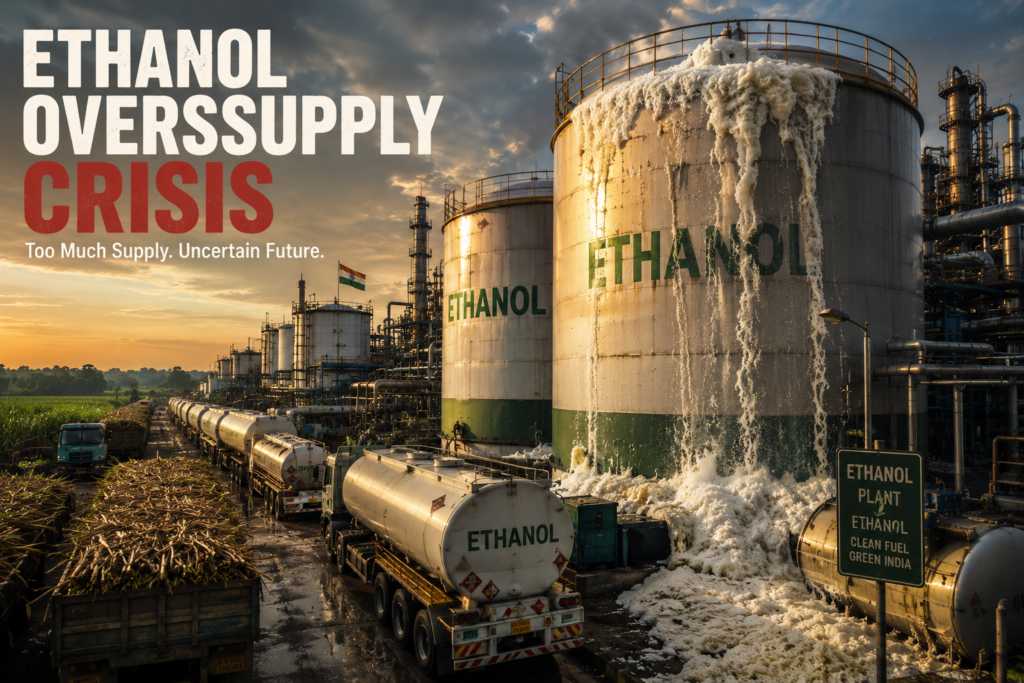
Understanding India’s Ethanol Boom
Before discussing India’s Ethanol Oversupply Crisis: 5 Shocking Facts, it is important to understand how India reached this stage.
India launched aggressive ethanol blending policies to:
- Reduce oil import bills
- Improve energy security
- Support sugarcane farmers
- Cut carbon emissions
- Create rural employment
The results have been impressive. Ethanol blending levels have risen dramatically compared to a decade ago. Oil marketing companies signed long-term procurement contracts, encouraging sugar mills and private firms to invest billions of rupees in ethanol production capacity.
As production capacity expanded rapidly, concerns emerged that supply growth might eventually outpace demand growth.

Fact #1: Ethanol Production Capacity Is Growing Faster Than Demand
The first shocking reality behind India’s Ethanol Oversupply Crisis: 5 Shocking Facts is the mismatch between production capacity and fuel demand.
Several factors have contributed:
Rapid Distillery Expansion
Across India, companies have invested heavily in:
- Grain-based ethanol plants
- Sugarcane-based distilleries
- Integrated biofuel facilities
Thousands of crores have been invested under government-supported schemes.
Demand Growth Has Limits
While blending targets are ambitious, petrol consumption growth is slowing due to:
- Electric vehicle adoption
- Improved fuel efficiency
- Public transportation expansion
- Urban mobility shifts
If ethanol production continues expanding while fuel demand stabilizes, excess inventories may accumulate.
Industry Concern
Many analysts warn that new ethanol plants may face lower utilization rates if supply exceeds procurement requirements.

Fact #2: Sugar Mills Could Face Financial Pressure
The second revelation in India’s Ethanol Oversupply Crisis: 5 Shocking Facts involves sugar producers.
Ethanol Became a Revenue Lifeline
For years, sugar mills struggled with:
- Excess sugar inventories
- Delayed farmer payments
- Volatile sugar prices
Ethanol production provided an alternative revenue stream.
Oversupply May Reduce Profitability
If ethanol availability exceeds demand:
- Procurement prices may come under pressure
- Margins could shrink
- Return on investment may decline
Mills that borrowed heavily to expand ethanol capacity could face financial stress.
Impact on Debt Servicing
Many companies financed expansion through loans. Lower utilization rates can reduce cash flow and affect debt repayment schedules.
This risk makes India’s Ethanol Oversupply Crisis: 5 Shocking Facts a major concern for the sugar industry.
Fact #3: Farmers Could Feel the Impact Despite Record Production
One of the most surprising aspects of India’s Ethanol Oversupply Crisis: 5 Shocking Facts is that farmers may also be affected.
Sugarcane Cultivation Expanded Rapidly
Encouraged by ethanol demand, many farmers increased sugarcane acreage.
Benefits included:
- Higher procurement certainty
- Better market access
- Stable incomes
What Happens During Oversupply?
If ethanol demand fails to absorb increasing production:
- Mills may reduce procurement
- Cane payments could slow
- Expansion plans may be postponed
Regional Effects
States heavily dependent on sugarcane include:
- Uttar Pradesh
- Maharashtra
- Karnataka
Farmers in these regions could face greater exposure to market imbalances.
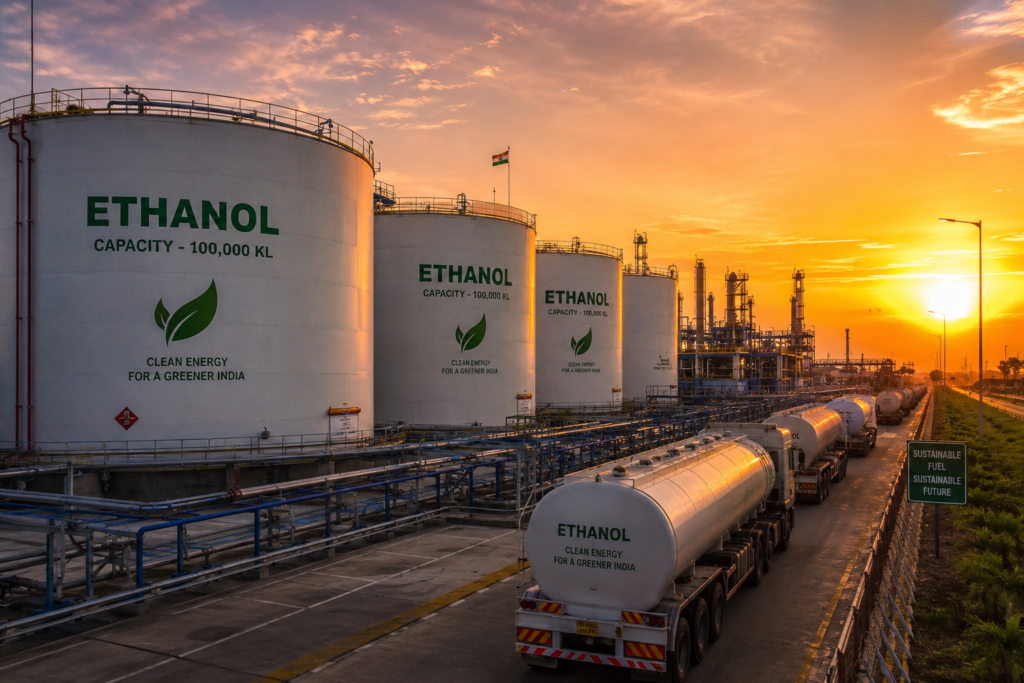
Fact #4: Storage Infrastructure Could Become a Major Bottleneck
The fourth point in India’s Ethanol Oversupply Crisis: 5 Shocking Facts is often overlooked.
Ethanol Requires Specialized Storage
Unlike some agricultural commodities, ethanol needs:
- Dedicated storage tanks
- Safe transportation systems
- Quality monitoring infrastructure
Inventory Build-Up Risk
If production exceeds immediate demand:
- Storage tanks can fill rapidly
- Logistics costs increase
- Transportation bottlenecks emerge
Rising Operational Expenses
Maintaining large inventories increases:
- Insurance costs
- Storage costs
- Financing costs
As inventories grow, profitability declines even if production remains high.
This infrastructure challenge could become one of the biggest hidden costs in India’s Ethanol Oversupply Crisis: 5 Shocking Facts.
Fact #5: The EV Revolution Could Change Long-Term Ethanol Demand
Perhaps the most significant factor in India’s Ethanol Oversupply Crisis: 5 Shocking Facts is the rise of electric mobility.
Electric Vehicle Growth
India is witnessing increasing adoption of:
- Electric two-wheelers
- Electric cars
- Electric buses
- Fleet electrification
Fuel Demand Transformation
Over the next decade:
- Petrol demand growth may moderate
- Alternative fuels may compete for market share
- Battery technology could become cheaper
Long-Term Strategic Challenge
If EV adoption accelerates faster than expected, ethanol demand forecasts may need revision.
This does not mean ethanol will become irrelevant. Instead, policymakers must balance investment decisions carefully to avoid structural oversupply.

Why India’s Ethanol Program Still Matters
Despite concerns surrounding India’s Ethanol Oversupply Crisis: 5 Shocking Facts, the ethanol mission remains strategically important.
Energy Security
India imports a significant portion of its crude oil requirements.
Higher ethanol blending helps:
- Reduce import dependence
- Improve trade balance
- Strengthen energy resilience
Environmental Benefits
Ethanol can contribute to:
- Lower emissions
- Cleaner combustion
- Reduced fossil fuel dependence
Rural Development
The ethanol ecosystem supports:
- Farmers
- Transport operators
- Distilleries
- Rural employment
Therefore, the objective is not to slow ethanol development but to ensure sustainable growth.
Possible Solutions to Prevent an Ethanol Glut
To address concerns highlighted in India’s Ethanol Oversupply Crisis: 5 Shocking Facts, several policy options are available.
1. Expand Industrial Ethanol Usage
Ethanol can be used in:
- Chemicals
- Pharmaceuticals
- Industrial solvents
- Manufacturing processes
Diversifying demand can reduce pressure on fuel markets.
2. Increase Export Opportunities
India could explore ethanol exports to countries seeking renewable fuel alternatives.
Export diversification can help absorb excess production.
3. Promote Flex-Fuel Vehicles
Greater adoption of flex-fuel vehicles can create additional ethanol demand.
Benefits include:
- Higher blending flexibility
- Reduced oil imports
- Expanded fuel choices
4. Improve Storage Infrastructure
Investments in:
- Storage tanks
- Rail transport
- Logistics hubs
can reduce bottlenecks and improve market efficiency.
5. Encourage Feedstock Diversification
Moving beyond sugarcane can improve sustainability and reduce regional concentration risks.
Potential feedstocks include:
- Maize
- Agricultural residues
- Biomass waste
Expert Perspective
Having followed India’s energy transition and biofuel policies for years, I believe the current situation reflects a classic challenge faced by rapidly growing industries.
Success itself can create new problems.
The ethanol sector has expanded at an extraordinary pace because policy incentives worked. However, long-term success requires matching supply growth with realistic demand projections.
The discussion around India’s Ethanol Oversupply Crisis: 5 Shocking Facts should not be interpreted as a failure of the ethanol mission. Instead, it should serve as an early warning that strategic planning is essential.
Countries that successfully manage renewable fuel transitions typically balance:
- Production growth
- Market demand
- Infrastructure investment
- Technological change
India now faces the same balancing act.
The Road Ahead
The future of India’s ethanol sector remains promising, but it will require careful management.
Key trends to watch include:
- Ethanol blending targets
- Flex-fuel vehicle adoption
- EV market growth
- Sugarcane production levels
- Government procurement policies
- Export opportunities
If these factors remain aligned, India can avoid a major glut while continuing to strengthen energy security.
However, if production expansion significantly outpaces demand growth, concerns highlighted in India’s Ethanol Oversupply Crisis: 5 Shocking Facts could become more pronounced in the coming years.
Conclusion
The story of India’s Ethanol Oversupply Crisis: 5 Shocking Facts is not merely about excess fuel production. It is about the complexities of managing a fast-growing renewable energy ecosystem.
India’s ethanol strategy has delivered significant benefits, including lower oil dependence, higher farmer incomes, and stronger rural economies. Yet rapid capacity expansion has introduced new risks involving storage, pricing, profitability, and future demand.
The challenge now is to ensure that ethanol growth remains sustainable. With proactive policies, diversified demand sources, improved infrastructure, and careful planning, India can transform a potential oversupply crisis into the next phase of its biofuel success story.
Frequently Asked Questions (FAQs)
What is India’s Ethanol Oversupply Crisis?
India’s Ethanol Oversupply Crisis refers to concerns that ethanol production capacity may grow faster than demand, potentially leading to excess inventories and lower profitability.
Why is India producing more ethanol?
India is increasing ethanol production to reduce crude oil imports, improve energy security, support farmers, and lower emissions.
Can ethanol oversupply affect farmers?
Yes. If demand growth slows, sugar mills may face financial pressure, which could eventually impact sugarcane procurement and farmer payments.
Will electric vehicles reduce ethanol demand?
Electric vehicles could moderate long-term petrol demand growth, potentially affecting future ethanol consumption forecasts.
Is ethanol still important for India?
Absolutely. Ethanol remains a critical component of India’s renewable energy strategy, energy security goals, and rural development plans.
What can India do to prevent ethanol oversupply?
India can expand industrial ethanol use, promote flex-fuel vehicles, improve storage infrastructure, diversify feedstocks, and explore export markets.