
RBI’s Bold Move: 3 Steps to Offshore INR Transparency marks a turning point in India’s currency market regulation. By mandating offshore INR derivative reporting, the Reserve Bank of India (RBI) aims to strengthen transparency, improve price discovery, and safeguard the rupee against speculative shocks. This phased framework, stretching from July 2027 to July 2028, is designed to close a long‑standing blind spot in India’s financial system.

Introduction: Why Offshore INR Transparency Matters
Offshore INR derivatives, particularly non‑deliverable forwards (NDFs), have long been traded in global hubs such as Singapore, London, and New York. These trades often set benchmarks that influence onshore pricing, creating volatility and widening the offshore–onshore gap.
By bringing these trades into the reporting net, RBI is not only enhancing transparency but also asserting greater control over the rupee’s global narrative.

Step 1: Initial Reporting Framework (July 2027)
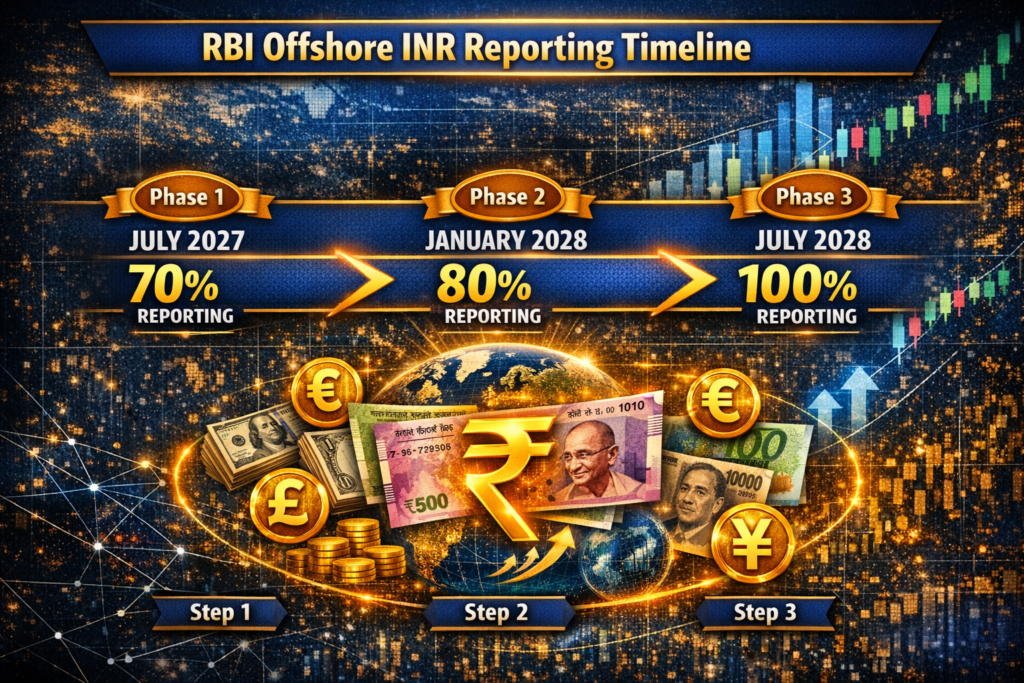
Under the first phase of RBI’s Bold Move: 3 Steps to Offshore INR Transparency, banks’ parent entities must report all offshore INR derivative contracts to the Clearing Corporation of India Ltd. (CCIL).
- Scope: All OTC foreign exchange derivative contracts involving INR.
- Coverage: 70% of notional value from related parties.
- Exemptions: Contracts below USD 1 million and certain back‑to‑back arrangements.
This step ensures that regulators gain visibility into the majority of offshore trades, laying the foundation for comprehensive oversight.

Step 2: Expanded Coverage (January 2028)
The second phase raises the reporting threshold to 80% of notional value.
- Objective: Reduce opacity in offshore markets.
- Impact: Narrow the offshore–onshore pricing gap.
- Benefit: Enhanced monitoring of speculative positions.
This stage reflects RBI’s gradual tightening approach, allowing banks time to adapt while steadily increasing transparency.
Step 3: Full Compliance (July 2028)
The final step of RBI’s Bold Move: 3 Steps to Offshore INR Transparency mandates 100% reporting of offshore INR derivatives.
- Outcome: Complete visibility into global rupee‑linked exposures.
- Result: Stronger price discovery and reduced volatility.
- Significance: A structural reform aligning offshore and onshore markets.
By July 2028, RBI expects a unified reporting system that eliminates blind spots and strengthens India’s financial resilience.
Market Implications
- Volatility Compression: Transparency reduces surprise flows.
- Speculation Control: RBI can monitor NDF positions more effectively.
- Rupee Stability: Enhanced oversight supports INR resilience amid global shocks.
- Investor Confidence: Greater clarity attracts long‑term capital inflows.
Industry Challenges
While the move is bold, banks face hurdles:
- Operational Burden: System overhauls for compliance.
- Confidentiality Concerns: Offshore clients may resist disclosure.
- Implementation Risks: Partial compliance could limit effectiveness.
Despite these challenges, the phased rollout provides time for adaptation.
Comparative Snapshot
| Aspect | Before Reform | After RBI Directive |
|---|---|---|
| Reporting | Only onshore OTC trades | Offshore INR trades included |
| Coverage | Limited visibility | Global related‑party transactions |
| Timeline | No offshore mandate | Full compliance by July 2028 |
| Transparency | Fragmented | Unified reporting via CCIL |
| Impact on INR | Offshore‑driven volatility | Smoother price discovery |
Conclusion
RBI’s Bold Move: 3 Steps to Offshore INR Transparency is more than a regulatory tweak—it is a structural reform that redefines India’s currency market oversight. By mandating offshore INR derivative reporting, RBI is closing a critical transparency gap, improving price discovery, and reinforcing rupee stability.
This initiative positions India’s financial system on stronger footing, ensuring resilience against global shocks and speculative pressures. While banks must overcome operational challenges, the long‑term benefits—greater stability, investor confidence, and market integrity—make this reform a landmark in India’s financial journey.
Final Thoughts
RBI’s Bold Move: 3 Steps to Offshore INR Transparency marks an important shift in India’s financial strategy. By improving market data, connecting onshore and offshore trading, and strengthening risk controls, RBI is building a more resilient rupee ecosystem.
These measures are not just technical reforms—they are part of India’s larger journey toward financial leadership. If implemented effectively, they could enhance trust in the rupee, attract more investment, and position India as a major force in global finance.
For businesses, investors, and policymakers, this is a development worth watching closely