
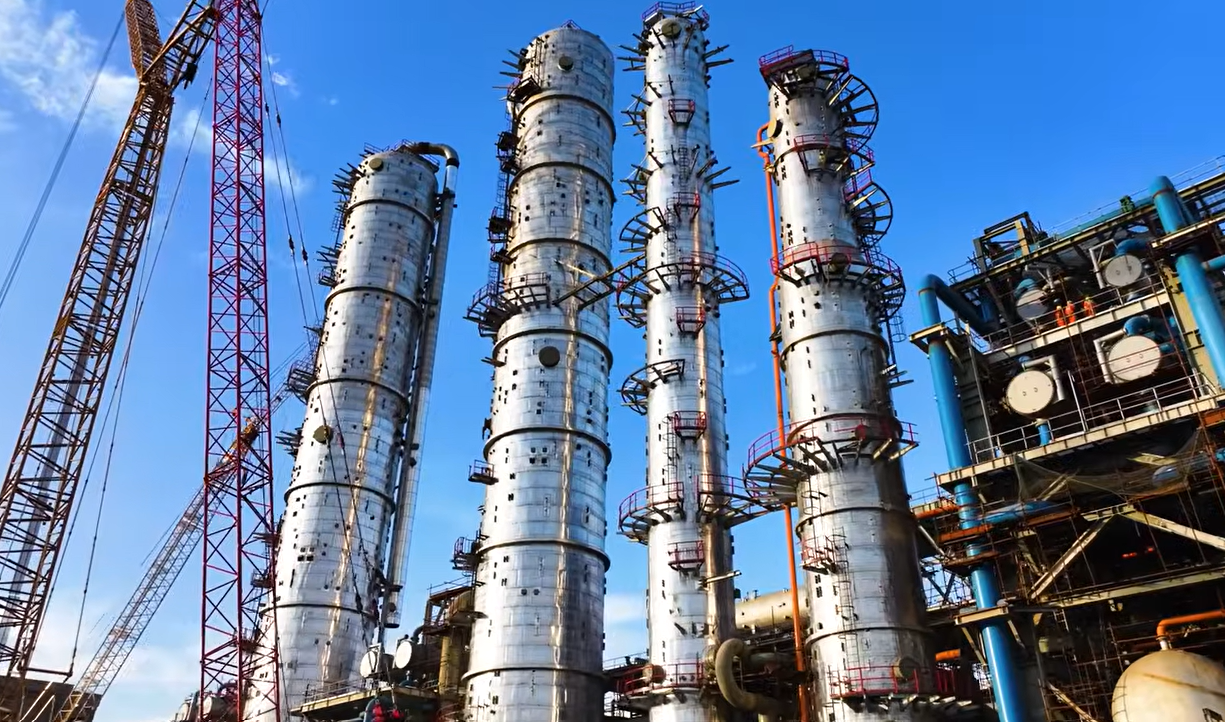
Vadodara’s Cryogenic Expertise: 5 Global Fusion Wins
Vadodara’s Cryogenic Expertise: 5 Global Fusion Wins is emerging as a powerful example of how India’s advanced manufacturing capabilities are becoming part of some of the world’s most ambitious scientific programmes.
The Gujarat city has earned a place in the international fusion-energy story through specialised cryogenic engineering supplied for the International Thermonuclear Experimental Reactor (ITER) in southern France. ITER is an International experimental fusion facility being built to demonstrate the feasibility of fusion as a future energy source.
India is one of seven ITER members and is responsible for about 9% of ITER’s in-kind contributions. India’s packages, include the cryogenic system, cryostat, cooling-water system, heating systems, power supplies and selected diagnostics.
Within this enormous international effort, Vadodara-based INOXCVA has played a significant role in cryogenic manufacturing and thermal-shield work.
The significance goes far beyond pipes and industrial equipment. Fusion reactors require an extraordinary combination of extremely high temperatures and extremely low temperatures. While fusion plasma must reach temperatures hotter than the Sun’s core, superconducting magnets and other components surrounding the plasma have to operate at temperatures close to absolute zero.
ITER‘s superconducting magnets and cryopumps need cooling to approximately 4 kelvin, or -269°C, while thermal shields operate at around 80 kelvin, or -193°C.
That is where Vadodara’s Cryogenic Expertise: 5 Global Fusion Wins becomes an important industrial story.
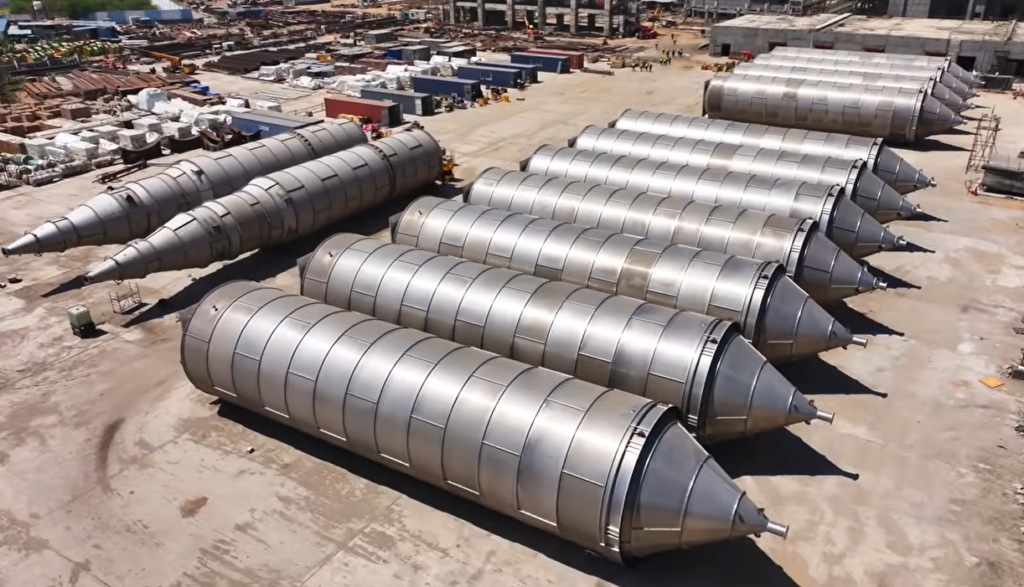
Vadodara’s Cryogenic Expertise: 5 Global Fusion Wins
What Makes Vadodara’s Cryogenic Expertise So Important?
Cryogenics is the science and engineering of extremely low temperatures. In a fusion reactor, cryogenic technology is essential because superconducting magnets need to remain extremely cold to operate efficiently.
ITER’s cryogenic infrastructure is designed to transport helium and other cooling fluids from the cryoplant to critical components of the fusion machine. The network includes cryolines, warm lines and cryodistribution equipment.
According to ITER-India, the cryogenic network involves kilometres of cryolines and warm lines as well as multiple cryodistribution boxes. The system connects cryogenic plants with the tokamak’s superconducting magnets, thermal shields and cryopumps.
For Vadodara, participation in this system demonstrates that Indian industrial companies can handle sophisticated engineering involving vacuum insulation, precision welding, thermal management and stringent leak testing.
The result is a combination of scientific expertise, industrial precision and international quality standards.
5 Global Fusion Wins Behind Vadodara’s Cryogenic Expertise
The story can be understood through five major achievements.
1. Supplying Advanced Cryolines for ITER
One of the most important achievements associated with Vadodara’s Cryogenic Expertise: 5 Global Fusion Wins is the manufacturing of sophisticated cryolines for ITER.
Cryolines are not conventional industrial pipelines. They transport extremely cold fluids while preventing heat from entering the system.
ITER explains that its cryolines can contain several process pipes inside a vacuum-jacketed structure. Depending on their purpose, individual pipes carry different fluids or perform different functions. The lines range from relatively small diameters to very large sections and include complicated bends and turns.
Manufacturing of ITER cryolines began in 2017 at INOXCVA’s cryogenic facility near Vadodara. The company subsequently produced the Indian scope of the project, with the final batch leaving the Vadodara facility in July 2021.
This was a major industrial accomplishment because the cryoline network had to meet demanding requirements for dimensional accuracy, insulation and leak tightness.
The project showed that Vadodara’s engineering ecosystem could produce components for a globally significant nuclear-science facility.
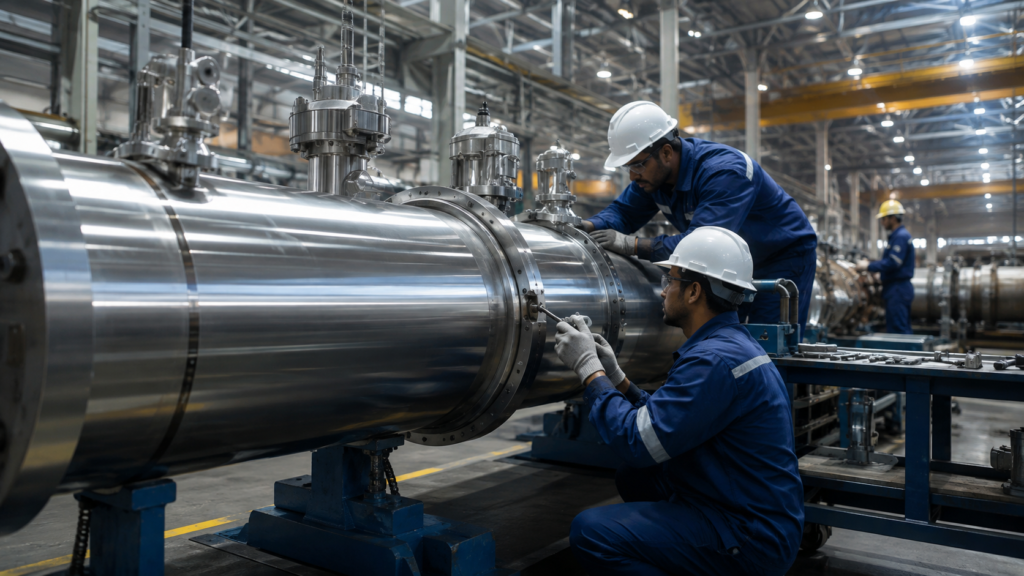
2. Passing ITER’s Demanding Cryogenic Leak Tests
The second major achievement was proving the integrity of the cryogenic network.
In March 2021, ITER reported that approximately 4.8 kilometres of cryolines and warm lines had successfully passed leak testing. The network included close to 1,000 spools and an approximately equal number of welds.
This achievement is particularly important because leakage in a cryogenic system can seriously compromise performance.
The system must retain its vacuum insulation and prevent unwanted heat transfer. Even tiny defects can become significant when equipment is expected to function at temperatures close to absolute zero.
ITER reported that the cryoline network was pressure tested at 30 bars after helium testing of a portion of the welds. The successful testing demonstrated the leak tightness of the network.
For Indian engineering, this represented a valuable validation.
The Vadodara manufacturing operation was not merely producing components according to drawings. It was delivering infrastructure capable of meeting the demanding standards of one of the world’s largest fusion projects.
This makes testing itself one of the five important wins behind Vadodara’s Cryogenic Expertise: 5 Global Fusion Wins.
Vadodara’s Cryogenic Expertise: 5 Global Fusion Wins and Precision Engineering
The complexity of ITER cryolines is worth highlighting because it explains why the Vadodara contribution matters.
A cryoline section can contain several process pipes inside an outer vacuum jacket. Pipes must be individually insulated, while the overall system has to accommodate different geometries.
ITER has reported cryoline sections ranging from 25 mm to 1,000 mm in diameter, with some capable of carrying six or seven process pipes.
Many sections were not straight.
They included bends, tees, changes in direction and other complicated geometries. This increased the manufacturing challenge because the components had to fit together accurately when installed at ITER.
Precision welding was also critical.
The large number of welds meant that quality assurance had to be integrated throughout manufacturing rather than left until the end.
For Vadodara’s industrial workforce, such a project provided experience in high-precision fabrication for a major international scientific installation.
It also demonstrated that India’s industrial capabilities can operate at the intersection of manufacturing and advanced physics.
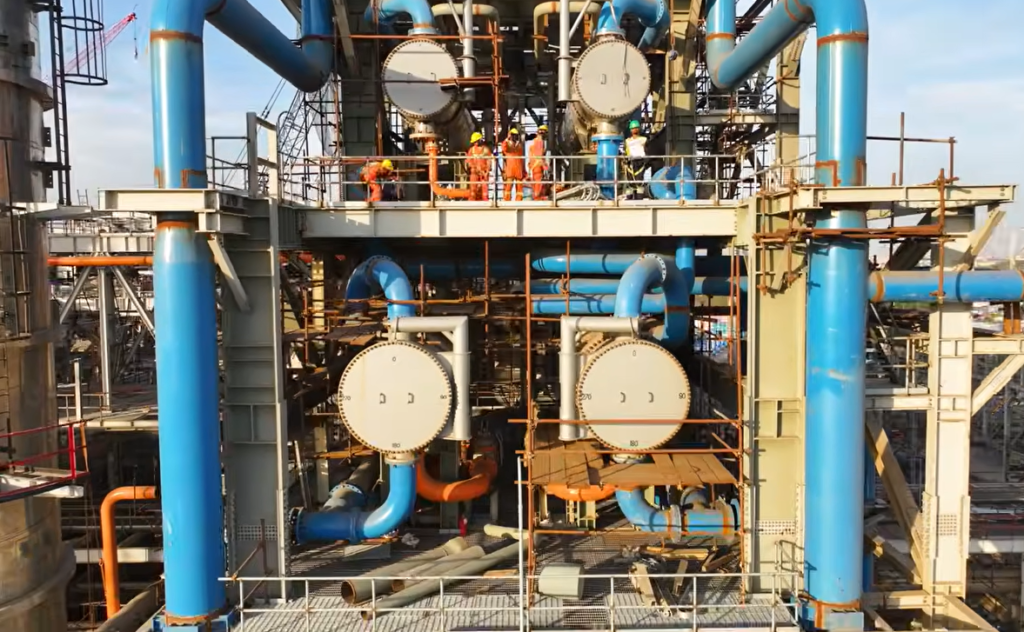
3. Repairing ITER’s Thermal Shield Components
The third major win is perhaps even more significant because it involves repair and refurbishment, not simply original manufacturing.
ITER’s thermal shield protects extremely cold components from unwanted heat transfer. It acts as a thermal barrier between warmer structures and superconducting magnets operating at cryogenic temperatures.
The vacuum-vessel thermal shield covers approximately 4,000 square metres and contains a network of cooling pipes. After microscopic cracks were identified in some cooling-pipe sections, ITER decided to replace cooling pipes across the wider thermal-shield system. The overall replacement programme involves approximately 23 kilometres of cooling piping.
Some thermal-shield elements were sent to India for specialised repair.
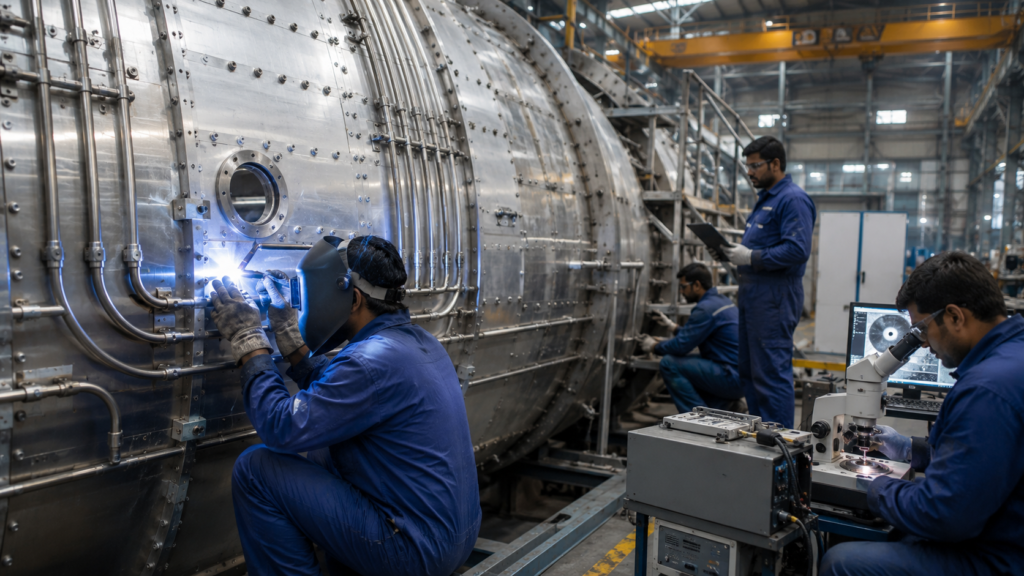
At the INOX-CVA facility in Vadodara, damaged cooling pipes were removed, pipe paths were machined and new piping was welded to the panels.
The first repaired panels left the Vadodara facility in February 2024 for shipment back to ITER.
This is an important milestone because repair work on a complex fusion component can be as demanding as original manufacturing.
It requires engineers to understand the existing structure, remove defective elements without damaging the underlying component, prepare the surface and install new cooling infrastructure.
The successful work strengthened the international reputation associated with Vadodara’s Cryogenic Expertise: 5 Global Fusion Wins.
4. Becoming a Trusted Global Partner for Fusion Engineering
The fourth win is the international trust built through the project.
ITER brings together the European Union, China, India, Japan, South Korea, Russia and the United States. The European Union is the host party and contributes the largest share, while the other partners contribute approximately 9% each, primarily through in-kind procurement.
For Indian companies, participation means working within a highly coordinated international procurement structure.
Vadodara’s contribution therefore carries a wider message: Indian engineering companies can participate in complex global scientific projects where components must meet strict technical and quality requirements.
This is particularly valuable for India’s growing high-technology manufacturing sector.
The experience gained through ITER can support capabilities in cryogenic systems, superconducting technology, hydrogen infrastructure, space applications, industrial gases and other advanced fields.
ITER-India itself has developed dedicated cryogenic testing infrastructure and has worked on prototype cryolines and cold-circulator technology. Its cryogenic programme includes testing at both 4 K and 80 K temperature levels.
The wider ecosystem therefore extends beyond one company.
It involves research institutions, engineers, manufacturers, quality specialists and technology suppliers.
Why Fusion Needs Extreme Cold
To understand the importance of Vadodara’s Cryogenic Expertise: 5 Global Fusion Wins, it is useful to understand the unusual engineering challenge presented by fusion.
Fusion seeks to reproduce the process that powers the Sun.
Two light atomic nuclei are brought together under extreme conditions. On Earth, researchers need to create and control an incredibly hot plasma.
ITER is designed to produce and sustain fusion plasma under conditions that can reach temperatures of roughly 150 million°C. At the same time, superconducting magnets surrounding the plasma chamber need to remain near 4 K.
This creates one of the most extraordinary engineering contrasts in modern technology:
extremely hot plasma surrounded by equipment operating extremely close to absolute zero.
The superconducting magnets generate powerful magnetic fields that help control and confine the plasma. Their superconducting state depends on maintaining very low temperatures.
The cryogenic system is therefore not an optional support system.
It is fundamental to the operation of the fusion machine.
Vadodara’s Cryogenic Expertise: 5 Global Fusion Wins:
5. Expanding Vadodara’s Role From Manufacturing to Advanced Repairs
The fifth win is the evolution of Vadodara’s role.
The city’s contribution to ITER has moved beyond the original supply of cryogenic components.
Recent ITER documentation shows continuing thermal-shield repair activity involving the INOX-CVA facility in Vadodara. The broader ITER thermal-shield repair programme has required replacement of cooling pipes and specialised repair strategies.
This progression matters because advanced repair requires a deeper understanding of the technology.
A supplier must understand not only how to manufacture a component but also how that component behaves after installation and years of service.
Repairing large thermal-shield elements also requires careful control of welding, machining, dimensional stability and thermal performance.
In other words, Vadodara is developing an engineering capability that covers the full lifecycle of sophisticated cryogenic equipment.
That could become increasingly valuable as the global fusion industry expands.
Vadodara’s Cryogenic Expertise: 5 Global Fusion Wins for India’s High-Tech Industry
The importance of Vadodara’s Cryogenic Expertise: 5 Global Fusion Wins extends well beyond the city.
India has been steadily expanding its role in advanced engineering and high-value manufacturing.
ITER provides an opportunity to demonstrate these capabilities on a global stage.
India’s ITER responsibilities include nine major packages, covering the cryostat, in-wall shielding, cooling water systems, cryogenic systems, radio-frequency heating systems, diagnostic equipment, power supplies and selected diagnostics.
The cryogenic contribution is particularly valuable because cryogenic engineering has applications across several strategic industries.
Space technology
Rocket and space systems rely heavily on cryogenic technologies, especially for handling liquid hydrogen, liquid oxygen and other extremely cold fluids.
Hydrogen economy
Liquid hydrogen requires temperatures around -253°C. As hydrogen infrastructure expands, expertise in cryogenic storage, transfer and insulation could become increasingly valuable.
Industrial gases
Oxygen, nitrogen, argon and other industrial gases are frequently processed or stored using cryogenic technologies.
Scientific research
Particle accelerators, superconducting magnets and specialised research equipment also depend on cryogenic systems.
Fusion energy
Future fusion reactors are likely to require advanced cooling and superconducting technologies, making today’s experience strategically important.
From Gujarat to France: A Global Industrial Journey
The physical journey of ITER components from Gujarat to France is also symbolic.
Cryogenic components manufactured in the Vadodara region have to meet technical requirements at the factory before being transported thousands of kilometres to Europe.
The first batches of ITER cryolines were shipped from India as early as 2017. ITER reported that the first batch included approximately 350 metres of nitrogen and relief lines and was transported in specially designed frames.
This logistics operation demonstrates another aspect of advanced manufacturing: components must be designed not only to work but also to survive transportation and arrive ready for integration.
Once at ITER, they become part of a much larger system.
That system connects the cryogenic plant to the tokamak complex, allowing cooling power to reach the magnets, thermal shields and cryopumps.

The Economic Importance of Vadodara’s Cryogenic Expertise
The emergence of specialised cryogenic manufacturing has implications for Vadodara’s industrial economy.
Cities with established engineering ecosystems can increasingly move up the value chain by producing specialised components for sectors such as nuclear science, aerospace, defence, semiconductors and clean energy.
Fusion technology is especially attractive because it requires expertise across several engineering disciplines.
These include:
- precision manufacturing,
- metallurgy,
- welding,
- vacuum technology,
- cryogenic fluid management,
- thermal insulation,
- quality assurance,
- non-destructive testing,
- automation and
- advanced project management.
Each international project can therefore create knowledge that can be applied elsewhere.
For Vadodara, the ITER experience provides an example of how traditional industrial capabilities can evolve into advanced scientific manufacturing.
India’s Role in the Global Fusion Race
The international fusion race is accelerating.
Governments, research organisations and private companies are investing in technologies designed to make fusion more practical and commercially viable.
ITER remains one of the world’s most ambitious public-sector fusion programmes.
Its purpose is not to become a commercial power plant. Instead, it is intended to demonstrate the scientific and technological feasibility of fusion energy at an unprecedented scale.
India’s participation gives Indian industry an opportunity to develop capabilities before commercial fusion becomes a major market.
That could prove strategically important.
If future fusion demonstration plants require large numbers of superconducting magnets, cryogenic systems, thermal shields and vacuum components, companies with ITER experience could be better positioned to compete.
This is why Vadodara’s Cryogenic Expertise: 5 Global Fusion Wins is more than a local manufacturing story.
It is part of India’s preparation for a possible future fusion economy.
Vadodara’s Cryogenic Expertise: 5 Global Fusion Wins and Future Opportunities
The next decade could create new opportunities for India’s cryogenic industry.
One area is green hydrogen.
As hydrogen production and distribution expand, cryogenic technologies may become increasingly important for storage and transportation, particularly where liquefied hydrogen is involved.
Another area is space exploration.
India’s space programme continues to require sophisticated propulsion and cryogenic technologies.
The third opportunity is superconducting infrastructure.
Superconducting magnets are relevant not only to fusion but also to scientific instruments, medical technology and advanced research facilities.
The fourth is advanced nuclear technology.
Future nuclear and fusion systems could require increasingly sophisticated thermal management and cryogenic infrastructure.
The fifth is global supply chains.
International companies increasingly seek specialised manufacturing partners capable of producing high-value components to demanding specifications.
Vadodara’s ITER experience could help its industrial ecosystem participate in these markets.
Why INOXCVA’s ITER Experience Matters
INOXCVA’s involvement demonstrates how a company can use industrial experience to enter highly specialised scientific markets.
The company was involved in the production of cryogenic systems for ITER and later in repair work involving thermal-shield components.
ITER described INOX-CVA’s Vadodara facility as the location where cooling pipes were removed from thermal-shield panels, pipe paths were machined and replacement piping was welded.
Such work requires specialised equipment and skilled personnel.
More importantly, it creates institutional knowledge.
Engineers learn how to manage complex specifications, international inspections, documentation and quality procedures.
That knowledge can remain within the industrial ecosystem long after a particular contract ends.
A Symbol of India’s Advanced Manufacturing Ambition
For decades, India’s manufacturing story was often associated with cost competitiveness and large-scale production.
Projects such as ITER offer a different narrative.
They show Indian companies participating in highly specialised, technically demanding areas where precision and reliability matter as much as production capacity.
Vadodara’s role is a strong example.
The city is not merely supplying generic industrial equipment to a foreign project. Its engineering capabilities are contributing to systems that operate at temperatures only a few degrees above absolute zero.
That represents a substantial technological achievement.
Vadodara’s Cryogenic Expertise: 5 Global Fusion Wins:
Environmental Promise of Fusion Energy
Fusion energy is attracting global attention because it has the potential to provide large amounts of low-carbon energy.
Unlike conventional fossil-fuel power generation, fusion does not rely on burning coal, oil or natural gas.
A successful commercial fusion system could potentially provide reliable electricity while producing far fewer greenhouse-gas emissions during operation.
However, fusion is not yet a commercial electricity source at the scale required for global energy systems.
Major technical and economic challenges remain.
ITER itself is an experimental facility designed to advance the technology and demonstrate key principles.
The cryogenic work being performed today therefore represents one piece of a much larger technological journey.
The Bigger Message From Vadodara
The most important message from Vadodara’s Cryogenic Expertise: 5 Global Fusion Wins is that advanced technology can emerge from established industrial centres.
Vadodara has a long history of engineering and manufacturing.
The city’s participation in ITER demonstrates how this industrial foundation can support cutting-edge scientific projects.
The achievement also highlights the importance of collaboration.
ITER is an international project. India contributes technology, equipment and expertise while working alongside partners from several major scientific and industrial economies.
For Indian companies, this provides exposure to international engineering practices and large-scale scientific procurement.
For Vadodara, it creates global visibility.
What Are the 5 Global Fusion Wins?
The five major wins can be summarised as follows:
1. Advanced Cryoline Manufacturing
Vadodara-based manufacturing contributed sophisticated cryogenic piping for ITER’s cooling network.
2. Successful Leak Testing
The cryoline network underwent demanding testing, with ITER reporting successful leak testing of approximately 4.8 kilometres of cryolines and warm lines.
3. Thermal-Shield Repairs
INOX-CVA’s Vadodara facility has handled repair work involving ITER thermal-shield panels and replacement cooling pipes.
4. International Engineering Recognition
The work places Indian cryogenic manufacturing inside a major international scientific collaboration involving seven ITER partners.
5. Future-Ready Industrial Capability
The experience creates capabilities that can potentially support future markets including fusion, hydrogen, space technology, superconducting systems and advanced cryogenics.
Conclusion: Vadodara’s Cryogenic Expertise Is Going Global
Vadodara’s Cryogenic Expertise: 5 Global Fusion Wins represents a significant chapter in India’s journey toward advanced manufacturing and high-end scientific engineering.
From manufacturing complex cryolines to successfully testing them and repairing sophisticated thermal-shield components, Vadodara has developed a meaningful connection with one of the world’s most ambitious fusion projects.
The significance of the achievement lies in the extreme engineering environment.
ITER requires plasma temperatures hotter than the Sun while simultaneously relying on equipment cooled to around -269°C.
Indian engineers and manufacturers are contributing to the systems that make this extraordinary combination possible.
For Vadodara, the achievement is a reminder that the city’s industrial strengths can compete on the global scientific stage.
For India, it demonstrates that advanced manufacturing can support frontier technologies rather than simply conventional industries.
And for the future of fusion, the work highlights an often-overlooked reality: revolutionary energy technologies depend not only on scientists and reactors, but also on thousands of precision-engineered systems working reliably behind the scenes.
Vadodara’s cryogenic capabilities are now part of that story.
As fusion research advances, the experience gained through ITER could become a valuable foundation for India’s next generation of clean-energy, space and advanced-engineering technologies.
Vadodara’s Cryogenic Expertise: 5 Global Fusion Wins:
Frequently Asked Questions
1. What is Vadodara’s Cryogenic Expertise: 5 Global Fusion Wins?
Vadodara’s Cryogenic Expertise: 5 Global Fusion Wins refers to five major achievements linked to Vadodara’s contribution to the international ITER fusion project. These include advanced cryoline manufacturing, successful leak testing, thermal-shield repair, international engineering participation and the development of future-ready cryogenic capabilities.
2. What is ITER?
ITER is an international experimental fusion facility being constructed in southern France. Its objective is to demonstrate the scientific and technological feasibility of fusion as a future energy source. India is one of seven ITER members.
3. Why does ITER need cryogenic technology?
ITER’s superconducting magnets and cryopumps need to operate at approximately 4 kelvin, or -269°C. Cryogenic systems provide the extremely low temperatures required for these components to function efficiently.
4. Which Vadodara company contributed to ITER cryogenic work?
INOXCVA, through its cryogenic manufacturing operations in Vadodara, has contributed to ITER’s cryogenic infrastructure and thermal-shield repair activities.
5. How much cryogenic piping was involved in the ITER project?
ITER-India describes a cryogenic network involving kilometres of cryolines and warm lines. ITER separately reported that approximately 4.8 kilometres of cryolines and warm lines in the cryoplant successfully passed leak testing in 2021.
6. What are ITER cryolines?
Cryolines are highly insulated, vacuum-jacketed piping systems that transport extremely cold fluids from cryogenic plants to components such as superconducting magnets, thermal shields and cryopumps.
7. What role did Vadodara play in ITER thermal-shield repairs?
INOX-CVA’s Vadodara facility repaired thermal-shield panels by removing cooling pipes, machining pipe paths and welding replacement piping to the panels. Repaired panels were subsequently shipped back to ITER.
8. Can India’s ITER experience help future fusion projects?
Yes. Experience with cryogenic systems, precision welding, thermal management, quality assurance and large international projects can provide Indian companies with valuable capabilities for future fusion and other advanced-energy projects.
9. Is ITER already producing commercial fusion electricity?
No. ITER is an experimental fusion facility intended to demonstrate fusion technology at a large scale. It is not a commercial power plant.
10. Why is Vadodara important to India’s advanced manufacturing sector?
Vadodara has an established industrial and engineering ecosystem. Its participation in ITER demonstrates how this manufacturing base can expand into specialised areas such as cryogenics, fusion technology and advanced scientific infrastructure.
My View:
Vadodara’s Cryogenic Expertise: 5 Global Fusion Wins, has carved a global footprint by securing five critical wins in the ITER fusion project. This achievement highlights India’s ability to deliver precision engineering at world scale, reinforcing Gujarat’s industrial strength and positioning the nation as a serious contender in the clean energy race. It is not just a technical milestone, it is a symbol of India’s rising influence in futuristic energy innovation.